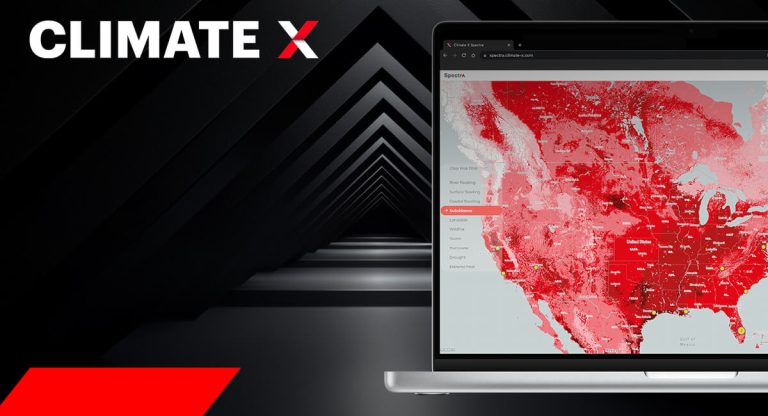
Climate X is a London-based climate analytics company serving real estate owners, investors, lenders, banks, insurers and other institutions exposed to physical assets. Its software changes a familiar CRE workflow: instead of treating climate risk as a separate sustainability exercise, teams can incorporate hazard exposure and potential financial loss into acquisition screening, underwriting, portfolio surveillance and capital planning. Spectra is the central risk assessment product, while Adapt addresses resilience measures and Carta maps corporate asset exposure.
The practical appeal is the movement from hazard maps toward decision variables. A flood, wildfire or extreme heat score can help identify exposure, but an investment committee needs to understand possible damage, valuation implications, operating disruption and required capital. Climate X positions its models around asset-level financial loss metrics, with assessments available across portfolios and different time horizons. BestCRE analysis finds this orientation more useful for owners and lenders than a climate dataset that stops at hazard probability.
Climate X is CRE-adjacent rather than a full real estate operating platform. It does not replace property management, valuation, transaction data or portfolio accounting systems. Its role is narrower: adding forward-looking physical climate risk evidence to decisions already made in those systems. That specialization is valuable where climate exposure can affect insurance availability, financing terms, due diligence, resilience spending or long-term hold assumptions.
The strongest buying case is for an institution with geographically distributed assets and a recurring need to assess climate risk consistently. Climate X says institutions using its software manage more than $13.5 trillion in assets, and public endorsements include representatives associated with CBRE, Triodos Bank, Deloitte, Equans and Capgemini. Those signals support credibility, but they do not establish model accuracy for a buyer’s particular assets. BestCRE analysis recommends a paid validation exercise using known loss events, engineering reports and local hazard data before portfolio-wide adoption.
What Climate X Does and How It Works
Spectra evaluates physical climate risks at the asset and portfolio levels, then translates modeled exposure into financial loss measures. A user can assess near-term and longer-term conditions rather than relying only on historical hazard records. The intended workflow is to upload or connect asset locations and relevant property information, run scenarios, compare exposure across holdings and bring the resulting loss estimates into lending, investment or risk processes. Climate X does not publicly disclose every modeling input, resolution limit or validation result on its main product presentation, so buyers should request technical documentation during diligence.
Adapt moves from diagnosis to mitigation. It estimates the capital required for adaptation measures and evaluates the prospective return associated with those investments. For a property team, that can connect climate analytics with a capital expenditure plan: identify an exposed asset, examine potential interventions, estimate their cost and compare the avoided risk with the investment required. The vendor says the product is built with reference to ISO standards, UNFCCC materials, European guidance and taxonomy. BestCRE analysis views this as a notable product distinction, although an estimate should not substitute for an engineer’s scope, local code review or contractor pricing.
Carta addresses a different problem, mapping portfolio exposure through public and private company assets. Climate X states that Carta covers 18.7 million companies, allowing financial institutions to examine exposure beyond directly owned real estate and familiar domestic markets. Across the suite, the outputs are intended to support due diligence, investment decisions, lending, regulatory work and resilience planning. The company also identifies alignment with disclosure and regulatory frameworks including TCFD, IFRS S2, SB 261, CSRD and ESRS. Buyers should distinguish framework-aligned reporting from formal assurance, and they should confirm that the available exports, audit trails and scenario definitions satisfy their own governance requirements.
9AI Framework: Dimension by Dimension Analysis
CRE Relevance: 8/10
Climate X earns an 8 for CRE relevance because its core unit of analysis is the physical asset, and its stated users include real estate owners, investors and lenders. Spectra can support acquisition screening, credit underwriting, portfolio monitoring and investment committee review, while Adapt connects identified exposure to resilience capital planning. Those are direct CRE workflows, not generic corporate sustainability tasks. The limitation is breadth. Climate X does not provide rent comparables, tenant intelligence, transaction evidence, leasing workflows, property operations or conventional valuation. It supplies a specialized risk layer that must sit beside those systems. BestCRE analysis therefore places it above general-purpose analytics products for climate-sensitive real estate decisions, but below a fully CRE-native platform on overall workflow coverage.
Data Quality and Sources: 8/10
Climate X earns an 8 for data quality. The product presents asset-level analysis, multiple physical risk types, scenario-based time horizons and financially expressed outputs. Its coverage across real estate and corporate assets suggests a data architecture designed for institutional portfolios rather than isolated property checks. References to established climate and reporting frameworks also indicate attention to standardized methods. However, buyers cannot judge quality from coverage claims alone. The vendor does not publish all underlying datasets, model weights, geographic resolution constraints, refresh schedules or independent validation results in its main public materials. BestCRE analysis considers the data proposition strong, but procurement should require hazard-specific methodology papers, lineage documentation, treatment of missing building attributes and evidence of performance in the buyer’s target countries.
Ease of Adoption: 7/10
Climate X earns a 7 for ease of adoption. The product is designed to let institutional teams run asset and portfolio assessments without commissioning a separate consulting study for every decision. Financial loss outputs can be easier for credit and investment committees to interpret than raw climate indicators, and the division between Spectra, Adapt and Carta gives buyers recognizable entry points. Adoption still requires substantial preparation. Address records must be normalized, properties matched correctly, asset attributes checked and internal teams trained to interpret scenario outputs. Governance teams must also agree on acceptable scenarios, thresholds and uses. Climate X does not publish a standard implementation schedule or a complete self-service onboarding specification. BestCRE analysis expects adoption to be manageable for a mature data team, but more demanding for smaller owners with fragmented property records.
Output Accuracy: 7/10
Climate X earns a 7 for output accuracy. Turning physical hazards into asset-level financial loss is more decision-ready than a simple risk flag, but it also introduces assumptions about vulnerability, damage functions, building characteristics, scenarios and time horizons. Accuracy can vary by hazard, geography and property type, particularly when detailed construction or protection information is unavailable. The company presents its analytics as designed for accuracy and institutional decision-making, yet it does not publish enough universal performance evidence to support a higher score across every CRE market. BestCRE analysis recommends testing outputs against insured losses, engineering surveys, flood defenses, local wildfire conditions and known historical events. A buyer should also examine confidence ranges and sensitivity to missing inputs, rather than treating a single loss estimate as a precise forecast.
Integration and Workflow Fit: 7/10
Climate X earns a 7 for integration. The company positions Spectra for use within portfolio management workflows, which is essential because climate metrics have limited value when isolated from asset, loan and investment records. Its asset-level structure should allow identifiers and results to be associated with properties in data warehouses, underwriting models and reporting tools. Public materials, however, do not provide a complete catalog of supported connectors, implementation patterns, data schemas or commercial terms for integration. BestCRE analysis sees credible enterprise fit, especially where an institution already maintains clean property data and integration resources. The score stops short of the top tier because buyers must verify APIs, batch processing, authentication, export formats, update handling and lineage controls directly with the vendor.
Pricing Transparency: 3/10
Climate X earns a 3 for pricing transparency. The vendor does not publish subscription prices, implementation fees, usage allowances, minimum contract values or standard package boundaries. Prospective customers are directed toward account creation or a demonstration, leaving them unable to estimate total cost before sales engagement. Enterprise climate analytics often require pricing based on asset count, geography, hazards, modules or usage, but Climate X does not publicly confirm a universal pricing formula. BestCRE analysis regards this as a meaningful procurement disadvantage, particularly for midmarket owners comparing specialized tools. Buyers should request a written breakdown covering licenses, portfolio volume, scenarios, modules, data preparation, integration, training, support, renewals and overages. They should also require a sample output before agreeing to a broader deployment.
Support and Reliability: 6/10
Climate X earns a 6 for support. Its enterprise focus and relationships with major professional services and real estate organizations suggest that guided implementation and subject-matter access are part of the commercial proposition. Climate risk analytics also demands explanation, since users need help interpreting scenarios, loss metrics and model limitations. However, the vendor does not publish enough detail about standard support hours, response targets, named customer success coverage, implementation staffing, training entitlements or service-level commitments to justify a higher score. BestCRE analysis expects support to be negotiated rather than standardized. Buyers should ask who handles address matching, portfolio data validation, methodology questions and disputed results, then place response times and escalation rights in the contract. Access to climate scientists or model specialists should be distinguished from ordinary account support.
Innovation and Roadmap: 9/10
Climate X earns a 9 for innovation. Its most distinctive capability is not hazard screening by itself, which several competitors offer, but the connection among physical risk, financial loss and adaptation economics. Spectra translates modeled hazards into potential monetary consequences, while Adapt estimates resilience capital requirements and prospective returns. That progression can move climate work from disclosure toward investment planning. Carta further extends the approach to corporate asset mapping for financial institutions. BestCRE analysis finds the adaptation component particularly differentiated because owners need to decide what to do with an exposed building, not merely identify that exposure exists. The remaining caution is that a novel output is only valuable when assumptions are transparent and local conditions are represented accurately. Innovation therefore strengthens the evaluation but does not remove the need for technical validation.
Market Reputation: 7/10
Climate X earns a 7 for market reputation. The company is venture-backed and has visible associations with established organizations across banking, consulting, real estate and energy services. Public endorsements from senior industry figures provide stronger evidence than anonymous testimonials, and the CBRE-related wildfire work indicates relevance to institutional property decisions. Climate X also positions its products around current regulatory and disclosure needs, which helps it participate in enterprise procurement conversations. The vendor does not publish a complete customer list, retention data, deployment counts or long-term performance statistics, so market penetration cannot be independently measured from public information. BestCRE analysis views Climate X as a credible specialist with meaningful institutional validation, but not yet as universally established in CRE data stacks as longstanding property information providers.
Who Should Use Climate X
Climate X best suits institutional owners, investment managers and lenders with assets spread across multiple regions or hazard zones. Portfolio strategy teams can use it to rank exposure and identify properties needing deeper diligence. Acquisition teams can add modeled physical risk and loss estimates to investment committee materials. Credit teams can evaluate collateral over the intended loan term, while sustainability and risk functions can apply a more consistent methodology across the organization. The value increases when climate findings already influence pricing, insurance review, hold periods or capital allocation.
It also suits organizations ready to act on the findings. Asset managers with engineering resources and multiyear capital plans can use Adapt as a starting point for comparing resilience measures, subject to local validation. Banks, insurers, private equity firms and consultancies may value Carta when exposure must be mapped through corporate holdings rather than a directly owned property list. BestCRE analysis finds the strongest fit where the buyer has clean location data, internal model governance and enough portfolio scale to make repeatable software analysis more efficient than property-by-property consulting.
Who Should Not Use Climate X
Climate X is not the right primary system for a broker seeking comparables, an asset manager tracking leases, or an operator managing work orders and utility bills. It does not replace CoStar, VTS, a property management system, an appraisal or an engineering inspection. Small owners with a few properties may find local consultants, insurers and municipal hazard sources more proportionate, particularly if they need a one-time assessment rather than recurring portfolio surveillance.
It is also a poor fit for teams expecting a model to produce certain predictions. Climate outputs depend on scenarios, asset information and vulnerability assumptions. Buyers without staff capable of challenging those assumptions may misuse precise-looking financial estimates. Organizations requiring public, fixed pricing before a sales call will find the procurement process frustrating. BestCRE analysis also advises against adoption when the buyer cannot connect risk findings to underwriting rules, insurance decisions or capital plans, since the result could become another reporting dataset with limited operational effect.
Pricing and ROI Analysis
Climate X does not publish prices for Spectra, Adapt or Carta. It also does not publish standard tiers, asset allowances, setup fees, contract lengths or integration charges. Buyers should assume a negotiated enterprise sale and request pricing for each module separately. A comparable quote should identify the number of properties or companies covered, permitted users, included hazards and scenarios, geographic limits, refresh frequency, exports, integration work, training, support and renewal treatment. Without those details, headline subscription figures would not be comparable.
BestCRE analysis: calculate ROI from decisions changed, not reports produced. If a portfolio team evaluates 500 assets annually and software saves one analyst hour per asset, multiply 500 hours by the organization’s fully loaded hourly cost. Add any avoided external assessment expense and any verified reduction in expected loss attributable to approved adaptation work. Then subtract subscription, implementation, data cleanup and internal governance costs. Do not count modeled avoided losses unless an engineer validates the intervention and the investment committee actually funds it. The purchase case is credible when recurring labor savings and better capital decisions exceed total annual cost under conservative assumptions.
Integration and CRE Tech Stack Fit
Climate X should sit as a risk enrichment layer beside a property master, loan system, investment database or data warehouse. Asset identifiers, addresses and building attributes flow into the analysis, while hazard, loss and adaptation outputs return to underwriting models, portfolio dashboards and reporting processes. That structure is compatible with institutional CRE stacks, but the quality of entity matching will matter. Duplicate properties, incomplete addresses and inconsistent building records can undermine otherwise sophisticated modeling.
The vendor says Spectra integrates with portfolio management workflows, but it does not publish a comprehensive connector directory or full technical specification in its main public materials. Buyers should verify API availability, bulk uploads, scheduled processing, single sign-on, permissions, audit logs and export formats. BestCRE analysis recommends retaining both the original inputs and model version with every output. That record allows risk teams to reproduce decisions when scenarios, asset attributes or methodologies change.
Competitive Landscape
First Street is the clearest alternative for property-level physical climate intelligence, particularly for buyers focused on hazard exposure and location-based risk. Cotality, formerly associated with the CoreLogic name, is relevant when climate risk must be combined with broad property, reconstruction cost and insurance-oriented data. Deepki is a stronger comparison for real estate sustainability management, energy data and decarbonization workflows, although its center of gravity differs from Climate X’s emphasis on physical risk and financial loss.
Climate X differentiates itself through a dedicated real estate orientation spanning commercial and residential assets, plus the progression from risk identification to financial impact and adaptation investment. BestCRE analysis finds Adapt more distinctive than basic hazard scoring. A buyer concerned mainly with disclosure, energy consumption or carbon accounting may prefer Deepki. A lender or insurer seeking extensive property records alongside hazard information may favor Cotality. A team needing accessible property risk screening should compare First Street directly with Spectra.
The selection should be made with a controlled portfolio test. Give each finalist the same assets, property attributes, hazards, time horizons and historical events. Compare geographic coverage, model explanations, confidence ranges, financial loss estimates, workflow integration and response to missing data. Climate X deserves a shortlist when resilience spending is part of the decision, but it should win on validated outputs and usable governance rather than the breadth of its claims.
The Bottom Line
Climate X is a strong specialist choice for institutional CRE organizations that need to translate physical climate exposure into underwriting, portfolio risk and resilience decisions. BestCRE analysis favors it over a simple hazard map when financial loss estimates and adaptation planning will influence actual capital allocation. The product’s real estate focus, scenario analysis and adaptation economics justify a serious pilot.
Do not sign a portfolio-wide agreement solely on a demonstration. Require technical methodology, input requirements, geographic limitations, confidence measures, model versioning, integration specifications and a detailed price schedule. Test representative assets against engineering evidence and known events. Buy if the results materially change decisions and withstand internal model review. If the need is limited to basic screening, carbon accounting or traditional property intelligence, a narrower or differently focused alternative may offer better value.
About BestCRE
BestCRE.com is the definitive authority on commercial real estate AI, analysis, and investment intelligence. Every article advances the platform’s mission to help CRE professionals identify, evaluate, and adopt the best tools and strategies in the industry. We benchmark platforms using the 9AI Framework so CRE leaders can compare tools with clear evidence. Explore the category map at 20 CRE sectors for deeper coverage across the CRE stack.
Frequently Asked Questions
What is Climate X?
Climate X is a climate risk analytics company that helps real estate owners, investors, lenders and other financial institutions assess physical climate exposure. Its Spectra product estimates asset-level and portfolio-level risk and translates that risk into financial loss measures. Adapt estimates potential resilience capital requirements and the prospective return from adaptation measures. Carta maps exposure through the assets of public and private companies. In CRE, the software is intended to support acquisition diligence, credit underwriting, portfolio monitoring, regulatory work and capital planning. It is a specialized risk layer, not a replacement for property management, leasing, valuation, engineering or transaction data systems. BestCRE analysis finds its strongest use case in portfolios where climate findings can influence financing, insurance review, investment terms or building improvements.
How does Climate X compare with First Street and Deepki?
Climate X, First Street and Deepki overlap around climate and real estate, but their emphasis differs. First Street is a close comparison for property-level physical hazard intelligence and location screening. Deepki is more focused on real estate sustainability management, energy performance and decarbonization workflows. Climate X emphasizes the conversion of physical hazards into asset-level financial loss, then extends the workflow into adaptation capital and prospective returns. BestCRE analysis considers that connection between exposure and resilience investment its main distinction. Buyers should compare the products using the same sample assets and scenarios, then examine hazard coverage, geographic resolution, assumptions, confidence ranges, exports and treatment of missing building information. The right choice depends on whether the primary problem is hazard screening, sustainability operations or financial risk and adaptation planning.
How much does Climate X cost?
Climate X does not publish standard prices for Spectra, Adapt or Carta. Public information does not specify subscription tiers, per-asset rates, minimum contracts, setup charges or integration fees. Buyers must contact the company for a tailored proposal. A useful quote should separate module licenses, asset or company volume, users, hazards, scenarios, territories, refresh frequency, implementation, training, support and any usage overages. BestCRE analysis recommends requesting a paid pilot or a contractually defined evaluation using representative properties before committing to a broad rollout. Compare total annual cost with analyst time saved, external studies avoided and capital decisions improved. Do not treat modeled avoided losses as certain savings, and include internal data preparation, validation and governance costs in the business case.
Who should use Climate X?
Climate X is best suited to institutional real estate owners, investment managers, banks, insurers, private equity firms and consultancies managing geographically diverse exposure. It is particularly relevant to acquisition, portfolio strategy, credit, sustainability and enterprise risk teams that need a consistent way to compare properties across hazards and future scenarios. Organizations with multiyear capital plans may benefit from Adapt because it connects identified exposure with possible resilience spending. BestCRE analysis sees less value for a small owner seeking a one-time property check, or for teams that cannot connect results to underwriting, insurance, asset plans or investment decisions. The buyer should have clean asset location data, internal responsibility for reviewing model assumptions and access to engineers or local specialists when a high-risk property requires detailed validation.
Will Climate X become more important for CRE investors?
BestCRE analysis expects tools such as Climate X to become more relevant as lenders, insurers, investors and regulators ask for clearer evidence of physical climate exposure and resilience planning. The important shift is from reporting that a property faces a hazard to estimating how that exposure could affect cash flow, value, financing and capital requirements. Climate X is positioned for that shift because it combines loss analytics with adaptation analysis. Future importance will depend on model transparency, validation across markets, workflow integration and the ability to update assumptions as climate science and property conditions change. Buyers should also watch whether outputs become accepted in credit policies, appraisals, insurance discussions and transaction diligence. Wider adoption is plausible, but no model can remove uncertainty or replace property-level engineering judgment.
Related Reviews
Compare Climate X with other tools BestCRE has scored in the same category: CompStak, Google Gemini, Cherre. Explore more CRE AI tool reviews in our Best CRE AI Tools directory. For sector-specific analysis and market intelligence, visit our 20 CRE Sectors hub.