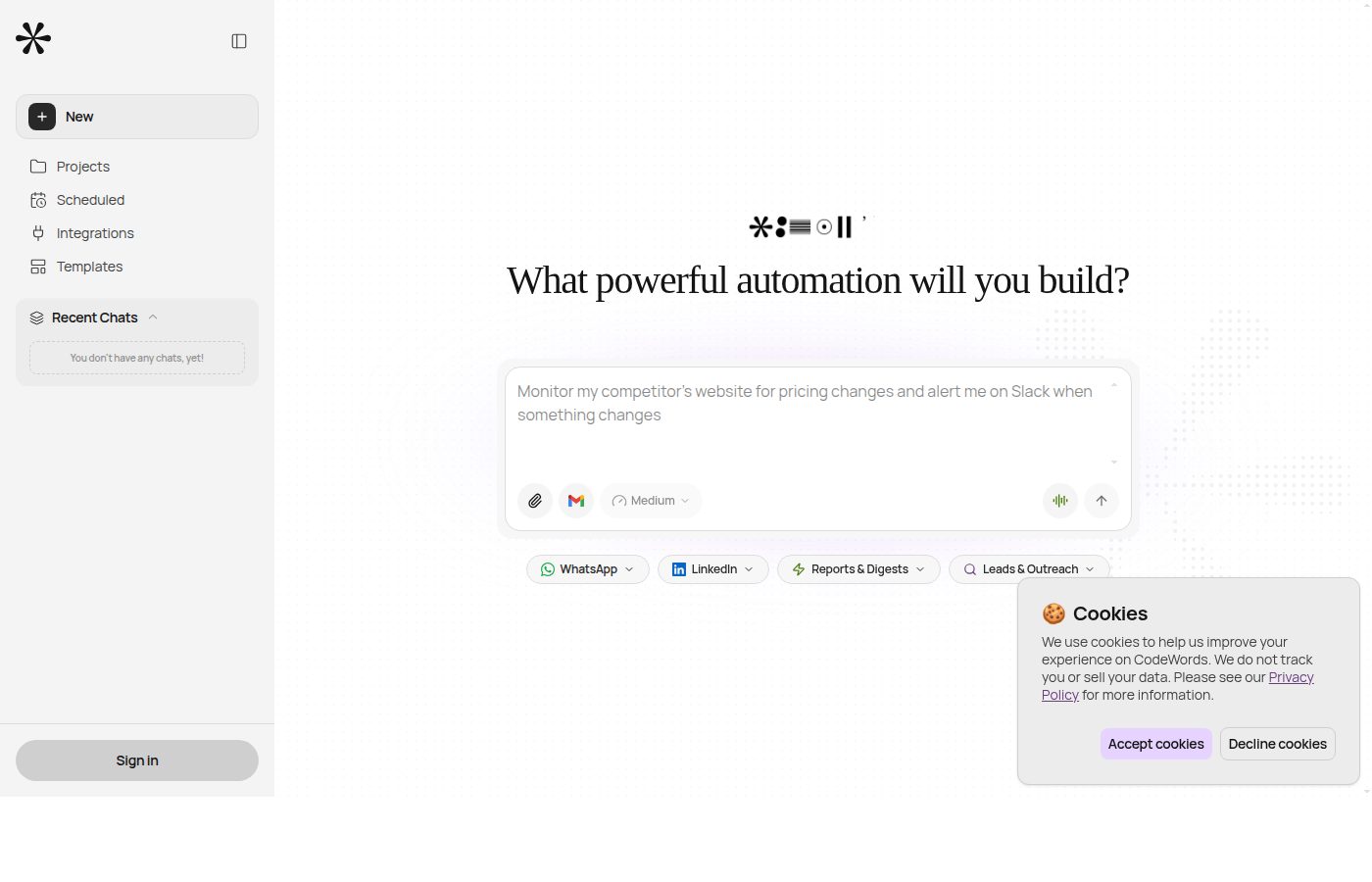
CodeWords (operated by Agemo AI Ltd.) is a chat-native workflow automation platform that translates plain English task descriptions into executable backend code. Founded with the premise that operators should not have to write scripts or manually chain APIs together, the platform utilizes an AI assistant named Cody to build, test, and deploy automations. A defining hard fact from our research is that CodeWords recently secured $9 million in seed funding in May 2026, led by Visionaries, to expand its autonomous agent capabilities. Unlike traditional visual drag-and-drop integration builders, this platform generates actual code, offering greater flexibility for complex commercial real estate processes such as deal monitoring or rent roll extraction.
For commercial real estate firms evaluating artificial intelligence tools in August 2026, the landscape is crowded with generic wrappers. Our analysis indicates that CodeWords differentiates itself by focusing on infrastructure and execution rather than just text generation. The system actively monitors operational patterns across a firm’s connected applications and can suggest automations proactively. While BestCRE classifies it as a Tier 2 CRE-Native tool due to its specific applicability to real estate deal workflows, it remains fundamentally a horizontal platform. It lacks proprietary property data, meaning its utility depends entirely on the quality of the user’s existing tech stack and data inputs. The platform targets analysts and principals who understand their operational bottlenecks but lack the engineering resources to build custom integrations from scratch.
What CodeWords does and how it works
At its core, CodeWords functions as an autonomous software engineer and integration specialist accessible via a chat interface. Users interact with the platform by typing natural language commands to Cody, the system’s primary AI agent. Instead of forcing users to map out logic flows on a visual canvas, Cody interprets the request, writes the necessary backend code, tests the connections, and deploys the automation. For example, a commercial real estate analyst can type a request to monitor a specific Dropbox folder for new offering memorandums, extract key financial metrics using a large language model, and populate a Monday.com tracking board. The platform handles the API authentication, data parsing, and error handling entirely in the background.
The mechanics rely heavily on a code-based architecture rather than rigid integration templates. When a user requests a workflow, CodeWords generates custom Python or Node.js scripts to execute the task. This approach allows for highly specific data transformations that visual builders often struggle to accommodate, such as parsing complex partnership structures or standardizing inconsistent rent roll formats before pushing the data into an underwriting model. The platform supports over 2,700 integrations, covering standard enterprise software like Google Workspace, DocuSign, and major CRM systems.
Beyond reactive task execution, CodeWords is developing proactive agentic capabilities. The system can run continuously, observing data flows across connected applications to identify repetitive manual actions. Once it detects a pattern, such as an analyst repeatedly downloading attachments from emails and uploading them to a shared drive, Cody will suggest an automation to handle the task. Users can also productize their workflows, turning internal automations into white-labeled portals for clients or investors. This allows a brokerage team to create a custom interface where clients can submit property addresses and automatically receive a compiled market report generated by the underlying CodeWords infrastructure.
9AI Framework: the score, dimension by dimension
CRE Relevance: 5/10
CodeWords is classified in our database as a Tier 2 CRE-Native tool, but it is fundamentally a horizontal automation platform adapted for real estate workflows. The system does not include proprietary property data, market analytics, or native underwriting models. Instead, its relevance to commercial real estate stems from its ability to connect disparate industry tools and automate heavy document-processing tasks. Real estate professionals spend countless hours moving data between emails, cloud storage, and CRM platforms. CodeWords addresses this operational friction effectively by allowing users to describe their ideal deal flow mechanics in plain English. However, because it relies entirely on third-party APIs and user-provided data, our analysis dictates it cannot exceed our baseline score for general-purpose applications. In practice: Commercial real estate teams must supply their own data sources and clearly define their operational logic to extract value from the platform.
Data Quality and Sources: 6/10
The platform does not provide native datasets, meaning its data quality score reflects its ability to process, transform, and maintain the integrity of information passing through its automations. Our analysis shows that CodeWords excels at extracting structured data from unstructured sources, such as pulling lease terms from a PDF and formatting them for a database. Because it generates actual code rather than relying on brittle visual connectors, the data transformations are highly customizable and less prone to formatting errors during transit. However, the accuracy of the extracted data still depends heavily on the underlying large language models powering the parsing engine. If an offering memorandum contains ambiguous financial footnotes, the system may misinterpret the context without human oversight. In practice: Users should implement validation steps within their automations to flag anomalous data before it populates critical underwriting models.
Ease of Adoption: 9/10
Deploying custom backend software typically requires dedicated engineering resources, but CodeWords bypasses this barrier through its chat-native interface. The learning curve is exceptionally flat because the primary input mechanism is natural language. Users do not need to understand API endpoints, webhooks, or JSON formatting to build complex integrations. Cody, the AI assistant, handles the technical configuration, debugging, and deployment. The platform also offers a managed infrastructure, meaning users do not have to provision servers or worry about hosting the generated code. While our analysis notes that defining complex, multi-step real estate workflows still requires clear logical thinking, the technical execution is almost entirely abstracted away from the user. In practice: A non-technical real estate analyst can build and deploy a functional, multi-app automation in a single afternoon simply by describing the required steps to the AI.
Output Accuracy: 8/10
Automation platforms are only as useful as their reliability, and CodeWords approaches accuracy by generating inspectable code. When a user requests a workflow, the system writes scripts that can be reviewed, tested, and modified. This transparency reduces the risk of silent failures common in black-box AI tools. The platform includes built-in testing environments where users can simulate data flows before pushing them live. However, our analysis indicates that because the initial code generation relies on natural language interpretation, the AI can occasionally misunderstand complex or ambiguous instructions, leading to logical errors in the workflow. The system mitigates this by allowing users to converse with Cody to debug and refine the output iteratively. In practice: Teams must rigorously test their automations with sample property data to ensure the AI has correctly interpreted the nuances of their specific workflows.
Integration and Workflow Fit: 9/10
With support for over 2,700 applications, CodeWords offers exceptional connectivity for modern commercial real estate tech stacks. The platform easily links standard corporate tools like Microsoft 365, Google Workspace, Slack, and Dropbox with specialized systems like Monday.com or Salesforce. Because the platform generates custom code, it can also interact with any software that offers an open API, even if a pre-built connector does not exist. Our analysis highlights this as particularly valuable for real estate firms using niche property management or accounting software that traditional integration platforms ignore. The system handles authentication and token management securely, reducing the administrative burden on IT teams. In practice: The platform serves as a highly adaptable connective tissue, capable of linking legacy real estate databases with modern communication and document management tools.
Pricing Transparency: 8/10
CodeWords maintains a transparent pricing model that allows users to test the platform before committing to enterprise contracts. Our research confirms the company offers a free tier, alongside credit-based consumption models. Professional plans start at accessible price points, typically around $20 to $49 per month, which include a set allocation of execution credits. This structure allows small brokerage teams to experiment with basic automations without significant financial risk. As workflows scale and consume more compute resources, the credit system scales proportionally. The company publishes these baseline tiers clearly, avoiding the opaque contact-sales gates that plague many enterprise AI tools. However, our analysis suggests high-volume users deploying complex, continuous agentic workflows will need to monitor their credit usage carefully. In practice: The entry-level pricing is highly accessible, but firms must model their expected automation volume to forecast long-term software costs accurately.
Support and Reliability: 6/10
As a startup that just secured its $9 million seed funding round in May 2026, CodeWords is still in the early stages of building its enterprise support infrastructure. The company relies heavily on community forums, documentation, and automated troubleshooting via its own AI assistant to resolve user issues. While the chat interface allows users to ask Cody for help debugging specific workflows, human intervention for complex platform outages or billing disputes may experience delays. The platform’s uptime is generally stable, backed by modern cloud infrastructure, but our analysis notes it lacks the guaranteed service level agreements and dedicated account managers expected from mature enterprise software vendors. Per our rating methodology for unproven startups, this dimension is strictly capped. In practice: Early adopters must be comfortable relying on self-serve documentation and AI-assisted debugging rather than expecting immediate white-glove human support.
Innovation and Roadmap: 8/10
The recent capital injection from prominent venture firms indicates a strong mandate for product development. CodeWords is actively moving beyond reactive workflow generation toward proactive, autonomous agents. The roadmap focuses on enhancing Cody’s ability to monitor background business activities and independently suggest efficiency improvements. The company is also expanding its productization features, allowing users to package their automations into branded portals for external clients. Our analysis shows this trajectory aligns well with the commercial real estate industry’s growing demand for intelligent systems that require less manual prompting. While the vision is ambitious, the core technology is already demonstrating tangible progress in shifting from simple task execution to complex reasoning. In practice: Buyers are investing in a rapidly evolving platform that promises to transition from a basic integration builder to an autonomous operational assistant over the next year.
Market Reputation: 6/10
CodeWords is generating significant interest among early adopters and automation enthusiasts, but its footprint in the traditional commercial real estate sector remains limited. The successful seed round led by Visionaries has validated its technical approach within the venture capital community, positioning it as a strong contender in the emerging AI agent space. However, our analysis reveals it has not yet established a track record of large-scale enterprise deployments within major brokerages or institutional investment firms. The platform is frequently compared to other automation tools, but it is still building the case studies and industry-specific testimonials required to win over conservative real estate executives. As a seed-stage startup, its reputation score is constrained by its short operating history. In practice: The tool is highly regarded by technical early adopters, but institutional real estate firms may wait for further market validation before deploying it globally.
Who should use CodeWords
CodeWords is designed for professionals who understand their operational bottlenecks but lack the coding expertise to build custom integrations. It is best suited for teams that process high volumes of standardized documents or manage complex, multi-step deal pipelines across various software platforms.
Acquisitions analysts who want to automatically extract financial data from offering memorandums and populate underwriting models without manual data entry.
Operations managers at mid-sized brokerages looking to connect their CRM systems with marketing platforms to automate lead generation and client reporting.
Asset managers who need to aggregate unstructured data from property managers, such as PDF rent rolls or maintenance logs, into a centralized database.
Boutique real estate firms seeking to build white-labeled client portals that provide automated market updates and deal tracking without hiring external developers.
Who should look elsewhere
Firms looking for out-of-the-box real estate analytics or proprietary market data will not find value here. This is an infrastructure tool, not a data provider. It requires users to define their own logic and bring their own software stack.
Institutional investors requiring on-premise deployments or strict enterprise service level agreements, as the startup currently lacks mature enterprise support structures.
Professionals seeking a native commercial real estate database, as the platform contains no proprietary property listings, ownership records, or market statistics.
Firms that rely exclusively on legacy, closed-ecosystem software that does not offer API access or webhooks for external connectivity.
Pricing and ROI
CodeWords operates on a transparent pricing model that combines subscription tiers with usage-based credits. Based on our August 2026 research, the company offers a free tier that allows users to test the chat interface and build basic automations. The Professional plans start at approximately $20 to $49 per month, which includes a baseline allocation of execution credits. As workflows become more complex or run more frequently, users consume more credits, scaling the cost directly with usage. The company publishes these details clearly, avoiding mandatory sales calls for initial adoption.
For a commercial real estate firm, the return on investment math is highly compelling. Consider a boutique brokerage where a junior analyst spends ten hours a week manually downloading offering memorandums from email, renaming the files, extracting high-level property details, and logging them into Monday.com or Salesforce. At a fully burdened cost of $50 per hour, this manual data entry costs the firm roughly $2,000 per month. By deploying CodeWords on a $49 per month Pro plan, the firm can automate this entire sequence. Even factoring in the time required to build and refine the initial prompt, the firm achieves a positive financial return within the first two weeks of deployment, while freeing the analyst to focus on actual underwriting and deal sourcing.
Integration and CRE tech stack fit
CodeWords excels in its ability to unify fragmented commercial real estate technology stacks. The platform supports over 2,700 native integrations, covering the foundational tools used by nearly every brokerage and investment firm, including Google Workspace, Microsoft 365, Slack, and Dropbox. For real estate specific workflows, its true value lies in its code-generating architecture. Because Cody writes actual backend scripts rather than relying on rigid visual templates, it can connect to any platform with an open API. This means firms can link modern CRMs like Salesforce or Hubspot directly to specialized real estate tools, provided those tools allow API access. The platform easily manages authentication and data routing, allowing an analyst to trigger a complex document workflow in DocuSign simply by moving a deal stage in their CRM. However, firms utilizing highly secure, on-premise legacy databases without modern API endpoints will struggle to integrate this cloud-native platform into their existing infrastructure.
Competitive landscape
The market for AI-driven automation and coding assistants in August 2026 is intensely competitive, and CodeWords faces pressure from both generalist coding tools and specialized workflow builders. For pure code generation, Cursor (BestCRE Score: 90) remains the gold standard for developers, offering a deeply integrated IDE experience. However, Cursor requires the user to actually know how to manage a codebase, whereas CodeWords abstracts the hosting and deployment entirely.
In the autonomous agent space, Agentforce (BestCRE Score: 88) provides a highly structured, enterprise-grade environment for deploying AI workers, particularly within the Salesforce ecosystem, making it a safer bet for institutional real estate firms heavily invested in that CRM. Replit (BestCRE Score: 88) offers a similar natural-language-to-software capability but caters more to developers building standalone applications rather than operators looking to automate background workflows.
For users who prefer visual automation builders over chat-native interfaces, Gumloop (BestCRE Score: 87) and Conduit (BestCRE Score: 87) offer excellent drag-and-drop experiences tailored to data extraction and workflow chaining. Manus (BestCRE Score: 87) also competes closely in the autonomous agent category, focusing on multi-step reasoning tasks. CodeWords distinguishes itself from these peers by combining the flexibility of custom code generation with the simplicity of a chat interface, though it lacks the mature enterprise track record of Agentforce or the visual intuitiveness of Gumloop.
The bottom line
CodeWords is a highly capable infrastructure tool that successfully democratizes backend automation for non-technical real estate professionals. It is not a magic bullet that will instantly source deals or underwrite properties, as it contains no proprietary market data. However, for firms drowning in manual data entry, document routing, and disjointed software systems, it offers an exceptionally fast path to operational efficiency. The chat-native interface drastically lowers the barrier to entry, allowing analysts to build custom integrations that would historically require expensive external developers. While institutional players may balk at the unproven support structure of a seed-stage startup, boutique brokerages and agile investment teams should adopt this tool immediately. If your firm relies on moving data between emails, cloud storage, and CRMs, the minimal monthly cost is easily justified by the sheer volume of administrative hours saved.
Frequently asked questions
Does CodeWords include commercial real estate property data or ownership records?
No. CodeWords is a horizontal workflow automation platform adapted for various industries. It does not provide proprietary real estate data, market analytics, or property listings. Users must connect their own data sources, CRMs, and document repositories to extract value from the system.
Do I need to know how to write code to use this platform?
You do not need programming experience. The platform uses a chat-native interface where you describe your desired workflow in plain English. The AI assistant, Cody, translates your instructions into backend code, handles API connections, and deploys the automation automatically without requiring manual scripting.
How does the pricing structure work for enterprise users?
The company offers a transparent pricing model featuring a free tier for basic testing and Professional plans starting between $20 and $49 per month. These paid plans operate on a credit system, meaning your total cost will scale based on the complexity and execution volume of your automations.
Can I connect CodeWords to my existing real estate CRM?
Yes, provided your CRM has an open API. The platform supports over 2,700 native integrations, including major systems like Salesforce. Because it generates custom code, it can also connect to niche real estate platforms that offer API endpoints, facilitating highly customized data transfer across your entire tech stack.
Is the platform secure enough for confidential financial documents?
The platform utilizes modern cloud infrastructure and securely manages API authentication tokens. However, because it processes data through third-party large language models to interpret natural language, firms should review their internal compliance policies regarding the transmission of highly sensitive or personally identifiable financial information through external AI APIs.
What happens if the AI builds an automation incorrectly?
Because the system generates inspectable code rather than hidden visual logic, users can review the output. If an automation fails or behaves unexpectedly, you can use the chat interface to explain the error to the AI, which will debug the scripts and deploy a corrected version of the workflow.
Related Reviews
Compare CodeWords with other AI Assistants & Copilots tools BestCRE has scored: Google Gemini (84/100), Grammarly (83/100), Copilot in Word (71/100) and Uniti AI (68/100). Browse every review in CRE AI Assistants & Copilots, the full Best CRE AI Tools directory, or the 20 CRE Sectors hub.