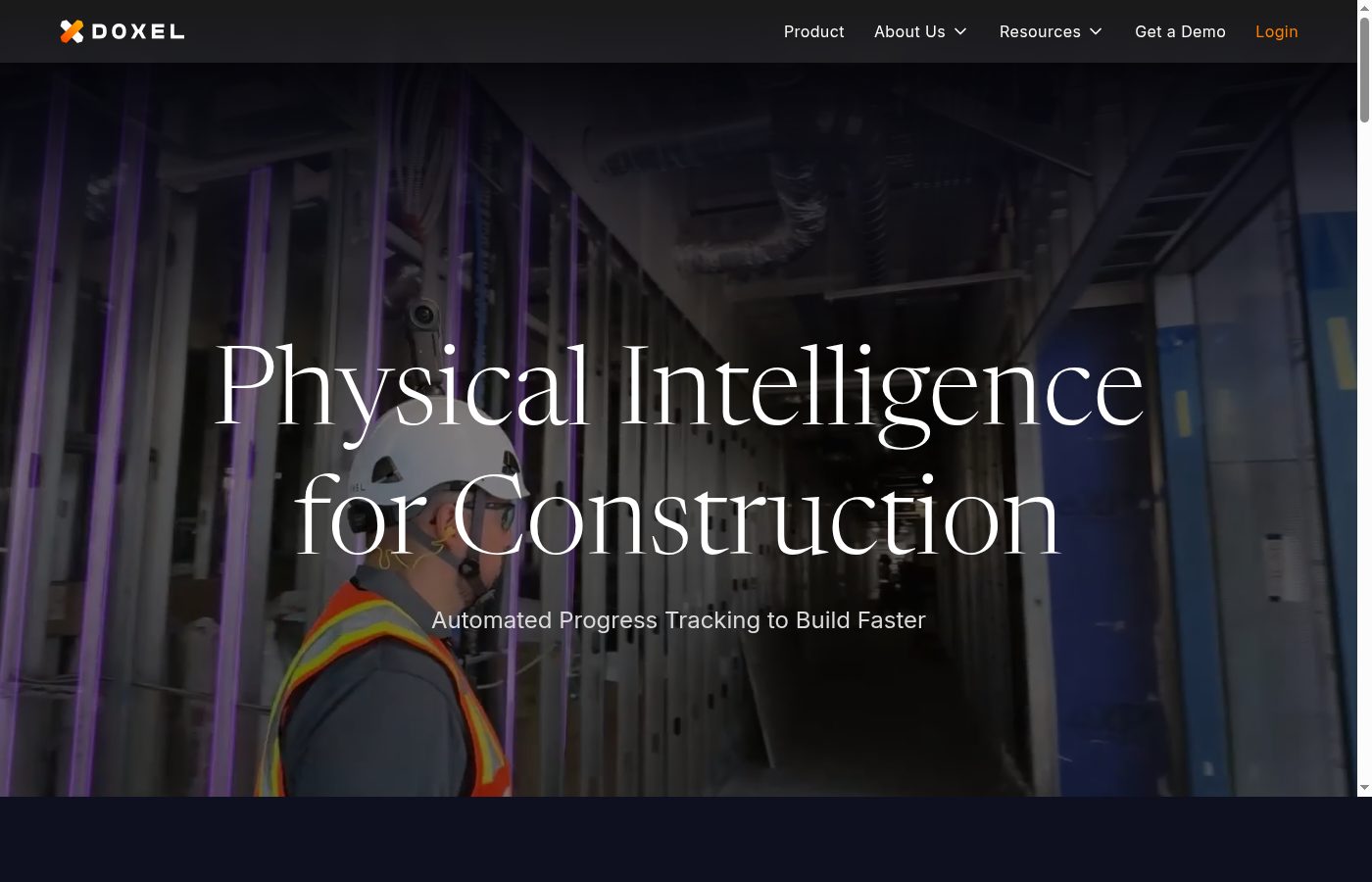
Doxel is an AI-powered construction progress tracking platform that utilizes computer vision to measure physical work-in-place against project schedules and Building Information Modeling (BIM) files. As a Tier 1 CRE-native solution, Doxel specifically targets large-scale commercial developments, data centers, and healthcare facilities where schedule overruns carry massive financial penalties. By processing 360-degree camera captures or LiDAR scans from the job site, the platform automates the traditionally manual process of verifying trade progress, measuring quantities installed, and validating pay applications. Rather than relying on superintendents to estimate completion percentages, Doxel provides an objective, verifiable reality capture that aligns physical progress with financial disbursements.
In a market crowded with generic project management software, Doxel differentiates itself through its deep integration of spatial data and predictive machine learning. The system tracks over 85 distinct stages of construction across all visible trades, instantly surfacing deviations between the approved BIM model and the actual built environment. While platforms like Autodesk Forma and TestFit dominate the pre-construction and design phases, Doxel operates strictly during active construction to prevent execution failures. For commercial real estate principals and general contractors, this means replacing subjective field estimates with objective, verifiable data to eliminate overbilling, reduce trade stacking, and mitigate schedule risks before they compound. The platform requires a dedicated hardware deployment and BIM integration, making it a heavy but highly specialized enterprise solution.
What Doxel does and how it works
Doxel functions as a continuous, automated auditing system for active construction sites, bridging the gap between digital planning and physical execution. The workflow begins with data capture, typically executed by field workers wearing hardhat-mounted 360-degree cameras or through autonomous LiDAR-equipped rovers navigating the site. As these devices scan the environment, Doxel’s proprietary Vision-based Simultaneous Localization and Mapping (VSLAM) technology spatially anchors the video footage directly into the project’s existing BIM model.
Once the visual data is uploaded, Doxel’s computer vision algorithms analyze the imagery to identify and quantify installed components. The AI is trained to recognize over 85 specific construction stages across architectural, structural, mechanical, electrical, and plumbing (MEP) trades. It measures linear feet of pipe, counts installed fixtures, and verifies framing progress, comparing these physical realities against the approved 3D model and the Oracle Primavera P6 schedule. If a subcontractor has installed ductwork in the wrong location or is falling behind their projected production rate, the platform flags the discrepancy immediately.
The output is delivered through a centralized dashboard featuring a color-coded 3D progress view, side-by-side photo comparisons, and predictive schedule reports. Project managers and owner executives use these insights to validate subcontractor pay applications based on hard, objective quantities rather than subjective estimates. By continuously updating the model with actual production rates, Doxel forecasts potential cascade delays, allowing teams to adjust sequencing, address labor shortages, or resolve coordination conflicts before they derail the critical path. This automated intelligence fundamentally shifts construction management from reactive troubleshooting to proactive optimization. Rather than discovering a critical delay during a monthly owner-architect-contractor meeting, stakeholders receive data-driven alerts that pinpoint exactly which trades are off-track.
9AI Framework: the score, dimension by dimension
CRE Relevance: 9/10
Doxel is purpose-built for the commercial real estate sector, specifically targeting the complex, high-stakes environment of large-scale construction. Unlike generic computer vision tools, its algorithms are natively trained on commercial building components, MEP systems, and structural elements. The platform directly addresses one of the most persistent challenges in CRE development: the disconnect between financial disbursements and actual physical progress. By serving owners, developers, and general contractors on massive projects like data centers and healthcare facilities, Doxel operates at the very core of commercial asset creation. Its deep integration with industry-standard scheduling and modeling formats further cements its status as a highly specialized, CRE-native application. In practice: CRE developers use Doxel to maintain absolute visibility over their capital deployments, ensuring that every dollar paid out corresponds exactly to verified work-in-place on the job site.
Data Quality and Sources: 9/10
The accuracy and utility of Doxel’s outputs are entirely dependent on the quality of two inputs: the project’s BIM file and the frequency of site captures. When provided with a highly detailed, clash-coordinated model and daily 360-degree camera walkthroughs, the platform’s machine learning models excel. Doxel’s AI has been rigorously trained to distinguish between over 85 distinct stages of construction, allowing it to accurately identify materials, measure linear footage, and calculate completion percentages with minimal human intervention. However, if the underlying BIM is poorly maintained or lacks granular detail, the AI’s comparative analysis will yield false flags or incomplete progress reports. In practice: Teams must enforce strict BIM standards and commit to regular, high-quality site scans to ensure the platform’s computer vision can accurately map physical progress against digital expectations.
Ease of Adoption: 7/10
Deploying Doxel is a significant enterprise undertaking that requires structural changes to how a job site operates. While the vendor claims a two-week onboarding period with no extra virtual design and construction (VDC) work required, the reality of implementation is more demanding. Teams must procure and manage hardware (360-degree cameras or LiDAR scanners), establish daily scanning routines, and ensure their BIM and scheduling files are perfectly formatted for ingestion. This is not a lightweight SaaS application that can be adopted casually; it demands buy-in from field superintendents, project managers, and VDC coordinators. The learning curve for field staff to properly capture data without disrupting active trades can also introduce initial friction. In practice: Successful adoption requires a dedicated champion on the general contractor’s side to enforce daily scanning protocols and manage the integration of the hardware into standard field workflows.
Output Accuracy: 9/10
Doxel delivers highly precise progress measurements by relying on objective spatial data rather than human estimation. The proprietary VSLAM technology accurately anchors visual captures within the digital twin, ensuring that installed components are measured against their exact intended coordinates. This precision allows the platform to catch subtle deviations—such as MEP rough-ins installed a few inches off-plan—that human inspectors routinely miss. By quantifying exact linear footage and unit counts, the system provides an unassailable baseline for approving pay applications and change orders. However, the system’s accuracy is limited to visible elements; once walls are closed, it cannot verify underlying work unless it was scanned prior to concealment. In practice: Project executives rely on Doxel’s automated measurements to confidently approve multi-million dollar subcontractor payouts, knowing the quantities are backed by indisputable visual and spatial evidence.
Integration and Workflow Fit: 9/10
Doxel understands that it must exist within a broader construction technology ecosystem to be effective. The platform boasts strong, native integrations with the industry’s most entrenched software, including Oracle Primavera P6 for scheduling, and Procore and Autodesk Construction Cloud for project management and BIM coordination. This connectivity ensures that the objective progress data generated by Doxel flows directly into the tools where financial and scheduling decisions are actually made. When the project schedule or BIM is updated in these third-party platforms, Doxel automatically ingests the changes, eliminating the need for manual dual-entry. This tight ecosystem fit makes it a natural extension of a modern general contractor’s existing tech stack. In practice: VDC managers can directly sync their latest Autodesk models with Doxel, allowing the AI to immediately begin comparing new site scans against the most current design revisions.
Pricing Transparency: 4/10
Doxel operates with a completely opaque pricing model, requiring prospective buyers to engage with their sales team to receive a custom quote. The vendor does not publish any pricing tiers, baseline costs, or implementation fees on its website. Costs are highly variable and depend on the scale of the construction project, the specific capabilities required, and the size of the job site. While the enterprise nature of the software justifies custom scoping to some degree, the total lack of public pricing data forces analysts to invest significant time in sales consultations just to determine baseline budgetary fit. This lack of transparency is a notable drawback for teams trying to quickly evaluate software alternatives. In practice: Buyers must prepare detailed project specifications, including square footage and BIM complexity, before entering negotiations to extract a reliable total cost of ownership estimate.
Support and Reliability: 8/10
As a well-funded, Tier 1 vendor, Doxel provides a high level of enterprise support tailored to the demands of massive commercial projects. The company offers US-based support teams that assist with the initial two-week implementation phase, helping to map the BIM and schedule files into the system. Given the hardware-dependent nature of the platform, reliable technical support is critical for troubleshooting camera malfunctions, data upload failures, or VSLAM alignment issues. User feedback indicates that Doxel’s support personnel are responsive and knowledgeable about construction workflows, which is essential when a delayed progress report could hold up critical path decisions or subcontractor payments. In practice: General contractors can expect hands-on, white-glove assistance during the critical early phases of deployment to ensure their field teams are capturing usable data without disrupting site operations.
Innovation and Roadmap: 9/10
Doxel is aggressively pushing the boundaries of what computer vision can achieve on a construction site. While early iterations focused purely on visual documentation, the platform has evolved into a predictive analytics engine. The company is continuously training its machine learning models to recognize a wider array of specialized construction stages and materials. Furthermore, Doxel is actively developing features that move beyond simple progress tracking to forecast cascade delays—predicting how a slowdown in electrical rough-in today will impact drywall installation three weeks from now. This transition from descriptive data (what happened) to predictive intelligence (what will happen) represents a strong, forward-looking development trajectory. In practice: Users benefit from an evolving AI that not only verifies current completion percentages but actively warns project managers of impending schedule collisions before they manifest on the job site.
Market Reputation: 9/10
Doxel has established a formidable reputation among top-tier general contractors and institutional owners. The platform is trusted by major industry players, including DPR Construction and McCarthy Building Companies, to manage risk on highly complex, capital-intensive projects like data centers and hospitals. Its ability to objectively eliminate billing friction and reduce schedule overruns has earned it strong word-of-mouth credibility within the VDC and project management communities. While it faces stiff competition from other reality capture tools, Doxel is widely regarded as a premium, highly accurate solution for teams that require deep BIM integration and automated quantity takeoffs. In practice: When an institutional developer mandates strict, objective progress tracking for a new mega-project, Doxel is frequently shortlisted as the gold standard for AI-driven construction verification.
Who should use Doxel
Doxel is engineered for enterprise-scale construction stakeholders who require absolute precision in tracking physical progress.
- Institutional developers and CRE owners managing mega-projects (data centers, hospitals) who need objective verification of work-in-place to approve massive pay applications.
- General contractors and project executives seeking to eliminate subjective field estimates and reduce overbilling by subcontractors.
- VDC (Virtual Design and Construction) managers who require an automated way to compare physical site conditions against complex BIM models.
- Construction scheduling coordinators looking for predictive analytics to identify cascade delays and optimize trade sequencing.
Who should look elsewhere
This platform is highly specialized and requires significant operational maturity, making it unsuitable for certain segments of the market.
- Small to mid-sized commercial developers working on standard, low-complexity builds where the cost of implementation outweighs the risk of schedule delays.
- Design and architecture firms looking for pre-construction coordination tools; Doxel only tracks physical work against approved models.
- General contractors who do not utilize comprehensive BIM or strictly maintained digital schedules.
- Teams unwilling or unable to commit to daily hardware-based site scanning protocols.
Pricing and ROI
As of August 2026, Doxel operates with a custom pricing model and does not publicly disclose its software licensing or implementation fees. Because the platform is deployed on a per-project or enterprise portfolio basis, costs scale dynamically based on the gross square footage of the job site, the complexity of the BIM, and the specific modules required (such as Doxel Schedule or Doxel Cost). Prospective buyers must engage directly with the sales team to scope their unique requirements and receive a tailored quote. The software typically includes unlimited user seats, meaning owners, general contractors, and trade partners can all access the dashboard without incurring additional licensing penalties.
Despite the lack of published pricing, the ROI math for Doxel is compelling for large-scale commercial developments. The vendor claims its objective data eliminates an industry-average 21% overbilling rate and accelerates project delivery by 11% through increased labor productivity. For a $100 million data center project, preventing even a 2% overpayment on change orders or avoiding a single month of schedule delay easily justifies a heavy software and hardware investment. However, buyers must also factor in the total cost of ownership, which includes the procurement of 360-degree cameras or LiDAR equipment, as well as the internal labor costs associated with daily site scanning and VDC coordination.
Integration and CRE tech stack fit
Doxel is engineered to sit at the intersection of a general contractor’s visual reality capture and their core project management systems. The platform offers native, API-driven integrations with the industry’s most critical software, ensuring that objective progress data does not remain siloed. For scheduling, Doxel integrates directly with Oracle Primavera P6, allowing the AI to map physical work-in-place against the master critical path and automatically update production rates.
On the project management and coordination front, Doxel connects directly with Procore and Autodesk Construction Cloud. This allows field teams to link visual discrepancies and flagged delays directly to RFIs or change orders within their existing Procore dashboards. Additionally, the software supports Revizto for advanced issue tracking and clash detection resolution. By automatically updating its analysis whenever a new BIM revision or schedule update is pushed from these third-party platforms, Doxel minimizes manual data entry and ensures that all stakeholders are operating from a single, objective source of truth.
Competitive landscape
The construction progress tracking and reality capture market is highly competitive, with several AI-driven platforms vying for enterprise general contractor contracts. Doxel’s most direct competitor in the automated progress tracking space is Buildots. Like Doxel, Buildots utilizes hardhat-mounted 360-degree cameras to capture site data and compares it against BIM and schedules. However, Buildots is often praised for a slightly more intuitive user interface, whereas Doxel leans heavily into predictive schedule analytics and cascade delay forecasting.
OpenSpace is another major player, dominating the pure reality capture segment. While OpenSpace is exceptional at creating searchable digital twins and is generally easier to deploy, Doxel offers deeper, more automated quantity takeoffs and explicit stage-by-stage trade tracking. If a team only needs visual documentation, OpenSpace is the lighter, faster alternative; if they need automated financial validation, Doxel is superior.
For pre-construction and design optimization, Autodesk Forma (Scored 80) and TestFit (Scored 78) serve entirely different purposes. They operate before ground is broken to optimize site feasibility and design, whereas Doxel is strictly a construction-phase execution tool.
Finally, AI scheduling tools like ALICE Technologies compete with Doxel’s predictive scheduling features. While ALICE uses AI to generate millions of schedule permutations to optimize the build sequence before and during construction, Doxel relies on physical site data to adjust an existing P6 schedule. Buyers must decide if they need generative scheduling or reality-based schedule auditing.
The bottom line
Doxel is a formidable, highly specialized AI platform that brings much-needed financial and operational objectivity to complex commercial construction projects. By automating the measurement of work-in-place and comparing it directly against BIM and P6 schedules, it effectively eliminates the guesswork and subjective estimations that lead to massive overbilling and schedule delays. It is not a tool for every developer; the requirement for pristine BIM files, daily hardware-based site scanning, and a custom enterprise price tag makes it overkill for standard, low-complexity builds. However, for institutional owners and Tier 1 general contractors managing data centers, hospitals, or large-scale commercial assets, Doxel is an invaluable risk mitigation engine. If your organization has the VDC maturity to support it, Doxel provides the indisputable, data-driven reality capture necessary to keep massive capital projects on time and strictly on budget.
Frequently asked questions
Does Doxel require a BIM file to operate?
Yes, Doxel requires a fully coordinated 3D Building Information Model (BIM) to function effectively. The platform’s computer vision AI compares the visual data captured on the job site against the BIM to accurately measure progress, verify quantities, and identify spatial deviations across all trades.
How does Doxel capture site data?
Data is captured using 360-degree cameras mounted on workers’ hardhats during routine site walks, or via autonomous LiDAR-equipped rovers and drones. This visual and spatial data is then uploaded to Doxel, where it is automatically aligned with the project’s digital twin.
Does Doxel integrate with Procore and Oracle P6?
Yes, Doxel features native integrations with leading construction management and scheduling software, including Procore, Oracle Primavera P6, Autodesk Construction Cloud, and Revizto. This ensures that progress data and schedule updates flow smoothly between your existing tech stack and the Doxel dashboard.
Is Doxel suitable for pre-construction design review?
No, Doxel is strictly a construction-phase execution tool designed to monitor active job sites. It measures physical work-in-place against previously approved models and schedules. It does not identify drawing coordination errors, code compliance gaps, or specification conflicts in the design package before construction actually begins.
How long does it take to implement Doxel?
Enterprise implementation typically takes about two weeks. Once the general contractor or owner submits the project’s BIM and schedule files, Doxel’s support team configures the system. The vendor claims this setup process requires no additional Virtual Design and Construction (VDC) engineering work from the client.
Can Doxel help validate subcontractor pay applications?
Absolutely. By providing objective, verifiable data on the exact quantities of materials installed and the percentage of work completed, Doxel allows project managers to approve pay applications and change orders based on indisputable visual evidence rather than subjective field estimates.