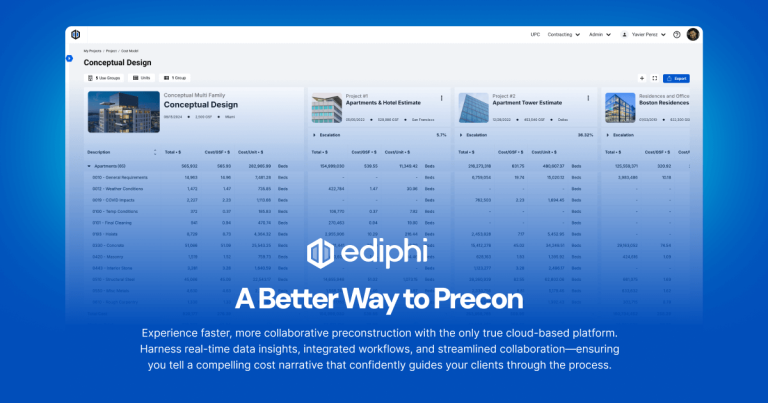
Ediphi is a cloud preconstruction platform for estimators, preconstruction leaders and general contractors. It changes the workflow between early cost modeling, detailed estimating, bid packaging and the handoff toward construction. Instead of treating conceptual budgets, estimate details and historical pricing as separate records, Ediphi puts them in one shared environment. That proposition is relevant to commercial real estate owners because the quality and speed of preconstruction directly influence feasibility decisions, capital approvals, design choices and the credibility of projected development costs.
The product sits closer to construction operations than to traditional property software. A developer, owner or asset manager is unlikely to operate Ediphi personally. The practical buyer is usually a contractor or construction management team, while the CRE principal receives the resulting budgets, alternates and cost narratives. BestCRE therefore classifies Ediphi as CRE adjacent. It can materially improve a development workflow, but it is not a property acquisition, leasing, valuation or asset management system.
Its strongest idea is continuity. Teams can begin with cost models, convert those models into detailed estimates, manage general conditions and general requirements, generate bid packages, compare bids and track value decisions toward a guaranteed maximum price. Historical estimate information can feed subsequent planning rather than remaining trapped in spreadsheets or isolated files. Analysis: this continuity should be more valuable to organizations running repeated building types, regions or client programs, because each completed estimate can improve the context available to the next project.
The buying case is credible, but not yet self proving. Ediphi identifies public customer stories involving contractors such as Blach Construction and Landry French, and its site includes a testimonial from Hensel Phelps. It also reports SOC 2 Type II compliance as of October 2026. However, the vendor does not publish pricing, customer count, implementation benchmarks or independently verified accuracy results. Buyers should treat the platform as a serious workflow candidate, then require a controlled pilot using their own estimate structure, cost history and reporting requirements before making it the source of truth for project costs.
What Ediphi Does and How It Works
Ediphi starts with cost modeling and estimating. Users can create configurable templates, assemble estimates and use prior estimate information as context for new work. The Unit Price Catalog centralizes unit costs and can retain quantity takeoffs associated with programmed units. The intended result is a structured pricing library that grows from actual estimating activity instead of a disconnected reference database. Teams can recall prior estimates for pricing analysis, examine relevant historical context and move a cost model into an estimate. Analysis: the value depends heavily on disciplined coding, normalization and governance. A cloud database does not automatically make inconsistent cost records comparable.
The platform also addresses the middle and later stages of preconstruction. General conditions and general requirements tools support resource allocation, budget tracking and compliance oriented workflows. Contracting functions generate bid packages from estimates, support bid leveling, assist buyout activity and centralize related reporting. Value Management tracks cost changes from budget through the guaranteed maximum price milestones. These functions give estimators and project leaders a common record of how a preliminary budget changed, what alternatives were considered and which assumptions survived into the committed plan. That traceability can make owner conversations more concrete when scope or market conditions force decisions.
Ediphi extends its workflow through integrations and what it calls Last Mile tools. Its published product description identifies connections with Excel, takeoff systems, customer relationship management software and workforce planning tools, supported by cloud infrastructure and an open API. The Excel add in can populate owner bid forms and support custom reports without requiring users to rebuild estimate information manually. Analysis: this is a practical response to an industry reality. Even a strong estimating platform must coexist with spreadsheets and specialist systems. Buyers should still test field mapping, permissions, version control, error handling and export fidelity, because the vendor does not publish a complete connector catalog or standardized performance results.
9AI Framework: Dimension by Dimension Analysis
CRE Relevance: 7/10
Ediphi earns a 7 for CRE relevance. The platform addresses preconstruction, a consequential part of commercial development where early cost assumptions influence land decisions, design progression, financing and owner approvals. Its estimating, value management, bid packaging and historical cost functions fit general contractors serving CRE projects particularly well. It is less directly relevant to principals, brokers and property operators because those users are usually consumers of its outputs rather than daily operators of the system. Ediphi also does not present itself as a source of property data, market rents, investment underwriting or portfolio operations. Analysis: its value to a CRE organization will rise with the volume and complexity of active development, but fall sharply for firms that outsource estimating and only need periodic budget reports from contractors. That distinction keeps it below the category leaders with broader direct applicability across CRE workflows.
Data Quality and Sources: 7/10
Ediphi earns a 7 for data quality. Its strongest data feature is the ability to capture historical and benchmarked information from estimates, store unit prices and quantities, and recall prior estimates for later pricing analysis. Keeping conceptual models and detailed estimates in the same system can reduce the context loss that occurs when teams copy figures across unrelated workbooks. The limitation is that Ediphi primarily organizes customer generated data. The vendor does not publish the breadth of any proprietary cost dataset, formal normalization methodology, refresh frequency or independent validation study. Analysis: the system can create a high quality institutional cost record, but only if administrators define consistent codes, units, locations, escalation assumptions and approval rules. Buyers should inspect how the platform handles duplicates, superseded prices, regional differences and incomplete records before trusting historical comparisons across projects.
Ease of Adoption: 7/10
Ediphi earns a 7 for ease of adoption. A browser based platform can remove desktop installation constraints and make concurrent collaboration more practical for distributed estimating teams. Customizable templates, modular workflows and an Excel add in should also reduce friction for users accustomed to spreadsheet based reporting. Ediphi maintains a Help Center with published sections covering administration, estimates, contracting, general conditions and general requirements, which indicates a meaningful body of product documentation. The harder adoption problem is organizational rather than technical. Estimators often rely on personal assemblies, workbook conventions and judgment developed over years. Moving that knowledge into a shared structure requires data cleanup, template design, permissions and training. Analysis: adoption should be manageable for a committed preconstruction department, but buyers should not assume quick acceptance merely because the interface is cloud based. A pilot should include both power users and skeptical estimators.
Output Accuracy: 7/10
Ediphi earns a 7 for output accuracy. The platform can improve consistency by using shared templates, stored unit prices, historical estimates and programmatic calculations rather than repeated manual transfer between files. Keeping cost models, detailed estimates and value decisions connected should also make assumptions easier to trace. However, estimating accuracy ultimately depends on quantities, scope interpretation, trade coverage, labor assumptions, escalation, regional conditions and estimator judgment. Ediphi does not publish independently verified error rates or comparative accuracy benchmarks. Analysis: the product is best understood as a controlled calculation and information environment, not an autonomous prediction engine. Buyers should test a completed project and compare Ediphi outputs with the original estimate, bid results and final buyout. They should also confirm rounding behavior, formula controls, alternates, allowances and export reconciliation before relying on the platform for owner facing commitments.
Integration and Workflow Fit: 8/10
Ediphi earns an 8 for integration. The product explicitly supports an open API and connections involving Excel, takeoff, customer relationship management and workforce planning systems. Its Last Mile approach is particularly relevant because owner bid forms and internal reports frequently remain spreadsheet based even after an estimating platform is adopted. Generating those deliverables from structured estimate data can remove repetitive rekeying and reduce version confusion. The score stops short of the top tier because the vendor does not publish a comprehensive connector directory, implementation specifications or service level commitments for each integration. Analysis: the architecture appears integration friendly, but buyers must distinguish a documented connector from a custom API project. During diligence, request demonstrations using the exact takeoff, accounting, project management and reporting products in the target environment, then assign ownership for monitoring failed transfers and schema changes.
Pricing Transparency: 3/10
Ediphi earns a 3 for pricing transparency. The vendor does not publish subscription prices, implementation charges, minimum commitments, data migration fees or support tiers. Prospective customers are directed toward a demonstration and sales process. That approach may reflect enterprise pricing based on users, modules, usage or organizational scope, but the commercial structure is not publicly specified. The absence of pricing makes it difficult for a contractor or CRE principal to compare Ediphi with desktop estimating products, broader construction suites or an internally maintained spreadsheet environment before entering procurement. Analysis: buyers should request a complete multiyear cost schedule that separates licenses, onboarding, configuration, integrations, training, premium support and renewal increases. They should also ask whether occasional reviewers, joint venture partners and external collaborators require paid seats. The score reflects disclosure, not whether the eventual price is fair.
Support and Reliability: 7/10
Ediphi earns a 7 for support. The vendor publishes a Help Center covering core administrative and workflow areas, alongside webinars, product releases and customer stories. That content suggests users have access to structured self service material rather than relying exclusively on informal sales assistance. The breadth of estimate related articles is encouraging for a product that must accommodate detailed working practices. Still, Ediphi does not publicly specify response times, support hours, named success resources, training entitlements or escalation commitments. Analysis: enterprise preconstruction software needs more than documentation because configuration choices affect every estimate built afterward. Buyers should require a written onboarding plan, defined data migration responsibilities, administrator training and support service levels. References should be asked about the quality of issue resolution after launch, not merely the quality of the sales and implementation experience. Support appears credible, but its contractual depth is not publicly established.
Innovation and Roadmap: 8/10
Ediphi earns an 8 for innovation. Its contribution is not a speculative artificial intelligence feature. It is the connection of conceptual cost modeling, detailed estimating, historical data, value management, bid packaging and reporting inside a cloud architecture. The Unit Price Catalog and direct conversion of a cost model into an estimate address recurring gaps between early planning and detailed preconstruction. The Last Mile concept also recognizes that custom forms and Excel reporting remain embedded in contractor and owner workflows. Analysis: this is useful process innovation because it concentrates context that is commonly fragmented across spreadsheets and older desktop applications. The platform does not receive a higher score because the vendor does not publish enough technical detail to establish uniquely advanced prediction, automated scope reasoning or independently measured productivity gains. Its innovation is strongest in workflow design, collaboration and data continuity rather than autonomous intelligence.
Market Reputation: 6/10
Ediphi earns a 6 for market reputation. The vendor presents customer stories involving Blach Construction and Landry French, while a published testimonial identifies Hensel Phelps. It has also built direct comparison pages against established estimating products, indicating an effort to compete in a mature software segment. Reported SOC 2 Type II compliance adds a relevant trust signal for organizations storing sensitive project cost data. Public proof remains narrower than that of long established construction platforms and the strongest rated companies in this category. Ediphi does not publish its customer count, retention, implementation success rate or broad independent user satisfaction data. Analysis: the visible contractor references justify consideration, but they do not by themselves establish widespread market acceptance. Buyers should obtain references matched by contractor size, project type and implementation complexity, with special attention to production usage across multiple offices rather than isolated pilots.
Who Should Use Ediphi
Ediphi is best suited to general contractors, construction managers and integrated builder developers with dedicated preconstruction teams. The strongest profile is an organization producing enough conceptual models and detailed estimates to benefit from reusable cost history, standardized templates and a common unit price structure. Multi office contractors may find particular value if they need specialists in different regions to work from shared information while preserving local cost context. CRE owners with substantial internal construction groups could also consider it when they directly manage estimates, procurement packages and cost milestones rather than merely reviewing contractor submissions.
The economic buyer should be a preconstruction executive, chief estimator or construction technology leader who has authority to standardize process and data. A CRE principal may sponsor the purchase when inconsistent budgets or opaque cost changes are delaying investment decisions, but the operating team must own configuration. Analysis: Ediphi becomes more compelling when a company has recurring building types, repeated owner reporting formats or a large archive of estimates that is difficult to search. It also suits teams seeking a cloud alternative to Destini Estimator, Trimble WinEst, Sage Estimating or Autodesk ProEst, provided their required calculations and downstream connections survive a realistic pilot.
Who Should Not Use Ediphi
Ediphi is unlikely to suit a small CRE investor that outsources estimating and receives only periodic budgets from its general contractor. Such a buyer would be paying for operational depth it does not control or regularly use. Brokers, property managers and asset managers looking for leasing, valuation, maintenance or portfolio analytics should choose software designed for those functions. It is also a weak fit for teams seeking a ready made national cost database without committing to the governance of their own historical estimate information.
Contractors should hesitate if they are unwilling to standardize cost codes, clean prior data or assign an accountable platform administrator. A team whose entire process depends on highly customized desktop macros may face more transition work than anticipated. Analysis: Ediphi should not be selected solely to replace spreadsheets cosmetically. Its value comes from shared structure, connected stages and institutional history. If leadership permits every estimator to preserve a separate taxonomy and workflow, the platform may reproduce existing fragmentation in a newer interface. Buyers requiring transparent public pricing or extensively documented independent performance benchmarks will also find the current public evidence insufficient.
Pricing and ROI Analysis
Ediphi does not publish pricing. There is no public rate card for subscriptions, modules, implementation, integrations, migration, training or support. Buyers must request a demonstration and commercial proposal. Procurement should ask for pricing by user type, including estimators, administrators, reviewers and outside collaborators. The proposal should state contract length, minimum seat counts, storage or usage limits, onboarding scope, renewal terms and charges for API work. Joint venture teams should confirm whether temporary project participants can be provisioned without purchasing full annual access.
Analysis: use simple internal ROI math rather than accepting a general productivity claim. Suppose a preconstruction team expects the platform to save H hours per estimator each month, employs E estimators and values loaded labor at C dollars per hour. Annual labor capacity created equals H multiplied by E multiplied by C multiplied by twelve. Add any measurable reduction in outsourced reporting work, then subtract annual software, implementation and internal administration costs. A purchase is economically attractive only if the resulting value exceeds the full cost by the buyer’s required margin. Validate H during a pilot by timing comparable estimates, revisions and owner reports. Do not count avoided errors unless the organization can document their historical frequency and cost.
Integration and CRE Tech Stack Fit
Ediphi is designed to sit between takeoff, business development, workforce planning and downstream reporting workflows. The vendor identifies Excel, takeoff systems, customer relationship management software and workforce planning tools as connection areas, and it offers an open API. Its Excel add in is particularly relevant for CRE projects because owners and lenders often require prescribed budget forms even when the contractor works in a specialized estimating system. The platform can serve as the structured cost source while Excel remains a delivery format.
Buyers should map the intended stack before contracting. Confirm how quantities enter from the selected takeoff tool, how project and client records arrive from the customer relationship system, and where approved budgets travel after preconstruction. Accounting and project management compatibility should be demonstrated rather than inferred from API availability. Analysis: Ediphi has a stronger integration posture than many isolated estimating applications, but an open API is only an enabling layer. Successful fit still depends on documented endpoints, authentication, field mapping, monitoring and a named party responsible for maintaining each connection.
Competitive Landscape
Destini Estimator is the clearest direct alternative. It is an established construction estimating product aimed at detailed estimate creation and related preconstruction workflows. Ediphi competes by emphasizing a true cloud environment, connected conceptual and detailed estimating, collaboration and accessible historical costs. A buyer should compare calculation depth, estimate structure, database migration and reporting fidelity rather than deciding from deployment model alone. Running the same live project in both systems will reveal more than a generic feature matrix.
Trimble WinEst and Sage Estimating are relevant for contractors with mature estimating practices or existing relationships with their surrounding software ecosystems. Autodesk ProEst is another cloud estimating alternative, especially for organizations already invested in Autodesk construction products. Ediphi may be more attractive when a team prioritizes cost modeling continuity, configurable workflows and custom last mile reporting. The established alternatives may carry stronger familiarity, existing integrations or internal expertise. Migration cost and staff acceptance could outweigh a cleaner interface.
Broader CRE Construction and Development products solve different problems. ALICE Technologies focuses on construction planning and schedule optimization, OpenSpace on site capture, Higharc on homebuilding design and data, and Field Materials on materials management. Civils.ai addresses civil engineering workflows. These are not substitutes for a detailed preconstruction estimating system. Analysis: Ediphi should be compared first with estimating platforms, then evaluated for coexistence with planning, field intelligence and project management tools. Its category value rests on being the cost record, not on replacing every construction application.
The Bottom Line
Ediphi deserves a place on the shortlist for contractors modernizing preconstruction around a shared cloud cost record. Its combination of cost modeling, detailed estimating, unit pricing, value management, contracting and custom reporting addresses genuine workflow fragmentation. The integration posture is promising, and visible contractor references add credibility. For CRE principals, the benefit is indirect but important: clearer cost evolution and more defensible budget conversations from feasibility through the guaranteed maximum price.
The decision should remain conditional. Require Ediphi to reproduce a completed estimate, ingest representative historical data, generate an actual owner form and exchange information with the target stack. Measure time, reconciliation issues and estimator acceptance. Obtain a complete multiyear commercial proposal because public pricing is unavailable. Analysis: buy if the pilot proves that shared history and connected workflows improve repeatability without sacrificing estimating detail. Pass if the organization lacks data governance, needs a different CRE workflow, or cannot establish a credible return after including implementation and administration.
About BestCRE
BestCRE.com is the definitive authority on commercial real estate AI, analysis, and investment intelligence. Every article advances the platform’s mission to help CRE professionals identify, evaluate, and adopt the best tools and strategies in the industry. We benchmark platforms using the 9AI Framework so CRE leaders can compare tools with clear evidence. Explore the category map at 20 CRE sectors for deeper coverage across the CRE stack.
Frequently Asked Questions
What is Ediphi software?
Ediphi is a cloud preconstruction platform for general contractors, estimators and construction management teams. It combines conceptual cost modeling, detailed estimating, general conditions and general requirements, bid packaging, bid leveling, value management and historical cost information. Its Unit Price Catalog stores pricing and quantity context that teams can reuse in later estimates. The platform also supports custom reporting and connections with tools such as Excel, takeoff, customer relationship management and workforce planning systems. For a commercial real estate owner, Ediphi is usually not a daily property management or investment application. Its value appears through the contractor’s workflow, where better structured budgets, traceable changes and connected estimate data can improve development cost discussions and approvals.
How does Ediphi compare with Destini Estimator?
Both products target construction estimating and preconstruction teams. Ediphi differentiates itself through a cloud based workspace that connects conceptual modeling, detailed estimates, historical pricing, value management and contracting. It also emphasizes an open API and last mile workflows such as populating Excel based owner forms. Destini Estimator is an established direct competitor with its own detailed estimating capabilities. The better choice depends on calculation requirements, existing data, reporting formats, integrations and estimator acceptance. Analysis: buyers should import the same representative project into both platforms, reproduce key calculations and revisions, and compare exports against the source estimate. They should also test historical cost searches, permissions, bid package workflows and migration effort. Vendor demonstrations alone will not establish which system fits a team’s actual estimating conventions.
How much does Ediphi cost?
Ediphi does not publish pricing. Public information does not specify subscription rates, implementation charges, minimum seat counts, training fees, migration costs or integration charges. A buyer must contact the vendor for a proposal. The request should separate recurring licenses from one time implementation work and identify costs for estimators, administrators, reviewers and external collaborators. It should also address contract length, renewal increases, data storage, API access, support tiers and termination assistance. Analysis: evaluate the quote against measured hours saved during a pilot. Multiply monthly hours saved per estimator by the number of estimators, loaded hourly cost and twelve months. Compare that capacity value with the full annualized cost, including internal administration. Avoid assigning financial value to error reduction unless historical evidence supports the assumption.
Who should use Ediphi?
Ediphi best suits general contractors, construction managers and builder developers with formal preconstruction departments. It is especially relevant for teams that produce frequent conceptual budgets and detailed estimates, maintain reusable cost history, operate across offices or repeatedly report costs in owner specific formats. A chief estimator, preconstruction executive or construction technology leader is the likely operating sponsor. Commercial real estate owners may benefit when they have an internal estimating function or want a contractor to provide more traceable cost information, but most principals will not use the platform directly. Analysis: the product is a weaker fit for small investors that outsource all estimating, firms unwilling to standardize cost structures, and property teams seeking leasing, asset management or building operations software. The buyer needs both sufficient estimating volume and authority to govern shared data.
Can Ediphi become the long term source of truth for project costs?
It can, but that outcome depends more on operating discipline than product positioning. Ediphi connects cost models, estimates, unit prices, value decisions and contracting workflows, creating a credible foundation for longitudinal project cost records. Its open API and reporting tools may help distribute that information to other systems. However, the vendor does not publish independent evidence proving long term data quality across customers. Analysis: a durable source of truth requires consistent cost codes, controlled templates, regional and temporal context, permissions, approval rules and documented ownership. Buyers should test whether records remain understandable after staff changes and whether approved values reconcile with accounting and project management systems. They should also establish export and retention procedures so institutional cost history remains usable if the technology stack changes.
Related Reviews
Compare Ediphi with other tools BestCRE has scored in the same category: Civils.ai, Field Materials, ALICE Technologies. Explore more CRE AI tool reviews in our Best CRE AI Tools directory. For sector-specific analysis and market intelligence, visit our 20 CRE Sectors hub.