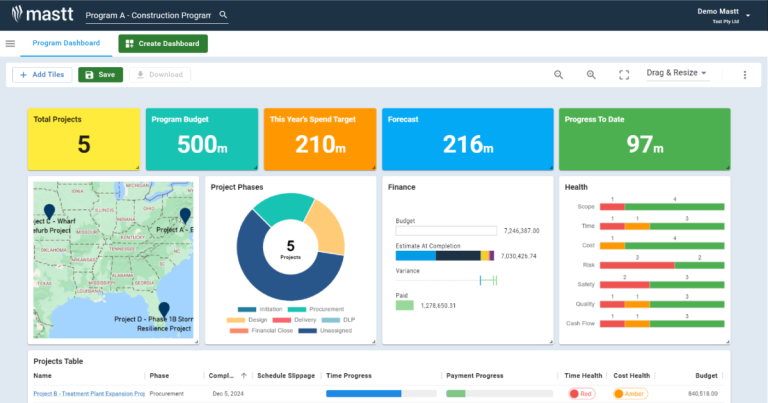
Mastt is capital project and program management software for owners, real estate developers, project management consultants and owners’ representatives. It changes a familiar CRE workflow: collecting budget, contract, payment, forecast, risk and schedule information from spreadsheets and disconnected reports, then converting it into current project and portfolio views. Its center of gravity is the owner’s side of construction, where investment committees, development executives and project directors need financial oversight without adopting a contractor-oriented field management system.
The product combines project controls with dashboards, documents, risk registers, scheduling and program roll-ups. Cost management appears to be the operational core. Teams can organize budgets, commitments, payments and forecast final costs in one system, while executives can review consolidated information across multiple projects. That structure is relevant to developers managing several active developments, capital improvement plans or geographically dispersed programs.
Mastt is CRE-adjacent rather than a purpose-built real estate investment platform. It does not replace acquisition underwriting, asset management, leasing, property accounting or market intelligence software. Its value begins after capital has been approved and the buyer needs disciplined oversight of project delivery. This distinction matters because Mastt can improve development controls without becoming the system of record for the full property lifecycle.
BestCRE analysis: Mastt presents a credible alternative to spreadsheet-heavy owner reporting and to larger construction platforms whose breadth can create unnecessary implementation work. The strongest buying case is a repeat capital-project operator that wants consistent cost governance and portfolio visibility. The principal diligence gaps are commercial and technical. The vendor does not publish standard pricing, and buyers should verify integrations, permission controls, implementation effort and the evidence supporting AI-generated outputs before selecting the platform.
What Mastt Does and How It Works
At project level, Mastt centralizes the financial control cycle. Users establish budgets, record contracts and commitments, process or monitor payments, and update forecasts. The resulting cost position can be displayed through live dashboards rather than rebuilt for each reporting period. For an owner, the important mechanism is the relationship among approved budget, committed cost, actual payment and expected final cost. When those records are maintained consistently, the platform can surface changes and areas requiring management attention.
Mastt also covers risks, issues, mitigation actions, milestones, schedules and documents. These modules connect financial data to delivery context. A project director can examine a forecast concern alongside the underlying contract, supporting file, risk item or schedule milestone. Documents are organized in folders and can be queried through AI features. At program level, project information rolls into consolidated views, enabling comparison across a portfolio and allowing executives to move from an aggregate indicator into project detail. Dashboard and reporting templates provide standardized outputs for clients, boards and internal stakeholders.
The newer Agent capability adds task-oriented AI. Mastt describes an agent that can accept delegated work by email, answer questions in a chat interface, draft material in company templates, review documents and automate repeatable workflows. A knowledge layer is intended to apply an organization’s own methods and reference information to those tasks. BestCRE analysis: this is more consequential than placing a generic chatbot beside a dashboard because it targets recurring project administration. However, buyers should test citations, approval steps, data boundaries and exception handling. AI can accelerate report preparation and document review, but reliable results still depend on complete source records, controlled templates and accountable human review.
9AI Framework: Dimension by Dimension Analysis
CRE Relevance: 8/10
Mastt earns an 8 for CRE relevance because its owner-side project controls map directly to development and capital improvement workflows. Budgets, commitments, payments, forecasts, risks and portfolio reporting are material concerns for developers and asset owners, particularly when several projects are active at once. The platform is more relevant to a development executive than a contractor-first field application. The deduction reflects its broader capital-project positioning. Mastt serves industries beyond commercial property and is not presented as a complete real estate operating system. It does not appear designed to handle acquisitions, leasing, valuation, property operations or investment performance. BestCRE analysis: buyers should view it as a specialized project-delivery layer within a CRE stack, not as the primary platform for every stage of an asset’s lifecycle.
Data Quality and Sources: 7/10
Mastt earns a 7 for data quality. Its model brings related project-control records into a common environment and rolls project information into program views. That is materially better than reconciling separately maintained cost reports, risk registers and executive presentations. Centralized documents and organizational knowledge can also give AI tasks more relevant context. The limitation is that software cannot correct weak project administration by itself. Forecasts remain dependent on timely contract, variation, invoice and progress updates, while portfolio comparisons depend on consistent coding and definitions across projects. The vendor does not publish independent benchmarks for completeness, error rates or data reconciliation performance. BestCRE analysis: Mastt can create a dependable management dataset when governance is strong, but buyers should test imports, validation rules, duplicate handling and the controls used when source information conflicts.
Ease of Adoption: 8/10
Mastt earns an 8 for ease of adoption. The product is organized around concepts that owners, project managers and cost consultants already use, including budgets, contracts, payments, forecasts, risks, schedules and dashboards. That familiar structure should reduce conceptual training compared with deploying a broad enterprise construction suite. Templates and visual reporting may also shorten the move away from spreadsheet-based monthly packs. Adoption will still require deliberate setup. Teams must define cost codes, approval responsibilities, reporting conventions, permissions and migration rules before the dashboards become trustworthy. Consultants working across different client standards may face additional configuration. The vendor offers a product tour, help resources and expert guidance, but it does not publish a universal implementation timetable. BestCRE analysis: usability appears strong, while successful adoption will depend more on process discipline and configuration ownership than on interface training alone.
Output Accuracy: 7/10
Mastt earns a 7 for output accuracy. Financial dashboards built from structured project records can provide consistent calculations and reduce the transcription problems created by repeatedly rebuilding reports. Program roll-ups should also make executive reporting more coherent when every project uses aligned definitions. The AI layer creates a different accuracy question. Drafts, document answers and delegated administrative work may be useful, but generative outputs can omit context or interpret source material incorrectly. Mastt does not publish independently validated accuracy measures for its Agent, document review or forecasting outputs. Buyers should therefore separate deterministic system calculations from AI-generated narrative and analysis. BestCRE analysis: require traceability to source records, visible assumptions, version history and human approval for any output used in payment, forecast or governance decisions. Accuracy should be tested with the buyer’s own contracts and reporting templates during a controlled pilot.
Integration and Workflow Fit: 5/10
Mastt earns a 5 for integration. The platform clearly consolidates several internal project functions, reducing the number of handoffs among separate cost, risk, document and reporting files. However, the vendor does not publish enough detail in its principal product information to establish the breadth, depth or commercial availability of connectors across common accounting, ERP, document storage, scheduling and business intelligence systems. That uncertainty matters because duplicate entry can undermine the value of an owner-side control platform. Buyers should request a current integration catalogue and distinguish packaged connectors from custom exports, imports or implementation services. BestCRE analysis: the product may fit well as a management layer, but the score remains moderate until a buyer verifies bidirectional data movement, field mapping, synchronization frequency, error handling, API access and ownership of integration maintenance.
Pricing Transparency: 3/10
Mastt earns a 3 for pricing transparency because standard subscription prices are not published. Prospective customers are directed toward sales contact and product evaluation rather than a public plan table with clear limits and inclusions. The vendor also does not publicly specify how pricing changes by user, project, portfolio, module, data volume or service level. This prevents buyers from estimating total cost before discovery. It also makes direct comparison with competing platforms more difficult. A negotiated model can be reasonable for complex programs, but the absence of indicative ranges shifts work onto the buyer. BestCRE analysis: request a written total-cost schedule covering licenses, implementation, migration, integrations, training, support, AI usage, renewal increases and additional projects. Commercial evaluation should use the same deployment assumptions for every shortlisted vendor.
Support and Reliability: 7/10
Mastt earns a 7 for support. The company publishes access to FAQs, help resources, technical support and expert coaching, which fits a product that requires both software guidance and project-control configuration. Templates, examples, webinars and educational content can help teams establish reporting practices rather than simply learn where buttons are located. Public customer material also indicates that Mastt works with owner and advisory organizations operating real capital programs. The vendor does not publish enough detail to compare response commitments, support tiers, escalation procedures, regional coverage or customer success staffing. Those terms may vary by contract. BestCRE analysis: buyers should evaluate support as part of implementation, not as an afterthought. Ask who configures the initial cost structure, who checks migrated data, how issues are escalated and whether named account support is included after launch.
Innovation and Roadmap: 8/10
Mastt earns an 8 for innovation. Its Agent concept extends AI beyond question answering into delegated project work, document review, reporting and template-based drafting. Email delegation and organization-specific knowledge could make the capability accessible to project personnel who do not want to learn prompting techniques. Connecting that layer with structured cost, risk, schedule and document information is a logical product direction because the underlying context is more useful than an isolated general-purpose assistant. The score stops short of the top tier because public product descriptions do not establish autonomous performance, measurable accuracy or broad production results across workflows. BestCRE analysis: the innovation is credible, but buyers should judge it through task-level demonstrations. The decisive tests are whether the Agent cites evidence, observes permissions, requests approval at consequential steps and handles incomplete or contradictory records safely.
Market Reputation: 7/10
Mastt earns a 7 for market reputation. It presents named customer evidence involving organizations such as Colliers Project Leaders and Newcastle Airport, and its positioning is specific enough to indicate experience with owner-side capital programs. Published case studies address recognizable operational problems, including cost reporting, payment control and board reporting. That gives buyers more substance than an unverified collection of logos. However, the vendor does not publish comprehensive customer counts, retention measures or independently audited outcome data. Public recognition also remains narrower than that of large construction software incumbents with extensive global ecosystems. BestCRE analysis: Mastt has credible reference value within its niche, but procurement teams should still request references that match their geography, project type, portfolio scale and integration requirements. Reputation supports a shortlist position, not an exemption from diligence.
Who Should Use Mastt
Mastt best suits real estate developers, institutional owners and owners’ representatives managing recurring capital work. The strongest profile is a team that has outgrown spreadsheets but does not need contractor field management to dominate its system. Development directors, project controls leaders and finance stakeholders can use a shared cost position while executives receive portfolio-level reporting. The product is particularly relevant when monthly reporting consumes substantial manual effort or when each project manager maintains a different workbook and presentation format.
Project management consultants and cost consultants are another logical audience. Mastt can provide a repeatable environment for budgets, contracts, payments, risks and client reporting across assignments. Buyers should have enough process maturity to define coding, approvals and reporting standards. They should also assign ownership for data quality. BestCRE analysis: the ideal customer values owner oversight, wants rapid access to current project information and is prepared to standardize project controls. A controlled pilot across representative projects is more informative than a polished demonstration because it reveals whether the product accommodates actual contracts, reporting conventions and governance requirements.
Who Should Not Use Mastt
Mastt is not the natural first choice for general contractors seeking a field-first platform for daily logs, subcontractor coordination, site safety, detailed drawing workflows or broad construction network participation. Procore, Autodesk Construction Cloud or Oracle Aconex may align better when contractor operations and document exchange are the central requirements. Mastt may still participate in the information flow, but it should not be assumed to replace every delivery-side system.
It is also a poor fit for firms seeking acquisition underwriting, leasing administration, property management, valuation or fund accounting in one application. Very small owners running an occasional, uncomplicated refurbishment may not generate enough reporting complexity to justify a dedicated platform. BestCRE analysis: buyers should avoid Mastt when they cannot maintain timely project records or agree on a common control structure. In that situation, a new dashboard can make inconsistent information look authoritative without solving the underlying governance problem.
Pricing and ROI Analysis
Mastt does not publish standard subscription pricing. Public product information directs prospective buyers to contact sales or start an evaluation, but it does not disclose plan prices, minimum commitments, module charges or enterprise tiers. Buyers should request an itemized proposal that identifies licensing metrics, included projects, named and guest users, implementation, migration, integrations, training, support, storage, AI consumption and renewal terms. They should also confirm whether portfolio reporting and Agent capabilities are included or priced separately.
BestCRE analysis: simple ROI math should start with avoidable reporting labor, not an assumed reduction in construction cost. If five project managers each spend six hours per month consolidating reports, and loaded labor costs $100 per hour, the annual administrative baseline is $36,000. A platform that removes half of that work creates $18,000 in potential labor value before considering fewer payment errors or earlier risk identification. Those are illustrative assumptions, not Mastt results. Replace them with observed time, compensation and error data, then compare the value with the complete first-year and renewal costs.
Integration and CRE Tech Stack Fit
Mastt fits most naturally between core finance systems and executive reporting. Project teams can manage detailed cost, contract, payment, risk, schedule and document information, while portfolio stakeholders consume consolidated views. In a CRE stack, it should complement rather than replace accounting, ERP, investment management, property operations and contractor collaboration systems. The practical design question is which application owns each record and how approved changes move between them.
The vendor does not publish a sufficiently detailed integration matrix in its principal product information. Buyers should verify connectors for their accounting platform, ERP, document repository, scheduling tools and identity provider. They should also ask about API access, single sign-on, import templates, exports, synchronization timing and audit logs. BestCRE analysis: avoid making Mastt another manually maintained reporting island. A successful architecture gives finance control over posted actuals, project teams control over forecasts and commitments, and leadership a reconciled view with clear data lineage.
Competitive Landscape
Mastt’s closest comparison depends on the buyer’s operating model. Procore and Autodesk Construction Cloud provide broader construction ecosystems with strong contractor and field workflows. Oracle Aconex is often considered for controlled document exchange and complex project collaboration. Those products may be better when many external delivery participants must work inside a common environment. They can also bring more implementation scope than an owner needs for focused cost and portfolio oversight.
Kahua is a more direct owner-oriented alternative, particularly for organizations seeking configurable capital program management. Northspyre is relevant to commercial real estate developers and emphasizes development financial management and automation. Mastt differentiates itself through an accessible owner-side combination of cost, contracts, payments, risks, dashboards, documents and program roll-up, with an emerging AI Agent across those workflows.
BestCRE analysis: shortlist Mastt against Kahua and Northspyre when owner controls are the priority. Include Procore, Autodesk Construction Cloud or Oracle Aconex when field execution, document governance or ecosystem breadth carries equal weight. Buyers should compare the same use cases: setting a baseline budget, processing a change, updating the final forecast, reconciling actuals, producing a board report and tracing an AI answer back to evidence. Feature counts are less revealing than the effort required to complete that sequence accurately.
The Bottom Line
Mastt deserves a shortlist position for owners and developers that need stronger capital project controls without centering their environment on contractor field management. Its combination of cost oversight, reporting and portfolio roll-up addresses a real gap between spreadsheets and large enterprise construction suites. The Agent capability adds useful potential where teams repeatedly prepare reports, search documents and administer standard workflows.
The decision should remain conditional on a pilot and a complete commercial proposal. Require Mastt to demonstrate data migration, financial reconciliation, permission controls, integration with core systems and evidence-backed AI outputs using representative project records. BestCRE analysis: buy when the platform reduces recurring reporting work and establishes a trusted owner-side control process at an acceptable total cost. Keep evaluating alternatives when field collaboration, published pricing or extensive prebuilt integrations are more important than focused owner oversight.
About BestCRE
BestCRE.com is the definitive authority on commercial real estate AI, analysis, and investment intelligence. Every article advances the platform’s mission to help CRE professionals identify, evaluate, and adopt the best tools and strategies in the industry. We benchmark platforms using the 9AI Framework so CRE leaders can compare tools with clear evidence. Explore the category map at 20 CRE sectors for deeper coverage across the CRE stack.
Frequently Asked Questions
What is Mastt construction project management software?
Mastt is capital project and program management software designed primarily for owners, real estate developers, project management consultants and owners’ representatives. It centralizes budgets, contracts, payments, forecasts, risks, schedules, documents and reporting. Project information can roll into portfolio views so executives can see where attention is required and move into supporting detail. Its emphasis is owner-side control rather than daily contractor field management. In a commercial real estate technology stack, Mastt sits within development and capital-project delivery. It is not a replacement for acquisition underwriting, leasing, property management or fund accounting software. BestCRE analysis: its clearest value is replacing fragmented spreadsheets and manually assembled reporting packs with a governed project-control environment.
How does Mastt compare with Procore and Northspyre?
Mastt is more narrowly centered on owner-side capital project controls than Procore, whose broad construction platform includes extensive contractor and field workflows. Northspyre is a closer comparison for real estate developers because it also focuses on development financial management and automation. Mastt combines budgets, contracts, payments, forecasts, risks, schedules, documents, dashboards and program reporting, then adds an AI Agent for administrative and information tasks. The right choice depends on the operating model. Select for owner reporting and cost governance first, field execution first, or real estate development finance first. BestCRE analysis: compare all candidates through the same real workflow rather than counting features. Test a budget change, forecast update, invoice reconciliation and executive report, then assess data lineage and user effort.
How much does Mastt cost?
Mastt does not publish standard pricing, plan limits or minimum contract values. Prospective customers need a vendor proposal based on their deployment. Ask whether fees depend on users, projects, portfolio size, modules, storage or AI usage. The proposal should separately identify implementation, data migration, configuration, integrations, training, support and renewal terms. Buyers should also confirm whether program dashboards and Agent functionality are included in the quoted subscription. BestCRE analysis: calculate value using the current labor required to consolidate project information, prepare reports, search documents and correct avoidable errors. Compare that value against total first-year cost and normalized renewal cost. A low subscription can still be expensive if integrations and internal administration remain manual.
Who should use Mastt?
Mastt is best suited to owners, developers, owners’ representatives, project management consultants and cost consultants running repeat capital projects. It is especially relevant when teams rely on separate spreadsheets for budgets, commitments, forecasts, payments and monthly reporting, or when executives lack a consistent portfolio view. The buyer should be willing to standardize cost codes, reporting definitions, permissions and approval responsibilities. Organizations managing multiple developments or capital improvement projects are more likely to realize value than a small owner delivering a single uncomplicated job. BestCRE analysis: the ideal customer wants an owner-controlled source for project decisions, has named responsibility for maintaining data and can test the platform with representative contracts, financial records and reporting templates before committing.
Will Mastt’s AI Agent replace manual project reporting?
Mastt’s Agent is intended to handle parts of project administration, reporting, document review, data work and template-based drafting. It can potentially reduce manual preparation by working with information held in the platform and an organization’s own knowledge. It should not be treated as an unsupervised replacement for project controls or financial accountability. Source data can be incomplete, contracts can be ambiguous and generated explanations can miss important context. The vendor does not publish independent accuracy benchmarks for these workflows. BestCRE analysis: the near-term value is assisted production with review, not autonomous approval. Buyers should require source citations, permission enforcement, audit history and human sign-off for consequential outputs. Future value will depend on how reliably the Agent completes multi-step tasks and handles exceptions.
Related Reviews
Compare Mastt with other tools BestCRE has scored in the same category: Civils.ai, Field Materials, ALICE Technologies. Explore more CRE AI tool reviews in our Best CRE AI Tools directory. For sector-specific analysis and market intelligence, visit our 20 CRE Sectors hub.