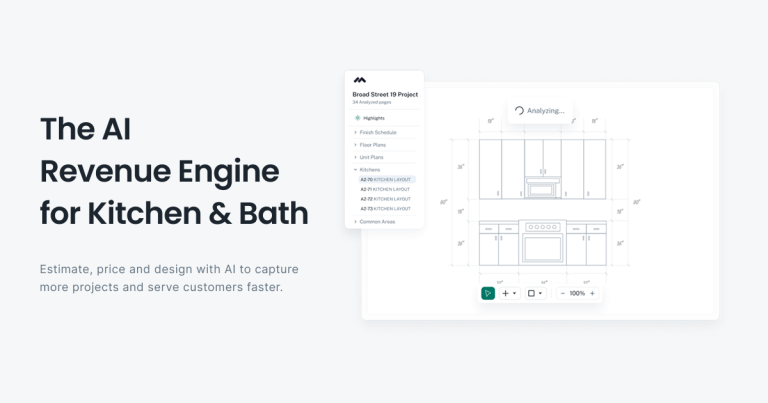
Materialspace is an AI operating platform for contractors, manufacturers, designers and developers responsible for kitchen, bath and interior fit out packages. It changes the workflow between receiving construction drawings and producing a priced, buildable proposal. Instead of moving manually among plan measurements, spreadsheets, supplier catalogs and design software, users can generate unit counts, cabinet schedules, countertop measurements, price scenarios and layouts in one environment. Its strongest fit is multifamily and other large projects with repeated unit types, substantial bid volume and expensive estimating bottlenecks.
The product is CRE adjacent rather than a broad commercial real estate platform. It does not underwrite acquisitions, manage leases or operate completed buildings. Its relevance appears during preconstruction, procurement and interior package execution, where slow takeoffs or pricing errors can affect development schedules and contractor margins. For a developer, the value is indirect but material: bidders may respond faster, alternates can be evaluated earlier and design changes can remain connected to pricing and ordering data.
Materialspace is differentiated by combining interior estimating, catalog based pricing and design generation. Several construction AI products analyze drawings or track field conditions, but fewer carry kitchen and bath information from blueprint interpretation through layouts and order preparation. That narrower scope creates depth, although it also limits the addressable buyer group. The platform should be evaluated as a specialist production system, not as a replacement for estimating, project management or building information modeling software across every trade.
BestCRE analysis: Materialspace is promising where repetitive interior scopes create enough volume to justify workflow change. The company reports customer outcomes from cabinet, countertop and building product businesses, but those claims are vendor selected and should not substitute for buyer testing. Materialspace was identified as a seed stage company with $7 million in funding. As of October 2026, detailed pricing, standardized accuracy benchmarks and a comprehensive public integration directory are not published. Those omissions make a controlled pilot more appropriate than an immediate portfolio rollout.
What Materialspace Does and How It Works
The estimating workflow begins with construction plans. Materialspace identifies unit types and extracts information needed for interior bids, including unit quantities, cabinet requirements and countertop measurements. This can reduce the repeated work of finding similar apartments, interpreting room configurations and transferring dimensions into estimating files. The practical benefit depends on drawing consistency and the treatment of exceptions. Renovation plans, incomplete specifications, mirrored units and late architectural revisions can create ambiguity, so an estimator still needs to review assumptions rather than treating generated quantities as final.
Pricing connects extracted scope with supplier catalogs. A user can upload catalog information, compare scenarios and export results into existing pricing formats. That matters because cabinet and interior package bids often combine product rules, finishes, upgrades, hardware and customer specific pricing. Keeping these variables associated with unit types can make alternates easier to produce and changes easier to trace. Materialspace also describes a unified record of pricing changes from takeoff through installation. Buyers should test how catalog updates, discounts, freight, taxes, labor, waste and regional adjustments are represented, since the published product description does not establish the depth of each calculation.
The design and ordering layer converts blueprint information into layouts and shop drawing outputs, with options for different configurations and upgrades. In principle, this closes a common gap between the estimator’s scope and the designer’s production work. Structured ordering data can also reduce rekeying after an award. The important diligence question is how much generated output is immediately usable versus how much requires correction by experienced designers. Materialspace does not publish a universal accuracy rate, exception rate or tolerance standard. BestCRE analysis: its mechanics are most credible on standardized, repetitive programs with controlled catalogs. Unique custom interiors or inconsistent legacy drawings are likely to require more human intervention.
9AI Framework: Dimension by Dimension Analysis
CRE Relevance: 7/10
A score of 7 reflects meaningful relevance to development and construction without treating Materialspace as a complete CRE platform. The product addresses a real preconstruction constraint: turning architectural plans into quantities, prices and interior layouts quickly enough to bid and procure large projects. Multifamily developers, general contractors and specialty suppliers can all benefit when repeated kitchens and baths are central to the scope. However, the platform does not cover acquisitions, underwriting, leasing, property operations or broad project controls. Its direct users are more likely to be cabinet companies, countertop fabricators, interior contractors and design teams than CRE principals. BestCRE analysis: Materialspace deserves an above average relevance score because its outputs can affect bid coverage, cost planning and procurement, but the narrow trade focus prevents a higher score.
Data Quality and Sources: 7/10
A score of 7 recognizes that Materialspace works with commercially important source data: blueprints, unit types, cabinet specifications, countertop measurements and supplier catalogs. The unified workflow can preserve relationships among quantities, product selections and pricing changes better than disconnected spreadsheets. Users also retain responsibility for the quality of uploaded catalogs and construction documents. Outdated product files, inconsistent naming or incomplete plans can propagate errors across estimates and layouts. The vendor describes data controls, retention settings, permissions and audit trails, which are useful governance features, but it does not publish detailed documentation on model training data, extraction confidence thresholds or formal data quality benchmarks. BestCRE analysis: the platform has a sound data structure for its specialization, while independent evidence about extraction performance and catalog normalization remains limited.
Ease of Adoption: 7/10
A score of 7 reflects a product designed to fit an existing estimating operation rather than requiring a company to rebuild its entire technology stack. Plan upload, catalog ingestion, familiar pricing exports and vendor provided onboarding should lower the initial barrier. Repetitive workflows also make it easier to compare the platform with a known manual baseline. Adoption is not automatic, however. Teams must clean supplier catalogs, define pricing logic, validate unit classifications and decide who approves generated designs. Estimators may also resist a system if exception handling is slower than editing their established spreadsheets. Materialspace states that implementation is customized to current business processes and includes training. The vendor does not publish a standard deployment timetable. BestCRE analysis: adoption should be manageable for organized teams with repeatable processes, but more demanding for companies whose estimating knowledge is largely undocumented.
Output Accuracy: 6/10
A score of 6 reflects plausible productivity gains combined with insufficient public validation of accuracy. Materialspace generates consequential outputs, including unit counts, cabinet requirements, countertop measurements, pricing scenarios and design documents. Errors in any of these areas can affect margin, procurement or installation, so speed alone is not an adequate standard. The vendor publishes customer endorsements concerning bid capacity and turnaround, but it does not publish independently verified takeoff accuracy, measurement tolerances, revision detection performance or rates of required designer correction. Buyers should therefore establish their own acceptance criteria and compare generated work with completed estimates across representative project types. BestCRE analysis: the system may perform well on standardized multifamily plans, but the evidence available publicly does not support a higher score across custom, incomplete or revision heavy documents.
Integration and Workflow Fit: 6/10
A score of 6 reflects useful workflow compatibility but limited public detail about technical connectivity. Materialspace supports catalog uploads and flexible pricing exports, which may allow it to coexist with established estimating and supplier processes. Its internal connection among takeoff, pricing, design and ordering also reduces some need for point to point transfers. However, the vendor does not publish a comprehensive directory of integrations, supported accounting systems, project management platforms, building information modeling tools or enterprise resource planning products. Public information also does not establish whether customers receive an open application programming interface, scheduled data synchronization or only file based exchange. BestCRE analysis: Materialspace appears practical as a focused layer within an interior contractor’s stack, but buyers requiring automated connections to enterprise systems should make integration proof part of the selection process.
Pricing Transparency: 3/10
A score of 3 reflects the absence of published subscription prices, implementation fees or usage limits. Prospective customers are directed to request a demonstration, and the vendor does not disclose whether pricing is based on users, projects, units, transaction volume or a negotiated enterprise agreement. It also does not publish the cost of onboarding, catalog configuration, support tiers or additional design capacity. This makes it difficult for a buyer to estimate total cost before entering a sales process or to compare Materialspace with internal labor and specialist alternatives. Customized pricing can be reasonable for a workflow that requires catalog and process setup, but it shifts discovery work onto the customer. BestCRE analysis: buyers should request a written cost model covering implementation, renewals, data export, support and volume growth before beginning a pilot.
Support and Reliability: 7/10
A score of 7 reflects the vendor’s stated emphasis on hands on onboarding, training and premium implementation assistance. That service model is appropriate because successful use depends on more than software access. Catalogs must be configured, pricing rules mapped, workflows assigned and generated outputs validated by experienced staff. The company also states that customers can receive answers quickly and that the platform can be adapted to existing business processes. Public information does not define support hours, response commitments, geographic coverage, escalation procedures or whether a named customer success manager is included in every contract. References on the vendor’s site indicate engagement with operating customers, but buyers should confirm service terms directly. BestCRE analysis: the support posture appears stronger than self service software, although contractual evidence is needed before awarding a higher score.
Innovation and Roadmap: 8/10
A score of 8 reflects the unusual breadth of the workflow within a narrow interior construction domain. Materialspace does more than extract quantities from drawings. It connects plan interpretation with supplier catalog pricing, design options, shop drawing production and ordering information. That continuity is valuable because many estimating tools stop after takeoff, while many design tools begin only after the commercial scope has already been assembled elsewhere. The platform’s ability to associate repeated unit types with multiple configurations is especially suited to multifamily interiors. The innovation score does not imply that every generated output is autonomous or error free. Materialspace does not publish enough technical detail to determine which functions rely on machine learning, deterministic product rules or human review. BestCRE analysis: the workflow design is distinctive, even though operational proof remains more limited than the product concept.
Market Reputation: 6/10
A score of 6 is the ceiling appropriate for a young company with a limited public market record. Materialspace names several customers and publishes attributed endorsements from cabinet, countertop and building product executives. These references suggest genuine use in demanding bid environments and are more useful than anonymous testimonials. Even so, they are selected by the vendor, and public information does not establish customer retention, total deployment count, renewal performance or the proportion of projects completed without substantial manual correction. The company is not yet as broadly recognized across construction technology as several category peers with longer operating histories and wider third party coverage. BestCRE analysis: early market evidence is encouraging, but a buyer should speak with comparable reference customers and examine completed project outputs before treating reputation as proof of performance.
Who Should Use Materialspace
Materialspace is best suited to cabinet manufacturers, kitchen and bath suppliers, countertop fabricators and interior package contractors that process a steady flow of multifamily or other repetitive construction plans. The strongest buyer has multiple estimators, recurring supplier catalogs and enough similar unit types to benefit from standardized extraction and design rules. A sales leader seeking greater bid coverage may sponsor the purchase, but estimating, design, operations and information technology teams should participate in validation.
Developers and general contractors may also find value when they directly control interior packages or need faster option pricing from preferred suppliers. The product is particularly relevant to build to rent, student housing, senior housing and apartment programs where repeated kitchens and baths create measurable production volume. BestCRE analysis: the ideal customer can provide clean plans, documented pricing logic and experienced reviewers. Such a team can measure time saved without relaxing approval controls. Buyers should select a pilot containing normal plans, difficult exceptions and at least one revision cycle so the evaluation reflects actual project conditions.
Who Should Not Use Materialspace
Materialspace is not the right primary system for owners seeking acquisition analysis, development budgeting across all trades, scheduling, field documentation or property operations. It is also unlikely to justify its setup burden for a small contractor that prices only occasional kitchens or relies almost entirely on unique custom designs. Those buyers may receive more value from established estimating, computer aided design and spreadsheet tools.
Companies with fragmented catalogs, undocumented pricing exceptions or no staff available to validate AI generated work should delay adoption until their underlying process is controlled. The platform should not be treated as an independent source of construction truth. BestCRE analysis: projects dominated by bespoke millwork, irregular existing conditions or poor legacy drawings may produce too many exceptions for the standardized workflow to deliver attractive returns. Buyers requiring a broad set of documented enterprise integrations or public accuracy certifications should also wait for stronger evidence or negotiate those requirements contractually.
Pricing and ROI Analysis
Materialspace does not publish pricing. There is no public rate card for subscriptions, users, projects, units, implementation or support. Buyers must request a demonstration and obtain a proposal. A complete quote should separate recurring software charges from catalog configuration, workflow customization, training and any usage based fees. It should also explain renewal increases, minimum commitments, data export rights and charges for adding divisions or supplier catalogs. Without these terms, direct cost comparison is not possible.
BestCRE analysis: calculate return using verified labor and conversion effects, not promotional capacity claims. For example, if a team processes 100 bids each year and saves three hours of combined estimating and design time per bid, the annual benefit is 300 labor hours multiplied by the company’s fully loaded hourly cost. Add any measured gross profit from bids the team could not previously pursue, then subtract subscription, implementation, review and integration costs. Do not count additional bid volume as revenue unless historical win rates and delivery capacity support that assumption. A purchase is defensible when audited savings exceed total cost under conservative inputs and remain positive after including human quality review.
Integration and CRE Tech Stack Fit
Materialspace should sit between construction documents and the systems used for pricing, design, procurement and project delivery. Catalog upload and configurable exports provide a practical path for organizations that still rely on spreadsheets or proprietary pricing templates. The internal connection from takeoff to ordering can reduce duplicate entry, provided product identifiers and revision rules remain consistent. Buyers should map the authoritative source for every field before implementation.
The vendor does not publish a comprehensive integration catalog or detailed public documentation for its application programming interface. A technical review should confirm supported file formats, identity management, accounting connections, project management exchange, design file compatibility and data export at contract termination. BestCRE analysis: file based compatibility may be sufficient for a specialist contractor, while a national enterprise will probably require tested automation, permission controls and monitoring. Integration acceptance should include a revised plan, an updated supplier catalog and a completed order export, not only a demonstration using ideal data.
Competitive Landscape
Materialspace competes most directly with a combination of estimating software, design applications and internal spreadsheets rather than with every construction AI platform. Its advantage is workflow continuity across interior takeoff, catalog pricing, layouts and ordering data. A buyer should compare that benefit with the flexibility of retaining specialist tools for each stage. Field Materials is a stronger alternative when the central problem is material procurement and vendor coordination. Higharc is more relevant when a residential developer needs a broader design and product configuration platform.
Among BestCRE’s construction and development category leaders, Civils.ai focuses more broadly on extracting and analyzing information from construction documents, while ALICE Technologies addresses construction planning and schedule optimization. OpenSpace and OnsiteIQ concentrate on site capture, progress visibility and field risk rather than cabinet and countertop bidding. Firmus focuses on design review and risk detection. These products can complement Materialspace, but they do not offer the same narrow interior workflow.
BestCRE analysis: choose Materialspace when kitchen and bath bid production is the specific bottleneck and repeated unit types dominate the workload. Choose a broader construction platform when the buying objective spans scheduling, field monitoring or multiple trades. The decisive comparison should use the same completed project, supplier catalog and revision package. Measure setup time, estimator corrections, pricing variance, design rework and usable export quality before comparing headline speed.
The Bottom Line
Materialspace merits a serious pilot for high volume interior contractors and suppliers whose estimating teams repeatedly translate multifamily plans into cabinet, countertop and design packages. Its connected workflow is more compelling than a basic takeoff assistant, and its focus should make it easier to test against an existing process. Do not purchase solely on the basis of vendor case studies or faster bid production.
BestCRE analysis: proceed when the vendor can demonstrate accurate handling of your plans, catalogs, exceptions and revisions, then commit those requirements to the contract. Require transparent total pricing, reference calls with similar operators and export testing before expansion. Developers with occasional interior needs should rely on qualified trade partners rather than add another platform. For the right specialist, Materialspace can be a valuable production system. For a general CRE operator, it remains a narrow tool whose value depends on project volume and workflow ownership.
About BestCRE
BestCRE.com is the definitive authority on commercial real estate AI, analysis, and investment intelligence. Every article advances the platform’s mission to help CRE professionals identify, evaluate, and adopt the best tools and strategies in the industry. We benchmark platforms using the 9AI Framework so CRE leaders can compare tools with clear evidence. Explore the category map at 20 CRE sectors for deeper coverage across the CRE stack.
Frequently Asked Questions
What is Materialspace?
Materialspace is an AI software platform for companies that estimate, design, price and deliver kitchens, baths and other interior construction packages. It reads construction plans to identify unit types, cabinet requirements and countertop measurements, then connects that information with supplier catalogs, pricing scenarios, layouts and ordering data. Its primary users are interior contractors, cabinet manufacturers, countertop businesses, designers and developers working on large projects with repeated units. It is not a general property management, underwriting or construction scheduling platform. BestCRE analysis: Materialspace is best understood as a specialist production system for the period between receiving plans and preparing a priced, buildable interior package.
How does Materialspace compare with other construction AI tools?
Materialspace is narrower than broad construction platforms and deeper within kitchen and bath workflows. It combines drawing interpretation, unit counting, product takeoff, catalog pricing, layout generation and order preparation. Field Materials centers more on procurement, ALICE Technologies on construction planning, OpenSpace on site capture and Firmus on design review. Higharc is a relevant comparison for residential design and product configuration. BestCRE analysis: Materialspace has the strongest case when an organization currently moves the same interior scope through several disconnected tools. Buyers with problems spanning many trades, field progress or scheduling should consider a broader platform or use Materialspace alongside one.
How much does Materialspace cost?
Materialspace does not publish subscription prices, implementation charges or usage limits. Prospective customers must request a demonstration and negotiated proposal. Buyers should ask whether charges depend on users, projects, units, catalogs, design volume or enterprise scope. The proposal should identify onboarding, catalog setup, training, support, renewal terms and data export costs. BestCRE analysis: compare total annual cost with verified labor savings and incremental gross profit, while retaining the cost of human review. A credible business case should remain positive under conservative assumptions and should not count every additional bid as won revenue. Pricing transparency is currently a material weakness, even if customization is necessary for implementation.
Who should use Materialspace?
Materialspace is most suitable for cabinet companies, kitchen and bath suppliers, countertop fabricators and interior contractors processing substantial volumes of repetitive construction plans. Multifamily, build to rent, student housing and senior housing programs are logical fits because repeated unit types can support standardized takeoff, pricing and design rules. Developers or general contractors may also use it when they directly manage interior packages. BestCRE analysis: the ideal buyer has clean supplier catalogs, documented pricing practices, experienced reviewers and enough bid volume to recover implementation costs. Small contractors with occasional custom projects, or owners seeking a broad development management system, are less likely to receive sufficient value.
Will Materialspace become a broader construction platform?
Materialspace publicly positions itself around companies that design and build interior spaces, with current emphasis on estimating, pricing, design and ordering. The vendor does not publish a detailed product roadmap showing expansion into scheduling, field management, accounting or other construction trades. Buyers should not contract on the assumption that unannounced functions will arrive. BestCRE analysis: the more defensible path is continued depth in interior products, catalogs, configuration and procurement, where the company already has a distinct workflow. Prospective customers should evaluate the product available now, request roadmap information under appropriate confidentiality terms and require contractual commitments when a planned capability is essential to the purchase decision.
Related Reviews
Compare Materialspace with other tools BestCRE has scored in the same category: Civils.ai, Field Materials, ALICE Technologies. Explore more CRE AI tool reviews in our Best CRE AI Tools directory. For sector-specific analysis and market intelligence, visit our 20 CRE Sectors hub.