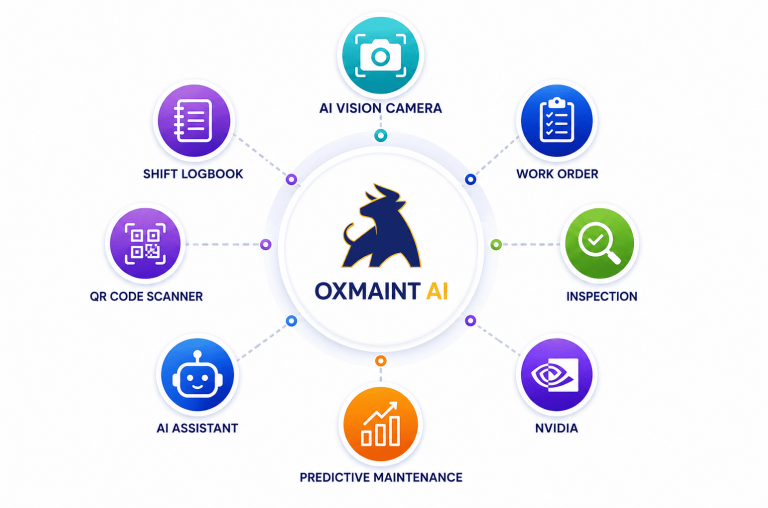
Oxmaint is an AI oriented computerized maintenance management system for facility, engineering and property management teams. In a commercial building, it can replace email, spreadsheets and disconnected maintenance logs with a shared system for requests, work orders, inspections, preventive schedules, assets and parts. The practical change is straightforward: operating activity becomes attached to equipment records and visible across technicians, managers and locations.
The product sits adjacent to core commercial real estate software rather than at its center. It addresses facilities operations well, but it is not presented as a complete platform for leases, tenant accounting, rent collection, investor reporting or valuation. A CRE owner would therefore use Oxmaint beside a property management or accounting system, particularly where equipment reliability, safety documentation and maintenance execution matter more than broader portfolio administration.
Oxmaint distinguishes itself through AI generated work orders and checklists, predictive maintenance, computer vision inspections, shift summaries and compliance monitoring. It also promotes connections to sensors, programmable logic controllers, telematics and SAP modules. Those capabilities create an unusually broad proposition, spanning ordinary facility requests through industrial edge computing. Analysis: breadth is attractive, but buyers should separate functions available in a standard deployment from those requiring cameras, sensors, NVIDIA infrastructure, implementation services or specialized models.
The buying case is strongest when a team has measurable maintenance problems and disciplined asset data. Properties with recurring failures, missed inspections, inconsistent handovers or weak work order histories could benefit from one operating record. The principal concern is proof. Oxmaint publishes extensive capability claims, but independently comparable evidence about predictive accuracy, CRE customer outcomes and implementation performance is limited. BestCRE views it as a credible product to evaluate through a controlled pilot, not a system to select from feature descriptions alone.
What Oxmaint Does and How It Works
Oxmaint starts with conventional CMMS mechanics. Managers create preventive maintenance schedules, assign work orders, record labor and parts, manage inspections and maintain equipment histories. Occupants or staff can scan an asset QR code to view information or submit a request, while technicians receive and update jobs through mobile workflows. Photos, status changes, costs and parts usage can remain connected to the work record, giving supervisors a traceable account of what happened and what remains open.
Its automation layer can prioritize requests, propose assignments, generate inspection steps and turn failed checklist items into corrective work orders. The shift logbook produces plain language handover summaries and highlights unfinished tasks or recurring issues. Predictive maintenance functions ingest condition signals such as vibration, temperature, runtime and historical events, then flag developing risks or recommend maintenance timing. Analysis: these outputs depend heavily on sensor coverage, consistent asset identifiers, sufficient history and sensible thresholds. A poorly structured equipment register will constrain the AI regardless of the interface.
The more distinctive component is AI vision. Oxmaint says camera and thermal feeds can identify conditions such as cracks, corrosion, leaks, abnormal heat and missing protective equipment, then create alerts or work orders. Edge deployment is intended to process sensitive visual data locally, while integration options cover SAP, sensors, PLCs, GPS, telematics, accounting software and developer APIs. Buyers should confirm each connector, data direction and refresh method during diligence. They should also test false positives, missed detections, evidence retention, permission controls and human approval rules before allowing automated findings to initiate safety or compliance actions.
9AI Framework: Dimension by Dimension Analysis
CRE Relevance: 7/10
Oxmaint earns a 7 for CRE relevance because work orders, preventive maintenance, inspections, compliance records, equipment histories and vendor coordination are fundamental building operations. Its property management and facility management positioning makes the workflow recognizable to engineering teams in offices, retail properties, industrial sites and mixed portfolios. QR requests can also reduce friction between occupants, property staff and technicians. The limitation is category scope. Oxmaint is not a full CRE operating system for leases, tenant ledgers, recoveries, budgeting, investor reporting or transactions. Some advanced functions appear designed as much for manufacturing and fleets as for commercial property. Analysis: the product is highly relevant to the physical operations layer, but it should usually complement, rather than replace, the portfolio’s property management and accounting platforms.
Data Quality and Sources: 6/10
Oxmaint earns a 6 for data quality. The system can consolidate asset records, work history, inspection results, parts usage, labor entries, sensor readings and visual evidence. That combination can produce a useful operational record, especially when every request and corrective action remains attached to the relevant equipment. Yet data quality is not created automatically. Asset hierarchies, naming conventions, meter configurations, failure codes and technician closeout practices determine whether the resulting history is analytically useful. Predictive functions also need representative sensor and failure data. The vendor does not publish enough independently comparable information about model training, data completeness controls or performance across CRE asset classes. Analysis: buyers should score a pilot on duplicate assets, missing fields, technician compliance and exception handling before treating the platform as a reliable system of record.
Ease of Adoption: 7/10
Oxmaint earns a 7 for ease of adoption because mobile work orders, QR requests, digital checklists and familiar maintenance concepts should reduce the learning burden for frontline teams. A property can begin with reactive requests and scheduled tasks before introducing sensors or vision systems. That staged path is useful for portfolios moving away from spreadsheets. Adoption becomes harder when the scope expands. Asset imports, preventive maintenance libraries, permissions, inventory locations, integrations and compliance templates all require deliberate setup. Camera analytics and predictive maintenance add installation, calibration and governance work that a conventional CMMS rollout may not require. The vendor does not publish standardized implementation timelines. Analysis: the basic CMMS should be approachable, while the advanced AI proposition needs a properly staffed implementation and a narrower pilot than the product’s broad feature set might suggest.
Output Accuracy: 6/10
Oxmaint earns a 6 for output accuracy. Transactional outputs such as assigned work orders, completed checklists and recorded parts are auditable when users enter data correctly. AI generated summaries and inspection templates can save time, but managers still need to confirm that the source record supports the result. Predictive alerts and computer vision findings deserve greater scrutiny because operating conditions, camera placement, sensor calibration and asset context can materially affect performance. The vendor makes specific performance claims on its site, but it does not publish enough third party validation, error distributions or CRE specific benchmarks to establish dependable accuracy across portfolios. Analysis: buyers should create a labeled test set, measure false alerts and missed events, and require human review for safety, compliance or capital decisions until local performance is demonstrated.
Integration and Workflow Fit: 7/10
Oxmaint earns a 7 for integration. The product promotes a developer API and connections spanning SAP modules, sensors, PLC feeds, telematics, GPS, fuel cards, accounting software and equipment data. This is broader than many maintenance tools and could serve organizations with complex operational technology. For ordinary CRE portfolios, the critical questions are more specific: whether Oxmaint connects cleanly to the selected property management system, identity provider, building automation environment, procurement process and business intelligence stack. A named integration category does not establish connector maturity, field coverage or bidirectional behavior. The vendor does not publish a complete compatibility matrix with implementation details. Analysis: integration is a relative strength, provided the buyer validates the exact systems, objects, permissions, latency, ownership and failure recovery required for its buildings.
Pricing Transparency: 4/10
Oxmaint earns a 4 for pricing transparency. The company promotes a free starting option and invites prospects to begin or schedule a demonstration, but it does not publish a complete price table that lets a CRE buyer calculate production cost. Public information does not clearly establish limits by user, location, asset, storage, integration, camera, sensor or AI feature. Costs for onboarding, data migration, hardware, edge computing and premium support are also not published. That uncertainty matters because the advanced proposition may involve more than a software subscription. Analysis: procurement should request a multiyear quote with every recurring and one time charge separated, then model growth in properties, technicians, assets, video streams and integrations. Contract review should also address export fees, renewal increases and charges for additional environments.
Support and Reliability: 6/10
Oxmaint earns a 6 for support. The company provides support oriented resources, including an FAQ, webinars, community content, articles, checklists and API material. These resources can help users learn routine workflows and give technical teams a starting point for integration. Publicly available information does not establish the service levels every production customer receives, the availability of dedicated implementation staff or the response commitments for critical incidents. It also does not make clear how support differs between a free entry option and paid deployments. Analysis: a CRE buyer should evaluate support as part of the contract, not infer it from the resource library. Require named escalation paths, coverage hours, severity definitions, response targets, data restoration procedures and responsibility boundaries for third party sensors, cameras and enterprise systems.
Innovation and Roadmap: 8/10
Oxmaint earns an 8 for innovation. It combines familiar CMMS workflows with generated checklists, automated handovers, condition based recommendations, visual inspection and edge AI. The ability to connect an observed defect directly to a prioritized work order is a meaningful design direction because it shortens the path from detection to accountable action. Local processing may also appeal to regulated or privacy conscious operators. Still, innovation should not be confused with proven operational value. Several capabilities depend on hardware, representative data and careful tuning, while some may be unnecessary for conventional office or retail portfolios. Analysis: Oxmaint is more ambitious than a basic maintenance tracker, and its strongest ideas deserve pilot testing. The score stops short of the top because public evidence does not yet show consistent CRE performance across the full advertised scope.
Market Reputation: 6/10
Oxmaint earns a 6 for market reputation. It has a visible product presence, a broad resource library and positioning across facilities, manufacturing, fleets, utilities and other asset intensive sectors. The vendor states that organizations use the platform globally, but independently verifiable detail about the size, composition and retention of its customer base is limited. It does not publish enough CRE specific references, independently audited performance evidence or detailed deployment case studies to place its reputation alongside the most established property technology vendors. Analysis: Oxmaint appears credible enough for a structured evaluation, particularly for maintenance led use cases, but brand claims should not substitute for reference checks. Buyers should speak with comparable customers about implementation effort, mobile adoption, uptime, support responsiveness and whether the advanced AI functions remained in regular production use.
Who Should Use Oxmaint
Oxmaint best suits facility directors, chief engineers and regional operations teams that need one system for work orders, preventive maintenance, inspections, equipment histories and parts. The strongest candidate manages multiple buildings or asset intensive sites, has recurring maintenance volume and can assign an internal owner to clean the asset register. Owners of office, retail, industrial, hospitality or mixed portfolios may find value when engineering execution is more fragmented than the accounting stack.
It also suits operators prepared to test condition monitoring or camera based inspection against defined problems. Examples include repeated HVAC failures, thermal anomalies, corrosion checks, safety observations or inconsistent shift handovers. Analysis: the buyer should have measurable baseline data, access to technical staff and authority to change operating procedures. A facilities group using SAP or operational sensors may find the integration scope particularly relevant, but it should confirm each required connector in a demonstration and paid pilot.
Who Should Not Use Oxmaint
Oxmaint is not the right primary system for a buyer seeking lease administration, tenant accounting, rent collection, brokerage workflows, valuation or investor reporting. Those functions belong in a broader CRE platform. A small property with few assets and limited maintenance volume may also find that simpler task management or the maintenance module already included with its property software is sufficient.
Teams should avoid an advanced deployment if they lack a trustworthy equipment list, consistent closeout practices or staff to review automated findings. Predictive and vision features will not repair weak operating discipline. Buyers requiring proven accuracy thresholds, extensive CRE references or fixed public pricing may find the current evidence insufficient. Analysis: in those cases, the prudent decision is to improve maintenance data first or evaluate a more established platform with narrower, better documented capabilities.
Pricing and ROI Analysis
Oxmaint does not publish a complete production pricing schedule. It promotes a free starting option, but public information does not clearly define its limits or the prices for paid tiers, enterprise controls, AI vision, predictive maintenance, integrations, onboarding, storage or support. Hardware and implementation requirements for cameras, sensors and edge processing also need separate confirmation. Buyers should request an itemized proposal covering licenses, properties, assets, usage, migration, training, connectors, hardware, renewals and data export.
Analysis: simple ROI math should begin with avoidable operating effort, not speculative failure prevention. If a portfolio processes 800 work orders each month and better intake, assignment and closeout save three minutes per order, the theoretical saving is 40 labor hours monthly. Multiply those hours by the fully loaded hourly cost, then subtract subscription, implementation, hardware and administration costs. Treat avoided downtime as a separate scenario supported by the property’s own failure history. A pilot should confirm the time saving and adoption rate before the buyer applies the calculation across the portfolio.
Integration and CRE Tech Stack Fit
Oxmaint can fit as the maintenance execution layer beside property management, accounting, procurement and building systems. Its API and promoted connections to SAP, sensors, PLCs, telematics and accounting software indicate useful technical range. CRE teams should map the exact flow from tenant or staff request through triage, work completion, cost allocation and reporting, then identify which platform owns each record.
The main diligence issue is connector depth. Buyers should confirm supported objects, write permissions, identity management, update frequency, error handling and whether configuration requires vendor services. Building automation and camera data also raise cybersecurity, retention and privacy questions. Analysis: Oxmaint is a plausible fit for a composable CRE stack, but only when duplicate work orders, asset identifiers and cost records can be controlled across systems.
Competitive Landscape
Facilio is the most direct alternative for CRE buyers seeking a property operations platform with connected building data, maintenance and portfolio level workflows. It may be a stronger comparison where building systems and multi-site property operations drive the decision. Oxmaint appears broader across industrial maintenance and edge AI, but buyers need to determine which advanced functions are production ready for their actual building types.
UpKeep, MaintainX and Limble CMMS are credible alternatives for mobile work orders, preventive maintenance, assets and frontline adoption. MaintainX is especially relevant for teams emphasizing procedures and operational execution, while UpKeep and Limble deserve consideration for conventional CMMS buying criteria. Product packaging and capabilities change, so each should be evaluated against the same scripted scenarios rather than a generic feature checklist.
DoorLoop, AppFolio, Entrata and Yardi serve a broader property management role, with accounting, leasing or resident and tenant processes that Oxmaint does not aim to replace. VTS addresses leasing and asset workflows, while Moved and Venn focus on different portions of the property experience. Analysis: Oxmaint should compete for the maintenance layer, not for the entire CRE system of record. The best alternative depends on whether the buyer needs specialist engineering execution or consolidated property administration.
The Bottom Line
Oxmaint merits a pilot for CRE operators whose maintenance program has outgrown spreadsheets or a basic property management module. Its combination of mobile CMMS workflows, compliance records, predictive signals and visual inspection is differentiated enough to investigate. The pilot should focus on one building group, a clean asset subset and two or three measurable operating problems.
Do not purchase the full vision solely on feature breadth. Require an itemized price, live demonstrations using representative data, customer references and measured accuracy for automated findings. Analysis: buy if the core work order system improves execution and the advanced features prove useful under local conditions. If the business case depends mainly on unverified failure predictions or broad replacement of the CRE stack, choose a narrower platform or continue diligence.
About BestCRE
BestCRE.com is the definitive authority on commercial real estate AI, analysis, and investment intelligence. Every article advances the platform’s mission to help CRE professionals identify, evaluate, and adopt the best tools and strategies in the industry. We benchmark platforms using the 9AI Framework so CRE leaders can compare tools with clear evidence. Explore the category map at 20 CRE sectors for deeper coverage across the CRE stack.
Frequently Asked Questions
What is Oxmaint?
Oxmaint is a computerized maintenance management system for teams that operate equipment, facilities, fleets and other physical assets. In commercial real estate, it can manage maintenance requests, work orders, preventive schedules, inspections, asset histories, inventory and compliance records. Mobile workflows and QR codes help technicians and occupants create or update requests in the field. The product also promotes AI generated checklists and summaries, predictive maintenance, computer vision and connections to sensors and enterprise systems. It is CRE adjacent rather than a complete property management suite. It does not replace the core functions of lease administration, tenant accounting, rent collection or investor reporting. Most CRE buyers would deploy it as the maintenance execution layer beside those systems.
How does Oxmaint compare with UpKeep and MaintainX?
Oxmaint, UpKeep and MaintainX all address frontline maintenance through work orders, preventive schedules, asset records and mobile access. Oxmaint differentiates its proposition with computer vision, edge processing, predictive monitoring and automated compliance workflows. UpKeep and MaintainX are sensible comparisons for buyers prioritizing established mobile CMMS processes and technician adoption. Analysis: the decision should turn on demonstrated workflow fit, implementation effort, integration depth and local accuracy, not the number of AI labels on a feature page. Ask each vendor to complete the same scenarios using representative assets, such as a QR request, failed inspection, parts issue, recurring fault and manager escalation. Then compare technician steps, reporting quality, permission controls, total cost and references from similar facilities.
How much does Oxmaint cost?
Oxmaint promotes a free way to get started, but the vendor does not publish a complete schedule of production prices. Public information does not clearly define the limits of the free option or establish costs for paid users, locations, assets, integrations, AI functions, video processing, sensors, onboarding, migration or premium support. A buyer should request an itemized multiyear quote and state expected growth in buildings, technicians, assets and data volume. The quote should separate recurring software charges from professional services and hardware. It should also disclose renewal terms, overage rules, support coverage and data export costs. Analysis: compare total cost over the intended contract term, then test claimed labor or downtime benefits through a limited pilot before approving portfolio deployment.
Who should use Oxmaint in commercial real estate?
Oxmaint is best suited to facility management, engineering and property operations teams with enough maintenance volume to justify a dedicated system. It is particularly relevant for multi-building portfolios that need consistent work orders, preventive maintenance, inspections, shift records, equipment histories and parts tracking. Teams considering sensor based monitoring or camera inspection may also find its technical scope attractive. The ideal buyer has a reasonably accurate asset register, an internal implementation owner and clear measures such as response time, schedule compliance, repeat failures or technician effort. Smaller properties with few assets may not need this breadth. Owners seeking accounting, leasing or investor reporting should select a core property platform and treat Oxmaint, if chosen, as an adjacent operations system.
Can Oxmaint become a predictive maintenance platform for CRE?
It can potentially support predictive maintenance when a property has suitable sensors, consistent asset identifiers, useful operating history and staff who can act on alerts. Oxmaint says it can analyze condition signals, identify developing problems and generate proactive work orders. The forward looking opportunity is a maintenance program based more on observed equipment condition and less on fixed calendars. Analysis: the limiting factor will be operational evidence, not interface capability. Every portfolio has different equipment, loads, climates and failure patterns, so a model that works in one setting may not transfer cleanly. Buyers should establish baseline failures, run predictions alongside existing procedures, measure missed events and false alerts, and keep human approval in place. Wider deployment is justified only after local results show dependable operational value.
Related Reviews
Compare Oxmaint with other tools BestCRE has scored in the same category: DoorLoop, Entrata, Moved. Explore more CRE AI tool reviews in our Best CRE AI Tools directory. For sector-specific analysis and market intelligence, visit our 20 CRE Sectors hub.