Property valuation remains one of the most consequential and least standardized processes in global real estate. CBRE’s 2025 U.S. Real Estate Market Outlook projects commercial real estate investment activity reaching $437 billion this year, yet valuation methodologies across residential and commercial portfolios continue to vary dramatically by geography, institution, and asset class. JLL estimates that fewer than 30 percent of European lenders have fully automated their property valuation workflows, leaving the majority reliant on manual appraisal processes that introduce inconsistency and delay into credit decisions. The global automated valuation model market is projected to exceed $14 billion by 2030, driven by regulatory pressure on banks to standardize risk assessment and by institutional investors demanding portfolio-level pricing transparency across borders.
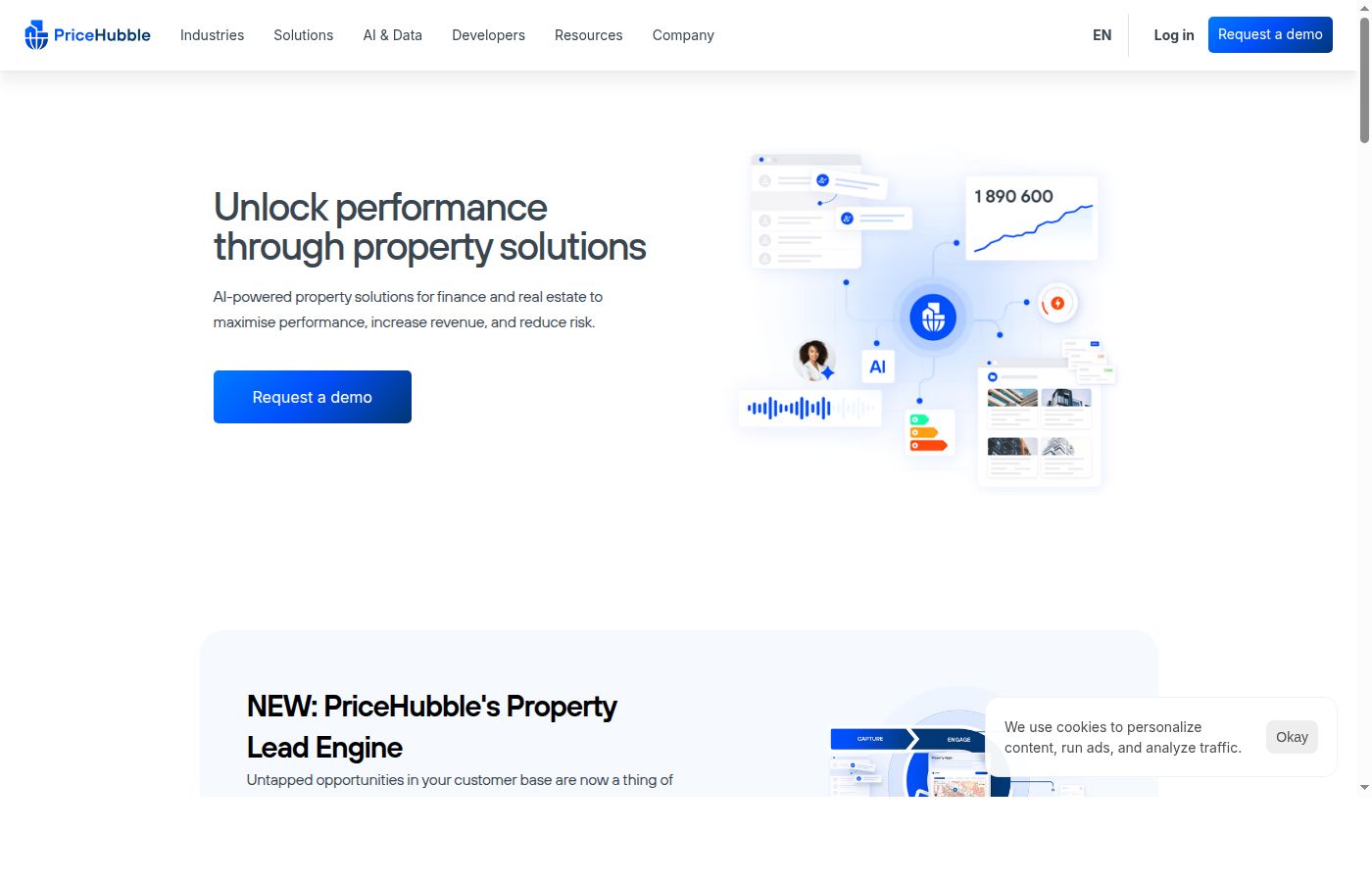
PriceHubble is a Zurich-based proptech company that applies machine learning and big data analytics to residential real estate valuation and market intelligence across 11 countries. Founded in 2016, the platform serves over 800 companies including banks, mortgage lenders, insurance providers, real estate agencies, and institutional investors. PriceHubble’s product suite spans automated valuations (AVM), location analytics, market signal detection, energy performance assessment, and portfolio monitoring. The company has raised $74.2 million in venture funding and employs more than 200 people globally. In early 2026, PriceHubble launched an AI Agents Suite comprising three tiers: Companion (always-on digital property insights), Copilot (workflow-embedded task execution), and a full AI agent layer for autonomous valuation report generation and client engagement.
BestCRE assigns PriceHubble a 9AI Score of 73/100, reflecting strong data quality and CRE relevance for residential-focused valuation workflows, meaningful innovation through the AI Agents Suite, and solid institutional adoption across European markets, balanced by limited pricing transparency and moderate integration depth with legacy CRE systems outside the banking sector.
This review is part of BestCRE’s systematic coverage of commercial real estate AI tools across 20 CRE sectors. For the full AI tools directory, see our Best CRE AI Tools hub.
What PriceHubble Does and How It Works
PriceHubble operates as a comprehensive property intelligence platform that ingests transaction records, listing data, cadastral information, building permits, demographic statistics, transport accessibility metrics, and environmental quality indicators to generate automated property valuations and market forecasts. The platform’s core AVM engine uses proprietary machine learning algorithms developed by an in-house data science team, processing what the company describes as one of the largest proprietary residential real estate databases in its operating markets. Users access valuations through a web interface that supports individual property lookups, portfolio batch processing, and API-driven integrations for enterprise workflows.
The product architecture extends well beyond simple price estimation. PriceHubble’s location analytics layer evaluates micro-market conditions at block-level granularity, incorporating factors like school quality, transit proximity, noise levels, and local amenity density. The market signals module detects buying, selling, and refinancing intent among property owners, enabling real estate agencies and mortgage lenders to identify prospects before they enter the open market. For institutional portfolio managers, the platform provides dynamic monitoring dashboards that track asset-level performance against market benchmarks, flag concentration risks, and model renovation impact on projected valuations.
The recently launched AI Agents Suite represents PriceHubble’s most significant product evolution. The Companion agent functions as a persistent digital advisor that delivers personalized property insights to end consumers through bank and agency websites. The Copilot agent embeds directly into practitioner workflows, automating tasks from valuation report drafting to client inquiry responses to underwriting preparation. The full autonomous agent layer handles complex multi-step processes like portfolio risk assessment and market opportunity analysis without human initiation. This three-tier architecture positions PriceHubble as a platform that can serve the entire value chain from consumer-facing lead generation through institutional portfolio analytics. The ideal practitioner profile spans mortgage underwriters at European banks who need standardized valuation inputs, real estate agency principals seeking competitive intelligence and lead generation tools, insurance risk managers modeling property exposure, and institutional investors monitoring residential portfolio performance across multiple countries simultaneously.
9AI Framework: Dimension-by-Dimension Analysis
CRE Relevance: 8/10
PriceHubble is purpose-built for real estate valuation and market intelligence, placing it squarely within core CRE workflows. The platform addresses the fundamental question every real estate transaction requires: what is this property worth, and how is that value likely to change? While PriceHubble’s primary focus is residential real estate rather than office, industrial, or retail assets, the decision logic mirrors institutional CRE underwriting: establishing defensible value, validating comparable transactions, assessing location risk factors, and monitoring portfolio-level performance. The platform is used by banks, insurance companies, and institutional investors whose real estate exposure spans residential mortgage portfolios, build-to-rent strategies, and mixed-use developments. In practice: mortgage lenders and residential portfolio investors can integrate PriceHubble into credit decisioning and asset monitoring workflows without repurposing a generalist analytics tool.
Data Quality and Sources: 8/10
PriceHubble’s data infrastructure represents one of the platform’s strongest differentiators. The company maintains what it describes as one of the largest proprietary residential real estate databases in its operating markets, aggregating transaction records, listing data, cadastral information, and environmental metrics across 11 countries. The AVM algorithms are developed entirely in-house by a dedicated data science team rather than licensed from third-party providers, giving PriceHubble direct control over model accuracy and methodology. The platform has passed stringent security audits for some of the largest financial institutions in Europe, which implies that the data governance and quality control processes meet enterprise banking standards. The primary limitation is geographic: data depth varies significantly across PriceHubble’s 11 markets, with Swiss and German coverage likely stronger than newer markets like Japan or the Czech Republic. In practice: the data foundation is robust enough for mortgage credit decisions at major European banks, which represents a higher validation threshold than most proptech platforms have achieved.
Ease of Adoption: 7/10
PriceHubble offers multiple adoption pathways that accommodate different organizational maturity levels. The web-based interface allows individual practitioners to generate property valuations and market reports without technical implementation. Template-based reporting enables users to produce branded valuation documents that can be shared digitally or exported as PDFs. For enterprise deployments, PriceHubble provides standard APIs that support deep integration into existing banking platforms and portfolio management workflows. However, enterprise onboarding involves sales-driven implementation processes and custom configuration that can extend deployment timelines to several months for large banking institutions. In practice: individual agents and small teams can start generating valuations within hours, while enterprise-scale deployments require structured implementation projects comparable to other institutional software rollouts.
Output Accuracy: 8/10
Valuation accuracy is PriceHubble’s central value proposition. The company publishes accuracy benchmarks for its AVM across operating markets, and the fact that major European banks rely on PriceHubble outputs for mortgage credit decisions provides indirect validation that accuracy meets regulatory thresholds. Explainability is a notable strength: valuation reports show how comparable properties were selected, what adjustments were applied, and how location factors influenced the final estimate. The AI Agents Suite extends accuracy into workflow automation by grounding agent responses in curated, verified property data rather than generating outputs from general-purpose language models. Accuracy limitations surface in markets with thin transaction volumes or for atypical properties that lack comparable precedents. In practice: outputs are reliable enough for institutional credit decisions in core European markets, though users should apply additional scrutiny in newer markets or for property types with limited transaction history.
Integration and Workflow Fit: 7/10
PriceHubble’s integration strategy prioritizes the banking and financial services stack over traditional CRE property management platforms. The Temenos partnership embeds PriceHubble directly into core banking infrastructure, and the company has built successful integrations with major European retail and private banks. Standard APIs enable programmatic access to valuations, market data, and analytics. However, PriceHubble does not publicly market integrations with CRE-specific systems like Yardi, MRI Software, Argus Enterprise, or CoStar, which limits its utility for firms whose workflows center on these platforms. In practice: PriceHubble fits seamlessly into European banking workflows through established partnerships, but CRE firms operating outside the banking ecosystem will need to build custom integration layers or accept the platform as a standalone analytics tool.
Pricing Transparency: 5/10
Pricing transparency is PriceHubble’s weakest dimension. The company does not publish pricing tiers, per-valuation costs, or subscription ranges on its website. Every pricing conversation routes through a sales contact form with “request a demo” as the primary call to action. This approach is standard for enterprise B2B platforms targeting banking institutions, where contract values depend on data volume, geographic scope, and integration complexity. However, it creates significant friction for mid-market firms and individual practitioners trying to evaluate the platform against alternatives. Without published pricing benchmarks, prospective buyers cannot perform preliminary ROI calculations before engaging with sales. In practice: organizations should expect enterprise-level pricing that reflects the platform’s institutional positioning, and should request detailed cost breakdowns before committing.
Support and Reliability: 7/10
PriceHubble’s support infrastructure reflects its enterprise positioning. The company employs over 200 people globally, with teams distributed across its 11 operating markets providing localized support and market expertise. The platform has passed security audits for some of the largest financial institutions in Europe, which implies operational reliability standards that meet banking sector requirements including uptime guarantees and data protection compliance. Client-facing support appears to operate through dedicated account management for enterprise clients, with implementation assistance during onboarding and ongoing optimization guidance. Documentation and self-service support resources are limited compared to U.S.-based SaaS platforms. In practice: enterprise clients receive the structured support relationship expected from an institutional software vendor, while smaller organizations may find support access more limited.
Innovation and Roadmap: 8/10
PriceHubble demonstrates meaningful innovation through both its core valuation technology and its strategic product direction. The 2026 launch of the AI Agents Suite positions PriceHubble as one of the first proptech companies to deploy agentic AI specifically grounded in real estate data, rather than wrapping general-purpose language models in a property-themed interface. CEO Stefan Heitmann’s explicit distinction that PriceHubble is building “agentic solutions that drive performance” rather than “general-purpose chatbots” signals a product strategy focused on measurable workflow outcomes. The company’s continuous expansion across new geographies and the addition of energy performance analytics demonstrate R&D velocity. Venture funding of $74.2 million provides runway for continued development. In practice: PriceHubble’s AI Agents Suite represents a genuine innovation frontier in proptech, though the real test will be whether agent outputs match the accuracy of the established AVM products.
Market Reputation: 8/10
PriceHubble has established strong market credibility within European real estate technology. The platform serves over 800 companies across 11 countries, with particular strength in the banking and financial services sector. The company’s client base includes major European retail banks, private banks, and insurance companies that subject technology vendors to rigorous procurement and compliance evaluation. Recognition as a Top 100 Swiss Startup across multiple consecutive years reinforces the company’s standing within the European innovation ecosystem. The $74.2 million in venture funding from 15 investors provides financial stability and validates the market opportunity. The primary reputational limitation for U.S.-focused CRE firms is that PriceHubble’s brand recognition is predominantly European, with limited North American presence. In practice: within European markets, PriceHubble is recognized as a category leader in residential property intelligence.
Who Should Use PriceHubble
PriceHubble is best suited for European banks, mortgage lenders, and insurance companies that need standardized residential property valuations embedded into credit decisioning and risk management workflows. Institutional investors managing residential or build-to-rent portfolios across multiple European markets benefit from the platform’s cross-border coverage and portfolio monitoring capabilities. Real estate agencies seeking competitive intelligence, lead generation tools, and branded valuation reports will find the product suite directly aligned with business development workflows. Organizations with API development resources can integrate PriceHubble as a valuation data layer within custom underwriting platforms or investor reporting systems.
Who Should Not Use PriceHubble
PriceHubble is not the right fit for firms focused exclusively on U.S. commercial real estate markets, as the platform’s geographic coverage is concentrated in Europe and Japan with no current North American presence. Organizations underwriting office, industrial, retail, or hospitality assets will find the residential-focused data models insufficient. Firms requiring deep integration with Yardi, MRI, CoStar, or Argus should evaluate alternatives with established U.S. CRE software partnerships. Small teams seeking transparent, self-serve pricing will find the enterprise sales model a barrier to evaluation.
Pricing and ROI Analysis
PriceHubble does not publish pricing on its website, routing all inquiries through a sales contact process. Based on the platform’s enterprise positioning and institutional client base, organizations should anticipate pricing that reflects data licensing, geographic scope, and integration complexity. ROI for banking clients typically materializes through faster mortgage processing cycles, reduced manual appraisal costs, and improved credit risk assessment accuracy. For real estate agencies, the lead generation and market intelligence features create revenue uplift by identifying prospective sellers and buyers earlier than traditional channels. The absence of published pricing makes it impossible to benchmark PriceHubble’s cost against alternatives without engaging in the sales process.
Integration and CRE Tech Stack Fit
PriceHubble integrates most deeply with banking and financial services infrastructure through partnerships like Temenos and direct API connections to major European banking platforms. Standard APIs enable programmatic access to valuations, market data, and analytics for organizations with development resources. However, the platform does not publicly market connectors to property management systems, commercial real estate analytics platforms, or U.S.-centric data providers. Organizations operating modern data warehouses can consume PriceHubble outputs as a valuation feed alongside other data sources. The platform functions best as a specialized valuation and intelligence layer within broader technology ecosystems rather than as a standalone system of record.
Competitive Landscape
PriceHubble competes in the residential property intelligence market against REalyse, Property Data, and HouseCanary, along with AVM components offered by CoreLogic and Moody’s Analytics. Within European markets, PriceHubble differentiates through multi-country coverage (11 markets from a single platform), the depth of its location analytics, and its recent investment in agentic AI capabilities. HouseCanary offers comparable AVM capabilities but operates primarily in the U.S. market. CoreLogic and Moody’s provide AVM models within broader suites, offering greater integration breadth at the cost of specialization depth. PriceHubble’s competitive positioning is strongest for organizations needing residential valuation intelligence across multiple European markets from a single, purpose-built platform.
The Bottom Line
PriceHubble delivers institutional-grade residential property intelligence for European markets, combining strong AVM accuracy with location analytics, portfolio monitoring, and a forward-looking AI Agents Suite. The 9AI Score of 73/100 reflects genuine strengths in data quality, CRE relevance, and innovation, balanced by pricing opacity and geographic limitations. For European banks, mortgage lenders, and residential portfolio investors, PriceHubble is a category-leading platform that merits serious evaluation. The company’s trajectory, with $74.2 million in funding, 800+ clients, and the AI Agents Suite launch, suggests a platform investing aggressively in capabilities that will matter increasingly as the real estate industry adopts agentic AI workflows.
About BestCRE
BestCRE.com is the definitive authority on commercial real estate AI, analysis, and investment intelligence. Our 9AI Framework provides institutional-quality, independent assessments of every significant AI tool serving the CRE industry. For coverage across all 20 CRE sectors, visit the BestCRE Sector Hub.
Frequently Asked Questions
What is PriceHubble and how does it serve commercial real estate?
PriceHubble is a Zurich-based proptech company that provides AI-driven residential property valuations and market intelligence across 11 countries in Europe and Asia. Founded in 2016 with $74.2 million in venture funding and over 200 employees, the platform serves banks, mortgage lenders, insurance companies, real estate agencies, and institutional investors. For CRE professionals, PriceHubble addresses the valuation layer of residential-focused investment workflows, providing automated property estimates, location analytics at block-level granularity, portfolio monitoring dashboards, and market signal detection. The platform’s relevance to CRE practitioners increases as institutional capital flows into build-to-rent, single-family rental, and mixed-use residential strategies.
How does PriceHubble compare to HouseCanary for property valuation?
PriceHubble and HouseCanary address similar valuation needs but serve different geographic markets. HouseCanary operates primarily in the United States with a dataset covering 136 million properties and a reported 3.1 percent median absolute percentage error, while PriceHubble covers 11 European and Asian markets with proprietary AVM algorithms validated by major European banking institutions. For firms operating in European markets, PriceHubble offers the multi-country coverage and local data depth that HouseCanary does not provide. PriceHubble’s AI Agents Suite represents a product innovation that HouseCanary has not yet matched, while HouseCanary’s published accuracy metrics provide greater transparency around model performance.
What types of CRE firms benefit most from PriceHubble?
PriceHubble delivers the strongest value for organizations with significant European residential real estate exposure. Major mortgage lenders use the platform to standardize credit risk assessment across loan portfolios, reducing reliance on manual appraisals and compressing origination timelines. Insurance companies integrate PriceHubble for property exposure modeling and claims validation. Institutional investors managing build-to-rent or residential portfolio strategies across multiple European markets benefit from the cross-border coverage and portfolio monitoring capabilities. Organizations processing high volumes of residential valuations, particularly across multiple European jurisdictions, realize the greatest efficiency gains.
Is PriceHubble worth the cost for a mid-size investment firm?
The ROI calculation depends heavily on the firm’s geographic focus and valuation volume. For a mid-size European investment firm underwriting 50 or more residential transactions annually across multiple markets, PriceHubble can compress valuation timelines from days to minutes per property, reduce third-party appraisal costs that typically range from 300 to 1,000 euros per property in European markets, and provide portfolio-level analytics that would otherwise require assembling data from multiple country-specific sources. For firms with fewer than 20 annual transactions or those operating exclusively in a single market, the implementation overhead may outweigh efficiency gains relative to local appraisal services or simpler AVM tools.
Where is PriceHubble headed in 2026 and beyond?
PriceHubble’s strategic direction centers on the AI Agents Suite launched in early 2026, representing the company’s most significant product evolution since founding. The three-tier agent architecture (Companion, Copilot, and autonomous agents) signals a shift from providing valuation data to delivering autonomous workflow execution grounded in property intelligence. Geographic expansion continues, with the company’s entry into Japan demonstrating the platform’s technical portability. The $74.2 million in venture funding provides runway for continued R&D investment. The competitive pressure from large data providers incorporating AI into their valuation products will require PriceHubble to maintain its innovation velocity and accuracy advantages.
Related Reviews
Explore more CRE AI tool reviews in the Best CRE AI Tools directory, or browse analysis across all 20 CRE sectors.