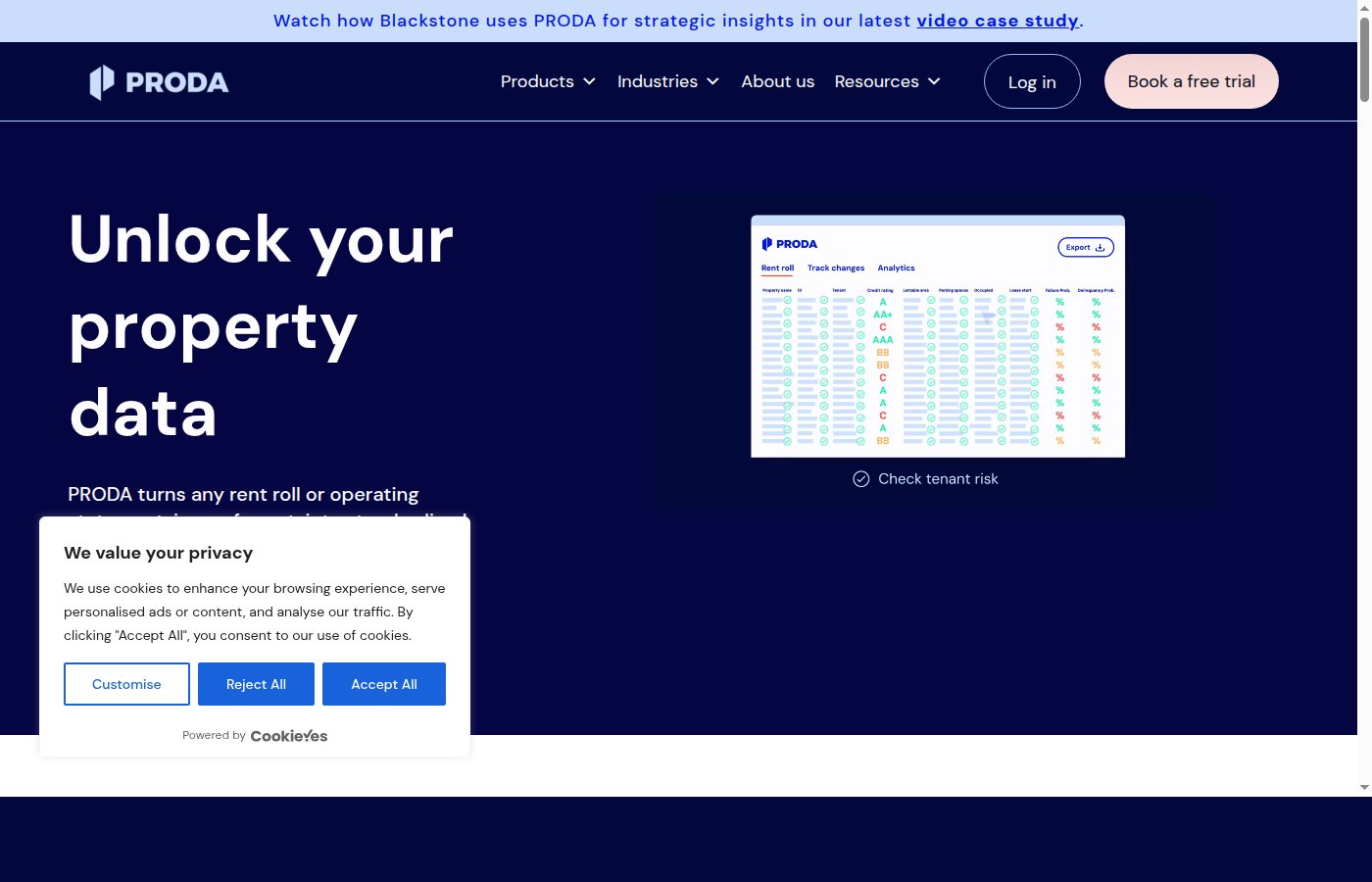
PRODA is a London-based commercial real estate software company that automates the collection, extraction, and standardization of rent roll data. Founded in 2017 and backed by institutional investors like JLL Spark, the platform targets asset managers, investment funds, and banks that struggle with fragmented tenancy data across different property management systems. The core utility of the product lies in its ability to ingest messy, unstructured rent roll files—such as an 85-page PDF exported from Yardi—and map them into a clean, unified data model in minutes. PRODA addresses a highly specific but universal pain point in commercial real estate: the manual reconciliation of incoming property data from diverse joint venture partners and third-party property managers who use conflicting reporting formats.
As a Tier 2 CRE-native application, PRODA focuses narrowly on document intelligence and data governance rather than attempting to be an end-to-end portfolio management system. The software uses machine learning to recognize tenant details, lease terms, rent amounts, and operating expenses across various formats, languages, and currencies. While many platforms claim to parse commercial leases, PRODA differentiates itself by specializing in the rent roll itself, providing error-checking and validation tools that highlight anomalies before the data enters a firm’s primary financial models. For underwriting and asset management teams evaluating the tool in August 2026, the primary question is whether the time saved on data entry justifies the cost of adding a dedicated middleware layer to their technology stack.
What PRODA does and how it works
PRODA operates as a data processing engine that sits between raw property reports and a firm’s analytical tools. Users upload rent rolls in various formats—including raw Excel spreadsheets, PDFs, or direct exports from property management systems like MRI, RealPage, and Argus. The software’s machine learning algorithms scan the documents to identify and extract critical data points such as tenant names, lease start and end dates, square footage, base rent, and step-up structures. Instead of relying on rigid templates, the system uses pattern recognition to interpret different naming conventions and column layouts, mapping them to a standardized internal taxonomy.
Once the data is ingested, PRODA runs a series of automated validation checks. The platform flags inconsistencies, such as missing lease expiration dates, mathematical errors in rent calculations, or duplicate tenant entries. Users review these flagged items in a centralized dashboard, correcting anomalies before the data is finalized. This validation layer acts as a quality control mechanism, ensuring that asset managers are not basing their financial projections on flawed inputs from third-party property managers. The system also tracks historical changes, allowing teams to compare current rent rolls against previous periods to identify unauthorized modifications or unexpected variances in occupancy and income.
After the data is cleaned and standardized, it can be exported or synced directly into other systems. PRODA provides an Excel Add-in that allows analysts to pull live, verified rent roll data directly into their custom underwriting or reporting models. For enterprise users, the platform offers an API to feed structured data into data lakes, business intelligence dashboards, or corporate accounting systems. By automating the extraction and standardization phases, the software shifts the analyst’s role from manual data entry to data review and strategic analysis.
9AI Framework: the score, dimension by dimension
CRE Relevance: 9/10
PRODA is entirely purpose-built for commercial real estate, focusing exclusively on the nuances of rent roll data. Generalist data extraction tools often fail when confronted with the idiosyncratic ways different property managers report lease structures, expense recoveries, or tenant concessions. PRODA understands the specific vocabulary of commercial leases and the mathematical relationships between square footage, rental rates, and annualized income. The platform handles multi-tenant office, retail, and industrial rent rolls with built-in logic that recognizes CRE-specific metrics. Because it was designed by former property professionals, the data model aligns with institutional reporting standards rather than generic financial ledgers. In practice: Asset management teams will find that the software natively understands the difference between base rent, percentage rent, and common area maintenance charges without requiring custom programming.
Data Quality and Sources: 8/10
The primary value proposition of this software is the elevation of data quality through systematic error-checking. Incoming rent rolls are frequently plagued by human error, inconsistent formatting, and missing fields. PRODA addresses this by applying rules-based validation and machine learning to catch anomalies that a junior analyst might overlook during a manual review. The platform flags mathematical discrepancies, such as a tenant’s monthly rent not aligning with their stated annual rate or square footage. It also standardizes disparate naming conventions, ensuring that a tenant listed as “Starbucks Corp” on one property and “Starbucks” on another are recognized as the same entity. In practice: Users can expect a significant reduction in reporting errors, as the software forces a standardized review of flagged anomalies before data is exported.
Ease of Adoption: 7/10
Implementing a new data standardization tool requires initial configuration, particularly when mapping a firm’s proprietary data model to the software’s taxonomy. While the drag-and-drop interface for uploading files is straightforward, administrators must spend time defining how specific fields should be categorized and exported. The platform relies on a supervised learning approach, meaning it requires human feedback to improve its accuracy on unfamiliar document formats. However, because it targets a specific workflow rather than attempting to replace core accounting systems, the disruption to daily operations is relatively low. The availability of an Excel Add-in also lowers the barrier to entry for analysts accustomed to spreadsheet-based workflows. In practice: Teams should anticipate a two-to-four-week onboarding period to train the system on their most common rent roll formats before seeing maximum time savings.
Output Accuracy: 8/10
The accuracy of the extracted data depends heavily on the quality and legibility of the source documents. For native Excel files and standard PDF exports from major property management systems, the extraction accuracy is exceptionally high. The machine learning models have been trained on thousands of commercial rent rolls, allowing them to correctly identify and categorize standard lease data points with minimal intervention. However, highly unstructured or scanned documents with poor optical character recognition (OCR) quality will still require manual verification. The software does not blindly push data; instead, it highlights low-confidence extractions for human review, which prevents false positives from corrupting the database. In practice: Analysts will still need to spot-check the output, but the software reduces the manual verification burden by explicitly directing attention to unverified or conflicting data points.
Integration and Workflow Fit: 8/10
For a middleware data tool, integration capabilities are critical, and PRODA performs well in this area. The software is designed to sit between raw property management outputs (like Yardi, MRI, and RealPage) and downstream analytical tools. The primary integration mechanism for many users is the Excel Add-in, which allows for dynamic data syncing directly into proprietary financial models. For more sophisticated enterprise architectures, the platform offers a REST API to facilitate direct data transfers into corporate data warehouses, BI tools like PowerBI, or portfolio management systems. While it does not offer pre-built, two-way syncs with every niche CRE application, its export flexibility covers the vast majority of institutional use cases. In practice: Technical teams can use the API to automate the flow of standardized rent roll data directly into their central data lakes.
Pricing Transparency: 4/10
PRODA does not publish its pricing tiers publicly on its website, which is typical for enterprise software but frustrating for buyers evaluating initial feasibility. The company operates on a custom, quote-based pricing model that likely scales based on the volume of rent rolls processed, the number of properties, or the total assets under management. A free trial is available, allowing prospective users to test the extraction capabilities on their own documents before committing. Because the pricing is obscured, buyers must engage with the sales team to understand the total cost of ownership, including any implementation fees or upcharges for API access. In practice: Buyers should prepare a clear estimate of their monthly rent roll volume to negotiate an accurate contract and determine the exact return on investment.
Support and Reliability: 7/10
Founded in 2017 and backed by major industry players like JLL Spark and ING Ventures, PRODA has established a stable operational foundation. The company maintains a dedicated support team to assist with onboarding, custom data mapping, and troubleshooting extraction failures. As a cloud-based SaaS platform, uptime and reliability are generally consistent with enterprise standards. While it remains a Tier 2 startup rather than a legacy software giant, its institutional backing provides a degree of financial stability that mitigates the risk of sudden vendor disappearance. User feedback indicates that the support team is responsive, particularly when the machine learning models struggle with a new or highly unconventional rent roll format. In practice: Clients can rely on the vendor for hands-on assistance during implementation, though they should establish clear service level agreements for ongoing technical support.
Innovation and Roadmap: 7/10
The company continues to iterate on its core extraction engine while expanding its feature set to address adjacent asset management needs. Recent developments include the introduction of an AI assistant for rent roll data analysis and tools for tenant risk assessment. The roadmap indicates a shift toward not just extracting data, but providing predictive analytics and deeper data governance capabilities. By moving beyond basic optical character recognition and focusing on contextual data intelligence, the platform is positioning itself as a comprehensive data quality layer for commercial real estate. However, buyers should evaluate the tool based on its current extraction capabilities rather than future analytical promises. In practice: Users will benefit from continuous improvements in extraction accuracy and processing speed as the underlying machine learning models ingest more diverse industry data.
Market Reputation: 7/10
PRODA has built a solid reputation among European and global asset managers, investment funds, and banks. Case studies from major institutions, such as LaSalle Investment Management and Blackstone, validate the software’s ability to handle complex, high-volume data environments. The platform is widely regarded as a highly effective point solution for rent roll standardization, though it is less known among smaller, regional property management firms. Within the proptech ecosystem, its partnerships and integrations signal strong industry acceptance. While it faces competition from lease abstraction tools like Prophia and underwriting platforms with built-in extraction, its specialized focus on rent rolls gives it a distinct identity in the market. In practice: Enterprise buyers can trust that the software has been stress-tested by major institutional players with stringent data security and accuracy requirements.
Who should use PRODA
Asset managers and investment firms dealing with fragmented property data will find the highest utility in this platform. It is designed for organizations that receive rent rolls in varying formats from multiple third-party property managers and need to consolidate that information quickly.
- Institutional asset managers overseeing diverse portfolios with multiple joint venture partners.
- Real estate investment trusts (REITs) requiring standardized data for quarterly financial reporting.
- Commercial lenders and banks that need to validate rent rolls during the underwriting process.
- Fund analysts spending more than ten hours a week manually reformatting Excel and PDF rent rolls.
Who should look elsewhere
Firms that internally manage all their properties on a single, unified property management system may not need a dedicated standardization tool. If your data is already clean and uniform, this software adds an unnecessary layer of complexity.
- Small property owners with a handful of leases that can be easily tracked in a basic spreadsheet.
- Fully vertically integrated firms where all property managers use the exact same software and reporting templates.
- Brokerage teams looking for a CRM or marketing platform rather than a data extraction engine.
- Residential property managers dealing exclusively with standard, uniform apartment leases.
Pricing and ROI
Because PRODA targets institutional asset managers and enterprise clients, the vendor does not publish its pricing structure on its website. Buyers must engage with the sales team to receive a custom quote, which is typically based on the volume of data processed, the number of properties, or the firm’s total assets under management. A free trial is available, allowing organizations to test the extraction engine on their own messy rent rolls before signing a contract. When calculating the return on investment for a custom-priced tool, buyers should quantify the administrative labor currently dedicated to data entry and reconciliation. If an analyst spends 20 hours a month manually extracting and reformatting rent rolls from 85-page PDFs, and their fully loaded cost is $75 per hour, the firm is spending $1,500 monthly just on data preparation for a single portfolio segment. If PRODA reduces that processing time to 10 minutes per file, the software quickly pays for itself in recaptured labor hours. Furthermore, the ROI extends beyond simple time savings; preventing a single calculation error in a rent roll can save a firm from making flawed underwriting decisions or reporting inaccurate yields to investors. Buyers should demand a clear pilot program to prove these time savings before committing to an annual enterprise license.
Integration and CRE tech stack fit
A data extraction tool is only as valuable as its ability to pass clean information to the rest of a firm’s technology stack. PRODA is built with a strong focus on interoperability, acting as a bridge between raw reporting outputs and analytical systems. The software can ingest data exported from major property management platforms, including Yardi, MRI, RealPage, and Argus. For the output phase, the most immediate integration for many analysts is the proprietary Excel Add-in. This feature allows users to sync standardized rent roll data directly into their existing financial models, preserving their custom formatting and formulas without requiring manual copy-pasting. For enterprise clients requiring automated data pipelines, the platform provides a REST API. This allows technical teams to push verified tenancy data directly into corporate data warehouses, business intelligence tools like PowerBI or Tableau, and portfolio management systems. While it does not function as a two-way sync that writes data back into the original property management software, its export capabilities ensure that asset managers have a clean, reliable data feed for their downstream underwriting and reporting workflows.
Competitive landscape
The market for commercial real estate document intelligence and lease abstraction has become highly competitive, with several vendors attacking the problem from different angles. PRODA focuses specifically on rent roll extraction and standardization, which distinguishes it from broader lease abstraction platforms.
Prophia (BestCRE Score: 94) is a formidable competitor, offering comprehensive AI lease abstraction and portfolio management. While Prophia excels at parsing the dense legal text of commercial leases to extract rights and encumbrances, PRODA is more narrowly optimized for the numerical and tabular data found in rent rolls. Buyers focused on legal risk will lean toward Prophia, while those focused on financial data aggregation may prefer PRODA.
Findable (BestCRE Score: 87) focuses heavily on building documentation and facility management records, making it less of a direct competitor for financial rent roll processing but relevant for overall asset data organization.
For underwriting-specific workflows, platforms like Cactus and Clik.ai offer rent roll extraction deeply tied to financial modeling and T-12 normalization. If a firm’s primary goal is to feed data directly into an acquisition model, these underwriting platforms might offer a more streamlined workflow. Similarly, redIQ is a major player in multifamily rent roll and operating statement standardization, often serving as the default choice for apartment investors, whereas PRODA handles complex commercial, retail, and mixed-use assets effectively. Buyers must decide whether they need a standalone data standardization layer like PRODA to feed multiple internal systems, or an end-to-end underwriting platform that includes extraction as a feature.
The bottom line
PRODA is a highly effective, purpose-built solution for commercial real estate firms drowning in fragmented rent roll data. By automating the extraction, standardization, and validation of property reports, it eliminates one of the most tedious and error-prone tasks in asset management. The software is not a complete portfolio management system, nor does it attempt to replace core accounting platforms. Instead, it serves as a critical quality-control layer that ensures analysts are working with accurate, unified data. For institutional investors, banks, and asset managers receiving disparate reports from multiple joint venture partners or third-party property managers, the platform offers a clear and immediate return on investment through recaptured labor hours and reduced reporting errors. However, smaller firms with uniform data practices or those seeking end-to-end lease abstraction may find it too specialized. If your analysts spend more time formatting spreadsheets than analyzing asset performance, PRODA is a necessary addition to your technology stack.
Frequently asked questions
What exactly does PRODA do?
PRODA is a cloud-based software platform that uses machine learning to automatically extract, standardize, and validate commercial real estate rent roll data from various unstructured file formats, including messy PDFs and raw Excel spreadsheets, saving analysts hours of manual entry.
Does PRODA integrate with Yardi and MRI?
Yes, the platform is designed to ingest raw data exports from major property management systems like Yardi, MRI, Argus, and RealPage. It automatically standardizes these disparate outputs into a single, unified data model, allowing asset managers to maintain consistent portfolio-wide reporting without manual formatting.
How much does PRODA cost?
The vendor does not publish pricing publicly on its website. Costs are custom-quoted by the sales team based on factors like the volume of rent rolls processed, number of properties, or total assets under management. Prospective buyers can request a free trial to test the extraction engine.
Is PRODA suitable for multifamily properties?
While it can certainly process multifamily rent rolls, the software is particularly strong at handling the complex mathematical relationships found in commercial, retail, and industrial leases. For purely multifamily portfolios, buyers often compare it against specialized tools like redIQ.
Does the software write data back into my accounting system?
No, it functions primarily as a one-way data extraction and standardization layer. It exports clean, verified data via a proprietary Excel Add-in or a REST API, feeding downstream financial models, business intelligence dashboards, and corporate data warehouses without altering the source system.
Do I still need human analysts if I use this tool?
Absolutely. While the software automates tedious data entry and systematically highlights mathematical anomalies, human analysts are still strictly required to review flagged errors, verify any low-confidence extractions, and perform the actual strategic financial analysis based on the newly cleaned data.