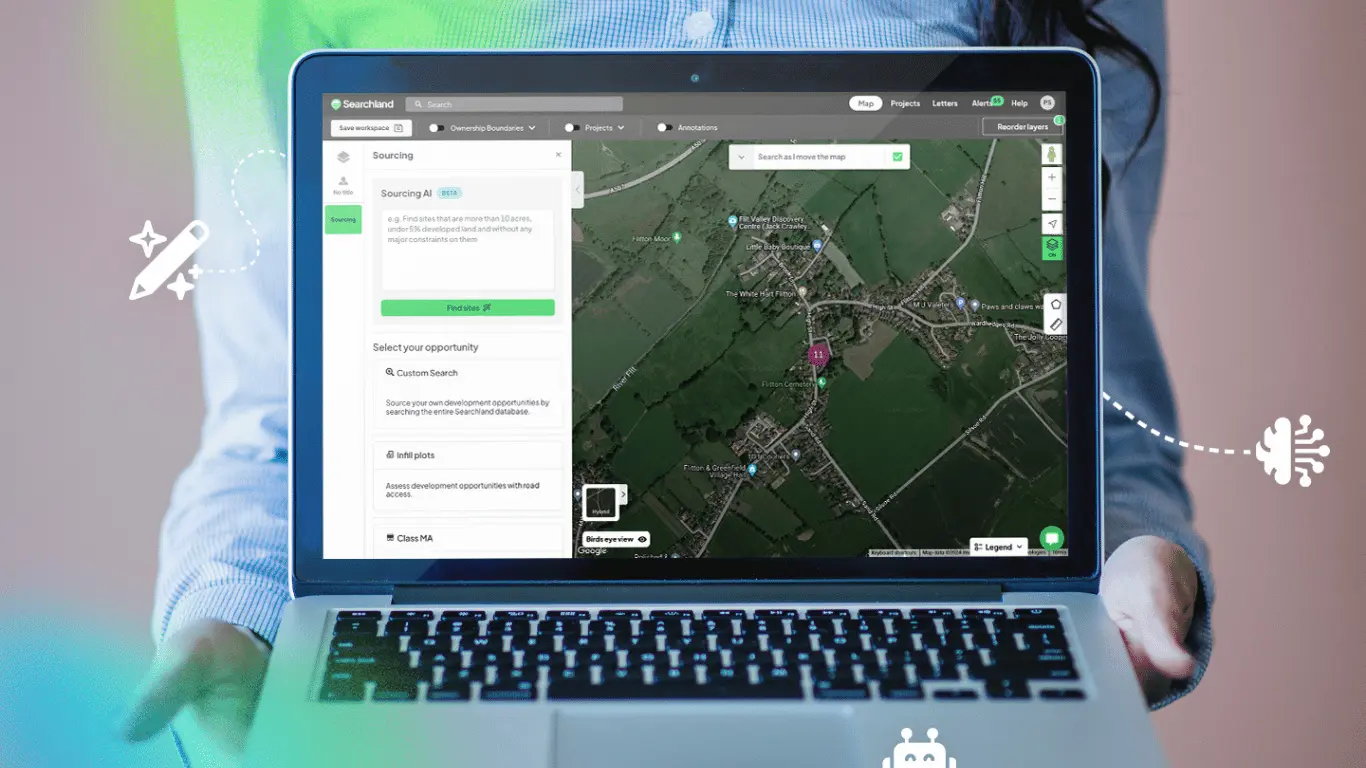
Searchland AI is a UK-focused commercial real estate data platform and land sourcing assistant that centralizes HM Land Registry records, planning applications, and strategic land data into a single map-based interface. The company differentiates itself by integrating a plain-language AI assistant directly into its sourcing tool, allowing acquisitions teams to bypass complex manual filters. According to published pricing in August 2026, Searchland Standard starts at £195 per user per month. The platform targets property developers, investors, and planning consultants who need to identify off-market sites, evaluate planning constraints, and contact landowners at scale.
In the highly fragmented UK property data market, analysts traditionally spend hours cross-referencing local council portals, SHLAA allocations, and corporate ownership structures. Searchland addresses this operational drag by aggregating over 23 million planning applications and 30 years of historical data alongside real-time ownership boundaries. The recent addition of a Model Context Protocol (MCP) connector elevates the platform beyond basic data retrieval. Users can connect their preferred AI assistant, such as Claude or ChatGPT, to query Searchland’s database directly. This allows a principal to ask for a complete site pack, including local plan status and comparable sales within a mile, and receive a structured, cited response. By merging comprehensive geospatial data with natural language processing, Searchland provides a highly specific utility for land acquisition teams looking to accelerate their pipeline generation.
What Searchland AI does and how it works
At its core, Searchland functions as a geospatial search engine for UK land and property data, but its AI Sourcing Assistant changes how users interact with that data. Instead of manually configuring dozens of dropdown menus for site size, use class, and planning constraints, a user types a natural language query. For example, an analyst can type, “Find sites greater than 10 acres with no previous development, free of residential planning constraints, within 5 miles of a settlement.” The AI translates this text into precise database filters, instantly returning matching parcels on the map interface.
Once a site is identified, the platform provides immediate access to its underlying data. Clicking on a parcel reveals its HM Land Registry title boundaries, corporate ownership tree (including ultimate parent companies), and transaction history. Users can overlay strategic land data, such as Strategic Housing Land Availability Assessments (SHLAA), settlement boundaries, and five-year housing land supply metrics. The platform also aggregates over 30 years of planning history, allowing users to search 23 million planning applications by keyword, view document texts, and track live updates on specific parcels.
The most technical component of Searchland’s AI offering is its Model Context Protocol (MCP) server. Included with a standard subscription, this connector allows users to plug Searchland’s database directly into external AI tools like ChatGPT or Claude. When a user asks their AI assistant to analyze ownership patterns or calculate indicative gross development values based on nearby comparables, the AI queries Searchland’s 35 datasets via the MCP. The system retrieves the exact figures, computes the answer, and provides source citations. Users can then save viable sites to internal project boards or initiate automated direct-to-vendor letter campaigns directly from the platform.
9AI Framework: the score, dimension by dimension
CRE Relevance: 9/10
Searchland is explicitly designed for the UK commercial real estate and land development sector. It does not attempt to serve residential realtors or general financial analysts. The platform aggregates highly specific datasets that matter to land buyers, including SHLAA allocations, Green Belt reviews, brownfield registers, and detailed corporate ownership structures. By focusing entirely on the nuances of UK planning policy and HM Land Registry data, the tool aligns perfectly with the daily workflows of acquisitions teams and town planners. The AI assistant is specifically trained to understand property-centric terminology like “Class MA,” “Class Q,” and “settlement boundaries.” In practice: A land buyer can bypass generic search tools and immediately filter sites based on strict local planning constraints and commercial viability.
Data Quality and Sources: 9/10
The platform relies on authoritative primary sources, drawing directly from HM Land Registry for ownership and sold prices, and from over 300 local councils for planning applications. By aggregating 30 years of planning history and 23 million applications, Searchland offers a deep historical context that is difficult to replicate manually. The inclusion of corporate ownership trees and ultimate parent company data adds significant value for off-market prospecting. While the system claims high accuracy in its head-to-head tests against competitors, data quality remains inherently tied to the reporting standards of individual local authorities. In practice: Analysts can trust the transaction and ownership data for initial underwriting, though final legal due diligence will still require official title deed verification.
Ease of Adoption: 9/10
Searchland drastically reduces the learning curve typically associated with complex GIS and property data platforms. The introduction of the AI Sourcing Assistant allows new users to execute highly specific searches using plain English rather than mastering a convoluted filter logic. The interface is browser-based and map-centric, which is intuitive for anyone familiar with basic web mapping tools. Furthermore, the Model Context Protocol (MCP) connector requires no coding to set up; users simply paste a URL into their existing AI assistant’s settings. This plug-and-play approach ensures that both junior analysts and senior partners can extract value immediately. In practice: A new hire can begin sourcing off-market land on their first day without needing extensive training on proprietary search syntax.
Output Accuracy: 8/10
Because Searchland uses a retrieval-based AI model via its MCP connector, output accuracy is strictly tethered to the underlying database rather than generative guesswork. When an external AI assistant queries the platform, it retrieves structured data such as exact sale prices, planning application statuses, and site dimensions. The system is designed to cite its sources, providing a clear audit trail back to the HM Land Registry or the specific local council document. This minimizes the risk of hallucinations that plague general-purpose AI tools. However, accuracy can occasionally be impacted if a local authority delays publishing its latest planning decisions. In practice: Users receive highly reliable, cited site packs and data summaries that can be confidently used in preliminary investment committee memos.
Integration and Workflow Fit: 8/10
The platform offers strong connectivity options for modern commercial real estate tech stacks. Searchland provides a native Zapier integration, which allows users to push saved sites, ownership details, and project board updates to over 6,000 external applications, including popular CRMs like Salesforce or HubSpot. For enterprise users, a REST API is available starting at £49 per month, offering 19 endpoints with JSON responses for custom internal dashboards. The standout integration is the MCP server, which natively bridges Searchland’s proprietary data with major LLMs like Claude and ChatGPT without requiring custom development. In practice: Acquisitions teams can easily pipe land data directly into their existing CRM workflows or proprietary underwriting models without hiring a dedicated software engineer.
Pricing Transparency: 9/10
Searchland publishes its pricing directly on its website, providing clear expectations for prospective buyers. As of August 2026, the Standard tier starts at £195 per user per month when billed annually. The company also openly lists the pricing for its REST API, which begins at £49 per month after a free tier of 100 calls. The MCP connector for AI assistants is included within the standard subscription cost, avoiding hidden add-on fees for the platform’s core AI functionality. This level of public disclosure is commendable in a software category where many vendors hide behind “Contact Sales” buttons. In practice: Principals can accurately model their software expenditure and calculate immediate return on investment before committing to a demo.
Support and Reliability: 7/10
As a growing PropTech startup that recently secured a seed funding round, Searchland has established a solid operational foundation but lacks the decades of enterprise support history seen in legacy providers. The platform boasts a 4.8 out of 5 rating on Trustpilot, indicating strong user satisfaction and responsive customer service. It holds ISO 27001 and Cyber Essentials certifications, which provides assurance regarding data security and uptime reliability. However, as a Tier 2 vendor, its support infrastructure may not yet match the 24/7 dedicated account management offered by massive global data conglomerates. In practice: Users can expect responsive online support and secure data handling, though enterprise-scale organizations should verify SLA terms for critical API integrations.
Innovation and Roadmap: 9/10
Searchland is positioning itself at the forefront of AI adoption within the UK property sector. By being the first UK PropTech platform to integrate a plain-language AI sourcing assistant directly into its map interface, the company has demonstrated a clear commitment to modernizing site identification. The deployment of a Model Context Protocol (MCP) server is a particularly forward-looking move, ensuring the platform remains compatible with rapid advancements in third-party LLMs like Claude and ChatGPT. This architecture prevents vendor lock-in and allows the tool to evolve alongside broader AI trends. In practice: Subscribers benefit from an agile platform that continuously adopts the latest data retrieval standards rather than relying on static, legacy search interfaces.
Market Reputation: 7/10
Searchland has rapidly built a strong reputation among UK property professionals, planners, and developers. The company is trusted by notable industry players, including Avison Young and Connells, which validates its utility for institutional-grade users. While it is a relatively young company with around $3 million in disclosed seed funding, its focus on solving specific, painful data aggregation problems has earned it high marks in user reviews. It is frequently compared favorably against competitors like Landstack and PropertyData for its depth of planning intelligence and automated outreach tools. In practice: The platform is widely regarded as a highly credible, specialized tool for UK land sourcing, even if it lacks the global brand recognition of Tier 1 data providers.
Who should use Searchland AI
Searchland AI is built for UK real estate professionals who need to identify and acquire off-market land efficiently. It is best suited for teams that require deep planning data and automated outreach capabilities.
Land Buyers and Sourcing Agents: Professionals who need to find specific parcels based on strict criteria (e.g. size, lack of planning constraints) and contact owners directly.
Property Developers: Teams looking to assess the viability of a site by reviewing 30 years of planning history, SHLAA allocations, and local council approval trends.
Planning Consultants: Analysts who require quick access to local plan policies, neighborhood plans, and historical appeal precedents without scouring individual council websites.
Strategic Land Promoters: Investors focused on identifying edge-of-settlement parcels and tracking land promotion activity across various local authorities.
Who should look elsewhere
While powerful for land acquisition, Searchland is highly specialized and will not suit every real estate professional. The following profiles should look elsewhere.
US-Based or International Investors: The platform is strictly focused on the UK market, relying on HM Land Registry and UK local council data.
Commercial Leasing Brokers: Professionals focused on tenant representation or office leasing will find the land-heavy datasets irrelevant to their daily workflows.
Residential Real Estate Agents: Agents focused solely on standard on-market home sales do not need the depth of corporate ownership or strategic planning data provided here.
Generalist Financial Analysts: Those looking for broad macroeconomic data or global REIT performance metrics will not find that information within this specialized geospatial tool.
Pricing and ROI
Searchland provides transparent pricing on its website, a welcome departure from the opaque quoting models common in commercial real estate software. As of August 2026, the Standard subscription starts at £195 per user per month when billed annually. This base tier includes the core map interface, the AI Sourcing Assistant, and the Model Context Protocol (MCP) connector for integrating external AI tools. For teams requiring programmatic access to the data, Searchland offers a REST API starting at £49 per month, which includes a free tier of 100 calls per month for testing and lightweight usage.
The return on investment (ROI) math for an active land acquisition team is highly compelling. A mid-level land buyer or planning analyst typically costs a firm upwards of £40,000 to £60,000 annually. Manually cross-referencing HM Land Registry titles, downloading local council planning documents, and identifying corporate ownership structures can easily consume 15 to 20 hours a week. By utilizing Searchland’s AI to instantly filter sites and retrieve cited data packs, an analyst can reclaim approximately 60 hours per month. At an effective hourly rate of £25, this equates to £1,500 in recovered productivity every month. When weighed against the £195 monthly license fee, the software pays for itself if it helps a team underwrite just one additional viable off-market site per quarter.
Integration and CRE tech stack fit
Searchland fits cleanly into modern commercial real estate technology stacks, offering multiple pathways for data integration. For non-technical teams, the platform features a native Zapier integration. This allows users to connect Searchland to over 6,000 external applications, enabling automated workflows such as pushing saved site details directly into CRMs like Salesforce, HubSpot, or Pipedrive, or triggering notifications in Slack when a new planning application is filed on a tracked parcel.
For more advanced enterprise requirements, Searchland provides a REST API with 19 distinct endpoints returning JSON responses. This allows engineering teams to pull sold prices, EPC ratings, and planning data directly into proprietary internal dashboards or custom underwriting models. The most notable integration feature is the Model Context Protocol (MCP) server. Included in the standard license, the MCP connector allows users to link Searchland’s database to their preferred LLM, such as Claude or ChatGPT, using a simple URL. This ensures that AI-driven analysis is grounded in verified CRE data, making Searchland a highly adaptable component of an automated sourcing pipeline.
Competitive landscape
The UK property data landscape features several strong alternatives, but Searchland differentiates itself through its AI and planning depth. The most direct competitor is Landstack, which offers solid fundamentals for site finding and a basic AI assistant. However, Searchland frequently wins head-to-head comparisons due to its unified platform architecture, whereas Landstack forces users to switch between four separate product modules. Searchland also offers superior MCP capabilities, allowing for complex computed answers rather than just single-purpose data retrieval.
PropertyData is another major alternative, widely regarded as the best tool for pure market analysis and residential deal stacking. While PropertyData excels at providing live rental comparables, yield heat maps, and HMO licensing areas, it functions more as a research engine than a complete sourcing pipeline. Searchland is the better choice for users who need to execute direct-to-vendor letter campaigns and analyze deep strategic land layers like SHLAA boundaries.
For users operating outside the UK, platforms like Prospect by Buildout (Scored 89), Crexi (Scored 84), and ProspectNow (Scored 80) offer similar off-market prospecting and ownership data for the US market. PropertyRadar (Scored 79) also provides excellent hyper-local data and routing for US-based teams. However, for UK-based land developers and planning consultants, Searchland’s exclusive focus on HM Land Registry and local council planning applications makes it the definitive choice in its specific geographic category.
The bottom line
Searchland AI is a mandatory evaluation for any UK-based land acquisition team, property developer, or planning consultancy. The platform successfully solves the persistent problem of fragmented local council data and opaque corporate ownership structures. By integrating a plain-language AI assistant and an MCP connector, Searchland has removed the friction from complex geospatial filtering, allowing analysts to focus on deal execution rather than manual data entry. At £195 per user per month, the pricing is highly justifiable given the immediate productivity gains and the potential to uncover off-market opportunities before competitors. If your firm relies on identifying unconstrained land and understanding local planning precedents in the UK, Searchland provides a distinct operational advantage. Teams focused on commercial leasing or non-UK markets should look elsewhere, but for its target demographic, Searchland is an exceptional, high-ROI investment.
Frequently asked questions
Does Searchland AI cover properties outside the UK?
No. Searchland is exclusively built for the United Kingdom market. The platform relies on data from HM Land Registry and UK local council planning portals, making it unsuitable for investors looking for land or property data in the United States or other international markets.
How does the AI Sourcing Assistant work?
Users type their land requirements in plain English, such as “Find 5-acre sites with no planning constraints.” The AI interprets this text and automatically applies the correct database filters. It bypasses the need to manually configure complex search parameters, instantly displaying matching parcels on the map.
Can I connect Searchland to my CRM?
Yes. Searchland offers a native Zapier integration that connects the platform to over 6,000 applications, including major CRMs like Salesforce, HubSpot, and Pipedrive. Users can automate workflows to push saved sites and ownership details directly into their existing pipeline management tools.
What is the Searchland MCP connector?
The Model Context Protocol (MCP) connector allows you to link Searchland’s database directly to external AI assistants like Claude or ChatGPT. By pasting a secure URL, your chosen AI can query Searchland’s verified datasets to generate structured, cited reports and perform complex site analysis automatically.
Does Searchland provide corporate ownership data?
Yes. The platform goes beyond basic title ownership by revealing complete corporate structures. Users can view company ownership trees, identify ultimate parent companies, and search by specific directors to uncover full land portfolios held across various subsidiary entities. This is highly useful for off-market prospecting.
Are there hidden fees for the AI features?
No. The AI Sourcing Assistant and the MCP connector are included in the standard Searchland subscription, which starts at £195 per user per month. Users do not pay extra for the platform’s core AI capabilities, though API access for custom engineering requires a separate paid tier.
Related Reviews
Compare Searchland AI with other Acquisitions tools BestCRE has scored: REIkit (80/100), Hamlet (64/100), Admyral AI (62/100) and DELI (59/100). Browse every review in CRE Acquisitions, the full Best CRE AI Tools directory, or the 20 CRE Sectors hub.