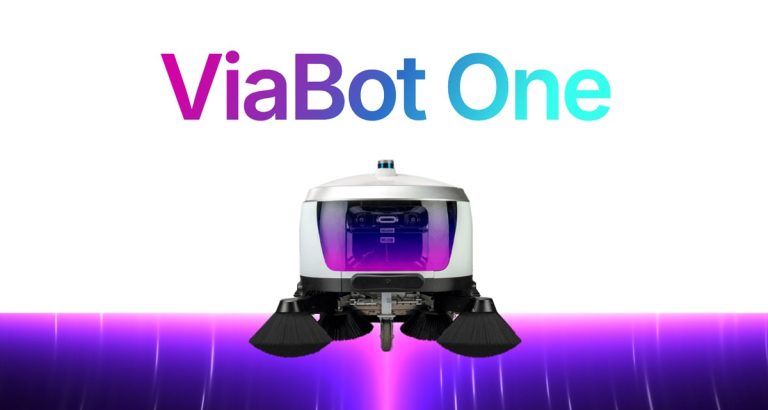
Viabot provides autonomous outdoor sweeping for owners and operators of retail, office, healthcare and industrial properties. Its Viabot One robot changes a recurring facilities workflow: instead of scheduling an operator and sweeping vehicle for each visit, a property can assign routine exterior cleaning to equipment stationed on site. The system is designed to start on a schedule, follow mapped routes, collect debris, return to its dock, empty itself and recharge without an attendant.
That proposition is most relevant for large parking lots, drive lanes and other paved areas where cleanliness affects tenant satisfaction, customer perception and facilities workload. Viabot sells the outcome as a managed service rather than asking the property team to purchase machinery and develop robotics expertise. The physical installation occupies approximately one parking space, uses a standard 120 volt outlet and deposits collected material into a conventional 65 gallon rolling trash container.
The operational case is credible. Viabot says a machine can sweep for up to six hours and collect material ranging from fine dust to debris measuring up to 10 inches. It also reports more than 5.1 billion square feet cleaned. Those figures describe activity and capability, not verified savings or service quality. The vendor does not publish named customer case studies, uptime results, cleaning completion rates or independently validated comparisons with conventional sweeping contracts.
BestCRE’s analysis is that Viabot is an unusually focused property operations product with a clear job to perform. Its autonomy, docking system and included maintenance reduce several adoption barriers commonly associated with facility robots. The main reservations are commercial and evidentiary: pricing is not published, integrations are not explained in meaningful detail and public customer proof remains thin. Buyers should treat a pilot at representative properties as the primary diligence exercise, with acceptance criteria covering route completion, debris recovery, incident handling and service response.
What Viabot Does and How It Works
Viabot One is a dedicated outdoor sweeper equipped to operate from a permanent docking station. Viabot maps the property and programs the cleaning routes during deployment. The company describes its navigation approach as combining 3D modeling with dynamic path planning, allowing the machine to follow assigned areas and adjust as conditions change. A property team chooses the operating schedule, after which the robot launches from its dock and sweeps the programmed route without a driver. This is scheduled physical automation, not a general facilities management platform.
At the end of a run, the machine returns to its station, empties collected debris into a standard rolling trash can and recharges. The dock does not require specialized electrical infrastructure, although buyers still need to confirm placement, protection, drainage, connectivity and local permitting requirements. Facility personnel remain responsible for emptying the trash container and occasionally wiping down the machine. Viabot says repairs, parts, brushes, filters, other consumables, labor and technician visits are included. Its internal team remotely monitors robot health, performance and uptime, troubleshoots issues and dispatches field service when required.
The robot also maps the facility while sweeping and can monitor activity encountered along its route. That provides potential security awareness, including detection of people lingering in monitored areas, but it should not be confused with a complete security program. The vendor does not publish enough detail about alert workflows, retention policies, sensor coverage, false alert performance or integrations with security operations systems to support broader claims. For a buyer, the central product remains autonomous sweeping. The reporting function should be evaluated for route completion, missed zones, downtime, obstruction events and service history. BestCRE’s analysis is that these records matter as much as the cleaning hardware because they determine whether an operator can verify performance across a portfolio without repeatedly inspecting each site.
9AI Framework: Dimension by Dimension Analysis
CRE Relevance: 7/10
Viabot earns 7 for CRE relevance because it addresses a real, recurring property operations expense at retail centers, office campuses, healthcare facilities and industrial sites. Outdoor sweeping directly affects appearance, tenant experience and facilities staffing. The product is less broadly relevant than a property management system because it performs one physical task and does not manage leases, work orders, accounting or tenant communication. Its security awareness features extend the operational value, but public detail is insufficient to treat Viabot as a security platform. BestCRE’s analysis is that the product is CRE adjacent rather than CRE native: it can serve commercial properties well, yet its core robotics could also apply to other large facilities. Relevance depends heavily on paved area, cleaning frequency, operating conditions and the cost of the service being replaced.
Data Quality and Sources: 6/10
Viabot earns 6 for data quality. The robot creates route maps, operational telemetry, cleaning records and equipment health information from activity at the property. That first party machine data can be useful because it reflects completed runs rather than contractor invoices or scheduled intentions. However, the vendor does not publish the precision of its mapping, the fields available in reports, data retention periods, export formats or methods for validating cleaned coverage. It also does not publish performance by debris type, weather condition or property configuration. BestCRE’s analysis is that the underlying data should be sufficient for operating the robot, but buyers lack the documentation needed to judge its value for portfolio analytics. A pilot should compare reported completion against direct inspections and record all interventions, missed areas and service events.
Ease of Adoption: 8/10
Viabot earns 8 for ease of adoption because the managed service model removes much of the technical burden from the property team. Viabot delivers the unit, installs its dock, maps the property, programs routes, monitors the equipment and handles maintenance. The stated infrastructure requirement is modest, and normal customer duties are limited to emptying the trash container and occasional cleaning. Adoption is still not automatic. Each site needs a suitable dock location, safe routes, operating rules and procedures for blocked paths, construction, weather and unexpected pedestrian or vehicle activity. Staff also need clear escalation contacts. BestCRE’s analysis is that implementation should be simpler than owning and maintaining autonomous equipment directly, but portfolio rollout should follow a controlled pilot rather than relying on a standard installation promise.
Output Accuracy: 6/10
Viabot earns 6 for output accuracy. Here, accuracy means whether the robot covers the assigned route, collects the expected debris, avoids hazards and reports the run correctly. The product description establishes relevant capabilities, including autonomous navigation, dynamic route adjustment, self emptying and remote monitoring. It does not establish measured cleaning effectiveness, navigation error rates, alert precision or performance under adverse conditions. Customer statements on the site are not attributed to named organizations, so they provide limited evidence for underwriting results. BestCRE’s analysis is that physical output must be tested locally because parking layouts, curbs, islands, traffic, loading activity and debris vary substantially. Buyers should define measurable acceptance standards and compare reports with inspections during a pilot. Exceptions should be categorized rather than averaged into a general satisfaction assessment.
Integration and Workflow Fit: 4/10
Viabot earns 4 for integration because the public product presentation concentrates on autonomous operation and the client portal, not connectivity with the wider CRE technology stack. The vendor does not publish a documented application programming interface, supported property management integrations, computerized maintenance management connections, security platform partners or standard data export specifications. Remote fleet monitoring may reduce the immediate need for deep integration at a single site, but portfolio operators will eventually want status and exception data in existing systems. BestCRE’s analysis is that Viabot should initially be evaluated as a managed operational service with its own interface. Buyers should ask whether alerts, run histories, uptime data and service tickets can flow into their work order, business intelligence or security tools. Any required custom work should be documented before contracting.
Pricing Transparency: 3/10
Viabot earns 3 for pricing transparency. The company does not publish subscription rates, installation charges, contract terms, minimum commitments, escalation provisions or site qualification fees. It states that repairs, parts, consumables, labor and service visits are included, which helps define the service boundary, but buyers still cannot estimate cost from public information. The absence of a visible price is especially important because financial value depends on comparing one site specific service with current sweeping labor, equipment and contractor costs. BestCRE’s analysis is that proposals should separate recurring fees, deployment costs, electrical or site work, taxes and charges triggered by relocation or unusual damage. Buyers should also seek service credits, termination rights and a clear definition of included uptime support. Without those terms, headline savings cannot be evaluated reliably.
Support and Reliability: 8/10
Viabot earns 8 for support based on the scope of service described. The company says it monitors each robot’s health, performance and uptime, provides remote troubleshooting and proactively dispatches technicians. Repairs, replacement parts, labor, trip charges and consumable components are presented as included. This structure is well aligned with property teams that do not want to employ robotics specialists or manage a new category of mechanical inventory. The limitation is that public service levels are not disclosed. Viabot does not publish response times, geographic coverage, replacement equipment commitments or uptime guarantees. BestCRE’s analysis is that the operating model is strong, but the contract must convert that promise into enforceable service standards. A buyer with sites outside major service areas should verify technician availability and parts logistics before treating support as uniform across a portfolio.
Innovation and Roadmap: 8/10
Viabot earns 8 for innovation. The distinctive element is not merely autonomous steering. It combines scheduled outdoor sweeping, self emptying, recharging, route adaptation, operational reporting and remote fleet support in a service intended to run without an onsite operator. Adding activity monitoring during cleaning creates a second potential use for equipment already moving through the property. The approach is materially different from hiring periodic sweeping crews or buying equipment that still requires a driver. BestCRE’s analysis is that the most valuable innovation is the complete operating loop from deployment through disposal and maintenance. Still, the score stops below the maximum because public evidence does not establish how the autonomy performs across difficult sites or how much additional value the monitoring function delivers. Execution over time matters more than the novelty of the robot.
Market Reputation: 6/10
Viabot earns 6 for market reputation. The company presents a meaningful deployed cleaning volume and completed a Series A financing of $24 million in September 2026, both of which suggest momentum. However, the vendor does not publish a substantial roster of named CRE customers, detailed case studies or independently verified performance benchmarks. Its website includes favorable customer statements, but the excerpts are not tied to identifiable organizations or operating metrics. That limits their usefulness for procurement diligence. BestCRE’s analysis is that Viabot appears beyond the concept stage but has not yet built the public evidence base associated with established facilities equipment and property software vendors. Buyers should request references from comparable asset types, climates and operating environments, then ask those references about downtime, service responsiveness, route changes and realized cost.
Who Should Use Viabot
Viabot best suits owners and operators with large, repeatedly swept paved areas and enough recurring expense to support a dedicated onsite system. Retail centers, shopping environments, office campuses, medical facilities, distribution properties and industrial sites are the clearest profiles. Strong candidates have predictable overnight access, a practical location for the dock and a facilities team willing to manage exceptions without supervising each run. Portfolio owners may benefit when several properties share similar layouts and cleaning standards.
The ideal buyer can measure the current service baseline before starting. That includes cleaning frequency, contractor invoices, internal labor, complaint volume, missed visits and the time managers spend checking performance. Buyers should also have authority over parking operations, electrical access and vendor contracting. BestCRE’s analysis is that Viabot is particularly attractive where conventional sweeping is unreliable or difficult to staff, provided a pilot proves that the machine can handle actual debris and traffic patterns. Security teams may value activity awareness, but facilities savings should justify the purchase independently.
Who Should Not Use Viabot
Viabot is a weaker fit for small properties, sites with limited paved area or locations that need only occasional sweeping. Properties with constantly changing routes, heavy overnight traffic, frequent construction or difficult curb geometry may require too many exceptions. Buyers seeking indoor floor care, landscaping, snow removal or a complete facility management suite should look elsewhere. The product automates a narrow exterior task and does not replace broader maintenance operations.
It is also unsuitable for organizations that require mature, documented integrations before approving a vendor or cannot accommodate a permanent docking station. Highly regulated sites should not assume the monitoring feature satisfies their security, privacy or evidentiary requirements. BestCRE’s analysis is that cost sensitive buyers should wait for a site specific proposal and validated pilot results. Without published pricing or detailed performance benchmarks, there is no responsible way to conclude from public information alone that the service will outperform an existing contract.
Pricing and ROI Analysis
Viabot does not publish pricing. Public information does not specify the recurring service fee, installation cost, contract length, annual increases, deposits or minimum property size. The company says its service includes repairs, parts, consumables, labor, trip charges and proactive monitoring. Buyers should confirm whether mapping, dock installation, connectivity, replacement equipment and route revisions are also included. Proposals should identify every customer responsibility, including electrical work, trash disposal, damage, relocation and site restoration at contract end.
Analysis: calculate the annual baseline as current sweeping invoices plus internal labor, owned equipment costs and management time. Then compare that figure with Viabot’s total annual contract cost and any one time site work. For example, if the verified baseline is B and Viabot’s first year cost is V, first year savings equal B minus V. The payback case is positive only when that difference remains favorable after adding exception labor and any retained conventional service. Buyers should not assign speculative value to security monitoring. Test a representative site, document service interruptions and use actual pilot performance to model a portfolio rollout.
Integration and CRE Tech Stack Fit
Viabot appears to operate primarily through its own robot, dock, remote operations process and client portal. The vendor does not publish standard integrations with property management systems, work order platforms, security operations software or portfolio reporting tools. It also does not publicly document an application programming interface. That may be acceptable for a standalone site deployment, but it creates additional diligence for owners that centralize vendor performance and facility exceptions.
BestCRE’s analysis is that the essential integration requirement is operational rather than transactional. Completion reports, downtime alerts and service events should reach the people already responsible for the property. Portfolio buyers should ask about automated notifications, exports, user permissions, single sign on and data retention. They should also determine whether robot incidents can create work orders or security cases automatically. Until Viabot documents those connections, underwrite the client portal as a separate system and include the administrative cost of monitoring it.
Competitive Landscape
Viabot competes first with conventional parking lot sweeping contractors and owner operated sweeping equipment. Those options are widely understood and can handle changing assignments, but they remain dependent on drivers, schedules and inspection. Viabot’s alternative is a dedicated machine that stays at the property and performs a repeatable route. The comparison should focus on verified cleaning coverage, total annual cost, response to unusual debris and the amount of human oversight still required.
Among technology alternatives, Trombia offers autonomous outdoor sweeping equipment, while Tennant and Brain Corp are established names in autonomous cleaning, with much of their visibility centered on indoor environments. Their products and commercial models are not direct substitutes in every case, so buyers should compare surface type, weather tolerance, disposal workflow, service coverage and whether equipment is purchased or provided as a service. Hakimo is relevant primarily for AI based physical security operations rather than sweeping. It is a closer alternative only when the buyer’s main objective is monitoring parking areas and responding to security events.
DoorLoop, Entrata and AppFolio are not direct Viabot competitors. They manage broader property workflows and records rather than physical exterior cleaning. BestCRE’s analysis is that a buyer should not compare Viabot with general property software on feature count. The correct decision is whether autonomous sweeping produces a better site outcome than the existing service, and whether its reporting can fit the operator’s oversight process.
The Bottom Line
Viabot deserves a pilot when outdoor sweeping is a meaningful, recurring operating expense and the property can support a stable autonomous route. The managed service design is sensible: Viabot handles mapping, monitoring, maintenance and consumables while the site team manages routine disposal. That reduces the operational burden that often makes facility robotics impractical.
Do not approve a portfolio rollout from demonstrations or unattributed testimonials. Require a representative site test, inspect results, reconcile reports with actual coverage and negotiate measurable service standards. BestCRE’s analysis is that Viabot can become a useful specialist in the property operations stack, but its opaque pricing, limited integration disclosure and sparse named customer evidence keep it from being a low diligence purchase. Buy only when pilot data proves the cleaning outcome and the contract protects against extended downtime.
About BestCRE
BestCRE.com is the definitive authority on commercial real estate AI, analysis, and investment intelligence. Every article advances the platform’s mission to help CRE professionals identify, evaluate, and adopt the best tools and strategies in the industry. We benchmark platforms using the 9AI Framework so CRE leaders can compare tools with clear evidence. Explore the category map at 20 CRE sectors for deeper coverage across the CRE stack.
Frequently Asked Questions
What is Viabot?
Viabot is a managed autonomous sweeping service for outdoor areas at commercial facilities. Its Viabot One robot is intended for parking lots, drive lanes and similar paved surfaces at retail, office, healthcare and industrial properties. The machine launches from a dedicated dock, follows routes mapped by Viabot, collects debris, returns to the dock, empties into a standard rolling trash can and recharges. Viabot remotely monitors the equipment and says maintenance, repairs, parts, labor and consumables are included. The property team still empties the trash container and handles basic site coordination. BestCRE’s analysis is that Viabot should be evaluated as a specialized facilities service, not as a general property management or security platform.
How does Viabot compare with a parking lot sweeping contractor?
A conventional contractor sends a staffed vehicle on scheduled visits, while Viabot places an autonomous sweeper and docking station at the property. Viabot can run on a recurring schedule without a driver, automatically dispose of collected material into a nearby container and report its activity. A contractor may be more flexible when routes change, unusual debris appears or several services must be combined. Viabot may offer greater consistency where a stable route needs frequent cleaning. BestCRE’s analysis is that buyers should compare actual coverage and total cost rather than scheduled frequency alone. A pilot should record missed areas, interventions, downtime, retained contractor work and the time property staff spend managing exceptions.
How much does Viabot cost?
Viabot does not publish pricing, contract duration, installation charges or minimum commitments. The service is described as including remote monitoring, repairs, parts, labor, trip charges and consumable items such as brushes and filters. Buyers must request a property specific proposal and confirm whether mapping, dock installation, route changes, connectivity, equipment replacement and site restoration are included. BestCRE’s analysis is to compare the complete annual proposal with current contractor invoices, internal labor, equipment costs and management time. Any expected savings should be reduced by the cost of exception handling and conventional service that must remain. Contract terms should also define uptime, response times, service credits, renewal increases and termination rights.
Who should use Viabot?
Viabot is best suited to owners and operators of commercial properties with large paved areas, frequent sweeping needs and predictable periods of low traffic. Retail centers, office campuses, healthcare facilities, distribution properties and industrial sites are natural candidates. A suitable property also needs space for the docking station, access to standard electrical power and a team that can empty the collection container and respond to exceptions. BestCRE’s analysis is that the strongest buyer has reliable baseline cost data and can run a measured pilot before expanding. Small sites, properties with constantly changing routes and organizations that need extensive software integrations at launch are less likely to receive immediate value.
Can Viabot become a broader property security and operations platform?
Viabot has the foundation for broader operational visibility because its robot maps a property, moves through exterior areas and can monitor activity along its route. That could support richer exception reporting or coordination with work order and security systems. However, the vendor does not publish enough information about integrations, alert accuracy, sensor coverage, data retention or security workflows to establish that broader role today. BestCRE’s analysis is that buyers should value Viabot primarily for autonomous sweeping and treat monitoring as supplemental. Future platform potential will depend on documented interfaces, reliable event detection, clear privacy controls and evidence that operating data can improve decisions beyond verifying completed cleaning runs.
Related Reviews
Compare Viabot with other tools BestCRE has scored in the same category: DoorLoop, Entrata, Moved. Explore more CRE AI tool reviews in our Best CRE AI Tools directory. For sector-specific analysis and market intelligence, visit our 20 CRE Sectors hub.