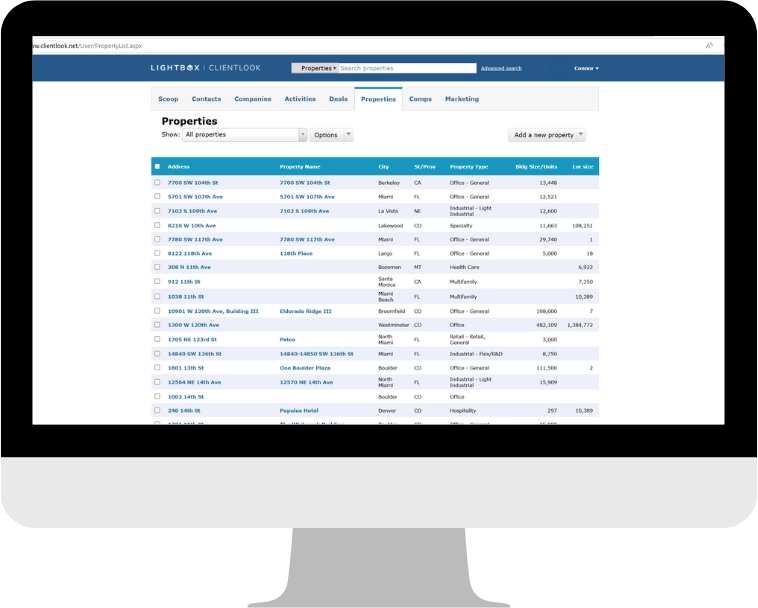
ClientLook is a commercial real estate broker CRM owned by LightBox, operating as a centralized database for property, contact, and deal tracking. The platform integrates directly with LightBox’s proprietary data service, allowing users to import from a database of over 155 million property records nationwide. Founded in 2009 and acquired by LightBox in January 2020, ClientLook has maintained a strict focus on simplicity and ease of use for solo brokers and small teams. Rather than deploying complex generative AI models to automate data entry, the company includes a human virtual assistant service that handles listing administration, lead capture, and contact logging on behalf of the user.
For a commercial real estate principal evaluating AI software in August 2026, ClientLook represents a baseline standard of digitization rather than an advanced automation engine. Analysis indicates that while competitors race to build large language models capable of reading lease documents or underwriting deals, ClientLook relies on its legacy architecture and human-in-the-loop services to maintain data integrity. It serves as a Tier 2 CRE-native database that captures the fundamental mechanics of brokerage—contacts, properties, and pipelines—without overwhelming users with configuration options. While it lacks the advanced artificial intelligence capabilities seen in newer proptech platforms, its high ease of adoption makes it a practical alternative for brokerages struggling with software compliance and basic data hygiene.
What ClientLook does and how it works
ClientLook functions as the central nervous system for a commercial real estate broker’s daily activities, linking people, properties, and pipeline stages in a single relational database. Users begin by building their proprietary property database, either through manual entry or by pulling records directly from the LightBox data service. When a broker adds a property, they can track ownership changes, sales history, and financing details, while linking that asset to specific contacts and active deals. The platform includes a dedicated module for tracking sale and lease comparables, allowing brokers to log market transactions and use them for future pricing analysis.
The deal management mechanics revolve around a consolidated pipeline that tracks various transaction types from initial pitch to signed letter of intent. ClientLook utilizes collaboration hubs, branded as deal rooms, where brokers can share updates, documents, and feedback directly with clients. For marketing and outreach, the system integrates with third-party platforms like Mailchimp and HubSpot, enabling users to create campaigns, manage distribution lists, and identify prospects without leaving the CRM environment. Brokers can access these features on the go via native iOS and Android applications, which include synchronization with Google services.
The most distinct mechanical feature of ClientLook is its approach to data entry automation. Instead of relying on optical character recognition or AI parsing to update contact records and log meeting notes, the platform provides access to a team of human virtual assistants. Users send business cards, spreadsheets, or dictated notes to this team, who manually input the data into the CRM. Analysis dictates that this human-driven process bypasses the hallucination risks associated with current AI models, ensuring high fidelity in contact and property records, albeit without the instant processing speeds of automated systems.
9AI Framework: the score, dimension by dimension
CRE Relevance: 9/10
ClientLook is entirely dedicated to the commercial real estate sector, functioning as a CRE-native Tier 2 database. Unlike general-purpose CRMs that require extensive customization to understand the relationship between a landlord, a tenant, and a physical asset, ClientLook is built around these specific entities out of the box. The platform natively supports the tracking of sale and lease comparables, property ownership changes, and commercial financing details. Its acquisition by LightBox further cemented its industry relevance by tying the CRM directly into a massive repository of commercial parcel and property data. Analysis shows that this specialized architecture prevents brokerages from having to hire expensive consultants to mold a generic system into a CRE tool. In practice: Brokers can immediately begin logging cap rates, lease expirations, and price-per-square-foot metrics without building custom fields.
Data Quality and Sources: 8/10
The platform achieves high data quality through a combination of external data integration and human oversight. Users can import property details directly from LightBox’s database of over 155 million records, ensuring that baseline asset information relies on verified national data rather than manual broker estimates. Furthermore, the inclusion of a human virtual assistant team acts as a quality control layer for user-generated data. Instead of relying on flawed AI transcription that might misinterpret a company name or phone number from a scanned business card, human operators review and enter the information. Analysis indicates that this minimizes the duplicate records and formatting errors that plague highly automated CRMs. In practice: The database remains clean and standardized because dedicated personnel handle the data entry that busy brokers typically rush or skip.
Ease of Adoption: 9/10
ClientLook is widely recognized as one of the most accessible platforms in the commercial real estate software market. The vendor explicitly markets the tool as virtually training-free, targeting solo brokers and small teams who lack dedicated IT departments. The interface is straightforward, avoiding the overwhelming menus and complex administrative overhead found in enterprise systems like Salesforce. Furthermore, the onboarding process is highly streamlined, allowing new users to transition their existing spreadsheets into the system with minimal friction. Analysis reveals that the included virtual assistant service drastically lowers the barrier to entry, as users can simply email their historical contact lists to the support team for formatting and upload. In practice: A non-technical broker can transition from a spreadsheet to a fully functioning CRM in a single afternoon.
Output Accuracy: 7/10
Because ClientLook relies on human virtual assistants rather than generative artificial intelligence for its automation features, its output accuracy is highly dependable. The system does not attempt to automatically draft complex lease summaries or underwrite properties using probabilistic language models, thereby eliminating the risk of AI hallucinations. When users query the system for sale and lease comparables, the outputs are exact reflections of the data imported from LightBox or manually entered by the brokerage. However, analysis suggests that this reliance on manual and human-assisted entry means the system cannot automatically surface hidden insights or predict market trends with the sophistication of true AI platforms like Dan AI or CompStak. In practice: Users can trust the contact and property reports generated by the system, provided the initial inputs were submitted correctly.
Integration and Workflow Fit: 6/10
ClientLook offers a functional but somewhat limited integration ecosystem compared to broader horizontal platforms. Its primary and most valuable integration is the native connection to the LightBox data service, which allows direct importing of property records. For marketing, the system supports two-way integrations with Mailchimp and HubSpot, enabling users to sync distribution lists and track email campaign performance directly within the CRM. It also offers mobile synchronization with Google services. However, analysis of recent technical overhauls indicates that the platform operates on an older architecture that required refactoring to support modern API connections. It lacks deep integration with advanced AI underwriting tools or modern document management systems used in complex deal execution. In practice: The software connects well with basic email marketing tools but struggles to plug into advanced proptech financial stacks.
Pricing Transparency: 9/10
The vendor maintains a highly transparent pricing model, publishing exact figures directly on its website and through third-party channels. As of Q3 2026, ClientLook costs $129 per user per month, or a discounted rate of $1,068 per user when billed annually. This flat-rate approach includes access to the mobile applications, the LightBox data integration, and the human virtual assistant service. Analysis indicates that this straightforward pricing structure is a significant advantage over competitors like Apto or enterprise Salesforce builds, which often require custom quoting, hidden implementation fees, and separate licenses for mobile access or data services. Buyers know exactly what their financial commitment will be before initiating a trial. In practice: A principal can accurately budget for their entire team’s software expenses without needing to negotiate with a sales representative.
Support and Reliability: 9/10
Support is the defining feature of the ClientLook offering, heavily anchored by the included virtual assistant team. This service goes far beyond traditional technical troubleshooting; the assistants actively perform data entry, listing administration, and lead capture tasks for the users. If a broker encounters a software bug, standard technical support is also available, and the company has a track record of resolving API and data duplication issues swiftly. Analysis shows that this hands-on support model is the primary driver behind the platform’s exceptionally high user retention rates, as it directly solves the most common CRM failure point: user abandonment due to data entry fatigue. In practice: Brokers can email a photograph of a sign rider or a stack of business cards to support and have the data accurately logged by the next morning.
Innovation and Roadmap: 4/10
ClientLook scores lower on the innovation roadmap, particularly when evaluated as an AI software platform. While the broader proptech market is rapidly deploying large language models for document abstraction and predictive analytics, ClientLook remains firmly rooted in its traditional CRM capabilities. The product roadmap focuses on minor bug fixes, such as correcting price-per-square-foot duplication errors in the LightBox API, rather than introducing advanced machine learning features. Analysis suggests that the parent company, LightBox, views ClientLook as a stable, simple data repository rather than an experimental ground for artificial intelligence. Teams looking for automated due diligence tracking or AI-driven deal execution will find the platform’s future development plans lacking. In practice: Buyers should purchase the software for what it does today, as there are no indications of major AI feature releases on the horizon.
Market Reputation: 8/10
Since its launch in 2009, ClientLook has built a formidable reputation as the default CRM for solo brokers and boutique commercial real estate firms. Its acquisition by LightBox in 2020 validated its position in the market and provided it with institutional backing. The platform consistently receives high ratings for user satisfaction and ease of use across software review boards. However, analysis reveals that its reputation is strictly confined to the small-to-medium brokerage space; enterprise firms and capital markets teams often view it as too simplistic for complex, multi-tranche deal management. Compared to peers like Apto, it is celebrated for its stability and the unique value of its human virtual assistants. In practice: The tool is universally respected by independent brokers who prioritize simplicity and outsourced data entry over complex workflow automation.
Who should use ClientLook
ClientLook is optimized for commercial real estate professionals who prioritize simplicity and immediate usability over complex automation. It is best suited for individuals and small teams who struggle with the discipline of manual data entry.
- Solo brokers who need a centralized database for contacts and properties but lack administrative support to keep it updated.
- Boutique brokerage firms (4 to 20 agents) without a dedicated IT department to manage complex software implementations.
- Landlord and tenant representation specialists who rely heavily on relationship tracking and basic lease expiration dates.
- Firms that already utilize LightBox data products and want a CRM that natively integrates with that ecosystem.
Who should look elsewhere
Firms requiring advanced artificial intelligence capabilities, complex financial modeling, or enterprise-grade custom reporting will find ClientLook insufficient for their needs.
- Capital markets teams that require deep due diligence tracking, secure virtual data rooms for sensitive financials, and multi-stage underwriting workflows.
- Enterprise brokerages that need highly customizable reporting dashboards to track complex commission splits and office-wide performance metrics.
- Analysts looking for generative AI tools capable of automatically parsing lease documents, extracting clauses, or writing property marketing descriptions.
- Firms that require deep integrations with advanced accounting software or complex proprietary back-office systems.
Pricing and ROI
ClientLook maintains a highly transparent and straightforward pricing model, which is a rarity in the commercial real estate software market. As of Q3 2026, the vendor publishes its pricing directly on its website. The platform costs $129 per user per month when billed monthly. For firms willing to commit to an annual contract, the price drops to $1,068 per user per year, which effectively reduces the monthly cost to $89 per user.
This single-tier pricing structure is comprehensive. The fee includes full access to the core CRM functionality, the native iOS and Android mobile applications, and the integration with the LightBox property database. Most importantly, the subscription includes unlimited access to the human virtual assistant team, which handles data entry and listing administration tasks. There are no hidden implementation fees or mandatory paid training sessions, as the software is designed to be adopted without specialized instruction.
Analysis of the return on investment (ROI) relies on the time saved through the virtual assistant service. If a junior broker or administrative assistant earns $25 per hour, the annual $1,068 subscription pays for itself if the virtual assistant team saves the user just 43 hours of data entry work over the course of a year. For a busy broker logging dozens of business cards and property updates weekly, this break-even point is typically reached within the first two months of deployment.
Integration and CRE tech stack fit
ClientLook’s position within the commercial real estate tech stack is highly specialized, serving primarily as a front-office contact and property repository rather than a fully integrated enterprise hub. Its most powerful integration is vertical: the direct connection to its parent company’s LightBox data service, which allows users to directly pull from over 155 million national property records. This eliminates the need for a separate property data subscription for basic asset tracking.
For marketing execution, ClientLook offers established two-way integrations with Mailchimp and HubSpot. This allows brokers to push contact lists directly into email campaigns and track open rates without leaving the CRM environment. The platform also syncs reliably with Google Workspace, ensuring that calendar events and emails are logged against the correct contact records.
However, analysis indicates that the platform struggles to integrate with the broader, modern AI proptech stack. Because it operates on an older architectural framework, it does not easily connect with advanced AI underwriting platforms, automated document abstraction tools, or complex back-office commission tracking systems. Firms adopting ClientLook should expect it to operate as a standalone CRM alongside, rather than integrated with, their financial and analytical software.
Competitive landscape
The commercial real estate CRM market is heavily fragmented, and ClientLook competes directly with both CRE-native platforms and customized horizontal solutions. Its primary competitors in the Tier 2, broker-focused database category include Apto, Buildout (formerly Rethink), and AscendixRE.
Compared to Apto (scored 64), ClientLook (scored 69) offers a much faster implementation process and a simpler user interface. Apto, built on the Salesforce chassis, provides significantly more customization and advanced reporting capabilities, but requires a steeper learning curve and higher administrative overhead. ClientLook wins on ease of adoption and its unique human virtual assistant offering, while Apto wins for firms needing complex, customized deal pipelines.
Buildout CRM represents another major alternative. Buildout offers a more comprehensive suite that ties the CRM directly into automated marketing brochure generation and financial modeling tools. Brokerages that want a single platform to handle both contact management and the creation of offering memorandums often prefer Buildout, whereas ClientLook is strictly focused on the database and pipeline management aspects.
AscendixRE, also built on Salesforce, competes with ClientLook by offering a middle ground between simplicity and enterprise power. Ascendix provides better search functionalities and map-based prospecting tools, but again lacks the outsourced data entry service that defines the ClientLook experience.
Analysis shows that when brokerages outgrow ClientLook, it is rarely because of contact limits; it is typically because they require deeper reporting, advanced due diligence tracking, or AI-driven document analysis. For lean teams prioritizing basic database hygiene over advanced analytics, ClientLook remains the most straightforward option on the market.
The bottom line
ClientLook remains the definitive choice for solo commercial real estate brokers and boutique firms that prioritize simplicity and reliable data entry over advanced artificial intelligence. By substituting complex generative AI features with a highly effective human virtual assistant team, the platform guarantees clean contact and property records without requiring brokers to change their daily habits. Its native integration with LightBox data provides immediate value, and the transparent pricing model ensures a clear return on investment. However, firms seeking sophisticated automated underwriting, AI-driven lease abstraction, or highly customizable enterprise reporting will find the platform’s legacy architecture restrictive. Ultimately, buy ClientLook if your primary obstacle is getting brokers to log their activities and update their pipelines; look elsewhere if you want a platform that actively analyzes your data to predict market movements.
Frequently asked questions
Does ClientLook include artificial intelligence for data entry?
No, ClientLook does not rely on generative AI or optical character recognition for data entry. Instead, it includes a human virtual assistant service. Users send business cards or notes to this team, who manually update the CRM, ensuring high accuracy without the hallucination risks of current AI models.
How much does ClientLook cost in 2026?
As of August 2026, ClientLook costs $129 per user per month on a month-to-month basis. If billed annually, the price is discounted to $1,068 per user per year, which breaks down to $89 per month. This price includes the virtual assistant service and mobile app access.
Can I import property data directly into ClientLook?
Yes, ClientLook natively integrates with its parent company’s LightBox data service. Users can search and import asset details from a database of over 155 million commercial property records nationwide, significantly reducing the time required to build a proprietary market database.
Does ClientLook integrate with Mailchimp or HubSpot?
Yes, ClientLook features two-way integrations with both Mailchimp and HubSpot. This allows brokers to manage distribution lists, execute email marketing campaigns, and track prospect engagement directly within the CRM without needing to constantly export and import CSV files.
Is ClientLook built on Salesforce?
No, ClientLook is a proprietary, standalone platform built specifically for commercial real estate. Unlike competitors such as Apto or AscendixRE, which are built on the Salesforce architecture, ClientLook utilizes its own codebase to maintain a simpler, more streamlined user interface requiring no specialized training.
Who owns ClientLook?
ClientLook is owned by LightBox, a major real estate information and technology platform. LightBox acquired the CRM in January 2020 to integrate it alongside their other commercial real estate tools, including Real Capital Markets and various mapping and demographic data products.