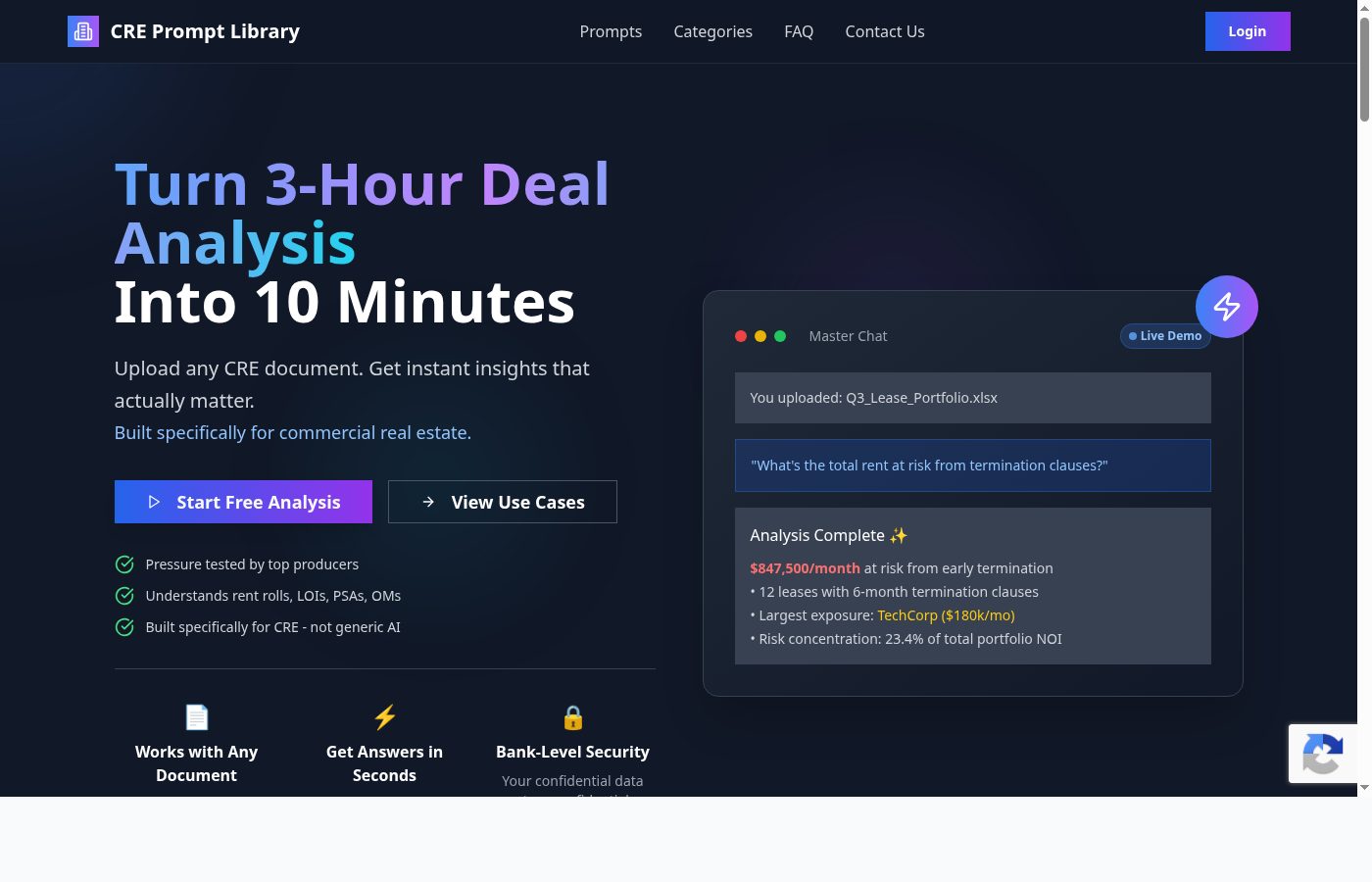
CRE Prompt Library is a categorized repository of custom text prompts designed specifically for commercial real estate use cases, operating on a published free and freemium pricing structure. In an environment where analysts and principals are increasingly turning to general-purpose large language models like ChatGPT, Claude, and Gemini to accelerate their workflows, the primary barrier to utility is often the user’s ability to instruct the model effectively. This platform aggregates tested instructions for tasks ranging from lease abstraction to operating statement analysis, providing a shortcut for professionals who lack the time or inclination to refine their own prompt engineering skills. As a Tier 2 CRE-native database, it does not process documents or execute workflows itself; rather, it serves as a reference guide for operators looking to extract more value from their existing artificial intelligence subscriptions.
The platform occupies a unique position in the broader landscape of commercial real estate artificial intelligence tools. While heavy-duty AI assistants and copilots like Agentforce or Conduit actively connect to proprietary databases and execute complex multi-step agents, CRE Prompt Library is fundamentally a static resource. It requires the user to manually copy the prompt, paste it into their model of choice, and supply their own context or data. This manual approach limits its scalability for enterprise deployments but makes it highly accessible for individual brokers, boutique investment firms, or independent appraisers. Evaluating this tool requires understanding that it is less a software application and more a specialized educational resource, designed to bridge the gap between commercial real estate domain expertise and effective machine communication in August 2026.
What CRE Prompt Library does and how it works
CRE Prompt Library functions as a searchable directory of pre-written text instructions tailored for commercial real estate tasks. Users navigate the site by filtering through categories such as acquisitions, asset management, leasing, debt origination, and property management. Each entry provides a specific text block designed to be copied and pasted into a third-party large language model. For example, rather than a user typing a basic request to summarize a lease, the library provides a highly structured prompt that instructs the model to extract specific clauses, identify co-tenancy requirements, highlight termination options, and format the output into a specific table structure. The tool relies entirely on the user’s external AI subscription to execute the actual work.
Beyond basic categorization, the platform includes variables within its prompts, indicating exactly where the user needs to insert their proprietary information. A prompt for drafting a letter of intent will feature bracketed sections for tenant name, square footage, base rent, and tenant improvement allowances. The user copies the template, fills in the bracketed variables with their deal-specific metrics, and feeds the complete text to their preferred model. This structure helps prevent the common issue of large language models generating generic or hallucinated responses due to vague instructions. It enforces a disciplined approach to interacting with artificial intelligence, ensuring that the model receives the necessary constraints and formatting requirements to produce a commercially useful output.
The freemium model dictates the depth of access. Basic prompts for routine tasks like drafting marketing copy are available at no cost. More complex prompts designed for financial modeling analysis, lease clause comparison, or zoning code interpretation are gated behind the premium tier. The platform does not host its own large language model, meaning it does not store user data, process confidential offering memorandums, or connect with external data sources. Its mechanics are strictly limited to providing text templates for the user to deploy elsewhere, making it an entirely manual but highly specialized utility for the commercial real estate sector.
9AI Framework: the score, dimension by dimension
CRE Relevance: 9/10
The entire value proposition of this platform is its strict focus on commercial real estate. Unlike generic prompt directories that cater to marketers or software developers, every entry here is built for industry-specific workflows like underwriting, tenant representation, and capital markets. The terminology used within the prompts reflects an accurate understanding of net operating income, capitalization rates, and lease structures. Because it is classified as a CRE-Native database, it successfully bridges the gap between generic artificial intelligence models and the specialized vocabulary required by industry professionals. It does not attempt to serve other verticals, which keeps the repository highly concentrated and immediately applicable to property professionals. In practice: Analysts will find the prompt templates use the correct industry jargon and structural expectations required for institutional-grade real estate analysis.
Data Quality and Sources: 4/10
As a Tier 2 repository, this tool provides text templates rather than empirical market data. It does not supply rent comps, sales histories, or demographic metrics. The data it provides consists entirely of the instructional text within the prompts themselves. While these instructions are generally well-crafted and logically structured, their ultimate utility relies entirely on the quality of the proprietary data the user pastes into the prompt alongside them. The platform cannot verify if the user’s input data is accurate, nor can it prevent the external large language model from hallucinating based on those inputs. In practice: Users must supply their own verified property metrics and lease documents, as the library provides only the framework for analysis, not the underlying facts.
Ease of Adoption: 9/10
The barrier to entry for this tool is effectively zero. Because it requires no software installation, no API configuration, and no integration with existing enterprise systems, users can begin extracting value immediately. The interface is a straightforward searchable directory, and the core action involves simply highlighting text, copying it, and pasting it into an external application like ChatGPT or Claude. This manual process bypasses typical IT procurement hurdles and security reviews, as no corporate data is ever uploaded to the prompt library itself. Training requirements are nonexistent, making it highly accessible for professionals with minimal technical expertise. In practice: A broker can navigate to the site, find a relevant prompt, and generate a property description in under three minutes without any onboarding.
Output Accuracy: 5/10
The accuracy of the results generated using these prompts is entirely dependent on the third-party artificial intelligence model the user chooses to employ. While a well-structured prompt significantly reduces the likelihood of errors or hallucinations, the library itself has no control over the final output. If a user pastes a highly detailed lease abstraction prompt into an older or less capable model, the results may still contain critical errors regarding termination dates or expense stops. The platform provides the best possible instructions, but it cannot guarantee the mathematical or factual correctness of the resulting analysis. In practice: Principals must still rigorously review the outputs generated by their external models, treating the prompt library as a guide rather than a definitive source of truth.
Integration and Workflow Fit: 2/10
This platform offers absolutely no technical integration with the standard commercial real estate technology stack. It does not connect to Argus, Yardi, VTS, or Salesforce. There are no APIs, webhooks, or browser extensions to automatically pull data from your existing systems into the prompt templates. The entire workflow relies on the user manually copying text from the library, pasting it into a separate browser tab, and then manually typing or pasting in their proprietary data. Compared to peers like Agentforce or Conduit, which actively connect to databases to execute multi-step workflows, this is a purely disconnected, manual utility. In practice: Analysts will have to maintain a highly manual, dual-screen workflow, constantly copying and pasting between the library, their data source, and their AI model.
Pricing Transparency: 9/10
The platform operates on a published Free/Freemium model, making its cost structure entirely transparent to prospective users. Basic access to general prompts requires no payment, allowing operators to test the utility of the repository before committing capital. The premium tier, which unlocks complex, multi-step analytical prompts, is clearly priced on the website without requiring a conversation with a sales representative. This straightforward approach is highly favorable for individual brokers or small teams who need immediate access without navigating enterprise software procurement cycles. There are no hidden implementation fees or mandatory multi-year contracts. In practice: Buyers can evaluate the exact cost of the premium tier upfront and calculate their expected return on investment without engaging in lengthy sales negotiations.
Support and Reliability: 5/10
As an unproven startup in the rapidly evolving artificial intelligence space, the long-term reliability and support infrastructure of the platform remain questionable. There is no dedicated account management, no service level agreements guaranteeing uptime, and limited avenues for technical support beyond basic email inquiries. While the static nature of a text repository means catastrophic software failures are unlikely, users cannot expect the enterprise-grade troubleshooting provided by established vendors. Furthermore, as large language models evolve to require less detailed prompting, the fundamental utility of the platform may shift, and it is unclear if the startup has the resources to continuously update its library to match new model capabilities. In practice: Users should expect a self-serve experience and rely on their own troubleshooting skills if a specific prompt template fails to yield the desired results.
Innovation and Roadmap: 4/10
The product roadmap for a static prompt repository is inherently limited. While the developers can continue to add new categories and refine existing text templates, the core mechanics of copying and pasting text are unlikely to evolve significantly. Unlike advanced engineering platforms like Cursor or Replit, which continuously ship complex features to automate actual workflows, CRE Prompt Library is constrained by its format. There is little indication that the platform will introduce native model hosting, document parsing, or automated data extraction capabilities in the near future. The innovation here is entirely dependent on the external models the prompts are designed for. In practice: Buyers should purchase this tool for its current repository of text templates, rather than expecting it to evolve into a comprehensive artificial intelligence application.
Market Reputation: 5/10
Operating as an unproven startup, the platform has yet to establish a significant footprint among institutional commercial real estate firms. While it may generate organic interest among independent brokers and forward-thinking analysts on social media, it lacks the validated case studies and enterprise deployments typical of higher-rated tools. It is not widely recognized by major brokerages or institutional asset managers as a standard part of their technology stack. The reputation is currently that of a niche utility rather than a foundational enterprise platform. Trust is still being built, and the company must prove it can maintain relevance as artificial intelligence models become more intuitive. In practice: Institutional buyers will likely view this as an experimental, individual-level productivity hack rather than a vendor worthy of a firm-wide enterprise software contract.
Who should use CRE Prompt Library
The manual, copy-paste nature of this platform makes it highly suitable for individuals and small teams who want to experiment with artificial intelligence without heavy software investments. It serves best as an educational bridge for those learning how to communicate with large language models.
Independent brokers needing quick templates for property descriptions and marketing emails.
Junior analysts looking to standardize their lease abstraction requests in ChatGPT.
Boutique investment principals who want to explore AI capabilities without committing to enterprise software contracts.
Marketing coordinators seeking structured frameworks for generating localized market reports.
Who should look elsewhere
Firms looking for automated, integrated workflows will find this manual repository entirely insufficient. It lacks the connectivity and security features required by large organizations managing proprietary data.
Institutional asset managers requiring direct integrations with Yardi or Argus.
Enterprise IT departments seeking secure, closed-loop AI environments that prevent data leakage.
Firms looking to automate complex, multi-step underwriting models without manual data entry.
Operators who prefer agentic workflows like those found in Conduit or Manus.
Pricing and ROI
CRE Prompt Library operates on a straightforward Free/Freemium pricing model, which is clearly published on their website. The basic tier is available at no cost and provides access to a limited selection of generalized prompts suitable for routine administrative and marketing tasks. For users requiring specialized instructions for financial analysis, complex lease review, or zoning evaluations, the platform gates these behind a premium subscription. Because the tool does not host the actual artificial intelligence models, users must also account for the cost of their separate subscriptions to services like ChatGPT Plus or Claude Pro. The return on investment math for the premium tier is highly favorable for individual operators. If the premium subscription costs the equivalent of one hour of an analyst’s time per month, the tool only needs to save a few minutes per week to justify the expense. By eliminating the trial-and-error phase of prompt engineering, a broker drafting two offering memorandums a month can easily recover the cost through time savings alone. However, enterprise buyers should note that the lack of bulk licensing or team administration features means this is typically expensed on individual corporate cards rather than procured centrally.
Integration and CRE tech stack fit
The integration fit for CRE Prompt Library is effectively nonexistent, which is entirely by design. This platform operates completely outside of the standard commercial real estate technology stack. There are no APIs, no direct database connections, and no plugins for common industry software like VTS, Dealpath, or MRI Software. It also lacks direct integration with the artificial intelligence models it serves; users cannot click a button to execute a prompt directly within the library. Instead, the workflow is entirely manual. An analyst must open the prompt library in one browser window, open their preferred large language model in a second window, and open their source data in a third. They must manually copy the prompt, paste it into the model, and then manually extract their proprietary property data from Excel or PDF to fill in the prompt’s required variables. This disconnected approach ensures zero risk of automated data leakage, but it entirely prevents the creation of streamlined, automated workflows for high-volume tasks.
Competitive landscape
When evaluating CRE Prompt Library, buyers must distinguish between static repositories and active execution platforms. For pure prompt engineering and workflow automation, heavy-duty tools like Cursor, Replit, and Gumloop offer vastly superior capabilities. Cursor and Replit allow technical analysts to build custom, code-driven applications that interact directly with real estate data, scoring highly in our evaluations (90 and 88, respectively). Gumloop (87) provides a visual interface for stringing together multi-step AI operations, automating the exact processes that CRE Prompt Library requires you to do manually. Furthermore, platforms like Agentforce (88), Manus (87), and Conduit (87) act as true AI agents, actively connecting to enterprise databases to retrieve information, process it, and execute tasks without manual copying and pasting. CRE Prompt Library does not compete with these tools on functionality. Instead, its primary competition comes from generic prompt directories, free newsletters, and internal company wikis where analysts share their own successful ChatGPT instructions. The specific advantage of CRE Prompt Library is its strict commercial real estate focus, saving users the effort of filtering through irrelevant marketing or coding prompts found on broader platforms. However, as AI models become more adept at understanding vague instructions, the competitive moat of a static prompt directory will inevitably shrink.
The bottom line
CRE Prompt Library is a specialized, low-risk educational resource rather than a transformative piece of enterprise software. It effectively solves the blank page problem for commercial real estate professionals who want to utilize large language models but lack the time to master prompt engineering. At its freemium price point, it is an easy recommendation for independent brokers, boutique principals, and junior analysts looking to accelerate their daily drafting and summarization tasks. However, institutional buyers and technology officers should pass. The complete lack of integrations, the manual copy-paste workflow, and the inability to process proprietary data at scale mean this tool cannot support enterprise-grade automation. Purchase the premium tier if you need an immediate, individual productivity boost, but look to more advanced agentic platforms if you want to fundamentally rewire your firm’s operational workflows.
Frequently asked questions
Does CRE Prompt Library connect directly to my ChatGPT or Claude account?
No, the platform does not offer direct API connections or browser extensions to link with your external artificial intelligence accounts. You must manually copy the text from the library and paste it into the chat interface of your chosen model.
Can I upload my property rent rolls or operating statements to the platform?
You cannot upload any documents, rent rolls, or proprietary data directly to the platform. It functions strictly as a static text repository. You must supply your sensitive property data directly to your external large language model only after pasting in the instructional template provided by the library.
Is the premium subscription required to get value from the tool?
The free tier provides sufficient value for basic tasks like drafting marketing emails or general property descriptions. However, if you require complex, multi-step instructions for financial underwriting, lease clause abstraction, or zoning analysis, you will need to upgrade to the paid premium subscription.
Will this tool automatically update my CRM with the generated property data?
No, the platform offers absolutely no integrations with commercial real estate technology stacks like Salesforce, VTS, or Dealpath. Any data or text generated by your external model must be manually copied and pasted back into your firm’s customer relationship management software.
How does this compare to enterprise platforms like Agentforce or Conduit?
Agentforce and Conduit are active platforms that connect to your databases and execute automated, multi-step workflows. CRE Prompt Library is a passive, static directory of text instructions. It requires entirely manual operation and serves as an educational guide rather than an automated execution engine.
Does the platform guarantee the mathematical accuracy of its underwriting prompts?
The platform provides instructions, but it cannot guarantee accuracy. The mathematical correctness of any financial analysis depends entirely on the capabilities of the third-party model you use and the accuracy of the data you input. Users must rigorously verify all generated outputs.
Related Reviews
Compare CRE Prompt Library with other AI Assistants & Copilots tools BestCRE has scored: Google Gemini (84/100), Grammarly (83/100), CodeWords (72/100) and Flowrite (68/100). Browse every review in CRE AI Assistants & Copilots, the full Best CRE AI Tools directory, or the 20 CRE Sectors hub.