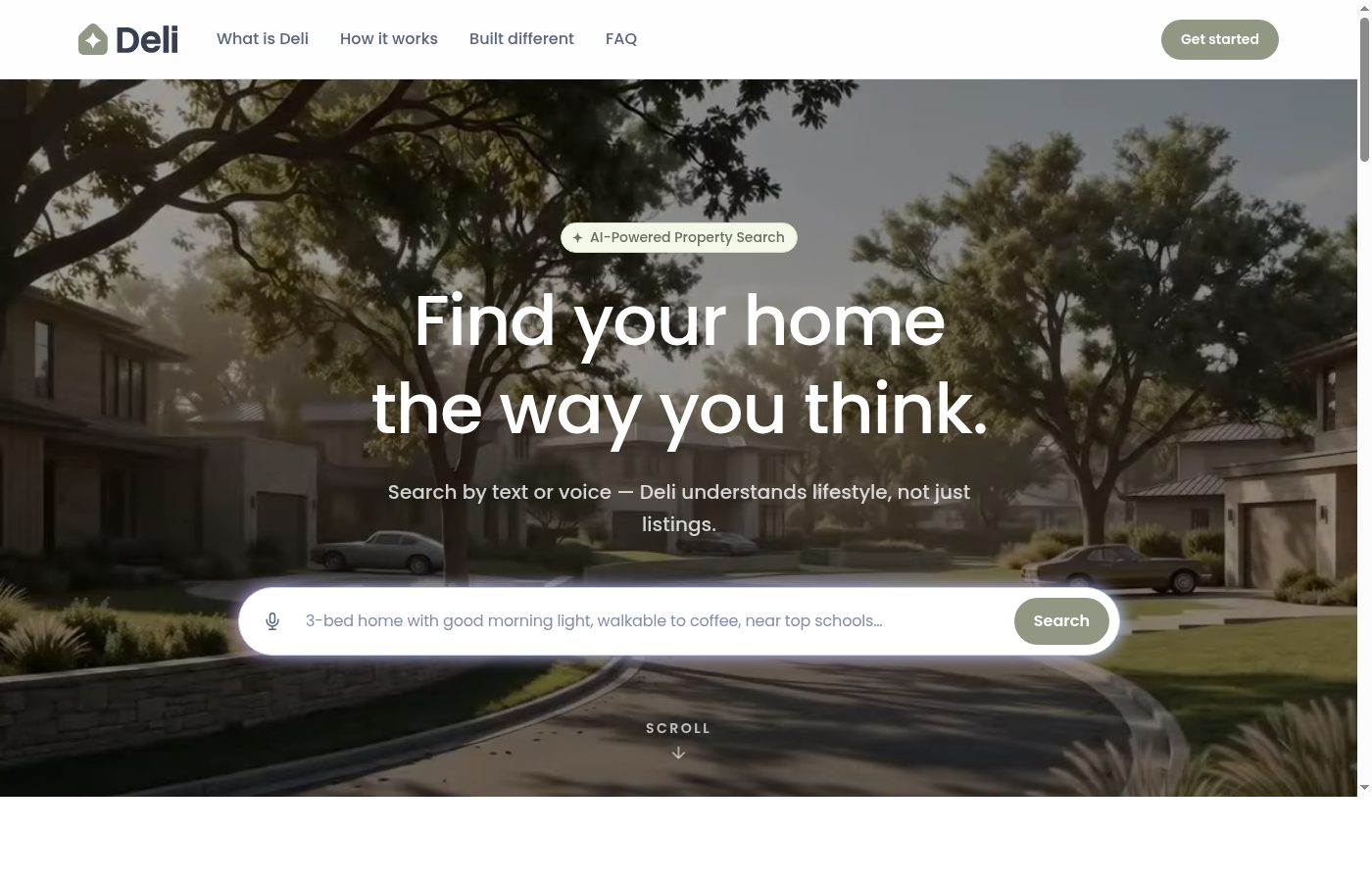
DELI is an AI-driven property search platform that utilizes natural language processing combined with MLS integration, currently offering a lifetime subscription for $135 or a monthly plan at approximately $13 as of March 2026. Classified as a Tier 2 CRE-Native tool in the BestCRE Master Database, DELI primarily targets the residential market through its home search capabilities. However, it has drawn attention from commercial real estate professionals evaluating acquisitions in the single-family rental (SFR) and small multifamily spaces. The platform attempts to replace traditional, filter-heavy database queries with conversational prompts, allowing users to type complex requirements and receive matching MLS listings. While the premise is attractive for high-volume screening, the underlying data architecture is fundamentally geared toward retail homebuyers rather than institutional acquisition teams.
Our analysis indicates that commercial principals must approach this application with a clear understanding of its limitations. DELI does not provide traditional commercial metrics such as cap rates, net operating income history, or tenant rent rolls. Instead, it serves as a top-of-funnel residential aggregator. For CRE firms building scattered-site portfolios or monitoring residential trends to inform commercial development, DELI offers a low-cost, experimental entry point into AI search. Yet, for pure commercial acquisitions involving retail, office, or industrial assets, the platform lacks the requisite data depth. The software positions itself in a crowded proptech market as a consumer-friendly interface, leaving commercial analysts to determine if the time saved on initial searches justifies the manual underwriting required later in the acquisition pipeline.
What DELI does and how it works
DELI functions primarily as a natural language search engine layered over standard MLS data feeds. Users interact with the platform via a chat-like interface, typing queries such as “show me four-bedroom properties under a million dollars with a pool” rather than manually selecting drop-down filters. The artificial intelligence parses these conversational inputs, translates them into database queries, and retrieves matching listings from the connected MLS. This mechanic eliminates the friction of traditional search forms, theoretically accelerating the initial property discovery phase for users who know exactly what they want but wish to avoid clicking through multiple parameter menus.
Behind the interface, the system relies on standard residential listing data. The AI evaluates property descriptions, basic specifications, and geographic tags to present results. However, our analysis reveals that the tool does not natively synthesize commercial underwriting parameters. Users cannot prompt the system for “properties with a six percent cap rate” or “assets with triple-net leases in place,” as the underlying MLS integration does not consistently capture or structure this commercial data. The output is typically a list of residential properties that match the physical and geographic constraints of the prompt, complete with standard listing photos and agent remarks.
For a commercial acquisitions analyst, the mechanical utility of DELI is restricted to single-family rental portfolio aggregation or identifying small residential parcels for potential redevelopment. The platform does not offer automated valuation models, rent roll parsing, or zoning analysis. It simply executes complex, multi-variable residential searches using plain English. Users can save searches and review listings, but any financial modeling or yield analysis must occur outside the platform in a separate spreadsheet or dedicated underwriting software.
9AI Framework: the score, dimension by dimension
CRE Relevance: 4/10
DELI operates entirely on an MLS integration designed for residential home searches, severely limiting its utility for traditional commercial real estate acquisitions. The BestCRE Master Database classifies it as a Tier 2 CRE-Native tool, but its primary use case remains consumer-facing residential discovery. The platform lacks fields for net operating income, lease expirations, or zoning classifications, which are mandatory for evaluating office, retail, or industrial assets. While single-family rental investors might find some crossover value, the absence of commercial-specific data structures means the software cannot function as a primary acquisitions database for institutional buyers. Analysts will find themselves exporting basic property data and manually appending the financial metrics required for actual investment decisions. In practice: Commercial teams will only use this for scattered-site residential portfolio building.
Data Quality and Sources: 6/10
The platform relies on a direct MLS integration, meaning the baseline data quality mirrors the accuracy of the local multiple listing service. While MLS data is generally reliable for basic property characteristics like square footage and bedroom counts, it is notoriously inconsistent regarding investment metrics. The AI attempts to parse broker remarks and unstructured text to fulfill natural language queries, which introduces a margin of error if the listing agent used unconventional abbreviations or omitted key details. Our analysis shows that because DELI does not clean or standardize commercial data points, users are entirely dependent on the quality of the original residential listing input. In practice: Users must independently verify any investment-critical information pulled from the natural language search results.
Ease of Adoption: 8/10
DELI excels in user experience due to its core premise: replacing complex search filters with a conversational interface. The natural language processing engine allows users to type queries exactly as they think of them, requiring zero training on database syntax or proprietary search mechanics. Because the tool targets the broader home search market, the onboarding process is virtually non-existent, allowing an analyst to create an account and begin querying the MLS within minutes. The interface is intuitive, uncluttered, and highly responsive to plain English commands. This consumer-grade design philosophy ensures that even the least technical members of an acquisitions team can operate the software immediately. In practice: Analysts can bypass training sessions and begin sourcing residential properties on day one.
Output Accuracy: 6/10
The accuracy of DELI heavily depends on the AI’s ability to interpret complex conversational prompts and map them to rigid MLS fields. When queried for standard parameters like price, location, and property type, the retrieval is highly accurate. However, our analysis indicates that when users introduce subjective or nuanced criteria, such as “properties needing light renovation” or “homes suitable for student housing”, the AI relies on keyword matching within broker remarks, leading to false positives. Furthermore, the system occasionally struggles to filter out pending or sold properties if the MLS feed experiences latency. The natural language model does not hallucinate properties, but it can misinterpret the intent behind a commercial buyer’s specific query. In practice: Analysts must manually review the generated property list to weed out irrelevant matches.
Integration and Workflow Fit: 4/10
As a standalone AI search interface, DELI offers minimal integration capabilities for a standard commercial real estate technology stack. The platform does not currently publish APIs for direct connections to enterprise underwriting tools like Argus or CRM systems like Salesforce. Users are restricted to the closed ecosystem of the DELI interface for their initial property discovery. To move a potential acquisition through the pipeline, analysts must resort to manual data entry or basic CSV exports, breaking the digital chain of custody. For a tool categorized in the CRE Acquisitions space, the inability to push selected properties directly into a financial modeling environment creates a significant workflow bottleneck. In practice: Teams will spend unbillable hours copying property addresses and asking prices into their proprietary Excel models.
Pricing Transparency: 10/10
DELI provides exceptional clarity regarding its cost structure, publishing its rates directly on the public website. The company offers a monthly subscription at approximately $13 per month, alongside a highly aggressive lifetime access tier priced at $135. This straightforward, dual-option model eliminates the need for prolonged sales calls or custom enterprise quotes, which are frustratingly common in the proptech sector. The published pricing allows commercial principals to calculate their exact financial exposure before ever creating an account. By avoiding hidden fees, seat licenses, or complex usage-based billing tiers, the vendor establishes immediate financial trust with prospective buyers evaluating the software for high-volume residential screening. In practice: Buyers can authorize the purchase on a corporate card without requiring a formal procurement review.
Support and Reliability: 5/10
Given its status as an early-stage startup offering a $135 lifetime deal, DELI presents significant risks regarding long-term support and platform reliability. The vendor does not publish service level agreements (SLAs) or offer dedicated account managers for enterprise clients. Support is likely relegated to basic email ticketing or automated chatbots, which is insufficient for commercial teams executing time-sensitive acquisitions. Our analysis suggests that companies offering lifetime subscriptions often struggle to maintain the server infrastructure required for intensive AI processing as their user base scales. Therefore, buyers cannot depend on immediate technical assistance if the MLS integration fails or the natural language engine experiences downtime during critical working hours. In practice: Users must treat the software as an unsupported utility rather than mission-critical enterprise infrastructure.
Innovation and Roadmap: 6/10
The vendor has not published a formal product roadmap detailing future feature releases or expanded commercial capabilities. While the core natural language search is a modern application of AI, the lack of forward-looking documentation makes it difficult to assess how the tool will evolve. Our analysis indicates that the current development focus remains strictly on refining the consumer home search experience rather than building out commercial underwriting tools or advanced portfolio analytics. Without a clear commitment to adding commercial data fields, API webhooks, or predictive valuation models, the software is likely to remain a top-of-funnel residential search widget rather than maturing into a comprehensive acquisitions platform. In practice: Buyers should purchase the tool for its current capabilities, expecting zero future commercial enhancements.
Market Reputation: 4/10
Within the commercial real estate sector, DELI possesses virtually no established market reputation. The platform is entirely absent from institutional acquisitions conversations, which typically center around heavyweights like Crexi or ProspectNow. Because it targets the broad residential market with a low-cost subscription model, it has not built the necessary credibility among commercial principals or senior analysts. The BestCRE Master Database notes its existence as a Tier 2 tool, but peer reviews from commercial users are non-existent. As an unproven startup, it lacks the case studies, enterprise client roster, and industry endorsements required to be considered a serious contender in the CRE technology landscape. In practice: Analysts advocating for this software will face skepticism from partners who prefer established, industry-standard databases.
Who should use DELI
DELI provides specific utility for buyers operating at the intersection of residential property and commercial investment strategies. The platform is best suited for teams that require high-speed filtering of standard MLS data without the need for complex financial metrics.
Single-family rental (SFR) portfolio aggregators looking to quickly identify inventory based on precise physical characteristics.
Small multifamily investors seeking duplexes or quadplexes through conversational queries rather than manual database searches.
Land developers monitoring residential market activity to identify potential assemblage opportunities in specific neighborhoods.
Boutique investment firms wanting a low-cost, experimental AI tool to supplement their primary commercial databases.
Who should look elsewhere
The platform is fundamentally inadequate for traditional commercial real estate professionals who require deep financial data, tenant information, or commercial-specific asset classes.
Institutional acquisitions teams targeting retail, office, or industrial assets, as the MLS integration does not support these property types.
Financial analysts requiring automated underwriting, cap rate history, or rent roll parsing directly within the search interface.
Enterprise brokerages that demand API connectivity to push property data directly into Salesforce or Argus.
Principals who require vendor service level agreements and dedicated enterprise support for their technology stack.
Pricing and ROI
DELI operates on a highly transparent, consumer-oriented pricing model that is publicly available on its website. According to the BestCRE Master Database, the software costs approximately $13 per month for a standard subscription. Alternatively, the vendor offers a lifetime access tier for a single payment of $135. This pricing structure is exceptionally low for the proptech sector, reflecting the platform’s focus on the broader home search market rather than enterprise commercial clients.
For a commercial acquisitions team evaluating single-family rental portfolios, the return on investment (ROI) math is compelling despite the tool’s limitations. If an analyst earns $50 per hour and typically spends four hours a week manually configuring MLS filters to find viable investment properties, the labor cost is $200 weekly. If the natural language search interface saves just one hour of that time per week, the tool generates $50 in weekly labor savings. At the $135 lifetime price point, the software pays for itself in less than three weeks of use. However, this ROI calculation only holds true if the firm actually acquires residential assets; for pure commercial firms, the software provides zero financial return regardless of its low cost, as the data is simply irrelevant to their core business.
Integration and CRE tech stack fit
When evaluating integration fit within a standard commercial real estate technology stack, DELI falls significantly short of industry expectations. The platform functions as an isolated, top-of-funnel search widget rather than a connected enterprise application. Our analysis reveals that the vendor does not provide open APIs, webhooks, or native integrations with industry-standard platforms such as Salesforce, HubSpot, or Argus Enterprise. Consequently, the software cannot automatically push identified properties into a firm’s proprietary underwriting models or customer relationship management systems.
Analysts are forced to rely on manual data extraction, typically copying and pasting property addresses, asking prices, and basic specifications from the DELI interface into Excel spreadsheets. This lack of connectivity breaks the digital workflow, increasing the risk of data entry errors and slowing down the acquisitions pipeline. While established peers like ProspectNow and Crexi offer structured data exports and CRM linkages, DELI remains a closed loop. For commercial teams that prioritize automated data flow and centralized portfolio management, introducing this tool will create an isolated data silo that requires constant manual reconciliation.
Competitive landscape
In the CRE Acquisitions category, DELI occupies a strange niche, competing more with consumer portals like Zillow than with true commercial databases. When benchmarked against peers scored by BestCRE, its limitations become glaringly apparent. Crexi (Scored 84) and LoopNet (Scored 76) remain the industry standards for active commercial listings, offering deep asset categorization, offering memorandums, and broker contact information that DELI simply cannot match. For off-market prospecting and predictive analytics, ProspectNow (Scored 80) and PropertyRadar (Scored 79) provide comprehensive ownership records, debt histories, and commercial zoning data, whereas DELI is restricted entirely to active residential MLS feeds.
If a firm is specifically looking for AI-driven site selection and assemblage tools, CityBldr (Scored 79) offers a far more sophisticated, commercially focused algorithm that analyzes highest and best use, rather than just parsing conversational search queries. Even legacy platforms like REIS (Scored 77) deliver the macroeconomic data and submarket rent trends required for institutional underwriting. Ultimately, DELI is a residential home search tool masquerading as a proptech innovation. Commercial analysts evaluating this software must recognize that it does not replace any of the aforementioned platforms. Instead, it serves only as a cheap, supplementary interface for teams that happen to acquire single-family rentals alongside their primary commercial operations.
The bottom line
Commercial real estate principals should pass on DELI unless their firm specifically targets single-family rental aggregations or small multifamily residential properties. The natural language search interface is undeniably clever, and the $135 lifetime pricing makes it an impulse purchase. However, clever interfaces do not underwrite commercial assets. The platform’s total reliance on residential MLS data means it completely lacks the financial metrics, tenant data, and commercial asset classifications required for institutional acquisitions. It is a consumer-grade tool that offers no API connectivity, no enterprise support, and no relevant data for office, retail, or industrial investors. Do not allocate training time or workflow integration efforts toward a platform that cannot export a rent roll or identify a cap rate. Treat this software as a cheap residential widget, not a viable addition to a professional commercial real estate technology stack.
Frequently asked questions
Does DELI provide cap rates and net operating income data?
No, the platform relies entirely on standard residential MLS data feeds. It does not capture, calculate, or display commercial financial metrics such as cap rates, net operating income, or tenant rent rolls, making it highly unsuitable for traditional commercial underwriting.
Can I integrate this software directly with Argus or Salesforce?
The vendor does not currently offer open APIs or native integrations for enterprise commercial real estate software. Users cannot automatically push property data into Argus, Salesforce, or other proprietary underwriting models, requiring analysts to manually enter data into their systems.
Is the lifetime subscription a reliable long-term investment for my firm?
Purchasing a lifetime deal for $135 from an early-stage startup carries inherent risks. The company does not provide enterprise service level agreements, and there is no guarantee the vendor will maintain the server infrastructure or MLS connections required to keep the tool operational long-term.
Does the AI search engine hallucinate property listings?
The natural language model does not invent properties, as it strictly pulls from active MLS feeds. However, it can misinterpret conversational prompts or rely too heavily on keyword matching in broker remarks, which frequently results in irrelevant listings appearing in your search results.
Will this tool help my team find off-market commercial properties?
No, the software only indexes active listings provided by the multiple listing service. It does not contain public tax records, debt histories, or predictive algorithms to identify distressed off-market commercial assets, unlike dedicated prospecting platforms such as ProspectNow or PropertyRadar.
How much training does an analyst need to use the platform?
The primary advantage of this software is its consumer-grade ease of use. Because it relies on a conversational interface rather than complex database filters, analysts require zero formal training. Users can simply type their property requirements in plain English and immediately review the results.
Related Reviews
Compare DELI with other Acquisitions tools BestCRE has scored: Searchland AI (83/100), Spaceflare (76/100), Combify (74/100) and Leadflow (74/100). Browse every review in CRE Acquisitions, the full Best CRE AI Tools directory, or the 20 CRE Sectors hub.