InspectMind AI is an artificial intelligence platform purpose-built for commercial real estate development, focusing specifically on construction inspection and field reporting. The BestCRE Master Database confirms the company operates on a custom pricing model, targeting general contractors, developers, and engineering firms who need to automate site documentation and pre-construction plan reviews. Founded by a Y Combinator alumni team with backgrounds in structural engineering and computer science, the software tackles the administrative bloat that typically consumes hours of a field inspector’s day. By applying large language models and computer vision to site photos, voice notes, and architectural PDFs, the platform converts unstructured field data into formatted, professional documentation without manual data entry.
For commercial real estate principals and development analysts evaluating construction technology in Q3 2026, InspectMind AI represents a shift toward generative AI applications in the field. While the commercial real estate industry has historically relied on manual checklists and late-night report formatting, this tool attempts to eliminate the friction between observing a site condition and documenting it for stakeholders. The platform operates across two primary vectors: a mobile application for generating daily logs and inspection reports from the job site, and a web-based plan checker that scans construction drawings for code violations before mobilization. As development yields face pressure from capital costs, tools that promise to reduce rework and accelerate administrative tasks are receiving intense scrutiny from asset managers and construction executives alike.
What InspectMind AI does and how it works
InspectMind AI functions as a dual-purpose artificial intelligence agent for construction execution and pre-development planning. The primary workflow centers on its field reporting application. When a project manager or structural engineer walks a commercial site, they use the mobile application to capture photographs and record unstructured voice notes about their observations. The artificial intelligence engine processes these inputs, transcribing the audio and analyzing the visual data to map findings into industry-standard templates. Instead of returning to the trailer to manually type up a structural evaluation or safety audit, the user receives a fully formatted Word or PDF document in minutes. The system categorizes issues, applies timestamps, and structures the narrative to match the specific requirements of the chosen report type.
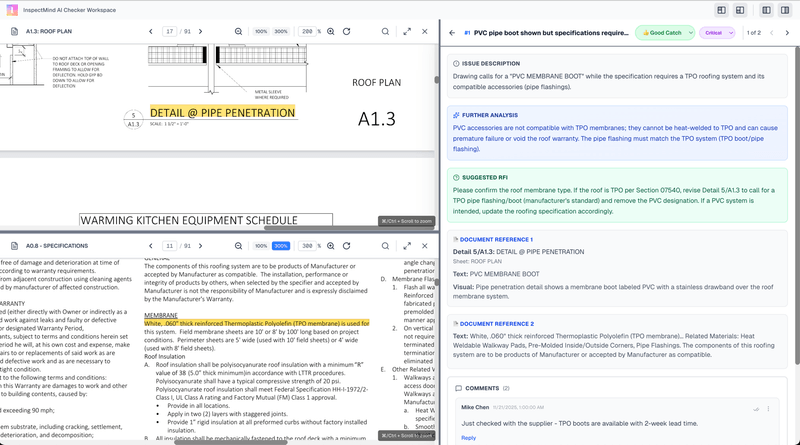
Beyond field documentation, the platform includes a pre-construction plan review module known as the AI Checker. Development teams upload their architectural, structural, civil, and mechanical, electrical, and plumbing (MEP) drawings alongside project specifications. The software scans these hundreds of pages against specific building codes, including the International Building Code (IBC) and local amendments. It cross-references the disciplines to identify coordination clashes, such as a specified air conditioning unit that exceeds the capacity of the detailed structural support, or dimensional mismatches between architectural plans and civil grading.
When the AI Checker completes its analysis, it generates a prioritized list of potential constructability issues and code violations. Every flagged item includes a direct citation to the uploaded documents and the relevant building code, providing the exact page number and visual evidence. This allows plan checkers and pre-construction managers to verify the findings quickly and issue Requests for Information (RFIs) to the design team before construction begins, aiming to prevent expensive field rework and schedule delays.
9AI Framework: the score, dimension by dimension
CRE Relevance: 9/10
Commercial real estate development relies heavily on accurate field reporting and stringent code compliance to maintain project schedules and protect capital returns. InspectMind AI directly addresses the operational bottlenecks inherent in ground-up construction and heavy value-add renovations. While it does not assist with leasing, property management, or financial underwriting, its focus on the physical execution of commercial assets makes it highly applicable to developers and owners’ representatives. By automating the documentation of site conditions and identifying design clashes before they manifest as change orders, the software targets the primary drivers of budget overruns in commercial real estate development. In practice: Development managers use the platform to maintain strict oversight of general contractors and ensure site observations are documented instantly.
Data Quality and Sources: 8/10
The platform’s effectiveness depends entirely on the quality of the inputs provided by field personnel and design teams. For field reports, the artificial intelligence relies on the clarity of voice dictation and the resolution of site photographs to generate accurate narratives. Background noise on an active construction site can occasionally challenge the transcription engine, requiring manual corrections. In the plan review module, the system requires high-fidelity PDF uploads of construction drawings and specifications to accurately read text and interpret diagrams. When fed clear, legible documents, the extraction and cross-referencing capabilities perform well, identifying complex discrepancies across different engineering disciplines. In practice: Users must ensure they capture clear audio and upload high-resolution, flattened PDFs to prevent the AI from generating false positives or missing critical details.
Ease of Adoption: 9/10
InspectMind AI is designed for immediate deployment without requiring extensive training or complex implementation periods. The mobile application interface is intuitive, mimicking standard voice memo and camera applications that field workers already use daily. For the pre-construction module, the web-based interface allows users to simply drag and drop PDF files into the system and select the relevant building codes. This self-serve model bypasses the heavy IT involvement typically associated with enterprise construction software. The learning curve is minimal, though users must adapt to reviewing AI-generated outputs rather than writing reports from scratch. In practice: A site superintendent can download the application, walk a job site, and generate their first formatted inspection report within an hour of account creation.
Output Accuracy: 8/10
The artificial intelligence engine demonstrates strong proficiency in structuring field notes into coherent, professional reports, though it requires human oversight. The transcription and formatting rarely introduce critical errors, but industry-specific terminology can sometimes be misinterpreted if spoken rapidly. In the plan review module, the system is highly conservative, flagging any potential discrepancy between drawings and specifications. This results in a high capture rate for legitimate coordination issues, but also produces a volume of false positives that a human engineer must filter out. The inclusion of direct citations and visual evidence for every flagged issue significantly mitigates the risk of hallucination. In practice: Engineers must treat the AI output as a highly thorough first draft, dedicating time to review and dismiss irrelevant flags before submitting official RFIs.
Integration and Workflow Fit: 7/10
The software currently operates primarily as a standalone application rather than a deeply embedded component of the enterprise technology stack. While it successfully exports findings into standard formats like Word and PDF documents, it lacks native, bidirectional synchronization with dominant construction management platforms like Procore, Autodesk Build, or CMiC. Users must manually download reports from InspectMind AI and upload them into their primary system of record. The platform does offer basic cloud storage synchronization, allowing teams to store their generated documents in shared repositories. However, for enterprise commercial real estate developers demanding unified data ecosystems, this disconnected workflow presents a minor administrative hurdle. In practice: Project coordinators will need to establish manual operating procedures to transfer AI-generated reports into the official project management database.
Pricing Transparency: 5/10
InspectMind AI does not publish its enterprise pricing tiers publicly, requiring prospective buyers to engage with their sales team to understand the full financial commitment. According to the BestCRE Master Database, the company operates on a custom pricing model. While some self-serve trial credits and per-upload fees are occasionally advertised for individual users, the actual cost for a commercial real estate development firm deploying the software across multiple projects and team members remains opaque. This lack of public pricing data forces analysts to invest time in discovery calls simply to determine if the platform fits within their technology budget. In practice: Buyers must prepare project volume estimates and user headcounts before initiating contact to secure an accurate enterprise pricing proposal.
Support and Reliability: 6/10
As a Tier 2 startup, the company is still building its enterprise support infrastructure. While the founding team is highly responsive and technically capable, the organization lacks the global, 24/7 support apparatus found in mature software vendors. Users typically rely on email support, in-app chat, and direct messaging channels to resolve technical issues. For standard field reporting glitches, this level of support is generally sufficient. However, if the plan review engine stalls during a critical pre-bid deadline, the absence of guaranteed, immediate phone support could frustrate enterprise development teams. The platform’s uptime is stable, but the support model is still scaling. In practice: Development teams should establish clear service level agreements during procurement to ensure adequate response times for critical project milestones.
Innovation and Roadmap: 8/10
Backed by prominent venture capital, the company demonstrates a rapid deployment of new features and capabilities. The development pipeline shows a clear focus on expanding the library of industry-specific report templates and deepening the AI’s understanding of complex, localized building codes. The founders’ backgrounds in structural engineering and computer science drive a product roadmap that is closely aligned with the actual pain points of construction execution. Future updates are expected to enhance the computer vision capabilities, potentially allowing the software to automatically detect safety violations or progress milestones directly from site photographs without requiring voice prompts. In practice: Early adopters will benefit from a fast-evolving feature set, provided they are comfortable adapting to frequent interface and capability updates.
Market Reputation: 6/10
InspectMind AI is gaining traction among early adopters in the construction and engineering sectors, but it has not yet achieved the ubiquitous brand recognition of older peers in the BestCRE database. Its Y Combinator pedigree lends it technical credibility, and initial user feedback highlights significant time savings in administrative tasks. However, as an unproven Tier 2 startup, it lacks the decade-long track record of successful enterprise deployments that risk-averse commercial real estate institutions typically require. The company is currently building its reputation project by project, proving its value through pilot programs rather than relying on established market dominance. In practice: Asset managers evaluating the tool will need to conduct thorough reference checks with current users rather than relying on broad industry consensus.
Who should use InspectMind AI
InspectMind AI delivers the highest return on investment for professionals directly responsible for site oversight and pre-construction risk management. The ideal users are those who spend excessive unbillable hours formatting documents or manually cross-referencing plan sets.
Owners’ Representatives: Professionals managing multiple commercial developments who need to generate independent, objective site observation reports quickly to keep stakeholders informed.
Pre-Construction Managers: General contractor teams looking to identify coordination clashes and code violations before finalizing bids, reducing the risk of margin erosion from unforeseen field issues.
Structural and Civil Engineers: Field personnel who conduct frequent site visits and require a faster method to translate their specialized observations into formal documentation.
Development Analysts: Real estate professionals tasked with auditing construction progress who want standardized, easy-to-read reports rather than deciphering handwritten superintendent notes.
Who should look elsewhere
This software is highly specialized for the physical construction phase and offers little utility for commercial real estate professionals focused on finance, leasing, or stabilized asset operations.
Acquisitions and Underwriting Teams: Analysts focused on financial modeling, rent roll analysis, and capital markets will find no relevant features in a construction inspection tool.
Leasing Brokers: Professionals managing tenant relationships and space marketing do not require building code analysis or hardhat field reporting capabilities.
Property Managers of Stabilized Assets: While they conduct property inspections, the heavy focus on construction codes and development plan sets makes this tool over-engineered for routine facility maintenance checks.
Pricing and ROI
According to the BestCRE Master Database, InspectMind AI utilizes a custom pricing model for its enterprise deployments. The vendor does not publish standardized subscription tiers, per-user license costs, or project-based flat fees on its public website. Consequently, commercial real estate developers and general contractors must engage directly with the sales team to scope their specific requirements, which are typically based on project volume, drawing complexity, and the number of field users.
For a commercial real estate principal evaluating the financial impact, the return on investment math relies on labor efficiency and risk mitigation. If a pre-construction manager earns $65 per hour and currently spends 20 hours manually cross-referencing a mid-rise multifamily plan set, the hard labor cost is $1,300 per review. If the AI Checker reduces that review time to 4 hours, the firm saves $1,040 in soft costs per project. More importantly, if the software catches a single structural-to-MEP coordination clash before mobilization, it can prevent a $15,000 change order and a three-day schedule delay. Similarly, if a field engineer saves six hours a week on report formatting, the firm gains approximately $1,500 in reclaimed productivity per month, per user. Buyers must weigh these projected savings against the custom quoted software fees to determine viability.
Integration and CRE tech stack fit
In the context of a modern commercial real estate technology stack, InspectMind AI operates more as a specialized point solution than a deeply integrated platform component. Currently, the software excels at generating standardized outputs, specifically Word documents and PDFs, that can be easily shared via email or uploaded into central repositories. However, it lacks native, out-of-the-box API connections to the industry’s dominant project management ecosystems.
For developers utilizing Procore, Autodesk Build, or Oracle Aconex, there is no direct pipeline to automatically sync AI-generated field reports into the daily log modules or automatically convert AI-flagged plan discrepancies into official RFIs within the system of record. Users must execute a manual export-and-upload workflow. The platform does support basic cloud storage synchronization, allowing teams to route finished reports to designated Google Drive, SharePoint, or Dropbox folders. While this ensures documents are archived correctly, the absence of deep data integration means project dashboards in enterprise resource planning (ERP) systems will not automatically reflect the insights generated by the AI. Development teams will need to rely on administrative discipline to ensure the outputs bridge the gap into their primary workflow tools.
Competitive landscape
The market for construction artificial intelligence is expanding rapidly, placing InspectMind AI in direct competition with both specialized startups and established platform incumbents. Within the BestCRE scored peer group, the most direct comparisons are Civils.ai (Scored 94) and Field Materials (Scored 91). Civils.ai offers a highly sophisticated approach to parsing geotechnical and civil engineering data, presenting a more mature data extraction capability for heavy infrastructure, whereas InspectMind AI is more strictly focused on vertical construction plan review and field reporting. Field Materials tackles a different operational bottleneck, procurement and material tracking, but shares the same buyer profile of general contractors looking to automate administrative overhead.
For pre-construction plan review, teams might also evaluate ALICE Technologies (Scored 87). While ALICE focuses heavily on generative scheduling and optioneering rather than static code compliance, both tools aim to de-risk the pre-construction phase. Datagrid (Scored 88) and LandScout AI (Scored 87) operate earlier in the development lifecycle, assisting with site selection and zoning analysis, making them complementary rather than strictly competitive.
Outside of the BestCRE scored peers, buyers should consider how InspectMind AI stacks up against legacy construction management software. Platforms like Procore and Autodesk are rapidly developing their own native artificial intelligence features for drawing management and daily logging. While InspectMind AI currently offers a more specialized, purpose-built agent for these specific tasks, buyers must decide whether to invest in a standalone Tier 2 startup or wait for their existing enterprise vendors to release similar native functionality. The decision hinges on the immediate need for automated report formatting versus the desire for a consolidated technology stack.
The bottom line
InspectMind AI is a highly effective, specialized tool for development teams drowning in construction documentation and manual plan reviews. By successfully applying artificial intelligence to the tedious tasks of field report formatting and cross-discipline drawing coordination, it offers immediate, measurable time savings for site engineers and pre-construction managers. However, its status as a Tier 2 startup with custom pricing and limited native integrations means it requires a deliberate implementation strategy. It will not natively connect to your enterprise resource planning software, and human oversight remains mandatory to filter out false positives. Commercial real estate developers and owners’ representatives should procure this software if their primary pain points are delayed site reporting and excessive early-stage change orders. If your firm prioritizes unified, all-in-one platform architecture over specialized point solutions, you may prefer to wait for incumbent vendors to mature their native artificial intelligence features.
Frequently asked questions
Does InspectMind AI integrate directly with Procore?
No, the platform currently lacks a native, bidirectional integration with Procore or Autodesk Build. Users must manually export generated reports as PDFs or Word documents and upload them into Procore’s daily log or documents modules. This disconnected workflow requires administrative discipline to keep enterprise systems updated.
What building codes does the AI Checker evaluate?
The AI Checker evaluates construction drawings against major national standards, including the International Building Code (IBC) and ADA requirements. It can also process specific local amendments, such as the Seattle Building Code, depending on the user’s project location and the parameters selected during the initial PDF upload process.
How much does InspectMind AI cost for an enterprise team?
The company operates on a custom pricing model for enterprise deployments, meaning public pricing tiers are not available. Buyers must contact the sales team to request a custom quote, which is typically calculated based on projected project volume, drawing complexity, and the total number of field users requiring access.
Can the software process handwritten field notes?
The platform is primarily designed to process voice dictation and site photographs captured directly through its mobile application. It converts those specific digital inputs into formatted text reports, meaning it is not optimized for scanning or transcribing traditional handwritten notes scribbled on paper clipboards.
Does the AI automatically issue RFIs to the architect?
No, the system does not automatically issue official Requests for Information. The AI flags potential coordination clashes and code violations, providing citations and visual evidence. A human engineer must review these findings, verify their accuracy, and manually initiate the formal RFI process through their standard communication channels.
Is InspectMind AI useful for property managers of existing buildings?
Generally, no. The tool is highly specialized for ground-up construction and heavy development projects. Its features focus on evaluating complex architectural plan sets and verifying building codes, making it significantly over-engineered for routine facility maintenance checks or standard property management inspections on stabilized commercial assets.
Related Reviews
Compare InspectMind AI with other Construction & Development tools BestCRE has scored: OpenSpace (86/100), Higharc (86/100), Firmus (84/100) and OnsiteIQ (84/100). Browse every review in CRE Construction & Development, the full Best CRE AI Tools directory, or the 20 CRE Sectors hub.