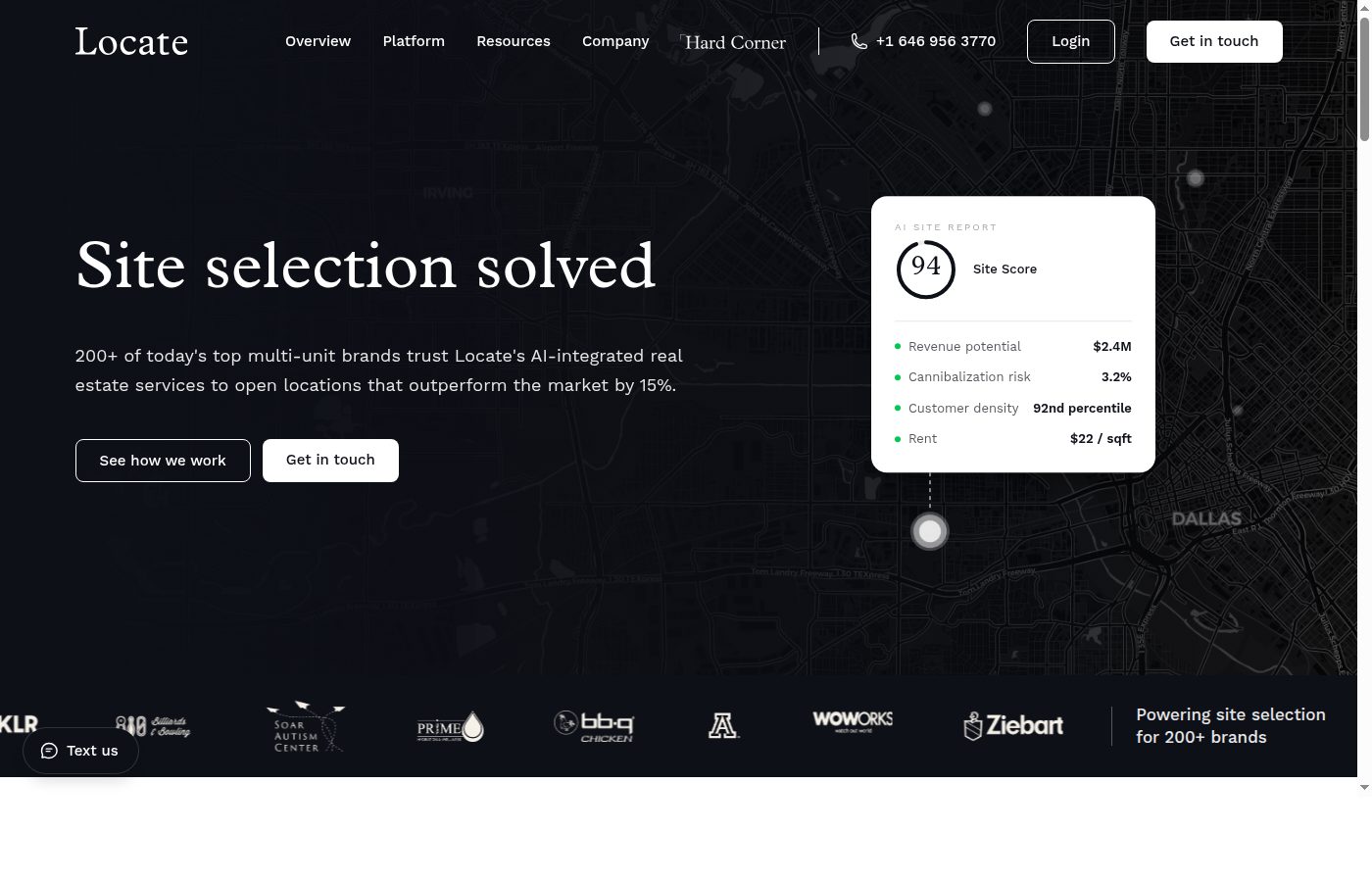
Locate.ai operates as a specialized hybrid between a technology platform and a commercial real estate brokerage, engineered specifically for multi-unit retail expansion. As verified in our BestCRE Master Database, its primary use case centers on AI models for retail location selection and lease workflows. Rather than offering a generalized property search engine, the company targets the highly specific problem of identifying profitable storefronts for expanding franchises and national chains, serving over 200 multi-unit brands. By combining mobile location data with proprietary machine learning, the platform attempts to replace traditional demographic radius rings with actual consumer movement patterns.
For a commercial real estate principal or retail expansion analyst evaluating this tool in August 2026, the value proposition rests on risk mitigation. Opening a new retail location requires significant capital expenditure, and traditional site selection often relies on static census data or anecdotal broker knowledge. Locate.ai digitizes this workflow, digesting foot traffic metrics, cross-shopping behaviors, and daytime population shifts to score candidate sites against a brand’s proven top performers. While the platform automates up to 90 percent of the commercial leasing workflow, buyers must understand that this is not a lightweight software-as-a-service application. It functions as an embedded advisory service where the software and the brokerage execution are deeply intertwined. This structure shifts the evaluation from a simple software procurement to a strategic partnership decision for your real estate department.
What Locate.ai does and how it works
Locate.ai functions by ingesting massive volumes of mobile device data to build dynamic trade areas, discarding the outdated methodology of drawing arbitrary mileage rings around a potential site. The platform tracks over 200 million mobile devices to understand where consumers actually travel, work, and shop. When an analyst inputs a candidate location, the system uses geofencing to analyze the specific foot traffic patterns of that parcel. It measures daytime versus residential pull, weekday versus weekend rhythms, and specific dwell times. This allows the software to differentiate between a quick errand stop and a destination visit, which is critical for tenant matching.
The core mechanic involves training a custom artificial intelligence model on a retailer’s existing, successful locations. By analyzing the mobile data and point-of-interest context of stores that already perform well, the system identifies the hidden variables driving that success. It then scans new markets to find parcels that share those exact characteristics. If a brand’s best customers frequently visit specific gyms or grocery stores before stopping at their shop, Locate.ai identifies those cross-shopping patterns and flags new sites with similar adjacencies. The output is a highly specific site score that ranks candidate locations based on their mathematical probability of matching or exceeding the baseline performance.
Beyond site identification, the platform digitizes the subsequent leasing workflows. It automates the generation of site packages, demographic reports, and initial landlord outreach materials. Because the system holds the underlying traffic data, analysts can instantly generate defensible, data-backed presentations to convince skeptical landlords or internal investment committees. The platform effectively acts as a centralized workspace where the analytical justification for a site and the transactional steps of securing the lease occur in the same environment.
9AI Framework: the score, dimension by dimension
CRE Relevance: 10/10
Locate.ai is entirely native to commercial real estate, specifically engineered for the retail and franchise sector. Unlike generalized data platforms that attempt to serve office, industrial, and multifamily assets simultaneously, this tool focuses exclusively on the mechanics of retail site selection and tenant representation. The platform understands the nuanced differences between daytime population pull, co-tenancy impacts, and vehicular traffic flow. Every feature, from trade area generation to lease workflow automation, is built around the specific pain points of a retail expansion team. It does not waste interface space on irrelevant asset classes or residential metrics that do not drive retail performance. In practice: Retail analysts will find a specialized environment tailored exactly to their daily site selection and underwriting requirements.
Data Quality and Sources: 9/10
The platform relies heavily on mobile location data and point-of-interest mapping rather than relying solely on static census figures. By tracking over 200 million mobile devices and utilizing nine years of training data, the system captures actual consumer movement, dwell times, and cross-shopping habits. This dynamic data provides a highly accurate picture of who is actually standing in front of a building, rather than who sleeps within a three-mile radius. However, mobile data is inherently directional and subject to privacy regulations, meaning it represents a sample rather than an absolute census. The proprietary models require high-quality input data from the retailer’s existing stores to function correctly; if your baseline data is flawed, the predictive outputs will suffer. In practice: You must supply accurate historical performance data from your existing portfolio to train the models effectively.
Ease of Adoption: 7/10
Because Locate.ai operates as a hybrid between a software platform and a brokerage service, adoption requires more than simply creating user accounts. The initial phase involves a significant onboarding process where the vendor’s team ingests your historical store performance data to train a custom model. This calibration period demands time and active participation from your real estate and operations teams. The interface itself is highly specialized, meaning analysts accustomed to traditional demographic reports will need to adapt to interpreting mobile data metrics, geofencing parameters, and probabilistic site scores. It is not a self-serve application that yields immediate results on day one. In practice: Expect a structured implementation period measured in weeks, requiring dedicated input from your data and real estate teams before generating actionable site scores.
Output Accuracy: 8/10
The predictive accuracy of Locate.ai is highly dependent on the volume and quality of the baseline data provided by the retailer. For established brands with dozens of locations, the machine learning models can identify subtle correlations in foot traffic and co-tenancy that humans routinely miss, resulting in highly accurate site recommendations. The platform excels at filtering out false positives, sites that look good on paper due to high population density but lack the specific daytime traffic patterns your brand requires. However, for emerging concepts with very few existing stores, the models have less training data to work with, which can widen the margin of error in the site scoring algorithms. In practice: The system delivers exceptional predictive accuracy for mature brands, but emerging concepts should treat the scores as directional guidance rather than absolute certainty.
Integration and Workflow Fit: 6/10
Locate.ai is designed primarily as a standalone environment for site selection and lease execution, rather than an API-first utility meant to plug into your existing enterprise resource planning software. While it can export reports and data visualizations for external presentations, it expects analysts to conduct their primary workflow within its proprietary interface. The platform does not natively sync with generalized CRM systems or property management databases, as its architecture is built around its own specialized data lake of mobile tracking and point-of-interest information. Buyers looking for a modular data feed to pipe into their own internal data warehouses will find this closed-ecosystem approach restrictive. In practice: Your real estate team will use this as their primary, standalone application for expansion planning rather than integrating it into a broader tech stack.
Pricing Transparency: 4/10
The vendor does not publish pricing on its website, requiring prospective buyers to engage in a direct sales process to understand the financial commitment. According to our BestCRE Master Database research, Locate.ai operates on a custom pricing model. Industry analysis indicates that the firm frequently utilizes a hybrid structure, charging recurring success fees per location or integrating software costs into traditional brokerage commission structures. Because the exact software licensing costs are obscured behind custom proposals and potential transaction fees, buyers cannot accurately benchmark the expense against traditional software-as-a-service alternatives prior to engagement. This lack of public clarity significantly complicates initial budget forecasting for real estate departments. In practice: You must complete a full discovery process and negotiate custom terms, as no standard pricing tiers are available for immediate comparison.
Support and Reliability: 8/10
Because the company functions as a tech-enabled brokerage, the support model is highly consultative. Users are not relegated to offshore call centers or generic ticketing systems; instead, they interact with dedicated real estate advisors and data scientists who understand the nuances of commercial leasing. This white-glove approach ensures that technical issues or data interpretation questions are handled by professionals familiar with your specific expansion strategy. However, this heavy reliance on human advisory means that support is inherently tied to the capacity of your assigned account team. While the expertise is high, response times for custom data pulls or model adjustments may vary based on transaction volume and team availability. In practice: You receive highly specialized, strategic support from industry experts, though complex model adjustments will require scheduled consultations rather than instant fixes.
Innovation and Roadmap: 8/10
The company maintains a strong focus on applying advanced machine learning to the commercial leasing lifecycle. Current development efforts center on deepening the automation of lease workflows, utilizing large language models to parse complex lease documents, and generating initial outreach communications. The roadmap indicates a clear trajectory toward digitizing the entire transaction process, moving beyond initial site selection into the legal and administrative phases of securing a location. By continuously updating its proprietary models with fresh mobile data and transaction outcomes, the platform creates a compounding data advantage. The vendor is actively expanding its capabilities to serve a broader range of multi-unit concepts. In practice: Buyers are investing in a platform that is actively pushing the boundaries of automated transaction management, not just static demographic mapping.
Market Reputation: 7/10
Locate.ai has carved out a strong reputation among multi-unit retail brands and franchisors. It is well-regarded for bridging the gap between complex data science and practical brokerage execution. Retail executives frequently cite the platform’s ability to provide defensible data that satisfies skeptical landlords and internal investment committees. However, outside of the retail and franchise expansion niche, the company remains relatively unknown. It does not compete in the broader commercial real estate data markets dominated by legacy providers, choosing instead to dominate its specific vertical. For its target audience, it is considered a premium, highly specialized solution. In practice: Retail expansion teams view this tool as a serious competitive advantage, though office or industrial investors will find it entirely outside their operational scope.
Who should use Locate.ai
This platform is highly specialized and delivers the highest value to organizations with specific expansion mandates and sufficient historical data.
National retail chains executing aggressive multi-market expansion plans requiring standardized site evaluation metrics.
Franchisors needing to provide franchisees with data-backed territory analysis and site approval justification.
Healthcare and urgent care operators seeking locations with specific daytime demographic and cross-shopping profiles.
Quick-service restaurant (QSR) brands optimizing for vehicular traffic flow and specific day-part consumer movement.
Who should look elsewhere
Organizations operating outside the specific parameters of multi-unit retail expansion will find the platform misaligned with their needs.
Office, industrial, or multifamily investors looking for generalized property data or investment sales comparables.
Single-location independent retailers who lack the historical performance data required to train the predictive models.
Firms seeking a raw data feed (API) to integrate into their own proprietary, internal data warehouses.
Real estate professionals requiring immediate, self-serve access without engaging in a consultative onboarding or brokerage relationship.
Pricing and ROI
Locate.ai does not publish standard subscription tiers or software licensing costs on its public website. Our BestCRE Master Database confirms that the vendor utilizes a custom pricing model. Based on our analysis of their hybrid brokerage approach, the financial structure typically involves success fees tied to actual lease executions, rather than a simple monthly software-as-a-service fee. This means the cost is heavily dependent on your brand’s expansion volume and the specific advisory services required.
To calculate the return on investment, an analyst must weigh the custom fees against the financial impact of avoiding a poor retail location. If a standard retail build-out costs $500,000 and carries a five-year lease liability of $750,000, a single failed location represents a seven-figure mistake. If the predictive models increase the probability of a top-quartile performing store by even 15 percent, the resulting revenue lift and risk mitigation easily justify the specialized fee structure. Furthermore, by automating the demographic reporting and site package generation, real estate departments can scale their expansion efforts without linearly increasing their internal headcount. However, because pricing is opaque, buyers must demand a clear breakdown of software licensing versus transaction fees during the procurement process to ensure alignment with internal budget constraints.
Integration and CRE tech stack fit
When evaluating integration fit, commercial real estate technology leaders must understand that Locate.ai operates primarily as a destination platform rather than a background utility. It is not designed to pipe raw mobile tracking data into your existing Salesforce instance or Yardi database via a standard API. Instead, the vendor expects your real estate analysts and expansion managers to log directly into its proprietary interface to conduct their site scoring and workflow management.
The platform excels at generating exportable, highly visual site packages and demographic reports that can be easily shared with internal committees or external landlords. However, the lack of native, bi-directional syncing with enterprise resource planning (ERP) systems means that finalized lease data may require manual entry into your corporate systems of record. The tool acts as the specialized tip of the spear for the acquisition and site selection phase, but it hands off the data manually once the lease is signed and the asset moves into the construction and operational phases of your tech stack.
Competitive landscape
The commercial real estate data landscape features several established players, but Locate.ai competes in a highly specific niche. Generalist platforms like Crexi (BestCRE Score: 84) and LoopNet (BestCRE Score: 76) dominate the active listings and marketing side of the business. If your primary goal is simply to see what spaces are currently available on the market, those platforms offer far broader inventory. However, they lack the predictive foot traffic models and custom site scoring that define Locate.ai.
For predictive analytics and off-market prospecting, tools like ProspectNow (BestCRE Score: 80) and PropertyRadar (BestCRE Score: 79) provide excellent ownership data and predictive modeling for investment sales and debt origination. Yet, these platforms are fundamentally built for identifying likely sellers and understanding property-level debt, not for analyzing consumer movement or retail co-tenancy.
CityBldr (BestCRE Score: 79) offers advanced AI for highest-and-best-use analysis and assemblage, but its focus is primarily on development potential rather than retail tenant placement. Legacy demographic providers like REIS (BestCRE Score: 77) offer deep macroeconomic trends and static census reporting, which are useful for high-level market underwriting but fail to capture the dynamic, day-part mobile data required for modern retail site selection. Locate.ai separates itself by discarding generalized property data in favor of hyper-focused retail movement analytics, making it the superior choice for franchise expansion, even if it lacks the broad utility of a Crexi or PropertyRadar.
The bottom line
Locate.ai is a highly specialized, premium solution that fundamentally alters how multi-unit retail brands execute site selection. By replacing static demographic rings with dynamic mobile data and custom machine learning models, it offers a mathematically defensible approach to retail expansion. It is not a generalized property search engine, and it offers zero value to office, industrial, or multifamily investors. The hybrid model, blending proprietary software with embedded brokerage advisory, means buyers are entering a strategic partnership rather than simply purchasing a software license. For national chains, franchisors, and healthcare operators with aggressive growth mandates and historical performance data to train the models, Locate.ai significantly mitigates the massive capital risk of opening a poor location. If your mandate is retail expansion, this platform demands serious evaluation.
Frequently asked questions
Does Locate.ai provide data for office or industrial properties?
No. The platform is exclusively designed for retail, franchise, and consumer-facing real estate. It focuses on foot traffic, consumer movement, and retail co-tenancy, offering no relevant data or predictive models for office, industrial, or multifamily asset classes.
How does the platform calculate site scores?
The system ingests historical performance data from your existing successful locations and trains a custom machine learning model. It then analyzes mobile device data, daytime demographics, and point-of-interest adjacencies to score new candidate sites based on their similarity to your top performers.
Can I access the mobile data through an API?
No. Locate.ai is designed as a standalone, closed-ecosystem platform. Users must log into the proprietary interface to conduct site selection and generate reports, as the vendor does not currently offer a raw data feed or API for internal data warehouses.
Is this a software subscription or a brokerage service?
It operates as a hybrid of both. While you gain access to a proprietary technology platform, the vendor also acts as a tech-enabled brokerage, often structuring pricing around success fees for executed leases rather than standard monthly software subscriptions.
Do I need existing stores to use the predictive models?
Yes, to get the highest accuracy. The AI models require historical performance data from your current portfolio to identify the specific variables driving your success. Emerging brands with very few locations will experience less accurate predictive scoring.
How does the software help with landlord negotiations?
The platform automates the creation of detailed, data-backed site packages. By providing concrete metrics on foot traffic, cross-shopping behaviors, and daytime population pull, analysts can present empirical evidence to convince skeptical landlords that their brand will drive traffic to the center.
Related Reviews
Compare Locate.ai with other Acquisitions tools BestCRE has scored: Searchland AI (83/100), Superlocal (61/100), DELI (59/100) and Quantierra (58/100). Browse every review in CRE Acquisitions, the full Best CRE AI Tools directory, or the 20 CRE Sectors hub.