Author: Best CRE Research

  • ContextFort Review: An AI drawing co-pilot for reviewing architectural and structural construction documents

    BestCRE 9AI Score

    68/100 · Niche

    ContextFort ranks #157 of 192 commercial real estate AI tools scored on the 9AI Framework.

    ContextFort is a Tier 2 CRE-native AI software categorized within the Construction and Development sector, functioning primarily as an AI drawing co-pilot for reviewing architectural and structural drawings. Operating on a paid model that requires prospective buyers to complete a demo before receiving a quote, the platform seeks to address the historically manual process of cross-referencing complex plan sets. For commercial real estate developers, general contractors, and owner’s representatives, reviewing drawing sets for constructability, omissions, and clashes has traditionally required hundreds of billable hours per project phase. ContextFort attempts to digitize and accelerate this workflow by applying machine learning specifically trained on construction documents.

    As the BestCRE independent rating authority evaluates this tool in Q3 2026, the construction technology landscape is increasingly crowded with point solutions. ContextFort enters a market where peers like Civils.ai and ALICE Technologies have already established strong benchmarks, scoring 94 and 87 respectively in our master database. The core analytical question for a CRE principal is whether ContextFort provides sufficient accuracy in reading structural and architectural schematics to offset the risk of relying on an emerging Tier 2 vendor. Our analysis indicates that while the tool offers a highly specialized interface for document review, its lack of transparent pricing and reliance on demo-gated sales processes require buyers to conduct rigorous pilot testing before committing to enterprise-wide adoption.

    What ContextFort does and how it works

    ContextFort operates as an AI-assisted drawing co-pilot designed specifically to ingest, index, and analyze architectural and structural drawing sets. Users upload standard PDF plan sets—ranging from schematic design through 100% construction documents—into the platform’s proprietary processing engine. The system utilizes optical character recognition combined with spatial relationship modeling to parse title blocks, callouts, detail references, and general notes. Instead of simply flattening the PDFs, ContextFort maps the relationships between different sheets. When an architect references a specific structural detail on a floor plan, the software automatically creates a hyperlink or a split-screen view, allowing the reviewer to instantly verify the structural engineer’s corresponding detail without manually hunting through a 500-page document set.

    Beyond basic navigation, the platform acts as an active reviewer. Users can query the drawing set using natural language prompts. For example, a project manager can ask the co-pilot to identify all sheer wall locations or highlight discrepancies between the architectural reflected ceiling plan and the structural framing plan. The AI scans the indexed vectors and text, returning specific sheet numbers and highlighted crop zones where the requested elements appear. This function is specifically tailored to catch omissions before they become costly requests for information or change orders during the active construction phase.

    The interface includes a markup and tracking dashboard where development teams can log the AI-generated findings, assign them to specific consultants, and track resolution across drawing iterations. By maintaining a version history, ContextFort allows analysts to upload a revised plan set and automatically generate a variance report detailing exactly what the design team altered, added, or removed since the previous submission. This automated slip-sheeting capability aims to reduce the administrative burden on development associates who typically perform these comparisons manually.

    9AI Framework: the score, dimension by dimension

    Dimension Score
    CRE Relevance 9/10
    Data Quality and Sources 8/10
    Ease of Adoption 7/10
    Output Accuracy 8/10
    Integration and Workflow Fit 6/10
    Pricing Transparency 4/10
    Support and Reliability 6/10
    Innovation and Roadmap 7/10
    Market Reputation 6/10
    Composite 9AI Score 68/100

    CRE Relevance — 9/10

    ContextFort earns a high score for its strict focus on commercial real estate construction and development. Unlike general-purpose document readers, this platform is explicitly trained on the unique nomenclature, symbology, and spatial logic of architectural and structural drawings. The system understands the difference between a structural grid line and a partition wall, recognizing standard industry abbreviations and detail callouts. This CRE-native classification ensures that development associates and project managers do not have to spend time teaching the AI basic construction terminology. The tool addresses a specific, high-friction workflow—plan review—that directly impacts project timelines and hard costs. In practice: Development teams can immediately deploy the software on active projects because the foundational AI models already comprehend standard construction documentation standards.

    Data Quality and Sources — 8/10

    The platform relies entirely on the quality of the PDF drawing sets uploaded by the user, making its internal data quality highly contingent on external inputs. However, ContextFort’s processing engine demonstrates strong capability in handling standard vector-based PDFs generated directly from Revit or AutoCAD. It accurately extracts text, recognizes line weights, and categorizes sheet types based on standard naming conventions. Performance degrades slightly when processing scanned, rasterized PDFs from older legacy projects, where the optical character recognition struggles with handwritten notes or faded architectural stamps. Assuming standard digital workflows, the structural and architectural data indexed by the system remains highly reliable for querying. In practice: Users will achieve optimal results by mandating that their design consultants submit clean, vector-based PDF files rather than flattened image exports.

    Ease of Adoption — 7/10

    Implementing ContextFort requires minimal technical infrastructure, as it operates entirely via a web-based interface. The primary hurdle for new users is adjusting their traditional workflow from manual PDF scrolling to query-based navigation. Uploading a massive, multi-gigabyte drawing set takes time, and the initial AI indexing process can require several hours before the co-pilot is fully functional. Once indexed, the user interface is relatively intuitive, mirroring familiar PDF viewing software but with an added conversational sidebar. Training a development associate to use the natural language query system effectively takes a few days of trial and error to understand which prompts yield the most accurate sheet references. In practice: Teams should expect a brief learning curve as staff transition from visual scanning to prompt-based document investigation.

    Output Accuracy — 8/10

    When functioning as an AI drawing co-pilot, ContextFort delivers high accuracy in basic cross-referencing and detail matching. If an architectural plan calls out a specific structural detail, the AI rarely fails to locate the corresponding sheet. However, when tasked with complex clash detection—such as identifying where structural beams conflict with architectural ceiling heights—the output requires human verification. The system is highly effective at flagging potential discrepancies, but it occasionally generates false positives due to overlapping line work or unconventional drafting techniques by specific engineering firms. It is best viewed as an aggressive assistant that highlights areas of concern rather than a definitive authority on constructability. In practice: Project managers must still review the AI’s flagged discrepancies to filter out false positives before issuing formal comments to the design team.

    Integration and Workflow Fit — 6/10

    As a Tier 2 solution, ContextFort currently operates largely as a standalone platform rather than a deeply embedded component of the broader CRE tech stack. While users can export variance reports and markup summaries as standard CSV or PDF files, direct API connections to major project management systems like Procore or Autodesk Construction Cloud are limited. This forces a dual-entry scenario where a team might discover a drawing error in ContextFort but must manually create the corresponding Request for Information within their primary construction management software. The lack of bidirectional data flow restricts its utility for teams demanding a highly synchronized digital environment. In practice: Development teams will need to establish manual protocols for transferring the insights generated by the drawing co-pilot into their official project management systems.

    Pricing Transparency — 4/10

    ContextFort operates on a strict Paid/Demo model, meaning the vendor does not publish its pricing tiers, user limits, or data storage costs publicly. For commercial real estate buyers, this lack of transparency complicates the initial software evaluation phase. A principal cannot quickly determine if the platform is priced per user, per project, or based on the total gigabytes of drawings processed. This opacity forces analysts to engage with the sales team and complete a demonstration simply to acquire baseline budget figures. Consequently, the tool cannot exceed a score of 5 in this dimension according to the BestCRE rating framework. In practice: Procurement teams must allocate time for direct sales negotiations and should demand clear definitions of any overage fees tied to drawing upload volumes.

    Support and Reliability — 6/10

    As a Tier 2 startup in the construction technology space, ContextFort provides adequate but unproven long-term support infrastructure. The company offers standard email ticketing and an assigned customer success manager for enterprise accounts, but it lacks the 24/7 global support network found in more established Tier 1 vendors. Response times during standard North American business hours are generally acceptable, though complex technical issues regarding failed drawing uploads often require escalation to the engineering team. Because the company is still scaling, buyers should anticipate occasional delays in resolving highly specific software bugs. The BestCRE framework caps unproven startups at a score of 6 for this dimension to reflect the inherent operational risk. In practice: Buyers should negotiate guaranteed service level agreements and dedicated training hours into their initial enterprise contracts.

    Innovation and Roadmap — 7/10

    The development trajectory for ContextFort indicates a strong focus on expanding its AI capabilities beyond architectural and structural drawings to encompass mechanical, electrical, and plumbing schematics. The current roadmap suggests upcoming features will include automated quantity take-offs based on the indexed vector data, which would significantly increase the platform’s value for general contractors. The engineering team pushes minor updates frequently, improving the natural language processing model’s ability to understand complex, multi-variable queries. However, because the company is a Tier 2 provider, the delivery timelines for these major feature expansions remain speculative. The focus on deepening the co-pilot’s domain expertise is promising. In practice: Current buyers should base their purchasing decisions strictly on the existing drawing review capabilities rather than promised future features like automated estimating.

    Market Reputation — 6/10

    ContextFort is building a specialized reputation among mid-sized commercial developers and regional general contractors who find enterprise solutions overly complex. However, as a relatively new entrant classified as Tier 2, it lacks the widespread industry validation enjoyed by peers like OpenSpace or ALICE Technologies. Early adopters report high satisfaction with the core drawing navigation features, but the user base remains too small to generate the volume of independent case studies required for a higher reputation score. The company is currently viewed as a promising niche tool rather than an industry standard. Under the BestCRE framework, an unproven startup cannot exceed a score of 6 in this category. In practice: Evaluating firms should request reference calls with current clients who have successfully utilized the platform on projects of similar scale and complexity.

    Who should use ContextFort

    ContextFort delivers the highest return on investment for teams burdened by heavy document review phases during pre-construction and active development.

    • Mid-Market Developers: Firms managing multiple ground-up projects that lack massive in-house architectural review teams can use the AI to catch basic design omissions early.
    • Owner’s Representatives: Consultants tasked with auditing design progress and constructability will find the automated cross-referencing and variance reporting highly efficient.
    • Pre-Construction Managers: General contractor estimating teams that need to quickly understand structural complexities and verify architectural details before finalizing bids.
    • Development Analysts: Junior staff members who are typically assigned the tedious task of slip-sheeting and comparing new drawing sets against previous iterations.

    Who should look elsewhere

    Certain commercial real estate profiles will find the platform either excessive for their needs or insufficiently integrated into their workflows.

    • Value-Add Investors: Firms focused on light cosmetic renovations or simple tenant improvements do not generate the complex structural drawing sets required to justify this software.
    • Enterprise General Contractors: Massive construction firms requiring deep, bidirectional API integrations with established project management software will find the standalone nature of this tool limiting.
    • Property Managers: Teams focused on operational asset management have no use for a construction drawing co-pilot, as their document needs center on leases and maintenance logs.

    Pricing and ROI

    ContextFort does not publish its pricing publicly, operating entirely on a Paid/Demo model. Prospective buyers are required to engage with the sales team and complete a platform demonstration before receiving a customized quote. Based on our analysis of similar Tier 2 construction technology vendors, pricing in this category is typically structured either as an annual enterprise license based on total user headcount or as a project-based fee tied to the total construction value or drawing volume. Because specific costs are not published, calculating precise return on investment requires firms to input their own baseline metrics during the evaluation phase. The ROI math centers on labor hours saved during the design review and pre-construction phases. If a development associate earning $60 per hour typically spends 40 hours manually cross-referencing a 100% construction document set for structural clashes and detail omissions, the baseline cost is $2,400 per review cycle. If ContextFort reduces this review time by 50%, the firm saves $1,200 per iteration. Multiplied across several design phases (Schematic Design, Design Development, Construction Documents) and multiple active developments, the labor savings can quickly offset a standard software subscription. Furthermore, the hard ROI is realized if the AI co-pilot catches a single structural omission that would have resulted in a $15,000 change order during active construction.

    Integration and CRE tech stack fit

    Assessing ContextFort’s fit within a standard commercial real estate technology stack reveals the limitations typical of a Tier 2 standalone application. Currently, the platform operates as an isolated environment for document review rather than a deeply connected node in a broader digital ecosystem. While users can easily export their findings, variance reports, and markup logs as standard PDF or CSV files, the software lacks native, bidirectional API integrations with dominant construction management platforms like Procore, Autodesk Construction Cloud, or CMiC. For a CRE principal, this means the AI drawing co-pilot will sit adjacent to the primary tech stack rather than inside it. When the AI identifies a clash between an architectural floor plan and a structural detail, the project engineer must manually transpose that finding into their official project management software to issue a formal Request for Information to the architect. Development teams must be prepared to build internal standard operating procedures that dictate exactly how and when data is moved from ContextFort into their system of record to maintain a single source of truth for project documentation.

    Competitive landscape

    The market for AI-assisted construction technology is highly competitive, and ContextFort faces pressure from both established Tier 1 platforms and specialized peers. Civils.ai, which scored a 94 in the BestCRE database, represents a formidable alternative. While Civils.ai leans heavily into geotechnical and civil engineering data, its broader capability to parse complex engineering documents makes it a strong contender for heavy infrastructure developers. ALICE Technologies, scoring an 87, approaches construction from a different angle; rather than focusing strictly on drawing review, ALICE uses AI for complex schedule optimization and optioneering. Firms looking for a tool that directly impacts the construction timeline might prioritize ALICE over a pure document co-pilot. Other peers like Attentive.ai (88) and LandScout AI (87) focus more heavily on site planning, automated takeoffs, and early-stage land assessment rather than deep structural drawing cross-referencing. For visual documentation, OpenSpace (86) remains the standard for 360-degree site capture, though it serves the active construction phase rather than the pre-construction drawing review phase. ContextFort differentiates itself by remaining hyper-focused on the architectural and structural plan review workflow. Buyers must decide whether they want a specialized point solution like ContextFort for document parsing, or if they prefer to invest in broader platforms that handle scheduling, site capture, or estimating, accepting that those broader tools might lack the specific, conversational drawing co-pilot features.

    The bottom line

    ContextFort is a highly specialized, capable tool for commercial real estate developers and contractors drowning in complex architectural and structural PDFs. It succeeds in its primary mission: digitizing the tedious process of cross-referencing plan sets and accelerating the identification of design omissions. However, its status as a Tier 2 provider with unpublished pricing and limited API integrations means it is not a mandatory enterprise acquisition for every firm. CRE principals should authorize a pilot program if their teams consistently lose billable hours to manual drawing reviews or frequently encounter costly change orders due to structural clashes missed during pre-construction. If your firm already utilizes a comprehensive construction management suite and demands fluid bidirectional data flow, ContextFort will feel disconnected. Proceed with a targeted trial on a single mid-sized ground-up development to validate the AI’s accuracy against your specific design consultants’ drafting standards before committing to a portfolio-wide rollout.

    Compare inside the same category: Civils.ai (94) · Attentive.ai (88) · Datagrid (88) · LandScout AI (87) · ALICE Technologies (87). The full ranking is in the BestCRE AI Index; the category view is at CRE AI tools by category.

    Frequently asked questions

    Does ContextFort integrate directly with Procore?

    No, ContextFort currently lacks a native, bidirectional API integration with Procore. Users must manually export their markup logs, variance reports, and identified drawing clashes as PDF or CSV files, and then manually upload or enter that data into Procore to issue formal Requests for Information.

    How much does ContextFort cost for a development team?

    The vendor does not publish its pricing publicly. ContextFort operates on a Paid/Demo model, requiring prospective buyers to complete a sales demonstration to receive a customized quote. Pricing is typically structured around enterprise user licenses or project-based volume metrics, but exact figures are not disclosed.

    Can the AI co-pilot read scanned, hand-drawn architectural blueprints?

    While the optical character recognition can process scanned documents, performance and accuracy degrade significantly on rasterized or hand-drawn blueprints. ContextFort is optimized for clean, vector-based PDF plan sets exported directly from modern drafting software like Revit or AutoCAD to ensure accurate spatial modeling.

    Does ContextFort automatically fix errors in structural drawings?

    No, the software functions strictly as a review and identification tool. It highlights potential clashes, omissions, and discrepancies between architectural and structural sheets using natural language queries, but it does not alter the underlying design files or automatically correct engineering mistakes.

    Is ContextFort suitable for property management or leasing teams?

    No, this platform is explicitly designed for the construction and development phases of commercial real estate. Property managers and leasing agents dealing with standard lease agreements, tenant communications, or basic floor plans will not find value in a structural drawing co-pilot.

    How does the variance reporting feature work?

    Users upload a revised plan set, and the system automatically compares it against the previously indexed version. The AI generates a slip-sheet report detailing exactly what the design team added, removed, or altered, eliminating the need for development associates to perform manual visual comparisons.

  • Constructable Review: AI-powered construction management platform for mid-size commercial general contractors

    BestCRE 9AI Score

    71/100 · Contender

    Constructable ranks #134 of 191 commercial real estate AI tools scored on the 9AI Framework.

    Constructable is an AI-powered construction management and collaboration platform designed specifically for mid-size commercial general contractors managing projects in the $20 million to $150 million range. Founded in 2023 by a team with deep software engineering and construction backgrounds, the Y Combinator-backed startup aims to consolidate the fragmented jobsite technology stack into a single, intelligent interface. A hard fact from our research confirms that Constructable targets advanced construction project management and collaboration, operating on a custom pricing model. The platform positions itself as a modern alternative to legacy systems like Procore, focusing on eliminating the friction of disconnected tools such as Bluebeam, DocuSign, and endless email threads.

    For commercial real estate principals and construction analysts, evaluating this platform requires looking past the standard artificial intelligence marketing claims. Constructable differentiates itself by embedding grounded AI directly into daily workflows rather than bolting on a separate chatbot. This means the system actively reads architectural drawings, requests for information (RFIs), submittals, and specifications to provide instant, traceable answers tied strictly to your proprietary project data. By targeting the mid-market segment, the vendor attempts to solve the chronic issue of software bloat and low field adoption. However, because it is a relatively young entrant in a space dominated by entrenched giants, buyers must carefully weigh its rapid innovation cycle against the inherent risks of adopting a newer vendor for mission-critical project delivery.

    What Constructable does and how it works

    At its core, Constructable functions as a centralized repository and intelligent search engine for all commercial construction project documentation. Users upload their architectural drawings, specifications, daily logs, and submittals into the platform, creating a unified knowledge base. The system utilizes grounded artificial intelligence to parse these documents, meaning the AI is strictly confined to the user’s uploaded data to prevent hallucinations. When a project manager or field superintendent needs to clarify a detail, they can query the system naturally. The software searches across all RFIs, plans, and specs simultaneously, returning an answer alongside direct citations and highlighted sections from the original source documents.

    Beyond simple search, the platform integrates AI directly into standard construction workflows to eliminate repetitive manual entry. For example, when a user measures a distance on a digital plan, the system automatically detects and applies the correct drawing scale. When closing out an RFI, the software drafts the response based on the accumulated thread context and linked specifications. The interface also supports field-first operations, offering voice-to-text functionality for generating punch lists and offline capabilities for jobsites with poor connectivity. This integrated markup and collaboration environment aims to replace external PDF editors and siloed communication channels.

    Recently, the platform expanded its technical infrastructure by introducing Model Context Protocol (MCP) servers in June 2026. This allows construction teams to expose their RFIs, drawings, submittals, and logs to other AI applications securely. By maintaining a strict focus on data traceability and workflow consolidation, the software attempts to bridge the gap between the field and the office. It acts as a research assistant that not only retrieves information but also contextualizes it within the specific parameters of the ongoing commercial build.

    9AI Framework: the score, dimension by dimension

    Dimension Score
    CRE Relevance 9/10
    Data Quality and Sources 8/10
    Ease of Adoption 8/10
    Output Accuracy 8/10
    Integration and Workflow Fit 7/10
    Pricing Transparency 4/10
    Support and Reliability 6/10
    Innovation and Roadmap 8/10
    Market Reputation 6/10
    Composite 9AI Score 71/100

    CRE Relevance — 9/10

    Constructable is built exclusively for the construction and development phase of commercial real estate. Unlike generic project management tools, its architecture natively understands the relationship between architectural drawings, specifications, and RFIs. The platform is specifically calibrated for mid-size commercial general contractors managing projects between $20 million and $150 million, addressing the exact operational bottlenecks these firms face. It handles industry-standard formats and workflows out of the box, ensuring that field teams and office staff are speaking the same language without needing to customize a blank-slate database. In practice: Commercial developers and general contractors will find a system that inherently understands jobsite realities rather than requiring extensive configuration to mimic a construction workflow.

    Data Quality and Sources — 8/10

    The platform relies heavily on the concept of grounded artificial intelligence to maintain high data integrity. By restricting its language models to query only the proprietary documents, drawings, and logs uploaded by the user, it significantly reduces the risk of hallucinations. The system acts as a strict research assistant, pulling facts directly from the project’s specific blueprints and contracts rather than relying on generalized internet training data. However, the quality of the AI’s output remains intrinsically linked to the quality and completeness of the documents the contractor uploads. In practice: Users can trust the system’s answers because every generated response includes direct citations and highlights pointing back to the original source document.

    Ease of Adoption — 8/10

    Constructable prioritizes a consumer-grade user interface designed specifically to drive high adoption rates among field workers who often resist complex software. The vendor claims an onboarding timeline measured in days rather than the months typically required by legacy enterprise systems. Features like voice-to-text punch lists and offline mobile functionality cater directly to the realities of a busy jobsite. By embedding intelligent features into familiar actions—such as auto-reading scales during drawing measurements—the tool minimizes the learning curve. In practice: Superintendents and project managers can start using the core features almost immediately without sitting through multi-day training seminars.

    Output Accuracy — 8/10

    Accuracy in construction documentation is a matter of liability, and Constructable addresses this by ensuring strict traceability. When the system drafts an RFI response or locates a building specification, it does not generate independent assumptions. Instead, it cross-references the uploaded plans and specs, providing exact locations for its data points. This grounded approach ensures that the output is as accurate as the underlying engineering documents. While no automated system is flawless, the mandatory citation feature allows human operators to verify the AI’s logic instantly before making costly field decisions. In practice: Project engineers can confidently use the drafted responses and search results after performing a rapid visual check of the cited source materials.

    Integration and Workflow Fit — 7/10

    The platform is designed to absorb the functions of several disparate tools, naturally integrating with standard email and chat protocols to centralize communication. A significant technical milestone was the introduction of Model Context Protocol (MCP) servers in mid-2026, which allows the platform to securely expose project data to external AI tools and custom applications. While it aims to replace tools like Bluebeam for markups, it still needs to fit within a broader financial ecosystem, and the vendor emphasizes the importance of two-way accounting syncs. In practice: IT directors will appreciate the modern API and MCP capabilities, though they must verify compatibility with their specific legacy ERP or accounting software.

    Pricing Transparency — 4/10

    Constructable operates on a custom pricing model, meaning exact subscription costs are not published on their public-facing website. The vendor describes its pricing as flat, transparent, and contractor-friendly, deliberately contrasting it with the complex, per-user, or percentage-of-construction-volume fees charged by enterprise competitors. However, without public tiers or baseline figures, prospective buyers cannot estimate their financial commitment prior to engaging the sales team. This lack of upfront visibility requires firms to invest time in discovery calls to determine basic budget alignment. In practice: Financial analysts will need to request a custom quote and negotiate terms directly, as self-serve purchasing or immediate budget modeling is impossible.

    Support and Reliability — 6/10

    As a startup founded in 2023, Constructable lacks the decades-long track record of legacy construction management giants. While the founding team brings significant experience from established vertical software companies like AppFolio, the company itself is still proving its long-term operational stability. They offer hands-on support typical of early-stage, Y Combinator-backed ventures, often providing direct access to the product team. However, enterprise buyers require assurance that the vendor can maintain uptime, security, and support quality as their user base scales rapidly. In practice: Buyers should expect highly responsive, personalized support but must carefully evaluate the vendor’s service level agreements and long-term viability.

    Innovation and Roadmap — 8/10

    The vendor demonstrates a highly aggressive and modern product trajectory, focusing on practical applications of artificial intelligence rather than superficial chatbots. Their recent rollout of MCP servers in Q2 2026 highlights a commitment to interoperability and advanced data querying. The roadmap clearly prioritizes deepening the AI’s ability to automate tedious project management tasks, such as cross-referencing complex drawing sets and automating submittal logs. This rapid development cycle is a strong indicator of a forward-thinking engineering culture. In practice: Clients will benefit from a continuous stream of meaningful feature updates that directly address emerging construction technology trends.

    Market Reputation — 6/10

    Constructable is rapidly gaining mindshare among mid-size commercial contractors seeking an alternative to bloated legacy platforms. It is frequently discussed in construction technology circles and podcasts as a promising challenger brand. However, as an unproven startup, it does not yet possess the ubiquitous market trust enjoyed by established incumbents. Its reputation is currently built on the strength of its founders’ backgrounds and early positive reviews regarding its user-friendly interface. In practice: While early adopters praise the platform’s agility and focus, conservative oversight committees may require more extensive reference checks before approving a full-scale deployment.

    Who should use Constructable

    Constructable is optimized for organizations that feel constrained by the complexity and cost of legacy construction management software.

    • Mid-size commercial general contractors managing project portfolios between $20 million and $150 million.
    • Project managers spending excessive hours manually cross-referencing architectural drawings, RFIs, and specifications.
    • Firms looking to consolidate their tech stack by replacing separate markup, document storage, and communication tools.
    • Construction teams that require high field adoption rates and need mobile-friendly, offline-capable software for superintendents.

    Who should look elsewhere

    Despite its modern architecture, this platform is not the right fit for every type of construction or real estate business.

    • Enterprise-level general contractors managing mega-projects over $500 million who require deeply entrenched, highly customized legacy systems.
    • Residential homebuilders or small specialty trade contractors who need specialized, trade-specific estimating tools rather than comprehensive commercial project management.
    • Firms looking for a purely financial or accounting-first ERP system, as this is primarily a project management and collaboration tool.

    Pricing and ROI

    Constructable operates strictly on a custom pricing model, meaning no specific subscription costs, per-user fees, or baseline tiers are published publicly. The vendor actively markets its pricing structure as a flat, contractor-friendly fee, positioning it as a predictable alternative to competitors who charge based on construction volume or exact headcount. Because pricing is not published, prospective buyers must engage directly with the sales team to scope their specific portfolio size and feature requirements to receive a quote.

    When calculating the return on investment, analysts should measure the hard costs of the software licenses Constructable intends to replace, such as standalone PDF markup tools, dedicated document storage, and separate field communication apps. The primary ROI driver, however, is labor efficiency. If the grounded AI search capabilities can reduce the time project engineers spend hunting for answers across disconnected documents from thirty minutes to thirty seconds, the aggregate savings in administrative overhead can be substantial. Buyers should build their ROI models around these projected administrative time savings and the reduction of costly rework caused by missed RFI details, weighing these benefits against the custom annual contract value.

    Integration and CRE tech stack fit

    A construction management platform must integrate smoothly into a broader commercial real estate technology stack to be effective. Constructable is designed to absorb several point solutions, natively handling the document management, markup, and communication functions that typically require separate applications. It connects directly with standard email and chat protocols, ensuring that external communications from subcontractors or architects are captured within the project’s central knowledge base.

    For advanced technical environments, the platform’s June 2026 introduction of Model Context Protocol (MCP) servers is a critical integration feature. This allows IT departments to securely connect Constructable’s repository of drawings and RFIs with other internal AI tools or custom dashboards. However, the most vital integration for any general contractor is the connection to their financial system. Buyers must carefully evaluate the platform’s API capabilities and pre-built connectors to ensure a reliable two-way sync with their specific construction accounting software or enterprise resource planning (ERP) system, as manual financial data entry negates many of the platform’s efficiency gains.

    Competitive landscape

    The commercial construction technology sector is heavily contested, and Constructable faces competition from both entrenched legacy giants and specialized AI startups. For mid-size general contractors, the most obvious point of comparison is Procore. While Procore offers an exhaustive, enterprise-grade suite with massive market penetration, Constructable positions itself as a more agile, flat-fee alternative that embeds AI directly into the workflow rather than requiring extensive configuration.

    When looking at peers evaluated by BestCRE, Civils.ai (scored 94) operates in a related space but focuses more heavily on civil engineering and geotechnical data parsing. ALICE Technologies (scored 87) is another strong competitor, though it specializes in AI-driven construction optioneering and schedule optimization rather than daily document and RFI management. OpenSpace (scored 86) dominates the visual documentation and 360-degree site capture niche, a different core use case than Constructable’s text and drawing-based knowledge management.

    Other notable alternatives include Fieldwire, which is highly effective for task management and plan viewing but caters heavily to specialty trades, and Buildertrend, which dominates the residential sector. Constructable’s primary competitive advantage lies in its targeted focus on mid-market commercial GCs and its native, grounded AI that synthesizes drawings, specs, and communications into a single, highly searchable interface, eliminating the need to constantly switch between disparate software applications.

    The bottom line

    Constructable presents a compelling, modern alternative to the bloated legacy systems that have long dominated commercial construction management. By building grounded artificial intelligence directly into the daily workflows of project managers and superintendents, it successfully addresses the chronic issues of data fragmentation and manual administrative overhead. Its focus on mid-size commercial general contractors ensures that the feature set remains highly relevant without becoming overwhelmingly complex.

    However, as a startup founded in 2023, it carries the inherent risks associated with newer vendors, particularly regarding long-term enterprise scalability and market longevity. The lack of transparent pricing also adds friction to the initial evaluation process. Ultimately, for mid-market firms frustrated by the high costs and low field adoption of traditional platforms, Constructable offers a highly efficient, intelligent workspace that is well worth the investment of a pilot program.

    Compare inside the same category: Civils.ai (94) · Attentive.ai (88) · Datagrid (88) · LandScout AI (87) · ALICE Technologies (87). The full ranking is in the BestCRE AI Index; the category view is at CRE AI tools by category.

    Frequently asked questions

    Does Constructable publish its pricing online?

    No, Constructable uses a custom pricing model. While they advertise a flat, contractor-friendly fee structure that avoids per-user or construction-volume penalties, prospective buyers must contact their sales team directly to receive a specific quote based on their portfolio requirements.

    Is Constructable suitable for residential homebuilders?

    Constructable is primarily designed for mid-size commercial general contractors managing projects between $20 million and $150 million. Residential builders typically require specialized estimating and client selection tools found in platforms like Buildertrend, making this software less optimal for that sector.

    How does the AI prevent hallucinating incorrect building specs?

    The platform utilizes grounded AI, meaning its language models are strictly confined to searching and referencing the specific architectural drawings, RFIs, and specifications uploaded by the user. Every answer includes direct citations and highlights from the source documents for human verification.

    Can Constructable replace Bluebeam for drawing markups?

    Yes, the software includes integrated markup and collaboration features designed to eliminate the need for external PDF editors like Bluebeam. It allows teams to measure, annotate, and auto-read drawing scales directly within the centralized project management interface.

    Does the software work on jobsites without internet access?

    Yes, Constructable features a field-first design that includes offline functionality. Superintendents can access documents and utilize features like voice-to-text punch lists while on-site, and the system will sync the data once a stable internet connection is re-established.

    What are MCP servers and why do they matter for this tool?

    Introduced in mid-2026, Model Context Protocol (MCP) servers allow Constructable to securely expose your project data—like RFIs and submittals—to other AI applications. This advanced integration capability helps IT teams connect the platform’s knowledge base with their broader technology stack.

  • Conflation Labs Review: AI-powered research assistant that translates complex municipal zoning codes into plain English

    BestCRE 9AI Score

    59/100 · Watch

    Conflation Labs ranks #186 of 190 commercial real estate AI tools scored on the 9AI Framework.

    Conflation Labs is a CRE-Native, Tier 2 software provider that uses artificial intelligence to read municipal zoning codes and answer user questions in plain English.

    As of August 2026, the commercial real estate industry continues to struggle with the fragmented, highly localized nature of zoning ordinances. Analysts and developers spend hundreds of hours parsing PDF documents and municipal websites to determine site viability, setbacks, and allowable uses. Conflation Labs enters this specific niche by offering a natural language interface for zoning queries, aiming to replace manual document review. Our analysis indicates that while the premise addresses a genuine pain point for acquisition teams, the execution relies heavily on the underlying language model’s ability to interpret dense legal text without hallucinating. BestCRE evaluates this tool through the lens of a principal or analyst who requires high-stakes accuracy. A missed overlay district or misinterpreted parking ratio can kill a deal or result in severe financial penalties. The platform is currently positioned in the market with a paid subscription model following a free trial, though exact enterprise pricing tiers are not published. As a Tier 2 vendor, Conflation Labs competes against more established permitting platforms but differentiates itself by focusing strictly on the code-reading and interpretation phase rather than workflow management or permit expediting. This review breaks down its capabilities, limitations, and overall utility for institutional and mid-market commercial real estate operators seeking to accelerate their site selection and due diligence processes.

    What Conflation Labs does and how it works

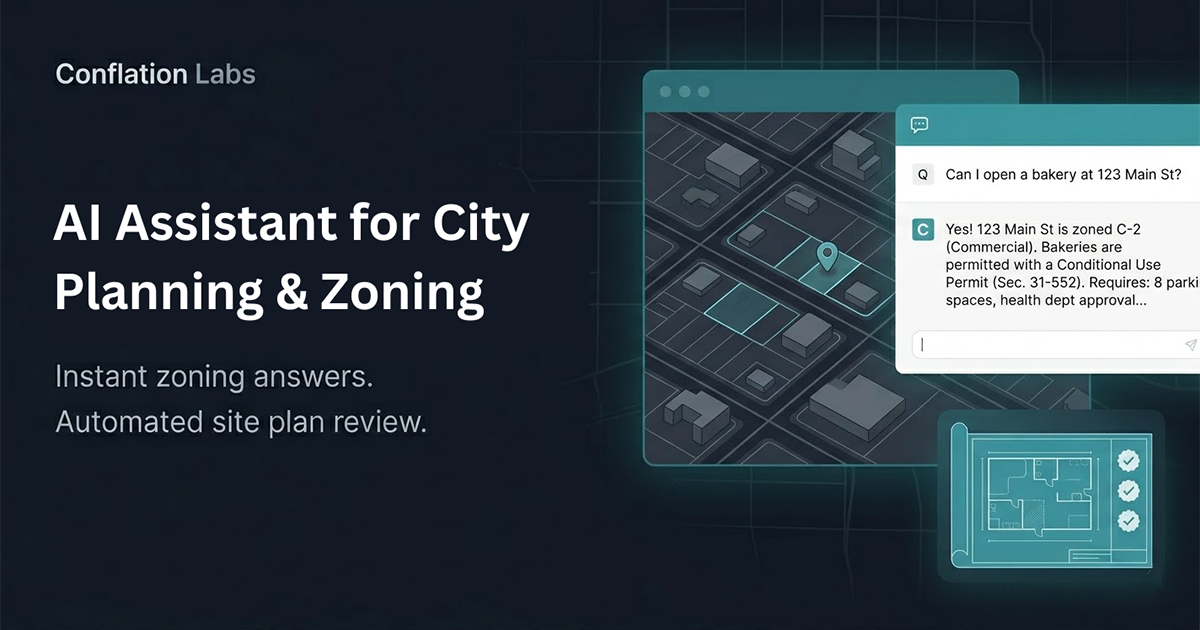
    Conflation Labs functions as a specialized search and synthesis engine for municipal zoning codes. Users input a specific property address or jurisdiction, and the platform retrieves the relevant zoning ordinances, overlay maps, and municipal guidelines. Instead of forcing the user to read through hundreds of pages of municipal PDFs, the software provides a chat-like interface where analysts can ask direct questions. For example, a user can type, “What is the maximum floor area ratio for a mixed-use development on this parcel?” or “Are there any setback requirements for a drive-thru restaurant in this specific zone?” The AI processes the query against the ingested municipal data and returns an answer in plain English.

    Our analysis shows that the core mechanic relies on natural language processing to map the user’s intent to the specific legal definitions within the local code. The system highlights the source text it used to generate the answer, which is a critical feature for commercial real estate professionals who must verify every claim before presenting it to an investment committee. If the tool states that a parcel allows for a 50-foot building height, it provides a direct citation to the exact section and paragraph of the municipal code. This traceability is intended to mitigate the risk of AI hallucinations, though users must still manually check the cited text to ensure the model did not misinterpret exemptions or conditional use clauses.

    Beyond single-parcel queries, the platform allows users to run comparative analyses across multiple jurisdictions. An acquisition team looking for light industrial sites can theoretically use the tool to compare warehouse parking requirements across five different suburban municipalities simultaneously. However, because Conflation Labs focuses entirely on reading and answering questions about existing codes, it does not generate architectural massing models, nor does it track the status of live permit applications. It is strictly a text-based research assistant designed to compress the time spent in the initial zoning feasibility phase of a project.

    9AI Framework: the score, dimension by dimension

    Dimension Score
    CRE Relevance 8/10
    Data Quality and Sources 7/10
    Ease of Adoption 8/10
    Output Accuracy 6/10
    Integration and Workflow Fit 4/10
    Pricing Transparency 4/10
    Support and Reliability 5/10
    Innovation and Roadmap 6/10
    Market Reputation 5/10
    Composite 9AI Score 59/100

    CRE Relevance — 8/10

    Conflation Labs is entirely dedicated to commercial real estate, specifically targeting the zoning and feasibility stages of development and acquisition. Unlike generic language models, this tool is classified as a CRE-Native platform, meaning its architecture is built around the specific terminology and structure of municipal land use codes. It directly addresses the tedious process of zoning research, which is a universal bottleneck for developers, brokers, and site selection consultants. However, because it is a Tier 2 application focused solely on text interpretation rather than full-cycle development management, its relevance is highly concentrated on front-end due diligence rather than asset management or operations. In practice: Acquisition analysts will use this daily during site selection, but property managers and leasing brokers will find little utility in the platform.

    Data Quality and Sources — 7/10

    The platform’s effectiveness is entirely dependent on the recency and completeness of the municipal codes it ingests. Zoning ordinances change frequently through city council amendments, variances, and updated comprehensive plans. Our analysis indicates that while Conflation Labs pulls directly from published municipal databases, the latency between a city passing an ordinance and the tool updating its corpus is an unknown variable. The data is inherently unstructured and varies wildly in format from one county to the next, making standardized data extraction difficult. The tool attempts to normalize this data, but users must remain vigilant about the “as of” date for any code it references. In practice: Users must independently verify that the AI is referencing the most recently amended version of the local zoning code before finalizing any site feasibility studies.

    Ease of Adoption — 8/10

    By utilizing a plain English question-and-answer interface, Conflation Labs removes the steep learning curve typically associated with specialized commercial real estate software. There are no complex dashboards to configure or extensive onboarding modules required to start querying zoning codes. Analysts who are already familiar with consumer-grade AI chatbots will immediately understand how to interact with the platform. The primary adoption hurdle is not technical, but rather behavioral: training senior partners and investment committees to trust the outputs generated by an AI assistant. The inclusion of a free trial allows teams to test the interface with zero financial commitment, further lowering the barrier to entry. In practice: A junior analyst can begin pulling zoning summaries within ten minutes of creating an account, requiring almost no formal software training.

    Output Accuracy — 6/10

    Translating dense, legally binding zoning text into plain English introduces significant risk. Municipal codes are filled with cross-references, conditional exceptions, and grandfather clauses that can easily confuse natural language processing models. While Conflation Labs provides citations to the original text, our analysis suggests that the AI may occasionally miss nuanced overlay districts or misinterpret the hierarchy of conflicting ordinances. The accuracy is sufficient for initial site screening, but it is not infallible enough to replace a formal zoning report from a qualified land use attorney. Users must treat the outputs as a highly educated starting point rather than a definitive legal conclusion. In practice: Analysts must click through every single citation provided by the AI to manually confirm that the plain English summary accurately reflects the legal text.

    Integration and Workflow Fit — 4/10

    As a specialized zoning research tool, Conflation Labs operates primarily as a standalone web application. There is no published evidence in our research that it offers native API integrations with major commercial real estate platforms like Argus, Yardi, or Salesforce. Users interact with the tool in an isolated environment, meaning that any data or summaries generated must be manually copied and pasted into external investment memos or underwriting spreadsheets. For enterprise teams looking to build automated, end-to-end data pipelines for site selection, this lack of connectivity presents a structural limitation. It functions as an isolated research terminal rather than a connected node in a broader tech stack. In practice: Analysts will run queries in a separate browser tab and manually export the findings into their firm’s standardized Word or Excel templates.

    Pricing Transparency — 4/10

    The vendor’s website indicates a model consisting of a paid subscription following a free trial. However, exact pricing tiers, seat licenses, and enterprise contract minimums are not published publicly. According to the 9AI Framework rules, a vendor that does not publish pricing cannot exceed a score of 5 in this category. This lack of transparency forces prospective buyers into a sales funnel simply to determine if the software fits their operating budget. While the free trial offers a risk-free evaluation period, the opaque nature of the subsequent paid tiers makes it difficult for procurement teams to forecast long-term software expenditures or calculate immediate return on investment prior to engagement. In practice: Buyers must complete the free trial and engage directly with a sales representative to uncover the actual cost of deployment.

    Support and Reliability — 5/10

    Conflation Labs is classified as a Tier 2, unproven startup in the commercial real estate technology space. Per the 9AI Framework, an unproven startup cannot exceed a score of 6 in this dimension. Information regarding dedicated customer success managers, service level agreements, or guaranteed response times is not published. Early-stage companies often struggle to scale their support infrastructure as their user base grows, leading to potential bottlenecks when users encounter bugs or require assistance with complex queries. While the simplicity of the tool may reduce the overall volume of support tickets, enterprise clients typically demand rigorous support guarantees that are currently unverified for this vendor. In practice: Users should expect standard email-based support and should not rely on the vendor for immediate, mission-critical technical assistance during active deal negotiations.

    Innovation and Roadmap — 6/10

    The core proposition of using AI to read zoning codes is highly relevant today, but the underlying technology is rapidly becoming commoditized. As foundational language models improve, the moat for specialized text-reading applications shrinks. Conflation Labs will need to innovate beyond simple question-and-answer mechanics to maintain its market position. Our analysis suggests that future iterations must incorporate geospatial mapping, automated massing generation, or integration with live municipal permit tracking to remain competitive. Currently, the roadmap is not published, leaving buyers to guess whether the platform will evolve into a comprehensive feasibility suite or remain a narrow, single-function research utility. In practice: Buyers are purchasing the tool for its current text-parsing capabilities, with no clear guarantee of future feature expansions or advanced geospatial integrations.

    Market Reputation — 5/10

    As a Tier 2 startup, Conflation Labs lacks the extensive track record and widespread industry adoption of older, more established software providers. Under the 9AI Framework rules, an unproven startup is capped at a score of 6 for market reputation. The company is currently building its brand within the niche of AI zoning analysis, but it has not yet accumulated a critical mass of published case studies or institutional endorsements. It competes in a crowded field alongside vendors like LandScout AI and Archistar AI, which have already secured higher visibility in the market. Trust is paramount when dealing with legal zoning codes, and Conflation Labs is still in the process of earning that trust from major developers. In practice: Institutional buyers will likely require a prolonged pilot program to independently validate the tool’s reputation for accuracy before committing to a firm-wide rollout.

    Who should use Conflation Labs

    Conflation Labs is purpose-built for professionals who spend a disproportionate amount of their week reading municipal codes. The tool is highly effective for teams that need to rapidly filter out unviable sites before committing capital to formal legal review.

    • Acquisition analysts at mid-sized development firms who need to quickly verify allowable uses and setbacks across multiple municipalities.
    • Site selection consultants working on behalf of retail or industrial tenants to identify parcels that meet specific zoning criteria.
    • Land brokers who want to provide prospective buyers with immediate, plain-English summaries of a parcel’s development potential to accelerate transactions.
    • Urban planners and architects conducting preliminary feasibility studies before drafting initial site plans or massing models.

    Who should look elsewhere

    Organizations that require full-service permit expediting, architectural design generation, or guaranteed legal opinions will find this tool insufficient for their needs. It is a research assistant, not a replacement for specialized legal or engineering professionals.

    • Property managers and leasing agents, as zoning feasibility has minimal impact on the daily operations of stabilized assets.
    • Institutional investment committees seeking legally binding zoning reports or formal land use opinions for final underwriting approval.
    • Firms looking for an all-in-one platform that generates 3D architectural massing models or tracks live construction permits.

    Pricing and ROI

    Pricing for Conflation Labs is not published on their public-facing website. The research confirms that the vendor operates on a paid subscription model following a free trial, allowing users to test the platform before committing. Because exact enterprise tiers, per-seat costs, and minimum contract lengths are hidden behind a sales wall, procurement teams cannot accurately benchmark the software against competitors like Shovels.ai or PermitFlow without direct engagement.

    Our analysis indicates that the return on investment math for a tool of this nature is straightforward, despite the opaque pricing structure. If an acquisition analyst earns $100,000 annually, which equates to roughly $50 per hour, and currently spends ten hours per week manually reading municipal zoning PDFs, the firm is spending $500 weekly on basic zoning research. If Conflation Labs can reduce that research time by 80 percent through its plain English question-and-answer interface, it saves the firm $400 per week, or over $20,000 annually per analyst. To achieve a positive return on investment, the undisclosed annual subscription cost must simply fall below the value of the analyst hours saved. Buyers must also factor in the administrative time still required to manually verify the AI’s citations, ensuring that the efficiency gains are not offset by the cost of correcting inaccurate legal interpretations.

    Integration and CRE tech stack fit

    Conflation Labs functions as an isolated application within the commercial real estate tech stack. There is no published documentation suggesting that it offers native APIs or pre-built connectors to industry-standard platforms such as Yardi, MRI, Argus, or Salesforce. For teams focused on building highly integrated, automated data pipelines, this lack of connectivity is a notable drawback. Users must conduct their zoning research within the Conflation Labs interface and then manually export or copy the plain English summaries into their firm’s underwriting models, investment memos, or relationship management records. While this siloed approach is common among early-stage, Tier 2 research utilities, it limits the tool’s ability to automatically pass data downstream to architectural or financial forecasting software. The platform is best viewed as a standalone research terminal, similar to a specialized search engine, rather than a foundational layer of a firm’s enterprise architecture. Firms adopting this tool will need to establish strict internal protocols for how the AI-generated zoning data is formatted, verified, and manually entered into their primary systems of record to maintain data integrity across the organization.

    Competitive landscape

    The market for artificial intelligence in zoning and permitting software is becoming increasingly crowded, and Conflation Labs faces stiff competition from vendors that offer broader feature sets. LandScout AI, which holds a BestCRE Score of 87, and Archistar AI, with a BestCRE Score of 81, represent the upper echelon of this category. Both competitors go beyond simply reading text; they incorporate geospatial data and automated 3D massing models, allowing users to visualize the zoning code on a specific parcel. For teams that need visual outputs, these higher-scoring platforms present a more comprehensive solution.

    In the permitting and contractor intelligence space, Shovels.ai, scoring 80, and PermitFlow, scoring 76, offer workflow management and historical permit data tracking, which Conflation Labs does not attempt to provide. GreenLite, scoring 71, and ReZone, scoring 70, are closer direct competitors in terms of zoning analysis, but they also offer more established track records. Conflation Labs differentiates itself strictly through its focused, plain English question-and-answer interface, prioritizing simplicity over complex feature bloat. However, because it lacks the visual and workflow capabilities of its peers, buyers must decide if a pure text-analysis tool justifies a dedicated subscription, or if they are better served by a platform like LandScout AI that handles both the reading of the code and the visual application of its rules.

    The bottom line

    Conflation Labs offers a sharp, highly focused solution to one of commercial real estate’s most tedious problems: reading and interpreting municipal zoning codes. Its plain English interface makes it incredibly easy to use, and the citation feature provides necessary transparency for high-stakes due diligence. However, as an unproven Tier 2 startup with unpublished pricing and no integration capabilities, it carries inherent adoption risks. The tool is not a replacement for land use attorneys or comprehensive platforms like LandScout AI that offer geospatial visualizations. Decision makers should utilize the free trial to test the AI’s accuracy against known zoning codes in their target markets. If the tool consistently saves your analysts hours of manual reading without hallucinating legal nuances, it is worth the investment as a standalone research utility. If your firm requires automated massing models or integrated workflow management, pass on Conflation Labs and look to higher-scoring alternatives.

    Compare inside the same category: LandScout AI (87) · Archistar AI (81) · Shovels.ai (80) · PermitFlow (76) · GreenLite (71). The full ranking is in the BestCRE AI Index; the category view is at CRE AI tools by category.

    Frequently asked questions

    Does Conflation Labs generate 3D architectural massing models?

    No. Conflation Labs is strictly a text-based research tool that uses AI to read zoning codes and answer questions in plain English. It does not provide geospatial mapping, visual site plans, or automated 3D massing models like some of its higher-rated competitors in the market.

    How much does a Conflation Labs subscription cost?

    Pricing is not published on the vendor’s website. The company offers a paid subscription model that requires users to transition from a free trial. Prospective buyers must engage directly with the sales team to determine enterprise pricing tiers, seat licenses, and contract minimums.

    Can this software replace my land use attorney?

    Absolutely not. While the AI provides plain English summaries and citations to specific municipal codes, it is not infallible. Users must manually verify the outputs, as AI can misinterpret complex legal nuances, grandfather clauses, or overlay districts. It is a research assistant, not a legal authority.

    Does Conflation Labs integrate with Argus or Yardi?

    There is no published evidence that the platform offers native integrations or APIs for major commercial real estate software like Argus, Yardi, or Salesforce. It operates as a standalone web application, requiring users to manually export and transfer data into their existing underwriting models.

    Is a free trial available for new users?

    Yes, the research confirms that Conflation Labs offers a free trial. This allows acquisition teams and analysts to test the natural language interface and verify the accuracy of the AI’s zoning citations before committing to a paid enterprise subscription.

    How does it compare to LandScout AI?

    LandScout AI scored an 87 on the BestCRE framework, significantly higher than Conflation Labs. While Conflation Labs focuses purely on text-based question-and-answer mechanics, LandScout AI offers a more comprehensive suite that includes geospatial data and visual massing models, making it better suited for complex site planning.

  • Combify Review: Map and analyze Swedish commercial real estate development opportunities with native AI.

    BestCRE 9AI Score

    74/100 · Contender

    Combify ranks #112 of 189 commercial real estate AI tools scored on the 9AI Framework.

    Combify is a specialized commercial real estate data platform designed to aggregate, visualize, and monitor Swedish development opportunities. Founded in Stockholm and recently acquired by the Norwegian proptech firm Placepoint in mid-2026, the software targets developers and land investors who need to navigate the notoriously fragmented municipal zoning and planning data across the Nordic region. Our research confirms that Combify offers a “free to browse” model for its baseline map of building rights, making it highly accessible for initial market scanning before committing to premium tiers.

    Unlike broad, general-purpose listing platforms such as Crexi or LoopNet, Combify is strictly regional and hyper-focused on the early stages of the land development lifecycle. It pulls detailed development plans, building permits, and land ownership records from all 290 Swedish municipalities into a single interactive map interface. To accelerate site selection, the company recently integrated artificial intelligence directly into this workflow via the Combify Agent. This natural-language search assistant allows acquisition analysts to query zoning codes, allowable densities, and site feasibility without manually digging through complex municipal PDFs. For European investors or local developers, this represents a distinct operational advantage over traditional manual site sourcing. However, its utility is entirely bounded by its geographic focus. Buyers evaluating this tool must weigh its deep, localized data against the reality that it cannot serve as a cross-border or global portfolio management solution.

    What Combify does and how it works

    At its core, Combify operates as an interactive, map-based search engine for land and building rights. Users log into a geographic interface that visually overlays zoning regulations, active building permits, and municipal development plans onto standard parcel maps. Instead of visiting individual city websites to download zoning documents, an acquisition analyst can pan across Stockholm or Gothenburg and instantly see color-coded parcels indicating development potential. The platform digitizes these municipal records, making previously unstructured data searchable by parameters such as maximum allowable building height, intended use, and current ownership status.

    The most prominent mechanical feature is the Combify Agent, an AI-driven assistant layered over the proprietary municipal database. Users can type natural-language queries—such as asking for all parcels over a certain size zoned for multifamily development within a specific transit radius—and the system filters the map accordingly. The AI also summarizes lengthy planning documents, extracting key constraints and deadlines so that analysts do not have to read hundreds of pages of Swedish bureaucratic text. This fundamentally changes the speed at which a feasibility study can be conducted.

    Additionally, the software includes monitoring capabilities. Development teams can set up alerts for specific neighborhoods or municipalities. When a new detailed plan is proposed, a building permit is filed, or a zoning change is approved, the system sends an automated notification. This allows developers to track off-market opportunities and engage landowners before a site is officially listed for sale. While the interface is heavily optimized for the Swedish market, the recent acquisition by Placepoint indicates that these mechanics are actively being adapted for Norwegian data, expanding the platform’s utility for pan-Nordic investment strategies.

    9AI Framework: the score, dimension by dimension

    Dimension Score
    CRE Relevance 9/10
    Data Quality and Sources 8/10
    Ease of Adoption 8/10
    Output Accuracy 7/10
    Integration and Workflow Fit 6/10
    Pricing Transparency 9/10
    Support and Reliability 6/10
    Innovation and Roadmap 8/10
    Market Reputation 6/10
    Composite 9AI Score 74/100

    CRE Relevance — 9/10

    Combify is entirely native to the commercial real estate sector, specifically engineered for land acquisition and development professionals. It does not attempt to serve residential buyers or general mapping needs. Every feature, from the zoning overlays to the AI document summarization, is built around the specific workflow of a real estate developer evaluating site feasibility. The platform addresses a very specific pain point: the fragmentation of municipal planning data. By centralizing building rights and detailed development plans, it serves as a highly specialized tool for a distinct CRE audience. In practice: Developers use this platform exclusively to source and evaluate land parcels for future commercial or multifamily construction.

    Data Quality and Sources — 8/10

    The platform aggregates data from all 290 Swedish municipalities, a massive undertaking given the variance in how local governments format and publish their records. Combify digitizes and standardizes this information, providing a unified view of building rights and ownership. However, because the underlying data originates from disparate public sources, there can be occasional latency in reflecting the absolute latest municipal updates or minor transcription errors in complex zoning text. The AI summarization relies entirely on the accuracy of these localized inputs. In practice: Analysts must still independently verify final zoning constraints with the local municipality before committing hard capital to an acquisition.

    Ease of Adoption — 8/10

    With its modern, map-centric interface, the software is highly intuitive for anyone familiar with basic geographic information systems or consumer mapping applications. The introduction of the natural-language AI agent further lowers the barrier to entry, allowing users to query complex datasets without needing to learn proprietary search syntax or complex filtering logic. The fact that the baseline map is free to browse allows teams to test the interface and experience the user experience immediately without navigating a lengthy enterprise sales process. In practice: New users can create an account and begin identifying potential development sites within minutes of logging in.

    Output Accuracy — 7/10

    The AI agent performs well when extracting explicit facts from digitized municipal documents, such as maximum building heights or allowable floor area ratios. However, zoning interpretation often involves nuance, historical context, or unwritten municipal preferences that an algorithmic summary might miss. The spatial accuracy of the parcel boundaries and zoning overlays is generally reliable, drawing directly from official cadastral maps, but the AI-generated summaries should be treated as a preliminary filter rather than a definitive legal opinion. In practice: The AI outputs serve as an excellent first-pass screening tool, but require human oversight for final underwriting and legal compliance.

    Integration and Workflow Fit — 6/10

    Combify functions primarily as a standalone destination platform rather than a background data feed, though it does offer API access for enterprise clients. Firms looking to pipe Swedish building rights data directly into their own internal underwriting models or proprietary CRM systems can do so, as evidenced by their partnerships with other Nordic software providers. However, out-of-the-box integrations with standard global CRE tech stacks like Yardi or Salesforce are limited, reflecting its regional and specialized nature. In practice: Most users will operate directly within the Combify map interface rather than integrating its data into external global software ecosystems.

    Pricing Transparency — 9/10

    The vendor excels in this category by offering a highly transparent, product-led growth motion. Our research confirms that the core platform is free to browse, providing immediate access to a baseline map of Swedish building rights. This open-map approach allows prospective buyers to validate the data coverage before upgrading. While enterprise API access and advanced AI monitoring features sit behind a paywall, the existence of a functional free tier provides absolute clarity on the baseline value proposition. In practice: Teams can evaluate the core mapping functionality at zero cost before justifying the expense of premium analytical features.

    Support and Reliability — 6/10

    As a relatively young Nordic startup, the company has a smaller support footprint compared to established global data vendors like REIS or PropertyRadar. While the recent acquisition by Placepoint injects new capital and resources, the support infrastructure is still scaling. Users should expect standard business-hour support rather than 24/7 dedicated enterprise account management. The platform itself is stable, but the reliance on hundreds of municipal data feeds means occasional localized downtime for specific city data is possible. In practice: Users will find adequate support for technical issues but should not expect white-glove, round-the-clock advisory services.

    Innovation and Roadmap — 8/10

    The company is moving aggressively to expand its technical capabilities and geographic footprint. The recent launch of the Combify Agent demonstrates a clear commitment to integrating generative AI directly into the acquisition workflow. Furthermore, the mid-2026 acquisition by Placepoint signals a definitive roadmap toward creating a unified pan-Nordic data platform, starting with the integration of Norwegian real estate data. This trajectory suggests the tool will become increasingly powerful for regional investors over the next twelve months. In practice: Buyers are investing in a platform that is actively evolving from a Swedish mapping tool into a comprehensive Nordic AI assistant.

    Market Reputation — 6/10

    Within the Swedish proptech ecosystem, the company is well-regarded, having won local awards for its approach to digitizing real estate development data. However, outside of Northern Europe, it remains largely unknown. It does not carry the established global weight of a CoStar or a LoopNet. Its reputation is tightly bound to its specific niche: aggregating fragmented Nordic municipal data. The recent acquisition validates its technology but also highlights its status as an emerging, regional player rather than a dominant global standard. In practice: Local developers view it as a highly useful specialized tool, but international institutions may require internal validation.

    Who should use Combify

    Combify is purpose-built for professionals operating within the Nordic real estate development sector.

    • Land Acquisition Managers: Professionals tasked with sourcing off-market development sites in Sweden who need to quickly filter parcels by zoning allowances and building rights.
    • Real Estate Developers: Teams looking to monitor specific municipalities for new detailed plans or zoning changes to gain a first-mover advantage on potential projects.
    • Urban Planners and Architects: Consultants who require fast, aggregated access to municipal building permits and zoning constraints to advise their developer clients on site feasibility.
    • Nordic Investment Funds: Institutional investors seeking a macro view of development pipelines and population growth indicators across Swedish municipalities to inform capital allocation.

    Who should look elsewhere

    This platform is highly specialized and will not serve generalist or out-of-region needs.

    • US-Focused Investors: Firms operating exclusively in North America will find zero utility here, as the database is strictly limited to Sweden and emerging Nordic markets.
    • Residential Real Estate Agents: Brokers focused on single-family home sales will find the deep zoning and building rights data unnecessary for their standard transaction workflows.
    • Property Managers: Teams looking for operational software to manage tenant work orders, rent collection, or building maintenance will not find those features in this land-focused application.

    Pricing and ROI

    Our research confirms that Combify operates on a freemium model, offering its baseline map of Swedish building rights as “free to browse.” This allows anyone to access the platform, view the open map, and conduct preliminary searches without entering a credit card. While the exact pricing for premium tiers—which include the advanced Combify Agent AI features, automated municipal monitoring, and API access—is not published on their public site, the free tier provides immediate, risk-free utility.

    For an acquisition team, the return on investment math is straightforward and heavily weighted toward labor savings. Traditionally, an analyst might spend ten to fifteen hours per week navigating disparate municipal websites, downloading PDF zoning plans, and manually cross-referencing parcel data to find a single viable development site. If a premium subscription costs several hundred dollars per month, the platform pays for itself if the AI agent and aggregated map save an analyst just five hours of manual research. Furthermore, the automated monitoring features can generate massive ROI by alerting a developer to an off-market zoning change before competitors are aware, potentially securing a land acquisition at a significantly lower basis. The free-to-browse model ensures that firms can validate this time-saving potential before committing any capital.

    Integration and CRE tech stack fit

    Combify is designed primarily as a standalone mapping and research destination rather than a middleware component built to sit quietly within a broader enterprise tech stack. For most local developers and acquisition teams, the platform operates in a silo: analysts log into the web interface, conduct their spatial research, query the AI agent, and then export their findings into external underwriting models or presentation decks.

    However, for larger institutions or data-heavy brokerages, the company does offer API access. This allows enterprise users to pull digitized Swedish detailed development plans and building rights directly into their proprietary databases or custom CRM systems. Recent partnerships with other regional software providers demonstrate that the API is functional and actively supported. Despite this, buyers should not expect native, one-click integrations with global CRE platforms like Yardi, MRI, or Salesforce. The tool is highly specialized for the Nordic market, and its integration capabilities are similarly focused on regional data partnerships rather than global software ecosystems. Teams evaluating the software should plan to use it primarily via its native web application.

    Competitive landscape

    When evaluating Combify, buyers must contextualize it within the highly localized nature of land and zoning data. In the United States, platforms like PropertyRadar (scored 79) or ProspectNow (scored 80) provide deep parcel-level data, while CityBldr (scored 79) specifically targets the identification of highest-and-best-use development opportunities. However, none of these US-centric tools offer coverage in Sweden, rendering them non-viable alternatives for Combify’s target audience.

    For investors operating in the Nordics, the primary alternative is often the manual aggregation of data directly from Lantmäteriet (the Swedish mapping, cadastral, and land registration authority) and individual municipal websites. This manual baseline is exactly what Combify is designed to replace. In terms of commercial software alternatives, local geographic information system (GIS) consultancies and broader European data providers like Datscha offer deep property data and ownership records in Sweden. Datscha provides excellent commercial transaction and ownership data but traditionally lacks the hyper-specific, AI-driven focus on unearthing early-stage municipal building rights and zoning changes that Combify champions.

    Additionally, the recent acquisition of Combify by Placepoint indicates that it will soon compete more broadly against pan-Nordic data platforms. Buyers should view Combify not as a competitor to global listing platforms like Crexi (scored 84) or LoopNet (scored 76), but rather as a highly specialized, regional intelligence tool that competes primarily against the inefficiency of manual municipal research and legacy local GIS mapping software.

    The bottom line

    Combify is a mandatory evaluation for any developer, architect, or land investor operating in the Swedish market. The platform successfully solves a highly specific, notoriously difficult problem: the fragmentation of municipal zoning and building rights data. By offering a free-to-browse baseline and layering a natural-language AI agent over complex bureaucratic documents, it drastically reduces the time required to conduct early-stage site feasibility. However, its strict geographic limitations mean it holds zero value for firms operating outside the Nordics. Buyers should not expect a global portfolio management tool or a comprehensive financial underwriting suite. Instead, they should adopt Combify strictly as an acquisition engine to identify and monitor localized development opportunities before they hit the broader market. If your mandate includes Nordic land development, the free tier makes this an immediate, risk-free addition to your sourcing workflow.

    Compare inside the same category: Crexi (84) · ProspectNow (80) · PropertyRadar (79) · CityBldr (79) · REIS (77). The full ranking is in the BestCRE AI Index; the category view is at CRE AI tools by category.

    Frequently asked questions

    Is Combify available for properties in the United States?

    No. The platform is strictly focused on the Nordic region, currently aggregating data exclusively from all 290 Swedish municipalities, with Norwegian data integration planned following its recent acquisition.

    Does Combify publish its pricing online?

    The vendor operates a freemium model. Our research confirms that the baseline map of building rights is free to browse, though advanced AI and monitoring features require a premium, unpublished subscription fee.

    How does the Combify Agent work?

    The AI agent functions as a natural-language search assistant. Users can ask complex questions about zoning laws, building heights, or land use, and the AI extracts answers directly from digitized municipal planning documents.

    Can I integrate this data into my own CRM?

    Yes, for enterprise clients. The company provides API access allowing larger firms to pull digitized building rights and detailed development plans directly into their internal proprietary databases.

    Does this replace the need for legal zoning review?

    Absolutely not. While the AI provides rapid summarization of municipal documents for initial feasibility studies, analysts must still verify all constraints and building rights with the local municipality before acquiring land.

    Who recently acquired Combify?

    In mid-2026, the company was acquired by Placepoint, a Norwegian proptech firm, which plans to expand the platform’s capabilities and geographic reach across the broader Nordic real estate market.

  • CodeWords Review: Natural language workflow automation powered by an intelligent coding assistant

    BestCRE 9AI Score

    72/100 · Contender

    CodeWords ranks #124 of 188 commercial real estate AI tools scored on the 9AI Framework.

    CodeWords (operated by Agemo AI Ltd.) is a chat-native workflow automation platform that translates plain English task descriptions into executable backend code. Founded with the premise that operators should not have to write scripts or manually chain APIs together, the platform utilizes an AI assistant named Cody to build, test, and deploy automations. A defining hard fact from our research is that CodeWords recently secured $9 million in seed funding in May 2026, led by Visionaries, to expand its autonomous agent capabilities. Unlike traditional visual drag-and-drop integration builders, this platform generates actual code, offering greater flexibility for complex commercial real estate processes such as deal monitoring or rent roll extraction.

    For commercial real estate firms evaluating artificial intelligence tools in August 2026, the landscape is crowded with generic wrappers. Our analysis indicates that CodeWords differentiates itself by focusing on infrastructure and execution rather than just text generation. The system actively monitors operational patterns across a firm’s connected applications and can suggest automations proactively. While BestCRE classifies it as a Tier 2 CRE-Native tool due to its specific applicability to real estate deal workflows, it remains fundamentally a horizontal platform. It lacks proprietary property data, meaning its utility depends entirely on the quality of the user’s existing tech stack and data inputs. The platform targets analysts and principals who understand their operational bottlenecks but lack the engineering resources to build custom integrations from scratch.

    What CodeWords does and how it works

    At its core, CodeWords functions as an autonomous software engineer and integration specialist accessible via a chat interface. Users interact with the platform by typing natural language commands to Cody, the system’s primary AI agent. Instead of forcing users to map out logic flows on a visual canvas, Cody interprets the request, writes the necessary backend code, tests the connections, and deploys the automation. For example, a commercial real estate analyst can type a request to monitor a specific Dropbox folder for new offering memorandums, extract key financial metrics using a large language model, and populate a Monday.com tracking board. The platform handles the API authentication, data parsing, and error handling entirely in the background.

    The mechanics rely heavily on a code-based architecture rather than rigid integration templates. When a user requests a workflow, CodeWords generates custom Python or Node.js scripts to execute the task. This approach allows for highly specific data transformations that visual builders often struggle to accommodate, such as parsing complex partnership structures or standardizing inconsistent rent roll formats before pushing the data into an underwriting model. The platform supports over 2,700 integrations, covering standard enterprise software like Google Workspace, DocuSign, and major CRM systems.

    Beyond reactive task execution, CodeWords is developing proactive agentic capabilities. The system can run continuously, observing data flows across connected applications to identify repetitive manual actions. Once it detects a pattern, such as an analyst repeatedly downloading attachments from emails and uploading them to a shared drive, Cody will suggest an automation to handle the task. Users can also productize their workflows, turning internal automations into white-labeled portals for clients or investors. This allows a brokerage team to create a custom interface where clients can submit property addresses and automatically receive a compiled market report generated by the underlying CodeWords infrastructure.

    9AI Framework: the score, dimension by dimension

    Dimension Score
    CRE Relevance 5/10
    Data Quality and Sources 6/10
    Ease of Adoption 9/10
    Output Accuracy 8/10
    Integration and Workflow Fit 9/10
    Pricing Transparency 8/10
    Support and Reliability 6/10
    Innovation and Roadmap 8/10
    Market Reputation 6/10
    Composite 9AI Score 72/100

    CRE Relevance — 5/10

    CodeWords is classified in our database as a Tier 2 CRE-Native tool, but it is fundamentally a horizontal automation platform adapted for real estate workflows. The system does not include proprietary property data, market analytics, or native underwriting models. Instead, its relevance to commercial real estate stems from its ability to connect disparate industry tools and automate heavy document-processing tasks. Real estate professionals spend countless hours moving data between emails, cloud storage, and CRM platforms. CodeWords addresses this operational friction effectively by allowing users to describe their ideal deal flow mechanics in plain English. However, because it relies entirely on third-party APIs and user-provided data, our analysis dictates it cannot exceed our baseline score for general-purpose applications. In practice: Commercial real estate teams must supply their own data sources and clearly define their operational logic to extract value from the platform.

    Data Quality and Sources — 6/10

    The platform does not provide native datasets, meaning its data quality score reflects its ability to process, transform, and maintain the integrity of information passing through its automations. Our analysis shows that CodeWords excels at extracting structured data from unstructured sources, such as pulling lease terms from a PDF and formatting them for a database. Because it generates actual code rather than relying on brittle visual connectors, the data transformations are highly customizable and less prone to formatting errors during transit. However, the accuracy of the extracted data still depends heavily on the underlying large language models powering the parsing engine. If an offering memorandum contains ambiguous financial footnotes, the system may misinterpret the context without human oversight. In practice: Users should implement validation steps within their automations to flag anomalous data before it populates critical underwriting models.

    Ease of Adoption — 9/10

    Deploying custom backend software typically requires dedicated engineering resources, but CodeWords bypasses this barrier through its chat-native interface. The learning curve is exceptionally flat because the primary input mechanism is natural language. Users do not need to understand API endpoints, webhooks, or JSON formatting to build complex integrations. Cody, the AI assistant, handles the technical configuration, debugging, and deployment. The platform also offers a managed infrastructure, meaning users do not have to provision servers or worry about hosting the generated code. While our analysis notes that defining complex, multi-step real estate workflows still requires clear logical thinking, the technical execution is almost entirely abstracted away from the user. In practice: A non-technical real estate analyst can build and deploy a functional, multi-app automation in a single afternoon simply by describing the required steps to the AI.

    Output Accuracy — 8/10

    Automation platforms are only as useful as their reliability, and CodeWords approaches accuracy by generating inspectable code. When a user requests a workflow, the system writes scripts that can be reviewed, tested, and modified. This transparency reduces the risk of silent failures common in black-box AI tools. The platform includes built-in testing environments where users can simulate data flows before pushing them live. However, our analysis indicates that because the initial code generation relies on natural language interpretation, the AI can occasionally misunderstand complex or ambiguous instructions, leading to logical errors in the workflow. The system mitigates this by allowing users to converse with Cody to debug and refine the output iteratively. In practice: Teams must rigorously test their automations with sample property data to ensure the AI has correctly interpreted the nuances of their specific workflows.

    Integration and Workflow Fit — 9/10

    With support for over 2,700 applications, CodeWords offers exceptional connectivity for modern commercial real estate tech stacks. The platform easily links standard corporate tools like Microsoft 365, Google Workspace, Slack, and Dropbox with specialized systems like Monday.com or Salesforce. Because the platform generates custom code, it can also interact with any software that offers an open API, even if a pre-built connector does not exist. Our analysis highlights this as particularly valuable for real estate firms using niche property management or accounting software that traditional integration platforms ignore. The system handles authentication and token management securely, reducing the administrative burden on IT teams. In practice: The platform serves as a highly adaptable connective tissue, capable of linking legacy real estate databases with modern communication and document management tools.

    Pricing Transparency — 8/10

    CodeWords maintains a transparent pricing model that allows users to test the platform before committing to enterprise contracts. Our research confirms the company offers a free tier, alongside credit-based consumption models. Professional plans start at accessible price points, typically around $20 to $49 per month, which include a set allocation of execution credits. This structure allows small brokerage teams to experiment with basic automations without significant financial risk. As workflows scale and consume more compute resources, the credit system scales proportionally. The company publishes these baseline tiers clearly, avoiding the opaque contact-sales gates that plague many enterprise AI tools. However, our analysis suggests high-volume users deploying complex, continuous agentic workflows will need to monitor their credit usage carefully. In practice: The entry-level pricing is highly accessible, but firms must model their expected automation volume to forecast long-term software costs accurately.

    Support and Reliability — 6/10

    As a startup that just secured its $9 million seed funding round in May 2026, CodeWords is still in the early stages of building its enterprise support infrastructure. The company relies heavily on community forums, documentation, and automated troubleshooting via its own AI assistant to resolve user issues. While the chat interface allows users to ask Cody for help debugging specific workflows, human intervention for complex platform outages or billing disputes may experience delays. The platform’s uptime is generally stable, backed by modern cloud infrastructure, but our analysis notes it lacks the guaranteed service level agreements and dedicated account managers expected from mature enterprise software vendors. Per our rating methodology for unproven startups, this dimension is strictly capped. In practice: Early adopters must be comfortable relying on self-serve documentation and AI-assisted debugging rather than expecting immediate white-glove human support.

    Innovation and Roadmap — 8/10

    The recent capital injection from prominent venture firms indicates a strong mandate for product development. CodeWords is actively moving beyond reactive workflow generation toward proactive, autonomous agents. The roadmap focuses on enhancing Cody’s ability to monitor background business activities and independently suggest efficiency improvements. The company is also expanding its productization features, allowing users to package their automations into branded portals for external clients. Our analysis shows this trajectory aligns well with the commercial real estate industry’s growing demand for intelligent systems that require less manual prompting. While the vision is ambitious, the core technology is already demonstrating tangible progress in shifting from simple task execution to complex reasoning. In practice: Buyers are investing in a rapidly evolving platform that promises to transition from a basic integration builder to an autonomous operational assistant over the next year.

    Market Reputation — 6/10

    CodeWords is generating significant interest among early adopters and automation enthusiasts, but its footprint in the traditional commercial real estate sector remains limited. The successful seed round led by Visionaries has validated its technical approach within the venture capital community, positioning it as a strong contender in the emerging AI agent space. However, our analysis reveals it has not yet established a track record of large-scale enterprise deployments within major brokerages or institutional investment firms. The platform is frequently compared to other automation tools, but it is still building the case studies and industry-specific testimonials required to win over conservative real estate executives. As a seed-stage startup, its reputation score is constrained by its short operating history. In practice: The tool is highly regarded by technical early adopters, but institutional real estate firms may wait for further market validation before deploying it globally.

    Who should use CodeWords

    CodeWords is designed for professionals who understand their operational bottlenecks but lack the coding expertise to build custom integrations. It is best suited for teams that process high volumes of standardized documents or manage complex, multi-step deal pipelines across various software platforms.

    • Acquisitions analysts who want to automatically extract financial data from offering memorandums and populate underwriting models without manual data entry.
    • Operations managers at mid-sized brokerages looking to connect their CRM systems with marketing platforms to automate lead generation and client reporting.
    • Asset managers who need to aggregate unstructured data from property managers, such as PDF rent rolls or maintenance logs, into a centralized database.
    • Boutique real estate firms seeking to build white-labeled client portals that provide automated market updates and deal tracking without hiring external developers.

    Who should look elsewhere

    Firms looking for out-of-the-box real estate analytics or proprietary market data will not find value here. This is an infrastructure tool, not a data provider. It requires users to define their own logic and bring their own software stack.

    • Institutional investors requiring on-premise deployments or strict enterprise service level agreements, as the startup currently lacks mature enterprise support structures.
    • Professionals seeking a native commercial real estate database, as the platform contains no proprietary property listings, ownership records, or market statistics.
    • Firms that rely exclusively on legacy, closed-ecosystem software that does not offer API access or webhooks for external connectivity.

    Pricing and ROI

    CodeWords operates on a transparent pricing model that combines subscription tiers with usage-based credits. Based on our August 2026 research, the company offers a free tier that allows users to test the chat interface and build basic automations. The Professional plans start at approximately $20 to $49 per month, which includes a baseline allocation of execution credits. As workflows become more complex or run more frequently, users consume more credits, scaling the cost directly with usage. The company publishes these details clearly, avoiding mandatory sales calls for initial adoption.

    For a commercial real estate firm, the return on investment math is highly compelling. Consider a boutique brokerage where a junior analyst spends ten hours a week manually downloading offering memorandums from email, renaming the files, extracting high-level property details, and logging them into Monday.com or Salesforce. At a fully burdened cost of $50 per hour, this manual data entry costs the firm roughly $2,000 per month. By deploying CodeWords on a $49 per month Pro plan, the firm can automate this entire sequence. Even factoring in the time required to build and refine the initial prompt, the firm achieves a positive financial return within the first two weeks of deployment, while freeing the analyst to focus on actual underwriting and deal sourcing.

    Integration and CRE tech stack fit

    CodeWords excels in its ability to unify fragmented commercial real estate technology stacks. The platform supports over 2,700 native integrations, covering the foundational tools used by nearly every brokerage and investment firm, including Google Workspace, Microsoft 365, Slack, and Dropbox. For real estate specific workflows, its true value lies in its code-generating architecture. Because Cody writes actual backend scripts rather than relying on rigid visual templates, it can connect to any platform with an open API. This means firms can link modern CRMs like Salesforce or Hubspot directly to specialized real estate tools, provided those tools allow API access. The platform easily manages authentication and data routing, allowing an analyst to trigger a complex document workflow in DocuSign simply by moving a deal stage in their CRM. However, firms utilizing highly secure, on-premise legacy databases without modern API endpoints will struggle to integrate this cloud-native platform into their existing infrastructure.

    Competitive landscape

    The market for AI-driven automation and coding assistants in August 2026 is intensely competitive, and CodeWords faces pressure from both generalist coding tools and specialized workflow builders. For pure code generation, Cursor (BestCRE Score: 90) remains the gold standard for developers, offering a deeply integrated IDE experience. However, Cursor requires the user to actually know how to manage a codebase, whereas CodeWords abstracts the hosting and deployment entirely.

    In the autonomous agent space, Agentforce (BestCRE Score: 88) provides a highly structured, enterprise-grade environment for deploying AI workers, particularly within the Salesforce ecosystem, making it a safer bet for institutional real estate firms heavily invested in that CRM. Replit (BestCRE Score: 88) offers a similar natural-language-to-software capability but caters more to developers building standalone applications rather than operators looking to automate background workflows.

    For users who prefer visual automation builders over chat-native interfaces, Gumloop (BestCRE Score: 87) and Conduit (BestCRE Score: 87) offer excellent drag-and-drop experiences tailored to data extraction and workflow chaining. Manus (BestCRE Score: 87) also competes closely in the autonomous agent category, focusing on multi-step reasoning tasks. CodeWords distinguishes itself from these peers by combining the flexibility of custom code generation with the simplicity of a chat interface, though it lacks the mature enterprise track record of Agentforce or the visual intuitiveness of Gumloop.

    The bottom line

    CodeWords is a highly capable infrastructure tool that successfully democratizes backend automation for non-technical real estate professionals. It is not a magic bullet that will instantly source deals or underwrite properties, as it contains no proprietary market data. However, for firms drowning in manual data entry, document routing, and disjointed software systems, it offers an exceptionally fast path to operational efficiency. The chat-native interface drastically lowers the barrier to entry, allowing analysts to build custom integrations that would historically require expensive external developers. While institutional players may balk at the unproven support structure of a seed-stage startup, boutique brokerages and agile investment teams should adopt this tool immediately. If your firm relies on moving data between emails, cloud storage, and CRMs, the minimal monthly cost is easily justified by the sheer volume of administrative hours saved.

    Compare inside the same category: Cursor (90) · Agentforce (88) · Replit (88) · Gumloop (87) · Manus (87). The full ranking is in the BestCRE AI Index; the category view is at CRE AI tools by category.

    Frequently asked questions

    Does CodeWords include commercial real estate property data or ownership records?

    No. CodeWords is a horizontal workflow automation platform adapted for various industries. It does not provide proprietary real estate data, market analytics, or property listings. Users must connect their own data sources, CRMs, and document repositories to extract value from the system.

    Do I need to know how to write code to use this platform?

    You do not need programming experience. The platform uses a chat-native interface where you describe your desired workflow in plain English. The AI assistant, Cody, translates your instructions into backend code, handles API connections, and deploys the automation automatically without requiring manual scripting.

    How does the pricing structure work for enterprise users?

    The company offers a transparent pricing model featuring a free tier for basic testing and Professional plans starting between $20 and $49 per month. These paid plans operate on a credit system, meaning your total cost will scale based on the complexity and execution volume of your automations.

    Can I connect CodeWords to my existing real estate CRM?

    Yes, provided your CRM has an open API. The platform supports over 2,700 native integrations, including major systems like Salesforce. Because it generates custom code, it can also connect to niche real estate platforms that offer API endpoints, facilitating highly customized data transfer across your entire tech stack.

    Is the platform secure enough for confidential financial documents?

    The platform utilizes modern cloud infrastructure and securely manages API authentication tokens. However, because it processes data through third-party large language models to interpret natural language, firms should review their internal compliance policies regarding the transmission of highly sensitive or personally identifiable financial information through external AI APIs.

    What happens if the AI builds an automation incorrectly?

    Because the system generates inspectable code rather than hidden visual logic, users can review the output. If an automation fails or behaves unexpectedly, you can use the chat interface to explain the error to the AI, which will debug the scripts and deploy a corrected version of the workflow.

  • Closera Review: AI platform generating commercial real estate marketing materials in minutes

    BestCRE 9AI Score

    67/100 · Niche

    Closera ranks #158 of 187 commercial real estate AI tools scored on the 9AI Framework.

    Closera is an artificial intelligence platform built specifically for commercial real estate brokerages, focusing on the rapid generation of property marketing collateral. According to the BestCRE Master Database, the primary use case for the software is producing offering memorandums (OMs), broker opinions of value (BOVs), and marketing materials in minutes. Classified as a Tier 2 CRE-Native application, the software aims to reduce the administrative burden associated with pitching and listing commercial properties.

    Brokerages historically spend days formatting financials, property descriptions, and market data into presentable PDFs or web pages. As of August 2026, analysis indicates that Closera attacks this bottleneck by applying generative AI to structure and format these inputs automatically. The platform operates in a highly competitive category, sitting alongside general-purpose AI writing tools and presentation software. However, Closera differentiates itself by focusing exclusively on the specific document types required by CRE professionals. Rather than asking a broker to engineer prompts for a generic language model, the system is structured around the standard components of an OM or BOV. The core value proposition relies on the assumption that saving hours of analyst time on document formatting justifies the adoption of a specialized tool over cheaper, general-purpose alternatives.

    What Closera does and how it works

    Closera functions as an automated document assembly engine tailored for commercial real estate transactions. Users begin by inputting core property data, which typically includes rent rolls, historical operating expenses, property photos, and basic physical characteristics. The system then processes these inputs through its AI models to generate the narrative sections of an offering memorandum or a broker opinion of value. This includes drafting the executive summary, property description, and location overview based entirely on the structured data provided by the user.

    The platform includes templating features that allow brokerages to maintain brand consistency across their marketing materials. Once the AI generates the initial draft, users interact with a document editor to refine the text, adjust financial tables, and swap images. Analysis suggests that the workflow is designed to replace the traditional process of manually copying and pasting data from Excel into InDesign or Word templates. By centralizing the data ingestion and document formatting steps, the software attempts to shorten the cycle time from winning a listing to taking it to market.

    Beyond OMs and BOVs, the system generates supplementary marketing collateral. This includes email blast copy, social media captions, and property flyers derived from the master property record. The mechanics rely heavily on the quality of the initial data entered by the broker or analyst. If the rent roll is incomplete or the expense history is inaccurate, the resulting BOV will reflect those deficiencies. Therefore, while the software accelerates document creation, it does not eliminate the need for human underwriting and data verification before distributing materials to potential buyers or clients.

    9AI Framework: the score, dimension by dimension

    Dimension Score
    CRE Relevance 9/10
    Data Quality and Sources 7/10
    Ease of Adoption 8/10
    Output Accuracy 7/10
    Integration and Workflow Fit 6/10
    Pricing Transparency 4/10
    Support and Reliability 6/10
    Innovation and Roadmap 7/10
    Market Reputation 6/10
    Composite 9AI Score 67/100

    CRE Relevance — 9/10

    As a Tier 2 CRE-Native application, Closera is built entirely around the workflows of commercial real estate brokerages. Unlike general-purpose AI writers that require extensive prompt engineering to understand cap rates, net operating income, or tenant improvements, this platform is pre-configured for these concepts. The interface and output templates are specifically designed for offering memorandums and broker opinions of value, which are highly specialized documents unique to this industry. Analysis shows that this narrow focus significantly reduces the friction typically associated with adopting AI in a brokerage setting. Users do not need to explain commercial real estate terminology to the system. In practice: Brokers can generate industry-standard documents without teaching the software basic real estate finance concepts.

    Data Quality and Sources — 7/10

    The quality of the output generated by Closera is directly proportional to the accuracy of the data supplied by the user. Because the system relies on user-uploaded rent rolls, financials, and property details to draft BOVs and OMs, it cannot independently verify the truthfulness of the inputs. Analysis indicates that while the AI effectively structures and formats the provided information, it does not pull proprietary market comps or verify zoning data on its own. The platform assumes the broker has already conducted the necessary underwriting and market research before initiating the document creation process. In practice: Analysts must still rigorously audit their financial inputs before relying on the platform to generate client-facing valuation documents.

    Ease of Adoption — 8/10

    Implementing Closera requires minimal technical expertise, as the platform operates primarily as a web-based document generator. The user interface guides brokers through a structured intake process, asking for specific property details and financial metrics. Because the templates are pre-built for standard CRE marketing materials, the learning curve is substantially lower than mastering complex design software like Adobe InDesign. Analysis suggests that teams can begin producing viable drafts within their first few sessions. However, configuring the platform to perfectly match a brokerage’s highly specific custom branding guidelines may require initial setup time and coordination with the vendor. In practice: Most brokerage teams can transition from manual drafting to AI-assisted generation within a matter of days.

    Output Accuracy — 7/10

    Generative AI models are prone to occasional hallucinations or phrasing inconsistencies, and Closera is not immune to these limitations. While the software excels at formatting financial tables and drafting boilerplate location descriptions, the narrative text requires careful review. Analysis of similar AI writing tools suggests that users must verify that the generated property descriptions accurately reflect the physical reality of the asset and do not exaggerate features. The financial summaries are generally accurate provided the input data is correct, but the qualitative text must be treated as a first draft rather than a final product. In practice: Brokers must allocate time to proofread and edit the AI-generated text before publishing any marketing materials.

    Integration and Workflow Fit — 6/10

    As a Tier 2 startup, Closera’s ability to connect with the broader commercial real estate technology stack remains developing. Analysis suggests that while the platform excels as a standalone document generator, users may need to manually export data from their CRM or underwriting software to feed into the system. There is limited evidence of deep, native integrations with enterprise-grade property management or financial modeling tools. Consequently, analysts will likely find themselves downloading CSV files from one platform and uploading them into another to initiate the marketing process. In practice: Users should expect a standalone workflow that requires manual data transfer rather than an automated pipeline from their existing CRM.

    Pricing Transparency — 4/10

    Closera does not publish its pricing tiers publicly, operating instead on a custom pricing model. According to the BestCRE Master Database, prospective buyers must engage with the sales team to receive a quote tailored to their brokerage size and usage volume. This lack of transparency makes it difficult for independent analysts or small boutique firms to evaluate the software’s return on investment prior to a demo. Analysis indicates that custom pricing often scales based on the number of seats or the volume of OMs and BOVs generated monthly. In practice: Buyers must invest time in the sales process to discover if the platform fits within their marketing budget.

    Support and Reliability — 6/10

    Classified as a Tier 2 vendor, Closera operates with the typical support constraints of an emerging startup. While the company is highly focused on its core brokerage user base, it may lack the 24/7 global support infrastructure found in enterprise legacy systems. Analysis suggests that users can expect responsive, personalized assistance during standard business hours, likely interacting directly with the product team. However, weekend support or immediate troubleshooting for urgent, late-night OM deadlines may be limited. The platform’s reliability is generally stable for document generation, but buyers must accept the support realities of a younger company. In practice: Teams should plan their critical document generation during business hours when support staff is readily available.

    Innovation and Roadmap — 7/10

    The product roadmap for Closera appears focused on deepening its AI generation capabilities specifically for brokerages. Analysis of the current feature set suggests future updates will likely target faster processing times, more sophisticated design templates, and potentially automated data extraction from messy financial documents. As a Tier 2 startup, the company has the agility to push updates frequently, responding directly to broker feedback. However, the long-term viability of the roadmap depends on the company’s ability to maintain its niche advantage against rapidly advancing general-purpose AI models that are constantly improving their context windows. In practice: Buyers are investing in a fast-moving product that will likely introduce new AI features at a rapid pace.

    Market Reputation — 6/10

    Closera is building a reputation as a specialized, time-saving utility for commercial real estate brokers, but it remains an unproven startup in the broader market. It has not yet achieved the ubiquitous name recognition of established tools like Matterport. Analysis indicates that early adopters appreciate the platform’s focus on CRE-specific documents, which provides a clear advantage over generic AI writers. However, as a Tier 2 vendor, it lacks a long track record of enterprise deployments. The company must still prove it can scale its user base and maintain performance as transaction volumes increase across a larger client base. In practice: Adopters are taking a calculated risk on a specialized startup rather than buying an established industry standard.

    Who should use Closera

    Closera is optimized for transaction-focused teams that spend excessive time formatting documents rather than calling clients. The platform provides the highest value to organizations that lack dedicated, in-house graphic design departments.

    • Investment sales brokers who need to quickly turn around BOVs to win listings.
    • Boutique brokerages seeking to produce institutional-quality OMs without hiring graphic designers.
    • Marketing coordinators at mid-sized firms struggling to manage high volumes of property flyers and email blasts.
    • Junior analysts who currently spend hours manually transferring Excel data into presentation templates.

    Who should look elsewhere

    Firms with highly rigid, complex branding requirements or those relying on deeply integrated enterprise tech stacks may find the platform limiting. It is not a substitute for underwriting software or a CRM.

    • Enterprise brokerages with proprietary, heavily customized automated marketing systems already in place.
    • Analysts looking for an AI tool to perform complex financial modeling or cash flow projections.
    • Firms that refuse to use cloud-based software for confidential client financial data.

    Pricing and ROI

    Closera operates strictly on a custom pricing model, meaning exact costs are not published on their website. Prospective buyers must contact the sales team to receive a quote, which analysis suggests is likely based on the number of user seats, the volume of documents generated, or the size of the brokerage. Because pricing is not published, evaluating the immediate financial commitment requires engaging in a sales process.

    To calculate the return on investment, brokerages must measure the cost of the software against the labor hours saved during document production. If a junior analyst or marketing coordinator currently spends ten hours formatting a single offering memorandum in InDesign, and Closera reduces that time to two hours of data entry and proofreading, the firm saves eight hours of labor per listing. Assuming an analyst’s fully loaded cost is $50 per hour, the platform saves $400 per OM. If a boutique firm produces five OMs and ten BOVs per month, the labor savings quickly reach thousands of dollars. The ROI is realized only if the brokerage redirects those saved hours into revenue-generating activities, such as prospecting or underwriting additional deals, rather than simply absorbing the free time.

    Integration and CRE tech stack fit

    Fitting Closera into an existing commercial real estate technology stack requires manual effort. As a Tier 2 application, the platform currently functions primarily as a standalone destination rather than a deeply integrated node within a broader ecosystem. Analysis indicates that users will not find native, push-button integrations with major industry CRMs or complex financial modeling platforms.

    Instead, the workflow relies on data export and import. Analysts must finalize their rent rolls and operating expenses in Excel, and then upload those files or manually input the data into Closera’s interface. Once the offering memorandum or broker opinion of value is generated, the final product is exported as a PDF or web link for distribution. While this lack of connectivity prevents the software from automatically pulling live property data from a CRM, it also simplifies the initial deployment. Brokerages do not need IT departments to configure API keys or map custom data fields. The platform sits adjacent to the core tech stack, utilized specifically at the moment a property is ready to be pitched or marketed.

    Competitive landscape

    Closera competes in a crowded landscape of both specialized real estate software and general-purpose AI tools. For pure text generation, brokers often turn to Jasper AI (BestCRE Score: 89) or Copy.ai (BestCRE Score: 87). These platforms excel at drafting email blasts and property descriptions but lack native understanding of commercial real estate financials and do not format BOVs or OMs. Beautiful.ai (BestCRE Score: 89) offers superior presentation design capabilities and faster slide creation than traditional software, but it still requires the user to manually structure the real estate narrative.

    Within the CRE-specific ecosystem, Closera competes with established marketing and deal management platforms that provide highly structured, automated OM and flyer generation. For custom app creation and internal property portals, Glide Apps (BestCRE Score: 87) allows firms to build bespoke property databases, but it is not designed for generating printable marketing PDFs. Dan AI (BestCRE Score: 87) offers CRE-specific AI chat capabilities, but focuses more on market research and conversational queries rather than end-to-end document assembly. Matterport (BestCRE Score: 92) dominates the visual marketing space but does not generate financial documents. Ultimately, Closera distinguishes itself by combining the generative text capabilities of a Jasper AI with the document structure of a traditional marketing platform, specifically targeting the bottleneck of BOV and OM creation.

    The bottom line

    Closera is a highly practical utility for commercial real estate brokerages looking to accelerate their marketing output. By focusing exclusively on offering memorandums, broker opinions of value, and property marketing materials, it eliminates the prompt engineering required by generic AI tools. The platform is not a magic solution; analysts must still ensure the accuracy of their financial inputs, and the generated text requires human review to correct inevitable AI phrasing quirks. Furthermore, the lack of published pricing and limited integrations require buyers to carefully evaluate the cost and workflow friction. However, for boutique firms and mid-sized brokerages spending excessive hours formatting PDFs in InDesign, the labor savings are undeniable. If your team is bottlenecked by document production rather than deal origination, Closera is a recommended purchase to modernize your listing process.

    Compare inside the same category: Matterport (92) · Jasper AI (89) · Beautiful.ai (89) · Dan AI (87) · Copy.ai (87). The full ranking is in the BestCRE AI Index; the category view is at CRE AI tools by category.

    Frequently asked questions

    Does Closera integrate with my existing CRM?

    Analysis indicates that Closera operates primarily as a standalone platform rather than a deeply connected node. Users typically need to manually export data from their existing customer relationship management systems and upload it into the software to generate marketing materials, as native integrations are currently limited.

    Can the AI underwrite a property automatically?

    No, the software cannot underwrite a property automatically. The platform formats and structures data into OMs and BOVs, but it relies entirely on the analyst to provide accurate financial inputs, rent rolls, and operating expenses. Users must complete their financial modeling before using the tool.

    How much does Closera cost?

    Pricing is not published on the official website. The company uses a custom pricing model, requiring prospective buyers to contact their sales team directly for a quote. Analysis suggests these costs are likely scaled based on firm size, the number of user seats, or total document volume.

    Do I need graphic design experience to use it?

    No graphic design experience is necessary to operate the platform. The software uses pre-built templates and artificial intelligence to format documents automatically. This approach replaces the need for complex design tools like Adobe InDesign, allowing brokers to produce standard marketing materials with basic data entry skills.

    Can it generate content for social media and emails?

    Yes, the platform extends beyond standard offering memorandums. In addition to OMs and BOVs, the system can generate supplementary marketing collateral. This includes drafting email blast copy and social media captions based on the master property data, helping teams distribute their listings across multiple digital channels.

    Is the generated text ready to publish immediately?

    No, the generated text should not be published immediately without review. While the artificial intelligence drafts executive summaries and property descriptions quickly, users must carefully review and edit the text. This ensures the narrative accurately reflects the physical asset and corrects any phrasing inconsistencies before client distribution.

  • Clik.ai Review: AI document extraction and financial spreading for commercial real estate underwriting

    BestCRE 9AI Score

    78/100 · Contender

    Clik.ai ranks #90 of 186 commercial real estate AI tools scored on the 9AI Framework.

    Clik.ai is a commercial real estate technology company that provides artificial intelligence software specifically designed for underwriting, document extraction, and lease abstraction. For acquisitions teams and commercial lenders, the bottleneck in deal analysis has always been the manual entry of unstructured data from rent rolls, trailing twelve-month (T12) operating statements, and offering memorandums. Clik.ai targets this exact friction point by replacing the manual rekeying process with machine learning models trained exclusively on commercial real estate financials. According to the BestCRE Master Database, the platform’s primary use case centers entirely on AI for CRE underwriting and financial document extraction, categorizing it as a Tier 2 CRE-Native solution.

    The platform operates primarily through its AutoUW product, which ingests messy, varied formats—ranging from scanned PDFs to broker-formatted Excel files—and normalizes them into structured, standardized underwriting models. Rather than operating as a generic optical character recognition (OCR) tool, Clik.ai understands the context of multifamily and commercial property financials, recognizing complex utility billing allocations, concession schedules, and non-standard line items. By automating the financial spreading process, the software allows analysts to spend their time actually analyzing deal viability and market risk rather than simply digitizing data. As the commercial real estate market moves through August 2026, the demand for operational efficiency in lending and acquisitions makes purpose-built extraction tools a critical component of the modern technology stack.

    What Clik.ai does and how it works

    At its core, Clik.ai functions as an automated financial spreading and document digitization engine. Users begin by uploading property documents—typically rent rolls, T12 operating statements, offering memorandums, or appraisals—into the platform via a drag-and-drop interface. The system accepts various file types, including PDFs, scanned images, and Excel spreadsheets. Once uploaded, the proprietary machine learning algorithms scan the documents to identify and extract key financial metrics, property details, and tenant information. The software is trained to recognize standard commercial real estate accounting categories, automatically mapping raw line items from a seller’s messy income statement to a standardized chart of accounts used by institutional lenders and investors.

    After the initial extraction, Clik.ai provides a side-by-side document viewer for validation. This interface displays the original source document next to the extracted, normalized data. Analysts can quickly trace any extracted number back to its exact location on the original PDF, allowing for rapid auditing and inline editing if the machine learning model misclassified a niche line item. This human-in-the-loop workflow ensures that the final underwriting model maintains high fidelity before any capital decisions are made. The platform supports multiple asset classes, including multifamily, retail, office, and industrial properties, adjusting its extraction logic based on the specific nuances of each property type.

    The final step in the Clik.ai workflow is exporting the structured data into production-ready formats. The platform can populate custom Excel underwriting models, allowing deal teams to maintain their proprietary calculation logic while automating the data entry phase. For lenders, the software also supports direct integration into agency workbooks, such as those required by Fannie Mae and Freddie Mac. By handling the heavy lifting of document parsing and data normalization, Clik.ai transforms static, unstructured files into dynamic financial inputs ready for immediate analysis and loan sizing.

    9AI Framework: the score, dimension by dimension

    Dimension Score
    CRE Relevance 10/10
    Data Quality and Sources 8/10
    Ease of Adoption 8/10
    Output Accuracy 8/10
    Integration and Workflow Fit 8/10
    Pricing Transparency 4/10
    Support and Reliability 8/10
    Innovation and Roadmap 8/10
    Market Reputation 8/10
    Composite 9AI Score 78/100

    CRE Relevance — 10/10

    Generic document parsers often fail when confronted with the idiosyncratic nature of commercial real estate financials. Clik.ai avoids this pitfall by being entirely CRE-native, built specifically to understand the nuances of rent rolls, T12s, and offering memorandums. The machine learning models are trained to differentiate between loss to lease, gross potential rent, and specific utility reimbursements, rather than just reading text on a page. This domain-specific training means the software understands the context of property-level accounting across multifamily, industrial, and office assets. It maps unstructured broker data directly into standard institutional charts of accounts without requiring users to build custom extraction templates for every new deal. In practice: Analysts can upload a poorly formatted seller rent roll and trust the system to recognize tenant names, lease dates, and rent amounts accurately.

    Data Quality and Sources — 8/10

    The integrity of any underwriting model depends entirely on the accuracy of its inputs. Clik.ai delivers high-quality structured data by combining advanced machine learning extraction with a mandatory validation interface. While the software boasts high automated extraction accuracy, the real quality control comes from the side-by-side viewer that forces analysts to verify the mapped data against the source document. This ensures that any anomalies—such as handwritten notes on a scanned PDF or unusual concession structures—are caught and corrected before the data enters the financial model. The output is clean, standardized, and auditable. In practice: Deal teams receive normalized financial data that retains a clear digital paper trail back to the original source documents.

    Ease of Adoption — 8/10

    Implementing new underwriting software often faces resistance from analysts accustomed to their own Excel workflows. Clik.ai mitigates this by functioning as an ingestion layer rather than forcing teams to abandon their proprietary models. The user interface is straightforward, relying on a simple drag-and-drop upload process and an intuitive validation screen. Because it exports directly into Excel and standard agency workbooks, the learning curve is minimal. Teams do not need to learn a new complex financial modeling language; they simply learn a faster way to get data into their existing spreadsheets. Training a new analyst to use the platform typically takes hours rather than weeks. In practice: Acquisitions teams can start processing live deal documents through the platform on their first day of deployment.

    Output Accuracy — 8/10

    Automated extraction tools are historically prone to errors when dealing with low-resolution scans or highly non-standard broker packages. Clik.ai addresses this by utilizing models trained specifically on millions of commercial real estate data points. The platform accurately captures complex tabular data, recognizing multi-tier utility billing and non-standard line-item descriptions that confuse generic OCR tools. However, complete autonomy is not the goal; the system highlights low-confidence extractions to prompt human review. This hybrid approach ensures that the final exported numbers are highly accurate, provided the analyst properly utilizes the validation tools. In practice: The software significantly reduces manual data entry errors, though a final human review remains a necessary step for institutional-grade accuracy.

    Integration and Workflow Fit — 8/10

    A tool that creates a data silo is a liability in modern commercial real estate operations. Clik.ai integrates well into existing technology stacks primarily through its flexible export capabilities and API offerings. The platform’s ability to populate custom Excel models means it fits naturally into the standard analyst workflow. For enterprise clients, the SmartExtract API allows institutions to embed the extraction engine directly into their own proprietary loan origination systems or asset management dashboards. Furthermore, the software supports agency workbook population for Fannie Mae and Freddie Mac, making it highly relevant for multifamily lenders. In practice: Firms can connect the extraction engine directly to their upstream lending systems to automate the flow of data from borrower submission to final credit memo.

    Pricing Transparency — 4/10

    Evaluating the financial commitment required for Clik.ai is difficult prior to engaging with their sales team. The vendor operates with custom pricing models, and specific tier costs or baseline subscription fees are not published publicly. This lack of transparency requires prospective buyers to invest time in discovery calls to determine if the software fits their technology budget. While enterprise solutions frequently obscure pricing to tailor packages based on volume and feature requirements, it makes initial vendor screening challenging for mid-sized brokerages or boutique investment firms. Buyers must negotiate based on their specific document processing volume and required integrations. In practice: Prospective users must complete a full sales cycle to understand the exact cost implications for their specific deal volume.

    Support and Reliability — 8/10

    As a Tier 2 CRE-native platform, Clik.ai has established a solid operational footprint among commercial lenders and brokerages. The company provides dedicated support for enterprise clients, particularly those utilizing the platform for high-volume agency underwriting where turnaround times are critical. The inclusion of human-assisted AI services indicates a commitment to ensuring clients are not left stranded if the software encounters an edge-case document it cannot parse. System uptime and processing speeds are generally reliable, supporting the demands of active deal teams during peak transaction periods. In practice: Users can rely on the platform to maintain consistent performance and receive adequate technical support when processing urgent deal packages.

    Innovation and Roadmap — 8/10

    The trajectory of Clik.ai shows a clear focus on expanding its utility across the entire commercial real estate lifecycle. Beyond basic extraction, the company is actively developing features for loan servicing analytics, lease abstraction, and portfolio reporting. By positioning itself as an infrastructure layer rather than a point solution, the platform is moving toward comprehensive data digitization for asset management. The ongoing refinement of its machine learning models to handle an increasing variety of asset classes—including niche sectors like student housing and healthcare—demonstrates a commitment to continuous improvement. In practice: Clients can expect the platform to steadily increase its automated recognition capabilities and expand its integration options over the coming years.

    Market Reputation — 8/10

    Within the commercial real estate lending and acquisitions space, Clik.ai has built a strong reputation as a practical, time-saving utility. It is frequently cited as a preferred alternative to generic document processing tools because of its specialized focus on T12s and rent rolls. The platform has secured adoption among notable institutional players, which lends credibility to its claims of high accuracy and efficiency gains. While it may not have the universal name recognition of broader data platforms like CompStak or Cherre, it is highly respected within its specific niche of automated financial spreading. In practice: Industry peers generally view the software as a reliable, specialized tool that delivers on its core promise of reducing manual underwriting hours.

    Who should use Clik.ai

    Clik.ai is engineered for commercial real estate professionals who spend a disproportionate amount of their week manually digitizing financial documents. The platform delivers the highest return on investment for teams that process a high volume of messy, unstructured data from external brokers or sponsors.

    • Commercial Lenders: Origination teams that need to rapidly spread T12s and rent rolls to issue term sheets faster than the competition.
    • Multifamily Acquisitions Teams: Analysts who must reconcile complex unit-level rent rolls against operating statements during tight due diligence windows.
    • Agency Underwriters: Firms working with Fannie Mae and Freddie Mac that require automated population of standardized agency workbooks.
    • CRE Brokerages: Investment sales teams looking to accelerate the creation of offering memorandums by automating the initial financial analysis of seller documents.

    Who should look elsewhere

    While highly effective at document extraction, Clik.ai is not a general-purpose data provider or a full-suite property management system. Firms looking for external market data or those with very low transaction volumes will not realize the full value of the platform.

    • Boutique Investors with Low Deal Flow: Teams underwriting fewer than a handful of deals per month may find that the cost and setup of an enterprise extraction tool outweigh the manual labor savings.
    • Market Researchers: Professionals seeking aggregated market rent comps or sales histories, as this tool extracts data from your own documents rather than providing external market intelligence.
    • Single-Family Residential Investors: Buyers focused on individual homes or small duplexes, as the software is optimized for complex commercial and large-scale multifamily financials.

    Pricing and ROI

    Clik.ai operates on a custom pricing model, and exact subscription tiers or baseline costs are not published on their website. Pricing is typically structured based on the volume of documents processed, the number of user licenses required, and the specific modules or integrations a firm needs. Because it is an enterprise-grade solution, prospective buyers must engage directly with the sales team to scope their requirements and receive a tailored quote.

    When evaluating the return on investment, the math centers entirely on labor arbitrage and speed to execution. Consider a mid-sized acquisitions team where analysts spend an average of four hours manually rekeying and formatting a complex 300-unit multifamily rent roll and T12 operating statement. If an analyst’s fully loaded cost is $75 per hour, each manual spread costs the firm $300 in direct labor, not accounting for the opportunity cost of delayed analysis. If Clik.ai reduces that processing time by 90%, the direct labor cost drops to $30 per deal. For a firm underwriting 50 deals per month, this translates to over $13,500 in monthly labor savings, or roughly $162,000 annually. Beyond the hard cost savings, the ability to return a preliminary underwrite to a broker in hours rather than days significantly increases the probability of winning competitive deals, providing a less quantifiable but highly impactful boost to the firm’s overall pipeline velocity.

    Integration and CRE tech stack fit

    In the modern commercial real estate technology stack, an extraction tool is only as valuable as its ability to push data into downstream systems. Clik.ai fits neatly into existing workflows by prioritizing flexible export options rather than forcing users into a closed ecosystem. For most acquisitions teams, the primary integration is simply the ability to export normalized data directly into custom Excel underwriting models, preserving the firm’s proprietary calculation logic.

    For institutional lenders and enterprise asset managers, the integration capabilities are far more advanced. The platform offers a SmartExtract API, allowing development teams to embed the document parsing engine directly into custom loan origination systems (LOS) or Salesforce environments. This ensures that data flows directly from a borrower’s uploaded PDF into the lender’s database without manual intervention. Additionally, the software’s native ability to populate Fannie Mae and Freddie Mac agency workbooks makes it a plug-and-play solution for specialized multifamily lenders. By acting as the translation layer between unstructured broker documents and structured financial databases, Clik.ai effectively bridges the gap between document intake and final credit analysis.

    Competitive landscape

    The landscape of commercial real estate data extraction and automated underwriting has expanded significantly, giving buyers several specialized alternatives to evaluate alongside Clik.ai. When comparing options, the primary distinction lies between generic intelligent document processing tools and CRE-native platforms.

    HelloData (BestCRE Score: 91) is a formidable competitor, particularly for multifamily investors. While Clik.ai focuses heavily on the mechanical extraction of rent rolls and T12s, HelloData incorporates broader market intelligence, automating rent and expense comps alongside document extraction. Buyers focused purely on internal document spreading may prefer Clik.ai, while those wanting integrated market analytics often lean toward HelloData.

    Cotality (BestCRE Score: 91) offers another high-end alternative, frequently utilized by institutional asset managers who require complex data aggregation and financial modeling automation. Cotality tends to serve broader portfolio management needs, whereas Clik.ai is highly optimized for the initial intake and underwriting phase of the transaction lifecycle.

    Generic AI document parsers like Docsumo or Akkio (BestCRE Score: 86) are also frequently evaluated. While these platforms can be trained to read financial documents, they lack the out-of-the-box CRE accounting logic that Clik.ai provides. An analyst using a generic tool will spend significant time building custom templates to recognize loss to lease or common area maintenance (CAM) reconciliations, whereas Clik.ai understands these concepts natively.

    Finally, for firms focused more on aggregating external market data rather than processing their own documents, platforms like CompStak (BestCRE Score: 88) or Cherre (BestCRE Score: 86) are more appropriate, though they serve entirely different use cases than Clik.ai’s document digitization engine.

    The bottom line

    Clik.ai is a highly effective, purpose-built utility that solves one of the most frustrating bottlenecks in commercial real estate: the manual digitization of messy financial documents. If your analysts are spending hours rekeying PDFs into Excel before they can actually begin analyzing a deal’s viability, this platform is a necessary acquisition. It is not a magical oracle that will underwrite a deal for you, nor is it a source of external market intelligence. It is a specialized extraction engine that turns static documents into structured data with high accuracy and speed. The custom pricing model requires a dedicated sales process, which may deter smaller shops, but for active lenders, brokerages, and acquisitions teams, the labor arbitrage alone justifies the investment. Stop paying highly educated analysts to do basic data entry; implement Clik.ai to automate the spreading process and refocus your team on actual risk assessment and deal structuring.

    Compare inside the same category: Cotality (91) · HelloData (91) · CompStak (88) · Cherre (86) · Akkio (86). The full ranking is in the BestCRE AI Index; the category view is at CRE AI tools by category.

    Frequently asked questions

    Does Clik.ai provide commercial real estate market data or rent comps?

    No, Clik.ai does not provide external market data, sales comps, or market rent estimates. It is strictly a document extraction and financial spreading tool designed to digitize and normalize the data contained within your own uploaded property documents, such as T12s and rent rolls.

    What types of documents can Clik.ai process?

    The platform is built to process standard commercial real estate financial documents. This includes trailing twelve-month (T12) operating statements, rent rolls, offering memorandums, and appraisals. It can ingest these documents in various formats, including standard PDFs, scanned images, and messy Excel spreadsheets.

    Can Clik.ai export data directly into my firm’s custom Excel model?

    Yes, one of the platform’s core features is its ability to map extracted data directly into custom Excel underwriting models. This allows deal teams to automate the data entry process without having to abandon their proprietary calculation logic or formatting preferences.

    How accurate is the automated data extraction?

    The vendor claims extremely high accuracy rates, but all automated extraction requires oversight. Clik.ai facilitates this through a side-by-side validation interface that highlights low-confidence extractions, allowing analysts to quickly verify and edit the data against the original source document before exporting.

    Is Clik.ai suitable for single-family residential investors?

    The software is not optimized for single-family residential properties. It is specifically trained on the complex accounting structures, multi-tenant rent rolls, and commercial lease terms found in multifamily, retail, office, and industrial asset classes. Single-family investors would not realize the full value of the platform.

    How much does Clik.ai cost for a small acquisitions team?

    Pricing is not published publicly and operates on a custom quoting model based on document volume, user count, and required integrations. Prospective buyers must engage with the sales team to receive a specific price. Smaller teams with low deal volume should weigh the cost against their current manual labor expenses.

  • ClientLook Review: Simple CRE broker CRM prioritizing human virtual assistants over generative AI features

    BestCRE 9AI Score

    77/100 · Contender

    ClientLook ranks #97 of 185 commercial real estate AI tools scored on the 9AI Framework.

    ClientLook is a commercial real estate broker CRM owned by LightBox, operating as a centralized database for property, contact, and deal tracking. The platform integrates directly with LightBox’s proprietary data service, allowing users to import from a database of over 155 million property records nationwide. Founded in 2009 and acquired by LightBox in January 2020, ClientLook has maintained a strict focus on simplicity and ease of use for solo brokers and small teams. Rather than deploying complex generative AI models to automate data entry, the company includes a human virtual assistant service that handles listing administration, lead capture, and contact logging on behalf of the user.

    For a commercial real estate principal evaluating AI software in August 2026, ClientLook represents a baseline standard of digitization rather than an advanced automation engine. Analysis indicates that while competitors race to build large language models capable of reading lease documents or underwriting deals, ClientLook relies on its legacy architecture and human-in-the-loop services to maintain data integrity. It serves as a Tier 2 CRE-native database that captures the fundamental mechanics of brokerage—contacts, properties, and pipelines—without overwhelming users with configuration options. While it lacks the advanced artificial intelligence capabilities seen in newer proptech platforms, its high ease of adoption makes it a practical alternative for brokerages struggling with software compliance and basic data hygiene.

    What ClientLook does and how it works

    ClientLook functions as the central nervous system for a commercial real estate broker’s daily activities, linking people, properties, and pipeline stages in a single relational database. Users begin by building their proprietary property database, either through manual entry or by pulling records directly from the LightBox data service. When a broker adds a property, they can track ownership changes, sales history, and financing details, while linking that asset to specific contacts and active deals. The platform includes a dedicated module for tracking sale and lease comparables, allowing brokers to log market transactions and use them for future pricing analysis.

    The deal management mechanics revolve around a consolidated pipeline that tracks various transaction types from initial pitch to signed letter of intent. ClientLook utilizes collaboration hubs, branded as deal rooms, where brokers can share updates, documents, and feedback directly with clients. For marketing and outreach, the system integrates with third-party platforms like Mailchimp and HubSpot, enabling users to create campaigns, manage distribution lists, and identify prospects without leaving the CRM environment. Brokers can access these features on the go via native iOS and Android applications, which include synchronization with Google services.

    The most distinct mechanical feature of ClientLook is its approach to data entry automation. Instead of relying on optical character recognition or AI parsing to update contact records and log meeting notes, the platform provides access to a team of human virtual assistants. Users send business cards, spreadsheets, or dictated notes to this team, who manually input the data into the CRM. Analysis dictates that this human-driven process bypasses the hallucination risks associated with current AI models, ensuring high fidelity in contact and property records, albeit without the instant processing speeds of automated systems.

    9AI Framework: the score, dimension by dimension

    Dimension Score
    CRE Relevance 9/10
    Data Quality and Sources 8/10
    Ease of Adoption 9/10
    Output Accuracy 7/10
    Integration and Workflow Fit 6/10
    Pricing Transparency 9/10
    Support and Reliability 9/10
    Innovation and Roadmap 4/10
    Market Reputation 8/10
    Composite 9AI Score 77/100

    CRE Relevance — 9/10

    ClientLook is entirely dedicated to the commercial real estate sector, functioning as a CRE-native Tier 2 database. Unlike general-purpose CRMs that require extensive customization to understand the relationship between a landlord, a tenant, and a physical asset, ClientLook is built around these specific entities out of the box. The platform natively supports the tracking of sale and lease comparables, property ownership changes, and commercial financing details. Its acquisition by LightBox further cemented its industry relevance by tying the CRM directly into a massive repository of commercial parcel and property data. Analysis shows that this specialized architecture prevents brokerages from having to hire expensive consultants to mold a generic system into a CRE tool. In practice: Brokers can immediately begin logging cap rates, lease expirations, and price-per-square-foot metrics without building custom fields.

    Data Quality and Sources — 8/10

    The platform achieves high data quality through a combination of external data integration and human oversight. Users can import property details directly from LightBox’s database of over 155 million records, ensuring that baseline asset information relies on verified national data rather than manual broker estimates. Furthermore, the inclusion of a human virtual assistant team acts as a quality control layer for user-generated data. Instead of relying on flawed AI transcription that might misinterpret a company name or phone number from a scanned business card, human operators review and enter the information. Analysis indicates that this minimizes the duplicate records and formatting errors that plague highly automated CRMs. In practice: The database remains clean and standardized because dedicated personnel handle the data entry that busy brokers typically rush or skip.

    Ease of Adoption — 9/10

    ClientLook is widely recognized as one of the most accessible platforms in the commercial real estate software market. The vendor explicitly markets the tool as virtually training-free, targeting solo brokers and small teams who lack dedicated IT departments. The interface is straightforward, avoiding the overwhelming menus and complex administrative overhead found in enterprise systems like Salesforce. Furthermore, the onboarding process is highly streamlined, allowing new users to transition their existing spreadsheets into the system with minimal friction. Analysis reveals that the included virtual assistant service drastically lowers the barrier to entry, as users can simply email their historical contact lists to the support team for formatting and upload. In practice: A non-technical broker can transition from a spreadsheet to a fully functioning CRM in a single afternoon.

    Output Accuracy — 7/10

    Because ClientLook relies on human virtual assistants rather than generative artificial intelligence for its automation features, its output accuracy is highly dependable. The system does not attempt to automatically draft complex lease summaries or underwrite properties using probabilistic language models, thereby eliminating the risk of AI hallucinations. When users query the system for sale and lease comparables, the outputs are exact reflections of the data imported from LightBox or manually entered by the brokerage. However, analysis suggests that this reliance on manual and human-assisted entry means the system cannot automatically surface hidden insights or predict market trends with the sophistication of true AI platforms like Dan AI or CompStak. In practice: Users can trust the contact and property reports generated by the system, provided the initial inputs were submitted correctly.

    Integration and Workflow Fit — 6/10

    ClientLook offers a functional but somewhat limited integration ecosystem compared to broader horizontal platforms. Its primary and most valuable integration is the native connection to the LightBox data service, which allows direct importing of property records. For marketing, the system supports two-way integrations with Mailchimp and HubSpot, enabling users to sync distribution lists and track email campaign performance directly within the CRM. It also offers mobile synchronization with Google services. However, analysis of recent technical overhauls indicates that the platform operates on an older architecture that required refactoring to support modern API connections. It lacks deep integration with advanced AI underwriting tools or modern document management systems used in complex deal execution. In practice: The software connects well with basic email marketing tools but struggles to plug into advanced proptech financial stacks.

    Pricing Transparency — 9/10

    The vendor maintains a highly transparent pricing model, publishing exact figures directly on its website and through third-party channels. As of Q3 2026, ClientLook costs $129 per user per month, or a discounted rate of $1,068 per user when billed annually. This flat-rate approach includes access to the mobile applications, the LightBox data integration, and the human virtual assistant service. Analysis indicates that this straightforward pricing structure is a significant advantage over competitors like Apto or enterprise Salesforce builds, which often require custom quoting, hidden implementation fees, and separate licenses for mobile access or data services. Buyers know exactly what their financial commitment will be before initiating a trial. In practice: A principal can accurately budget for their entire team’s software expenses without needing to negotiate with a sales representative.

    Support and Reliability — 9/10

    Support is the defining feature of the ClientLook offering, heavily anchored by the included virtual assistant team. This service goes far beyond traditional technical troubleshooting; the assistants actively perform data entry, listing administration, and lead capture tasks for the users. If a broker encounters a software bug, standard technical support is also available, and the company has a track record of resolving API and data duplication issues swiftly. Analysis shows that this hands-on support model is the primary driver behind the platform’s exceptionally high user retention rates, as it directly solves the most common CRM failure point: user abandonment due to data entry fatigue. In practice: Brokers can email a photograph of a sign rider or a stack of business cards to support and have the data accurately logged by the next morning.

    Innovation and Roadmap — 4/10

    ClientLook scores lower on the innovation roadmap, particularly when evaluated as an AI software platform. While the broader proptech market is rapidly deploying large language models for document abstraction and predictive analytics, ClientLook remains firmly rooted in its traditional CRM capabilities. The product roadmap focuses on minor bug fixes, such as correcting price-per-square-foot duplication errors in the LightBox API, rather than introducing advanced machine learning features. Analysis suggests that the parent company, LightBox, views ClientLook as a stable, simple data repository rather than an experimental ground for artificial intelligence. Teams looking for automated due diligence tracking or AI-driven deal execution will find the platform’s future development plans lacking. In practice: Buyers should purchase the software for what it does today, as there are no indications of major AI feature releases on the horizon.

    Market Reputation — 8/10

    Since its launch in 2009, ClientLook has built a formidable reputation as the default CRM for solo brokers and boutique commercial real estate firms. Its acquisition by LightBox in 2020 validated its position in the market and provided it with institutional backing. The platform consistently receives high ratings for user satisfaction and ease of use across software review boards. However, analysis reveals that its reputation is strictly confined to the small-to-medium brokerage space; enterprise firms and capital markets teams often view it as too simplistic for complex, multi-tranche deal management. Compared to peers like Apto, it is celebrated for its stability and the unique value of its human virtual assistants. In practice: The tool is universally respected by independent brokers who prioritize simplicity and outsourced data entry over complex workflow automation.

    Who should use ClientLook

    ClientLook is optimized for commercial real estate professionals who prioritize simplicity and immediate usability over complex automation. It is best suited for individuals and small teams who struggle with the discipline of manual data entry.

    • Solo brokers who need a centralized database for contacts and properties but lack administrative support to keep it updated.
    • Boutique brokerage firms (4 to 20 agents) without a dedicated IT department to manage complex software implementations.
    • Landlord and tenant representation specialists who rely heavily on relationship tracking and basic lease expiration dates.
    • Firms that already utilize LightBox data products and want a CRM that natively integrates with that ecosystem.

    Who should look elsewhere

    Firms requiring advanced artificial intelligence capabilities, complex financial modeling, or enterprise-grade custom reporting will find ClientLook insufficient for their needs.

    • Capital markets teams that require deep due diligence tracking, secure virtual data rooms for sensitive financials, and multi-stage underwriting workflows.
    • Enterprise brokerages that need highly customizable reporting dashboards to track complex commission splits and office-wide performance metrics.
    • Analysts looking for generative AI tools capable of automatically parsing lease documents, extracting clauses, or writing property marketing descriptions.
    • Firms that require deep integrations with advanced accounting software or complex proprietary back-office systems.

    Pricing and ROI

    ClientLook maintains a highly transparent and straightforward pricing model, which is a rarity in the commercial real estate software market. As of Q3 2026, the vendor publishes its pricing directly on its website. The platform costs $129 per user per month when billed monthly. For firms willing to commit to an annual contract, the price drops to $1,068 per user per year, which effectively reduces the monthly cost to $89 per user.

    This single-tier pricing structure is comprehensive. The fee includes full access to the core CRM functionality, the native iOS and Android mobile applications, and the integration with the LightBox property database. Most importantly, the subscription includes unlimited access to the human virtual assistant team, which handles data entry and listing administration tasks. There are no hidden implementation fees or mandatory paid training sessions, as the software is designed to be adopted without specialized instruction.

    Analysis of the return on investment (ROI) relies on the time saved through the virtual assistant service. If a junior broker or administrative assistant earns $25 per hour, the annual $1,068 subscription pays for itself if the virtual assistant team saves the user just 43 hours of data entry work over the course of a year. For a busy broker logging dozens of business cards and property updates weekly, this break-even point is typically reached within the first two months of deployment.

    Integration and CRE tech stack fit

    ClientLook’s position within the commercial real estate tech stack is highly specialized, serving primarily as a front-office contact and property repository rather than a fully integrated enterprise hub. Its most powerful integration is vertical: the direct connection to its parent company’s LightBox data service, which allows users to directly pull from over 155 million national property records. This eliminates the need for a separate property data subscription for basic asset tracking.

    For marketing execution, ClientLook offers established two-way integrations with Mailchimp and HubSpot. This allows brokers to push contact lists directly into email campaigns and track open rates without leaving the CRM environment. The platform also syncs reliably with Google Workspace, ensuring that calendar events and emails are logged against the correct contact records.

    However, analysis indicates that the platform struggles to integrate with the broader, modern AI proptech stack. Because it operates on an older architectural framework, it does not easily connect with advanced AI underwriting platforms, automated document abstraction tools, or complex back-office commission tracking systems. Firms adopting ClientLook should expect it to operate as a standalone CRM alongside, rather than integrated with, their financial and analytical software.

    Competitive landscape

    The commercial real estate CRM market is heavily fragmented, and ClientLook competes directly with both CRE-native platforms and customized horizontal solutions. Its primary competitors in the Tier 2, broker-focused database category include Apto, Buildout (formerly Rethink), and AscendixRE.

    Compared to Apto (scored 64), ClientLook (scored 69) offers a much faster implementation process and a simpler user interface. Apto, built on the Salesforce chassis, provides significantly more customization and advanced reporting capabilities, but requires a steeper learning curve and higher administrative overhead. ClientLook wins on ease of adoption and its unique human virtual assistant offering, while Apto wins for firms needing complex, customized deal pipelines.

    Buildout CRM represents another major alternative. Buildout offers a more comprehensive suite that ties the CRM directly into automated marketing brochure generation and financial modeling tools. Brokerages that want a single platform to handle both contact management and the creation of offering memorandums often prefer Buildout, whereas ClientLook is strictly focused on the database and pipeline management aspects.

    AscendixRE, also built on Salesforce, competes with ClientLook by offering a middle ground between simplicity and enterprise power. Ascendix provides better search functionalities and map-based prospecting tools, but again lacks the outsourced data entry service that defines the ClientLook experience.

    Analysis shows that when brokerages outgrow ClientLook, it is rarely because of contact limits; it is typically because they require deeper reporting, advanced due diligence tracking, or AI-driven document analysis. For lean teams prioritizing basic database hygiene over advanced analytics, ClientLook remains the most straightforward option on the market.

    The bottom line

    ClientLook remains the definitive choice for solo commercial real estate brokers and boutique firms that prioritize simplicity and reliable data entry over advanced artificial intelligence. By substituting complex generative AI features with a highly effective human virtual assistant team, the platform guarantees clean contact and property records without requiring brokers to change their daily habits. Its native integration with LightBox data provides immediate value, and the transparent pricing model ensures a clear return on investment. However, firms seeking sophisticated automated underwriting, AI-driven lease abstraction, or highly customizable enterprise reporting will find the platform’s legacy architecture restrictive. Ultimately, buy ClientLook if your primary obstacle is getting brokers to log their activities and update their pipelines; look elsewhere if you want a platform that actively analyzes your data to predict market movements.

    Compare inside the same category: CompStak (88) · Dan AI (87) · Happenstance AI (84) · DocuSign (80) · Uniti AI (68). The full ranking is in the BestCRE AI Index; the category view is at CRE AI tools by category.

    Frequently asked questions

    Does ClientLook include artificial intelligence for data entry?

    No, ClientLook does not rely on generative AI or optical character recognition for data entry. Instead, it includes a human virtual assistant service. Users send business cards or notes to this team, who manually update the CRM, ensuring high accuracy without the hallucination risks of current AI models.

    How much does ClientLook cost in 2026?

    As of August 2026, ClientLook costs $129 per user per month on a month-to-month basis. If billed annually, the price is discounted to $1,068 per user per year, which breaks down to $89 per month. This price includes the virtual assistant service and mobile app access.

    Can I import property data directly into ClientLook?

    Yes, ClientLook natively integrates with its parent company’s LightBox data service. Users can search and import asset details from a database of over 155 million commercial property records nationwide, significantly reducing the time required to build a proprietary market database.

    Does ClientLook integrate with Mailchimp or HubSpot?

    Yes, ClientLook features two-way integrations with both Mailchimp and HubSpot. This allows brokers to manage distribution lists, execute email marketing campaigns, and track prospect engagement directly within the CRM without needing to constantly export and import CSV files.

    Is ClientLook built on Salesforce?

    No, ClientLook is a proprietary, standalone platform built specifically for commercial real estate. Unlike competitors such as Apto or AscendixRE, which are built on the Salesforce architecture, ClientLook utilizes its own codebase to maintain a simpler, more streamlined user interface requiring no specialized training.

    Who owns ClientLook?

    ClientLook is owned by LightBox, a major real estate information and technology platform. LightBox acquired the CRM in January 2020 to integrate it alongside their other commercial real estate tools, including Real Capital Markets and various mapping and demographic data products.

  • Civils.ai Review: No-code AI workflow builder automating quantity takeoffs and compliance reviews for construction

    BestCRE 9AI Score

    94/100 · Leader

    Civils.ai ranks #2 of 184 commercial real estate AI tools scored on the 9AI Framework.

    Civils.ai is a no-code AI workflow builder for the architecture, engineering, and construction (AEC) sector, automating quantity takeoffs and compliance reviews with published pricing ranging from $60 to $420 per month. Founded by former civil engineers and based in Singapore, the platform addresses the manual bottleneck of extracting data from hundreds of pages of unstructured geotechnical reports, contracts, and PDF drawings. Instead of relying on general-purpose large language models that hallucinate on technical specifications, Civils.ai uses a vector database approach to anchor its answers directly to the uploaded project documents. This ensures that every extracted quantity or compliance check includes a clickable citation to the exact page and section of the source file.

    For commercial real estate developers and general contractors, the preconstruction phase is notoriously slow and prone to human error. Estimators spend weeks manually tracing elevations, deducting openings, and reading through dense building codes. Civils.ai shifts this paradigm by allowing users to type their scope in plain English. The platform then processes the documents, applies computer vision to measure areas and lengths, and extracts critical text using optical character recognition. Notably, the vendor incorporates a human-in-the-loop quality assurance step for its takeoffs, differentiating it from purely automated competitors. By combining domain-specific artificial intelligence with rigorous verification, Civils.ai enables preconstruction teams to submit bids faster while minimizing the risk of costly material overages or compliance failures.

    What Civils.ai does and how it works

    At its core, Civils.ai functions as a document intelligence and automation engine tailored specifically for the built environment. Users begin by creating a project workspace and uploading their raw files, which can include 2D CAD exports, PDF floor plans, geotechnical site reports, and dense legal contracts. The platform normalizes these documents, aligns grids, and digitizes the text via optical character recognition, making the entire dataset instantly searchable. From there, users interact with the system through a no-code interface, building custom workflows by typing plain-English prompts. For example, an estimator can ask the system to measure all concrete volumes for the ground floor slab or identify any non-compliance with fire safety codes in the MEP specifications.

    The takeoff module applies computer vision to recognize architectural features, distinguish between different materials, and calculate precise measurements. It handles complex geometries, such as curved facades or serrated elevations, and automatically deducts openings like windows and doors. The engine categorizes the extracted quantities into structured data, covering areas, lengths, counts, and volumes. Crucially, before the final bill of quantities is delivered to the user, Civils.ai routes the AI-generated takeoff through an internal quality assurance review performed by their team. This hybrid approach ensures that the output is reliable enough for high-stakes commercial bidding.

    Beyond visual takeoffs, the platform excels at parsing unstructured text. It can read scanned borehole logs and extract geological descriptions, water levels, and test coordinates, structuring them into industry-standard formats like AGS 4.1. When users query the AI about specific contract clauses or deliverable dates, the system retrieves the answer and displays the exact source paragraph alongside it. All extracted data, annotated PDFs, and 3D site models can be exported directly to Excel, DXF, or via API, allowing teams to feed the verified numbers directly into their existing estimating and project management software.

    9AI Framework: the score, dimension by dimension

    Dimension Score
    CRE Relevance 10/10
    Data Quality and Sources 10/10
    Ease of Adoption 10/10
    Output Accuracy 10/10
    Integration and Workflow Fit 9/10
    Pricing Transparency 10/10
    Support and Reliability 8/10
    Innovation and Roadmap 10/10
    Market Reputation 8/10
    Composite 9AI Score 94/100

    CRE Relevance — 10/10

    General-purpose artificial intelligence struggles with the highly specific terminology, spatial reasoning, and formatting of construction documentation. Civils.ai bypasses this limitation by training its models exclusively on AEC datasets and structuring its workflows around the actual tasks performed by estimators and engineers. The platform natively understands the difference between gross floor area and net floor area, recognizes standard architectural symbols, and parses complex geotechnical data that would baffle standard text models. By focusing entirely on the built environment, the vendor delivers a tool that immediately aligns with the daily realities of commercial real estate development and heavy civil construction. The inclusion of specialized modules for earthworks, drainage, and cladding takeoffs further cements its utility for specialized subcontractors. In practice: Preconstruction teams can deploy the software immediately without needing to teach the AI basic construction terminology or measurement principles.

    Data Quality and Sources — 10/10

    The effectiveness of any document extraction tool depends heavily on its ability to handle messy, unstructured, or poorly formatted inputs. Civils.ai excels in this area by deploying advanced optical character recognition and computer vision models that can interpret scanned PDFs, legacy CAD exports, and dense technical reports. The platform does not generate its own data; rather, it acts as a highly accurate lens for the user’s proprietary project files. By utilizing a vector database, the system temporarily stores the specific project context, ensuring that answers are drawn strictly from the uploaded documents rather than external, potentially inaccurate internet sources. This closed-loop approach prevents hallucinations and maintains strict data fidelity. In practice: Users can trust the extracted quantities and compliance checks because every data point is tethered directly to the original source file.

    Ease of Adoption — 10/10

    Implementing new technology in the construction sector often faces steep resistance due to complex interfaces and lengthy training requirements. Civils.ai mitigates this friction by employing a no-code, chat-based interface that mimics natural human conversation. Users do not need a background in programming or data science to build custom automation workflows; they simply type their requirements in plain English. The browser-based platform requires no heavy desktop installation, making it accessible from any device with an internet connection. Furthermore, the straightforward project workspace allows teams to drag and drop their files and begin querying the data within minutes. The intuitive design dramatically shortens the learning curve for estimators and project managers. In practice: A mid-level estimator can upload a set of PDF plans and generate their first automated takeoff on the very first day of using the software.

    Output Accuracy — 10/10

    Accuracy is the most critical metric for preconstruction software, as a single measurement error can destroy a project’s profit margin. Civils.ai addresses the inherent unreliability of artificial intelligence by implementing a mandatory human-in-the-loop quality assurance process for its takeoffs. While the computer vision models perform the heavy lifting of tracing elevations and counting fixtures, the vendor’s internal QA team reviews the results before delivering the final bill of quantities. For text-based queries and compliance checks, the platform displays the exact page and paragraph from the source document alongside the answer, forcing the user to verify the context. This dual layer of verification ensures high confidence in the final outputs. In practice: Estimators receive highly accurate, annotated takeoff sheets that require minimal correction before being imported into the final bid proposal.

    Integration and Workflow Fit — 9/10

    A standalone extraction tool is of limited use if the data cannot flow easily into the rest of a developer’s technology stack. Civils.ai provides multiple export options that align with standard industry practices. Users can download their takeoffs as formatted Excel spreadsheets, annotated PDFs, or DXF files for further manipulation in CAD software. For geotechnical engineers, the ability to export borehole data into the AGS 4.1 format ensures compatibility with specialized modeling tools like OpenGround and Leapfrog. The vendor also offers API access, allowing enterprise clients to push the extracted data directly into their enterprise resource planning or project management systems. While it lacks native, one-click plugins for every estimating platform, the available export formats cover the essential bases. In practice: Teams can easily transition the verified quantities and compliance data from the platform into their preferred pricing spreadsheets and 3D modeling environments.

    Pricing Transparency — 10/10

    Finding clear pricing in the commercial real estate technology sector is often a frustrating exercise in requesting custom quotes. Civils.ai breaks this trend by publishing its subscription tiers directly on its website, with pricing ranging from $60 to $420 per month depending on the volume of documents and user seats required. This transparent, pay-as-you-go model allows small subcontracting firms to adopt the technology without committing to massive enterprise contracts. The vendor also offers a free trial extending beyond 30 days, giving teams ample time to test the platform against their own historical project data before making a financial commitment. The clear delineation of features across the pricing tiers prevents unexpected billing surprises. In practice: Cost consultants and preconstruction directors can accurately model their software expenses and calculate their return on investment without enduring a lengthy sales cycle.

    Support and Reliability — 8/10

    For a relatively young startup, proving reliability and securing enterprise trust is a significant hurdle. Civils.ai has quickly established a strong reputation, backed by a $1 million seed funding round and adoption by major engineering firms like Aecom and Stantec. The vendor maintains an active community presence, offering comprehensive training courses, a detailed glossary of AI terms, and responsive customer service. The inclusion of a human QA team for takeoffs inherently provides a layer of operational support, as users are not left entirely to their own devices when dealing with complex drawings. While the company is headquartered in Singapore, their global user base indicates a capacity to support international clients effectively. In practice: Users benefit from a stable platform backed by engineering professionals who understand the specific pressures and deadlines of the construction bidding process.

    Innovation and Roadmap — 10/10

    The pace of development at Civils.ai indicates a strong commitment to expanding the platform’s capabilities beyond basic text extraction. The vendor recently released version 2.0, introducing specific functionality for geotechnical engineering and the ability to generate initial 3D site models directly from raw borehole data. The roadmap shows a clear trajectory toward deeper spatial analytics, allowing users to measure bedrock levels and identify subsurface risks visually. By continuously refining its computer vision models to handle more complex architectural features like serrated facades and multi-story mullion grids, the company is positioning itself as a comprehensive preconstruction intelligence hub. The focus on integrating machine learning for predictive tasks, such as tunnel lining predictions, highlights their technical ambition. In practice: Subscribers can expect regular feature updates that progressively automate more complex and time-consuming aspects of civil engineering and cost estimation.

    Market Reputation — 8/10

    In a crowded market of construction technology startups, Civils.ai has carved out a distinct niche by focusing heavily on civil engineering and geotechnical use cases. The platform boasts over 15,000 monthly users, signaling strong grassroots adoption among estimators, quantity surveyors, and project managers. Independent reviews frequently highlight the platform’s superiority over general-purpose AI models, specifically praising its ability to handle messy construction documents without hallucinating data. The vendor’s transparent approach to the limitations of artificial intelligence—emphasizing the need for human verification—has earned them credibility among naturally skeptical engineering professionals. Competing effectively against established takeoff tools, the company is widely regarded as a rising star in the preconstruction software ecosystem. In practice: Commercial real estate firms evaluating the tool will find a well-regarded platform that is actively used and validated by peer organizations across the industry.

    Who should use Civils.ai

    Civils.ai is purpose-built for teams that spend excessive hours manually reviewing documents and measuring quantities during the preconstruction phase. It provides the highest value to organizations dealing with complex, unstructured project data.

    • Commercial Estimators: Professionals needing to rapidly generate bills of quantities from PDF plans to meet tight bid deadlines.
    • Geotechnical Engineers: Teams looking to automate the extraction of borehole logs and soil data into structured formats like AGS and Excel.
    • Subcontractors: Cladding, flooring, and earthworks specialists who require precise surface area and volume measurements to calculate material yields.
    • Preconstruction Managers: Leaders seeking to reduce the risk of missed contract clauses or building code non-compliances by automating document reviews.

    Who should look elsewhere

    While highly effective for preconstruction data extraction, the platform is not designed to replace comprehensive project management or design authoring tools.

    • Architects and Designers: Teams looking for generative design software to create floor plans or 3D models from scratch.
    • Field Superintendents: Professionals needing a mobile-first application for daily site reporting, punch lists, or real-time worker tracking.
    • Property Managers: Operators seeking a platform to manage tenant leases, collect rent, or monitor building IoT sensors.

    Pricing and ROI

    Civils.ai provides a highly transparent pricing model, which is a welcome departure from the opaque, custom-quote standards typical of commercial real estate software. The vendor publishes its pricing directly on its website, with individual tiers ranging from $60 to $420 per month. This structure is designed to accommodate everyone from independent cost consultants to mid-sized subcontracting firms. For larger enterprise deployments, the company offers a corporate package priced at $2,400 per month, which includes access for up to 10 users and higher document processing limits. The platform also features a pay-as-you-go option starting at $5 per document upload, allowing firms to test the system on specific projects without committing to a recurring subscription.

    The return on investment math for this tool is compelling and easy to calculate. A senior estimator earning $120,000 annually costs a firm approximately $60 per hour. If that estimator spends 15 hours per week manually tracing elevations, deducting openings, and reading through dense geotechnical reports, the labor cost is $900 weekly. By implementing Civils.ai at the $420 per month tier, a firm can automate the bulk of this extraction work. Even if the software only reduces manual takeoff and review time by 50%, the firm saves over $1,800 in labor costs per month. This yields a direct financial payback period of less than one week, while simultaneously increasing the volume of bids the team can submit.

    Integration and CRE tech stack fit

    Civils.ai is designed to act as an intelligent data extraction layer rather than a closed ecosystem, ensuring it fits neatly into an existing commercial real estate technology stack. The platform does not attempt to replace dedicated estimating software or enterprise resource planning systems; instead, it feeds them verified data. Users can export their automated takeoffs as annotated PDFs and structured Excel files, which can be easily imported into industry-standard pricing tools like Procore, Buildertrend, or customized internal spreadsheets.

    For spatial and engineering workflows, the software exports 2D sections as DXF files, making them immediately usable in AutoCAD or Revit. Geotechnical teams benefit significantly from the platform’s ability to structure raw borehole data into the AGS 4.1 format, enabling direct integration with advanced subsurface modeling software like Seequent’s Leapfrog or Bentley’s OpenGround. Furthermore, the vendor provides API access, allowing enterprise IT teams to build custom data pipelines that push compliance checks and bill of quantities data directly into proprietary databases. This flexibility ensures that the extracted intelligence is never siloed, maintaining a smooth flow of information from the initial bid documents through to the final construction models.

    Competitive landscape

    The market for preconstruction artificial intelligence is expanding rapidly, and Civils.ai faces competition from both specialized startups and legacy software providers adding machine learning capabilities. The most direct competitor is Togal.AI, which also automates quantity takeoffs from PDF drawings using computer vision. While Togal.AI is highly regarded for its rapid, self-service automated measurements and chat capabilities, Civils.ai differentiates itself by inserting a human-in-the-loop quality assurance step before delivering the final takeoff. This makes Civils.ai slightly slower but potentially more reliable for high-stakes, complex bids.

    Legacy takeoff platforms like Bluebeam Revu and PlanSwift remain the industry standard for manual digital measurement. While these tools are deeply entrenched in the workflows of most estimators, they require the user to trace every line manually. Civils.ai automates this measurement step entirely, positioning itself as a faster alternative to Bluebeam’s manual process, though many teams will still use Bluebeam to review the final annotated PDFs.

    For document analysis and contract review, tools like Document Crunch offer similar capabilities in parsing dense legal text and identifying risk clauses. However, Document Crunch is strictly focused on legal and risk analysis, whereas Civils.ai combines text analysis with visual takeoffs and specialized geotechnical data extraction. Another alternative is Kreo, a tiered 2D takeoff software that users run themselves, which contrasts with Civils.ai’s service-oriented, QA-reviewed approach. Ultimately, Civils.ai stands out by offering a unique blend of visual measurement, deep civil engineering data parsing, and verified accuracy, making it a highly specialized weapon for estimators and groundworks contractors.

    The bottom line

    Civils.ai is an exceptional tool for preconstruction teams drowning in unstructured project documents and manual measurement tasks. By combining domain-specific artificial intelligence with a rigorous human-in-the-loop quality assurance process, the platform solves the accuracy problem that plagues many general-purpose AI tools. It is not a tool for architects designing new buildings or property managers handling leases; it is a highly specialized engine for estimators, geotechnical engineers, and specialized subcontractors who need to extract actionable data from messy PDFs and CAD files quickly. The transparent pricing and rapid return on investment make it an easy recommendation for mid-sized contractors looking to scale their bidding capacity without aggressively expanding their headcount. If your firm frequently loses days to manual takeoffs and contract reviews, implementing Civils.ai in Q1 2026 is a highly practical step toward modernizing your preconstruction workflow.

    Compare inside the same category: Attentive.ai (88) · Datagrid (88) · LandScout AI (87) · ALICE Technologies (87) · OpenSpace (86). The full ranking is in the BestCRE AI Index; the category view is at CRE AI tools by category.

    Frequently asked questions

    Does Civils.ai require CAD files to perform quantity takeoffs?

    No, the platform does not strictly require CAD files. It can perform automated quantity takeoffs directly from standard PDF floor plans, elevations, and scanned drawings using advanced computer vision models, though it is fully capable of processing native CAD exports when they are available.

    How does the software handle complex architectural facades?

    The platform’s computer vision models are specifically trained to trace highly complex architectural geometries. This includes serrated facades, feature fins, and multi-story mullion grids. The system automatically detects and deducts openings like windows, doors, and louvers to calculate the true surface area accurately.

    Is the extracted data verified by a human?

    Yes, Civils.ai differentiates itself by incorporating a mandatory internal human-in-the-loop quality assurance process. After the artificial intelligence generates the initial measurements, their internal engineering team reviews the results for accuracy before delivering the final bill of quantities to the user’s dashboard.

    Can the platform read scanned geotechnical reports?

    Yes, the software utilizes advanced optical character recognition to read and digitize scanned borehole logs and dense geotechnical reports. It automatically extracts critical data points like geological descriptions, water levels, and test coordinates, structuring them into industry-standard formats such as AGS 4.1.

    Does Civils.ai integrate with Procore or AutoCAD?

    While the software currently lacks native, one-click plugins for platforms like Procore or AutoCAD, it supports highly compatible export formats. Users can download their data as structured Excel files, DXF sections, and annotated PDFs, which easily import into standard project management and design tools.

    Is there a free trial available for new users?

    Yes, the vendor provides a generous free trial period that extends beyond the standard 30 days. This allows preconstruction teams and estimators ample time to test the platform’s extraction accuracy against their own historical project documents before committing to a paid monthly subscription.

  • CityBldr Review: AI platform identifying off-market redevelopment and assemblage opportunities for commercial real estate

    BestCRE 9AI Score

    79/100 · Contender

    CityBldr ranks #79 of 183 commercial real estate AI tools scored on the 9AI Framework.

    CityBldr is an artificial intelligence platform designed to identify redevelopment potential and off-market sites for commercial real estate investors and developers. According to BestCRE research, the platform operates on a success-based pricing model with no upfront cost, directly aligning its fees with successful transactions. Founded to help users locate and value underutilized properties, CityBldr aggregates disparate data points to calculate the highest and best use for specific parcels. The tool primarily targets the acquisitions phase, scanning large geographic areas to flag properties where the current use generates less value than a potential redevelopment.

    For commercial real estate principals and analysts, sourcing viable development sites often involves tedious manual research and fragmented data analysis. CityBldr attempts to automate this workflow by modeling buildable units, environmental constraints, and local zoning codes to estimate the development potential of individual or assembled parcels. As a CRE-Native, Tier 2 database, its primary utility lies in surfacing opportunities that traditional listing platforms miss. While competitors like Crexi and LoopNet focus on active market listings, CityBldr functions as an acquisitions engine for off-market discovery. Our analysis indicates that the platform is best suited for groups actively engaged in land assemblage and ground-up development, rather than those seeking stabilized yield-generating assets. By calculating a redevelopment value, the software provides a quantitative basis for approaching property owners. This review evaluates the platform’s utility for acquisition teams operating in Q3 2026, measuring its capabilities against established industry benchmarks and peer tools like ProspectNow and PropertyRadar.

    What CityBldr does and how it works

    CityBldr functions as a predictive analytics engine that evaluates land for its highest and best use. The core mechanic involves scanning thousands of parcels within a target market and applying machine learning algorithms to public and proprietary datasets. The system models local zoning regulations, floor area ratios, and building constraints to calculate what can legally and physically be built on a given site. It then compares the current market value of the existing property against the projected value of the land if it were redeveloped. When the potential redevelopment value significantly exceeds the current use value, the platform flags the site as an acquisition target.

    A primary feature of the software is its ability to identify multi-parcel assemblage opportunities. Instead of evaluating sites in isolation, the algorithm assesses adjacent parcels to determine if combining them would unlock higher density or more profitable zoning designations. Users view color-coded maps that highlight underutilized properties, allowing acquisition analysts to prioritize outreach based on the spread between current value and projected redevelopment value. The platform also generates estimated property valuations and rent comparisons, which serve as a baseline for underwriting before a team commits resources to a deep financial model.

    Because the platform targets off-market acquisitions, it acts as a lead generation tool for developers and investors. Once a target is identified, the system provides data to facilitate outreach to existing property owners. Our analysis shows that by focusing exclusively on redevelopment potential and off-market sites, CityBldr bypasses the highly competitive inventory found on traditional listing sites. The mechanics are designed to reduce the time spent on initial site feasibility studies, replacing manual zoning research and spreadsheet-based density calculations with automated, data-driven site selection.

    9AI Framework: the score, dimension by dimension

    Dimension Score
    CRE Relevance 9/10
    Data Quality and Sources 8/10
    Ease of Adoption 8/10
    Output Accuracy 8/10
    Integration and Workflow Fit 6/10
    Pricing Transparency 8/10
    Support and Reliability 7/10
    Innovation and Roadmap 9/10
    Market Reputation 8/10
    Composite 9AI Score 79/100

    CRE Relevance — 9/10

    CityBldr is a CRE-Native, Tier 2 database built explicitly for commercial real estate acquisitions and development. Unlike general-purpose data aggregators, the platform’s architecture is designed around the specific workflows of land assemblage, zoning analysis, and site feasibility. The primary use case of identifying redevelopment potential and off-market sites ensures that every feature serves the commercial real estate developer or investor. By modeling buildable units and environmental constraints, the tool addresses the exact pain points of acquisition analysts tasked with sourcing new projects. Our analysis indicates that its narrow focus on highest and best use calculations makes it highly relevant for its target audience, though it offers little utility for property management or lease administration. In practice: Acquisition teams use the platform to replace manual zoning code research with automated site feasibility screening.

    Data Quality and Sources — 8/10

    The platform relies on a combination of public records, tax history, demographic data, and municipal zoning codes to fuel its predictive models. By synthesizing these disparate sources, the software calculates development potential and flags underutilized parcels. However, the accuracy of these calculations is inherently tied to the quality and timeliness of municipal data, which can vary significantly across different jurisdictions. Details regarding the exact frequency of data updates are not published, meaning users must verify critical zoning changes independently. Our analysis suggests that while the aggregation of multiple data points per parcel provides a strong foundation for early-stage feasibility, the data should be treated as directional rather than definitive. In practice: Analysts rely on the data to filter out unviable sites but must still conduct formal zoning verification during the due diligence period.

    Ease of Adoption — 8/10

    Implementing CityBldr requires a shift in how acquisition teams source deals, moving from relationship-based or broker-led sourcing to a data-driven approach. Because the platform features a visual, map-based interface with color-coded utilization metrics, the learning curve for basic navigation is relatively low. However, our analysis indicates that fully integrating the tool’s predictive analytics into an existing underwriting workflow requires dedicated training. The platform does not publish detailed documentation on its onboarding process or standard implementation timelines. Since the pricing model involves no upfront cost and is success-based, the financial barrier to entry is eliminated, which typically accelerates organizational approval and user adoption. In practice: New users can immediately begin scanning maps for color-coded assemblage opportunities, though mastering the underlying valuation assumptions takes time.

    Output Accuracy — 8/10

    CityBldr’s primary outputs are its estimates of redevelopment value and its identification of assemblage opportunities. The platform uses machine learning to project what can be built and what that future development is worth. Because these outputs are predictive, they carry inherent assumptions about construction costs, market rents, and municipal approval processes. Our analysis shows that while the algorithm excels at identifying mathematical spreads between current and future values, real-world development involves political and physical variables that software cannot fully anticipate. The accuracy of its highest and best use calculations serves as an excellent starting point, but it cannot replace a formal appraisal or architectural test fit. In practice: Developers use the output to justify initial outreach to property owners, knowing the exact economics will shift during formal underwriting.

    Integration and Workflow Fit — 6/10

    Information regarding CityBldr’s ability to connect with external commercial real estate software is not published. The vendor does not publicly detail available APIs, direct CRM integrations, or export capabilities to standard financial modeling tools like Excel or ARGUS. For a platform focused on off-market acquisitions, the inability to verify automated data flow into tools like Salesforce or Dealpath is a limitation. Our analysis indicates that users likely operate the platform as a standalone research environment, manually transferring identified leads and site data into their proprietary tracking systems. Without published integration pathways, enterprise buyers must assume a siloed workflow. In practice: Analysts must manually export or copy site parameters from the platform into their internal underwriting spreadsheets and deal management CRMs.

    Pricing Transparency — 8/10

    BestCRE research verifies that CityBldr operates on a success-based pricing model with no upfront cost. This structure is highly transparent in its mechanism, directly aligning the vendor’s compensation with the successful acquisition or transaction of a property. By eliminating subscription fees, the platform removes the initial capital expenditure typically associated with Tier 2 data providers. However, the exact percentage or fee structure applied upon a successful deal is not published on the public website. Our analysis suggests this model is highly attractive to developers looking to minimize overhead during the sourcing phase, provided they are comfortable sharing transaction economics. In practice: Acquisition teams can deploy the software without budget approval for software-as-a-service fees, paying the vendor only when a sourced deal officially closes.

    Support and Reliability — 7/10

    As a specialized technology provider rather than a legacy data conglomerate, CityBldr’s support infrastructure appears tailored to its success-based business model. Because the vendor only generates revenue when clients close deals, our analysis suggests a strong internal incentive to assist users in identifying and pursuing viable properties. However, specific service level agreements, dedicated account management details, and standard response times are not published. It is unknown if users have access to 24/7 technical support or if assistance is limited to standard business hours. Given its status as a growing firm, buyers should expect personalized but potentially less standardized support compared to legacy platforms like REIS or LoopNet. In practice: Users should expect support interactions to focus heavily on deal viability and transaction facilitation rather than traditional software troubleshooting.

    Innovation and Roadmap — 9/10

    CityBldr demonstrates a clear trajectory of innovation by applying machine learning to complex municipal zoning codes and land assemblage strategies. The ability to programmatically identify multi-parcel development opportunities represents a significant advancement over traditional, manual parcel-by-parcel research. While the vendor does not publish a formal product roadmap, its core focus on predictive analytics and highest and best use calculations positions it well ahead of basic public record aggregators. Our analysis indicates that future iterations will likely need to incorporate real-time construction cost data and more granular environmental constraints to maintain a competitive edge. The current capability to automate site feasibility studies shows a strong commitment to advancing acquisition technology. In practice: Users benefit from an evolving algorithm that continuously refines its ability to spot profitable land assemblages before competitors do.

    Market Reputation — 8/10

    Within the niche of land assemblage and off-market development sourcing, CityBldr has established a distinct identity. It is recognized for targeting the specific inefficiencies of urban redevelopment, earning attention from industry publications and development firms. However, it does not possess the universal brand recognition of general-purpose platforms like Crexi or ProspectNow. Because it operates on a success-based model rather than a standard SaaS subscription, its user base is likely more specialized, consisting primarily of active developers and opportunistic investors. Our analysis shows that the firm is viewed as a specialized tactical tool rather than a foundational data utility. Its reputation is built on its unique approach to uncovering hidden land value. In practice: Industry professionals view the platform as a specialized partner for off-market discovery rather than a traditional software vendor.

    Who should use CityBldr

    CityBldr is engineered for groups that actively pursue off-market land acquisitions and ground-up development projects. The success-based pricing model makes it accessible to firms that want to scale their sourcing efforts without increasing their software overhead.

    • Ground-up developers: Teams looking for automated site selection and highest-and-best-use calculations to feed their development pipeline.
    • Land assemblage specialists: Investors who focus on acquiring adjacent parcels to unlock higher density zoning and institutional-grade project sizes.
    • Off-market acquisition analysts: Professionals tasked with finding deals outside of heavily brokered channels like Crexi or LoopNet.
    • Urban infill investors: Groups targeting underutilized properties in dense municipalities where zoning changes create hidden value.

    Who should look elsewhere

    The platform offers little utility for professionals focused on stabilized assets, active market listings, or traditional property management. Its predictive models are built for development, not operational efficiency.

    • Core and Core-Plus investors: Buyers seeking fully stabilized, yield-generating properties will not benefit from redevelopment analytics.
    • Leasing brokers: Professionals focused on filling vacancies in existing structures do not need land assemblage or zoning data.
    • Property managers: The software lacks any features for tenant communication, maintenance tracking, or rent collection.
    • Passive limited partners: Investors who allocate capital to existing syndications rather than actively sourcing raw land.

    Pricing and ROI

    According to BestCRE research, CityBldr operates on a success-based pricing model with no upfront cost. This means there are no published monthly or annual software-as-a-service (SaaS) subscription fees to access the platform’s core data and predictive analytics. Instead, the vendor acts as a partner in the acquisition process, earning a fee or commission only when a transaction sourced through the platform successfully closes. The exact percentage or structure of this success fee is not published on the public website and must be negotiated directly with the vendor.

    Our analysis indicates this model fundamentally shifts the return on investment (ROI) calculation for acquisition teams. Traditional data platforms require a fixed capital outlay, meaning the software must generate enough leads to justify the sunk cost. With CityBldr, the upfront financial risk is zero. The ROI is measured by the time saved during the site selection process and the profit margin of the completed development, minus the vendor’s success fee. For example, if an analyst typically spends 20 hours a week manually researching zoning codes and tax records to find one viable off-market site, automating that process frees up roughly 1,000 hours annually. If the platform successfully identifies a multi-parcel assemblage that yields a $5 million development profit, the success fee paid to the vendor is easily absorbed by the newly unlocked equity.

    Integration and CRE tech stack fit

    Information regarding CityBldr’s integration capabilities with external commercial real estate software is not published. The vendor does not publicly disclose the availability of an open API, nor does it list native connections to popular industry CRMs like Salesforce, Dealpath, or Hubspot. Furthermore, there is no published documentation detailing automated data exports to financial modeling platforms such as ARGUS or standard Excel underwriting templates.

    Our analysis suggests that due to this lack of published connectivity, users should expect to operate the platform as a standalone environment within their technology stack. Acquisition analysts will likely use the software at the very top of the funnel to identify and evaluate underutilized parcels. Once a target site is selected and the initial redevelopment value is verified, the analyst must manually transfer the property details, zoning data, and owner information into their firm’s proprietary deal-tracking system. While the absence of automated integrations creates a siloed workflow, it is a common limitation among highly specialized, early-stage predictive analytics tools. Firms evaluating the software must account for the manual data entry required to move a lead from the discovery phase into the formal underwriting and pipeline management phases.

    Competitive landscape

    CityBldr occupies a highly specific niche in the commercial real estate technology landscape, focusing almost entirely on off-market redevelopment and land assemblage. When comparing alternatives, buyers must differentiate between active listing platforms and off-market data providers. Traditional marketplaces like Crexi (BestCRE Score: 84) and LoopNet (BestCRE Score: 76) are excellent for finding properties currently for sale, but they do not provide the predictive zoning and highest-and-best-use analytics required for proactive land assemblage.

    For off-market discovery, ProspectNow (BestCRE Score: 80) and PropertyRadar (BestCRE Score: 79) serve as closer operational peers. Both platforms allow users to search tax records, identify property owners, and filter for specific property characteristics to generate acquisition leads. However, our analysis indicates that these tools function primarily as data aggregators and contact databases. They require the user to manually determine if a site is underutilized. In contrast, CityBldr automates the feasibility process by algorithmically calculating the spread between current value and potential redevelopment value.

    Another peer in the predictive analytics space is Mercator.ai (BestCRE Score: 72), which focuses on identifying early-stage construction and development signals. While Mercator helps users find projects that are already in motion, CityBldr is designed to originate the project from scratch by finding the raw dirt. Ultimately, firms choosing this platform are prioritizing automated zoning analysis and assemblage identification over the broad, general-purpose property data offered by legacy competitors like REIS (BestCRE Score: 77).

    The bottom line

    CityBldr is a specialized, high-utility platform for commercial real estate teams explicitly focused on ground-up development and land assemblage. By eliminating upfront subscription fees in favor of a success-based pricing model, the vendor removes the financial friction typically associated with adopting new predictive analytics software. Our analysis determines that the tool’s ability to automate zoning research and calculate highest-and-best-use scenarios offers a distinct advantage over manual site selection methods. However, the lack of published integration pathways means it will likely remain a siloed application at the top of your acquisition funnel. If your firm’s strategy relies on acquiring stabilized, yield-generating assets or purchasing active market listings, this platform provides zero value. Conversely, if your mandate is to uncover hidden density and orchestrate off-market assemblages in complex urban environments, CityBldr is a highly targeted instrument that justifies its implementation through its risk-free pricing structure.

    Compare inside the same category: Crexi (84) · ProspectNow (80) · PropertyRadar (79) · REIS (77) · LoopNet (76). The full ranking is in the BestCRE AI Index; the category view is at CRE AI tools by category.

    Frequently asked questions

    Does CityBldr charge a monthly subscription fee?

    No. According to BestCRE research, the platform operates entirely on a success-based pricing model with no upfront cost. Instead of paying a recurring software-as-a-service fee, users partner with the vendor and pay a commission or fee only when a property sourced through the platform is successfully acquired or transacted.

    Can I use this tool to find active commercial real estate listings?

    CityBldr is not designed to function as a traditional listings marketplace like Crexi or LoopNet. Its primary use case is identifying off-market sites and calculating redevelopment potential. Our analysis shows it is best utilized by developers seeking underutilized parcels rather than investors looking for properties actively marketed by brokers.

    Does the platform integrate directly with Salesforce or ARGUS?

    Information regarding native integrations with external CRMs or financial modeling tools is not published by the vendor. Our analysis indicates that users should expect to operate the software as a standalone platform, requiring manual data entry to transfer identified leads and zoning data into internal deal-tracking systems.

    How does the software identify land assemblage opportunities?

    The platform applies machine learning to municipal zoning codes, tax records, and environmental constraints to evaluate adjacent parcels. By calculating the potential density and highest-and-best-use of combined lots, it flags groups of properties where the projected redevelopment value significantly exceeds the current market value of the individual homes or buildings.

    Is the zoning and development data guaranteed to be accurate?

    While the software aggregates multiple data points to estimate buildable units and development potential, the outputs are predictive. Our analysis suggests that the data is excellent for initial site feasibility and lead generation, but users must still perform formal zoning verification and architectural test fits during due diligence.

    Who is the ideal user for this software?

    The ideal user is a commercial real estate developer, acquisition analyst, or land assemblage specialist focused on off-market urban infill projects. Because the tool specifically calculates redevelopment value and identifies underutilized sites, it is highly effective for teams looking to build ground-up projects rather than buy stabilized assets.

PRIME 6.75%FED FUNDS 3.63%5-YR UST 4.39% 10-YR UST 4.69% SOFR 30D 3.64%Updated Aug 23, 2026
Talk to a CRE Capital Advisor
Sizing a deal? | Curated capital network Tell Us About Your Deal (307) 439-0410