Category: CRE Asset Classes

  • v0 Review: AI Powered UI Generation for CRE Applications

    v0 Review: AI Powered UI Generation for CRE Applications

    BestCRE 9AI Score

    63/100 · Niche

    v0 ranks #359 of 450 commercial real estate AI tools scored on the 9AI Framework. Nine dimensions, each scored out of 10: CRE relevance, data quality, ease of adoption, output accuracy, integration fit, pricing transparency, support, innovation and market reputation.

    The commercial real estate industry’s digital transformation continues to expose a critical gap between the user interfaces CRE professionals need and the development resources available to build them. Poor internal tool interfaces are a recognized barrier to technology adoption at many CRE firms, with analysts citing cluttered dashboards, non-responsive layouts, and inconsistent design as primary friction points. Technology budgets are rising. In Deloitte’s 2027 Commercial Real Estate Outlook, more than 90 percent of surveyed CRE executives plan to increase spending on data and technology next year, up from 76 percent in the previous survey. NAR’s commercial technology survey found that broker satisfaction with CRE platforms correlated most strongly with interface quality, ahead of data accuracy and feature completeness. The demand for high-quality, responsive user interfaces has never been higher, and the supply of frontend development talent remains constrained across the CRE sector.

    v0 by Vercel is an AI-powered development tool that generates production-ready React and Next.js components from natural language descriptions. Users describe the interface they want, whether a pricing page, a data dashboard, a multi-step form, or a complete application layout, and v0 generates clean, accessible, responsive code that follows professional development standards. Built by Vercel, the company behind the Next.js framework used by companies like Netflix, TikTok, and Notion, v0 leverages deep expertise in modern web development to produce code that experienced developers would write by hand. In 2026, v0 expanded beyond individual components to include sandbox-based full-stack application generation, Git integration for branch creation and pull requests directly from chat, and database connectors for Snowflake and AWS.

    v0 earns a 9AI Score of 63 out of 100, reflecting exceptional output accuracy in code generation, strong innovation in AI-powered interface design, and robust backing from Vercel’s enterprise ecosystem, balanced by limited native CRE features and a frontend-focused scope that does not cover backend or database logic independently. The result is a specialized development accelerator that CRE teams can use to build polished interfaces rapidly.

    This review is part of BestCRE’s systematic coverage of commercial real estate AI tools across 20 CRE sectors. For the full AI tools directory, see our Best CRE AI Tools hub.

    What v0 Does and How It Works

    v0 operates as a conversational AI interface that accepts natural language descriptions of desired user interface elements and generates production-ready React code. The platform translates prompts like “build a property comparison dashboard with three columns showing address, cap rate, NOI, and price per square foot” into functional React components with Tailwind CSS styling, responsive layouts, and accessibility attributes. The generated code follows Next.js conventions and can be integrated directly into existing codebases or deployed as standalone applications through Vercel’s hosting platform.

    The platform’s code quality distinguishes it from other AI code generators. v0 produces components that mirror how experienced frontend developers write code, with proper type annotations, semantic HTML, ARIA accessibility labels, and responsive breakpoints. For CRE teams building investor portals, deal dashboards, or tenant-facing applications, this means generated interfaces look and function professionally without requiring extensive manual refinement. The code follows React best practices including component composition, state management patterns, and data-driven rendering that scales with growing datasets.

    In 2026, v0 expanded its capabilities significantly. The sandbox-based runtime allows generation of full-stack applications with server-side logic, moving beyond pure UI component generation. The Git panel integration enables developers to create branches and pull requests directly from the v0 chat interface, streamlining the workflow from prompt to production deployment. Database integration with Snowflake and AWS services allows generated applications to connect to data sources directly. Figma import capabilities on the Premium plan enable teams to convert existing design mockups into functional React code, which is relevant for CRE firms that have design specifications but lack frontend development capacity.

    For CRE operations, v0 is best understood as a rapid prototyping and component generation tool. A property management company could use v0 to generate a tenant maintenance request interface, a portfolio performance dashboard, or a lease comparison table in minutes. An investment firm could generate investor reporting layouts, deal pipeline visualizations, or market analysis dashboards. The generated components can be assembled into complete applications using Vercel’s deployment infrastructure, providing a path from concept to production with minimal engineering overhead.

    9AI Framework: Dimension by Dimension Analysis

    CRE Relevance: 3/10

    v0 is a horizontal UI generation tool with no native CRE features, templates, or real estate-specific terminology. It does not ship with pre-built property management components, deal tracking interfaces, or CRE data visualization templates. Users must describe their CRE interface requirements from scratch through natural language prompts. The platform generates generic React components that can be customized for any industry, but it requires the user to specify CRE-relevant data structures, layouts, and workflows. There are no connections to property data sources, MLS feeds, or commercial real estate analytics platforms. In practice: v0 serves CRE teams as a general-purpose frontend development accelerator, and its CRE value depends entirely on the clarity of prompts describing real estate-specific interface requirements.

    Data Quality and Sources: 3/10

    v0 does not provide, curate, or process real estate data. It generates user interface code that displays and interacts with data provided by the user or connected backend systems. The quality of data displayed in v0-generated interfaces depends entirely on the upstream data sources that feed the application. The 2026 expansion to include database connectors for Snowflake and AWS provides infrastructure for connecting generated interfaces to data warehouses, but v0 does not include pre-built connections to CRE data providers like CoStar, CBRE, or public record databases. The platform generates placeholder data for demonstration purposes, which must be replaced with real data sources during production deployment. In practice: v0 is a presentation layer tool with no inherent data capabilities, and CRE teams must supply their own data infrastructure to power generated interfaces.

    Ease of Adoption: 8/10

    v0’s adoption experience is streamlined for both developers and non-technical users. The conversational interface accepts plain English descriptions and generates functional code within seconds. Non-technical CRE professionals can describe desired interfaces and receive visual previews before any code integration is needed. Developers benefit from clean, standards-compliant code output that requires minimal modification for production use. The free tier includes $5 per month in credits, providing genuine testing capacity. The Figma import feature on Premium plans enables design-to-code workflows that CRE firms with existing design specifications can leverage immediately. The primary adoption limitation is that integrating generated components into existing applications requires some React and Next.js knowledge. In practice: CRE teams can generate and preview interface components with no technical background, but deploying those components into production applications benefits from developer involvement.

    Output Accuracy: 8/10

    v0 produces the cleanest React code of any AI code generator currently available. Generated components follow professional development standards, including proper TypeScript annotations, semantic HTML structure, ARIA accessibility attributes, and responsive design breakpoints. For straightforward interface requests like data tables, forms, dashboards, and navigation layouts, the output is production-ready with minimal modification. More complex requests involving intricate state management, multi-step workflows, or sophisticated data visualization may require iterative refinement through additional prompts. Independent reviews consistently rate v0’s code quality above competitors including Bolt.new and Lovable for frontend-specific generation. The code output matches patterns that experienced Next.js developers use in production codebases. In practice: generated interfaces work correctly for standard CRE application requirements, and the code quality reduces the refinement time compared with other AI generation tools.

    Integration and Workflow Fit: 6/10

    v0 integrates natively with the Vercel ecosystem, including Next.js, Vercel hosting, and the Vercel CLI. The 2026 Git panel integration enables direct branch creation and pull request submission from the v0 interface, streamlining deployment workflows for teams using GitHub. Database connectors for Snowflake and AWS provide backend data access for generated applications. However, v0 does not provide pre-built integrations with CRE-specific platforms like Yardi, MRI, CoStar, or Argus. Generated components can consume API data from any source through standard React data fetching patterns, but CRE-specific integrations must be built manually. The platform is optimized for React and Next.js projects, which may not align with CRE firms using other frontend frameworks. In practice: v0 fits well into modern React-based development workflows and the Vercel ecosystem, but CRE-specific integrations require custom implementation.

    Pricing Transparency: 6/10

    v0 transitioned to token-based pricing in 2026, which creates some cost unpredictability. The free tier includes $5 per month in credits. Premium plans start at $20 per month with $20 in monthly credits, Figma imports, and API access. Team plans begin at $30 per user per month with shared credits. Enterprise pricing is custom. The shift from fixed credit counts to variable token consumption means that generation costs depend on prompt complexity. A simple component might cost pennies while a complex full-stack application generation could consume significant credit allocation. This variability makes cost forecasting more difficult than platforms with fixed per-action pricing. Published pricing tiers provide clear subscription costs, but actual usage costs within tiers can vary substantially. In practice: CRE teams can estimate subscription costs from published tiers, but per-generation costs are less predictable under the token-based model.

    Support and Reliability: 7/10

    v0 benefits from Vercel’s established enterprise infrastructure and support operations. The platform provides comprehensive documentation, example galleries, and community forums. Vercel’s hosting infrastructure delivers high uptime and global edge deployment for generated applications. Enterprise customers receive dedicated support channels and SLA guarantees. The platform’s codebase is maintained alongside Next.js, which is one of the most actively developed web frameworks in the industry, ensuring ongoing compatibility and feature development. Independent reviewer feedback highlights the quality of documentation and the responsiveness of community support channels. The primary support limitation is that complex debugging of generated code may require general React development expertise rather than v0-specific support. In practice: platform reliability is strong through Vercel’s enterprise infrastructure, and documentation quality supports self-service troubleshooting for most common issues.

    Innovation and Roadmap: 8/10

    v0 has evolved rapidly since its initial launch as a component generator. The 2026 expansion to sandbox-based full-stack applications, Git integration, and database connectors demonstrates significant innovation velocity. Vercel’s position as the company behind Next.js provides unique advantages in understanding modern web development patterns and generating code that aligns with current best practices. The Figma import capability bridges the gap between design and development in ways that most competitors cannot match. Vercel’s broader AI strategy, including the AI SDK used by companies like Amazon and Shopify, suggests continued investment in AI-powered development tools. The platform regularly ships improvements to code generation accuracy, framework support, and deployment workflows. In practice: v0 demonstrates strong innovation within the frontend development space, and Vercel’s ecosystem position ensures it remains at the leading edge of AI-powered interface generation.

    Market Reputation: 8/10

    v0 benefits from Vercel’s strong market reputation in the web development ecosystem. Vercel hosts applications for companies including Netflix, TikTok, Notion, and OpenAI, establishing deep credibility with enterprise technology teams. v0 itself has gained significant adoption among frontend developers, with independent reviews consistently ranking it as the highest quality AI code generator for React components. The platform has been featured in major technology publications and developer conferences. While v0’s CRE-specific adoption is not publicly documented, Vercel’s enterprise client base provides institutional credibility. The platform’s rapid expansion from component generation to full-stack application building reflects product-market validation. In practice: v0 is widely recognized as the quality leader in AI-powered frontend code generation, and Vercel’s enterprise credibility provides confidence for CRE teams evaluating the platform.

    9AI Score Card v0 by Vercel
    63
    63 / 100
    Emerging Tool
    AI UI Generation
    v0 by Vercel
    v0 generates production-ready React components from natural language, delivering the cleanest AI-generated code for CRE dashboard and interface development.
    9 Dimensions, Scored 1 to 10
    1. CRE Relevance
    3/10
    2. Data Quality & Sources
    3/10
    3. Ease of Adoption
    8/10
    4. Output Accuracy
    8/10
    5. Integration & Workflow Fit
    6/10
    6. Pricing Transparency
    6/10
    7. Support & Reliability
    7/10
    8. Innovation & Roadmap
    8/10
    9. Market Reputation
    8/10
    BestCRE.com, 9AI Framework v2 Reviewed April 2026

    Who Should Use v0

    v0 is best suited for CRE technology teams building React-based applications who need to accelerate frontend development. Investment firms creating investor portals, property management companies building tenant-facing interfaces, and brokerage teams developing listing presentation tools can all benefit from v0’s rapid component generation. The platform is particularly valuable for CRE firms that already use Next.js or Vercel in their technology stack, as generated components integrate seamlessly. Teams with designers who create mockups in Figma can use the import feature to convert designs into functional code, bridging the design-to-development gap. CRE operations leaders who want to prototype internal dashboards before committing to full development cycles will find v0’s instant generation capabilities valuable for validating concepts.

    Who Should Not Use v0

    v0 may not suit CRE teams that need complete, database-backed applications rather than frontend components. While the 2026 expansion adds backend capabilities, the platform’s primary strength remains frontend code generation. Teams without React development experience may struggle to integrate generated components into production applications. CRE firms using non-React frontend frameworks will find v0’s output incompatible with their existing codebases. Organizations that need turnkey CRE applications with pre-built property management, deal tracking, or lease administration workflows should evaluate purpose-built CRE platforms instead. The token-based pricing may also deter teams with unpredictable generation volumes.

    Pricing and ROI Analysis

    v0’s free tier includes $5 per month in credits, sufficient for generating several simple components or exploring the platform’s capabilities. The Premium plan at $20 per month adds Figma import, API access, and $20 in monthly credits. Team plans begin at $30 per user per month with shared credit pools. Enterprise pricing is custom. For CRE teams, the ROI centers on frontend development time saved. A React developer typically spends four to eight hours building a production-quality dashboard component, compared with minutes using v0. At developer rates of $100 to $175 per hour, each component generated by v0 saves $400 to $1,400 in development cost. A team generating ten to fifteen components per month could realize $4,000 to $21,000 in monthly savings against a subscription cost of $20 to $30 per user. The token-based model introduces some cost variability, but the overall economics strongly favor v0 for teams with ongoing frontend development needs.

    Integration and CRE Tech Stack Fit

    v0 is designed for the Vercel and Next.js ecosystem. Generated components deploy natively to Vercel’s global edge network, providing fast load times for CRE applications serving users across multiple markets. The Git panel integration enables direct connection to GitHub repositories, supporting standard development workflows including branch management, pull requests, and code reviews. Database connectors for Snowflake and AWS allow generated applications to access enterprise data warehouses that CRE firms may already use for analytics. For CRE-specific system integration, v0-generated components can consume API data from property management systems, market data providers, or internal databases through standard React data fetching patterns. The platform does not provide pre-built CRE connectors, requiring custom implementation for Yardi, MRI, or CoStar integration.

    Competitive Landscape

    v0 competes with Lovable, Bolt.new, Cursor, and GitHub Copilot in the AI-powered development space. Against Lovable and Bolt.new, v0 differentiates through superior code quality for React components, trading breadth of full-stack generation for depth of frontend excellence. Against Cursor, v0 offers a more accessible interface for non-developers who need to generate UI components without IDE familiarity. Against GitHub Copilot, v0 provides complete component generation rather than line-by-line code completion. The Figma import capability is a unique competitive advantage that no other major AI code generator currently matches. For CRE teams, the choice between v0 and full-stack generators like Lovable depends on whether the primary need is polished frontend components (v0) or complete applications with backend logic (Lovable).

    The Bottom Line

    v0 is the quality leader in AI-powered frontend code generation, producing React components that match professional development standards. Its 9AI Score of 63 reflects exceptional output accuracy, strong innovation backed by Vercel’s ecosystem, and solid market reputation, balanced by limited native CRE features and a frontend-focused scope. For CRE teams building React-based applications, v0 delivers significant development acceleration at a compelling price point. The platform is most valuable as a component of a broader development workflow rather than a standalone application builder, and CRE firms that pair v0 with backend development tools can achieve substantial reductions in time-to-deployment for internal tools and client-facing interfaces.

    About BestCRE

    BestCRE.com is the definitive authority on commercial real estate AI, analysis, and investment intelligence. Every article advances the mission of helping CRE professionals identify, evaluate, and deploy the best technology tools for their operations. We benchmark platforms using the 9AI Framework so CRE leaders can compare tools with clear, evidence-based scoring. Explore the full category map at 20 CRE sectors for deeper coverage across the CRE technology stack.

    Frequently Asked Questions

    Can v0 generate a CRE property dashboard from a natural language description?

    v0 can generate a fully functional property dashboard component from a natural language prompt. A CRE analyst could describe requirements like “create a dashboard with cards showing property name, address, NOI, cap rate, and occupancy rate, with a sidebar filter for property type and market, and a sortable data table below” and receive a production-ready React component within seconds. The generated dashboard would include responsive layout, proper data table sorting, filter logic, and professional styling. The component would use placeholder data that needs to be replaced with real property data through API connections or data imports. For visualization elements like charts and maps, v0 can generate components using popular React charting libraries. The iterative prompt system allows refinement of layout, styling, and functionality through additional conversational instructions.

    How does v0 code quality compare with hand-written React code?

    Independent reviews consistently rate v0 as producing the highest quality AI-generated React code available. The generated components follow TypeScript best practices with proper type annotations, use semantic HTML elements for accessibility compliance, include ARIA labels for screen reader compatibility, and implement responsive design through Tailwind CSS utility classes. Professional developers reviewing v0 output typically report that generated code matches patterns they would write by hand, requiring minimal modification for production deployment. The code structure follows component composition patterns recommended by the React team, with clean separation of concerns between presentation and logic layers. For CRE applications where interface quality directly impacts user adoption, v0’s code quality advantage translates to faster deployment of polished, professional interfaces.

    What are the limitations of using v0 for CRE application development?

    v0’s primary limitation for CRE teams is its frontend focus. While the 2026 expansion adds backend capabilities, the platform’s core strength remains UI component generation. CRE applications that require complex backend logic, such as underwriting models, financial calculations, or multi-tenant data isolation, need separate backend development. The platform does not include pre-built integrations with CRE systems like Yardi, MRI, or CoStar, requiring custom API integration work. The token-based pricing model can make costs unpredictable for teams with variable generation needs. Generated code is optimized for React and Next.js, which may not align with CRE firms using Angular, Vue, or other frontend frameworks. Teams without any React development knowledge may struggle to integrate generated components into production environments.

    Is v0 suitable for building tenant-facing CRE applications?

    v0 can generate high-quality frontend interfaces for tenant-facing applications, including maintenance request portals, lease document viewers, payment interfaces, and communication dashboards. The generated code includes responsive design that works across desktop and mobile devices, accessibility features that comply with WCAG guidelines, and professional styling that meets the presentation standards expected in commercial real estate. Property management companies can use v0 to rapidly prototype tenant portal interfaces, test different layouts and workflows, and then deploy the validated designs as production applications through Vercel. The Figma import feature enables conversion of branded design mockups into functional code, maintaining visual consistency with the property management company’s brand identity. Backend functionality for authentication, payment processing, and data storage requires separate implementation.

    How does v0 pricing work with the new token-based model?

    v0 transitioned from fixed credit counts to token-based pricing in 2026. Each generation consumes a variable number of tokens based on prompt complexity and output length. Simple component requests like buttons, cards, or navigation bars consume minimal tokens, while complex multi-component layouts or full-page generations use significantly more. The free tier includes $5 per month in credits, which typically supports five to fifteen simple component generations or two to three complex page layouts. The Premium plan includes $20 per month in credits with additional features like Figma import. Team plans provide shared credit pools across users. For CRE teams, the practical impact is that cost per generation varies. A team generating a complete investor portal might consume its monthly credits in a concentrated development session, while a team making incremental UI improvements would spread credits across the month. Monitoring credit consumption through the dashboard helps manage costs effectively.

    Related Reviews

    Compare v0 with other Workflow & Automation tools BestCRE has scored: Yardi Virtuoso (79/100), Cherre (74/100), QuickData.ai (72/100) and Beam AI (40/100). Browse every review in CRE Workflow & Automation, the full Best CRE AI Tools directory, or the 20 CRE Sectors hub.
  • Lovable Review: AI Full-Stack App Development for CRE Teams

    Lovable Review: AI Full-Stack App Development for CRE Teams

    BestCRE 9AI Score

    68/100 · Niche

    Lovable ranks #286 of 450 commercial real estate AI tools scored on the 9AI Framework. Nine dimensions, each scored out of 10: CRE relevance, data quality, ease of adoption, output accuracy, integration fit, pricing transparency, support, innovation and market reputation.

    Commercial real estate firms face a persistent technology gap between the custom tools they need and the engineering resources available to build them. Custom deal trackers, tenant portals, and reporting dashboards are among the most common internal tool requests at CRE firms, and many of them stall due to developer scarcity. Custom software development is a significant annual expense for the typical CRE firm, with delivery timelines that often stretch for months. Technology budgets are rising. In Deloitte’s 2027 Commercial Real Estate Outlook, more than 90 percent of surveyed CRE executives plan to increase spending on data and technology next year, up from 76 percent in the previous survey. The market demand for accessible application development is reshaping how CRE operations teams approach technology investment.

    Lovable is an AI-powered full-stack development platform that transforms natural language descriptions into complete, deployable web applications. Users describe the application they want to build in plain English, and Lovable generates the frontend, backend, database schema, authentication system, and payment processing logic automatically. The platform integrates with Supabase for database and authentication, Stripe for payment processing, and GitHub for version control and deployment. In December 2025, Lovable closed a $330 million Series B at a $6.6 billion valuation, reaching $200 million in annual recurring revenue with enterprise customers including Klarna, Uber, and Zendesk. For CRE teams, Lovable offers the ability to build custom deal trackers, tenant portals, property comparison tools, and internal dashboards without hiring dedicated engineering staff.

    Lovable earns a 9AI Score of 68 out of 100, reflecting exceptional ease of adoption, strong innovation, and robust market validation, balanced by limited native CRE features and integration depth with property management systems. The result is a transformative development platform that CRE teams can use to build custom tools in hours rather than months.

    This review is part of BestCRE’s systematic coverage of commercial real estate AI tools across 20 CRE sectors. For the full AI tools directory, see our Best CRE AI Tools hub.

    What Lovable Does and How It Works

    Lovable operates as an AI-first application development environment where the primary input is natural language and the output is a fully functional web application. Users describe their desired application through conversational prompts, specifying features, layouts, data structures, and business logic. The platform’s AI engine interprets these descriptions and generates production-ready code spanning React frontends, Node.js backends, database schemas, and API endpoints. The entire codebase syncs to GitHub, giving teams full ownership and portability of their generated applications.

    The platform’s backend infrastructure runs on Supabase, which provides PostgreSQL databases, row-level security, user authentication, and file storage. This means applications built with Lovable ship with real database capabilities from day one, not just static frontends. For CRE teams, this translates to the ability to build deal management applications with persistent data storage, user roles and permissions, and document upload capabilities without configuring infrastructure. Stripe integration handles payment processing for applications that require subscription billing or transaction fees, which is relevant for CRE firms building tenant payment portals or service marketplaces.

    Lovable’s AI uses Gemini 3 Flash as its default model, with the ability to switch between models depending on task requirements. The platform supports iterative development, meaning teams can refine applications through additional prompts that modify existing features, add new pages, adjust styling, or restructure data models. This iterative approach mirrors how CRE teams typically develop internal tools: start with a minimum viable version, test with users, and refine based on feedback. The platform also includes cloud hosting with a free monthly allowance that covers small applications with fewer than 5,000 monthly visits, eliminating the need for separate hosting infrastructure during early deployment phases.

    For CRE operations, practical applications include custom deal pipeline trackers that replace spreadsheet-based processes, tenant communication portals that consolidate maintenance requests and lease information, property comparison dashboards that pull data from multiple sources, and investor reporting tools that present portfolio metrics in branded interfaces. The platform’s ability to generate complete applications from descriptions in hours rather than months fundamentally changes the economics of custom CRE tool development.

    9AI Framework: Dimension by Dimension Analysis

    CRE Relevance: 3/10

    Lovable is a horizontal application development platform with no native CRE features, templates, or terminology. It does not ship with pre-built real estate application templates, property data integrations, or CRE-specific business logic. Users must describe their CRE applications from scratch through natural language prompts. The platform’s value to CRE teams lies in its ability to rapidly generate custom applications that address specific operational needs, but it requires the user to define those needs clearly. There are no pre-configured connections to property management systems, MLS feeds, or commercial real estate data providers. In practice: Lovable serves CRE teams as a general-purpose development accelerator, and its relevance depends entirely on the team’s ability to articulate their specific CRE application requirements through natural language prompts.

    Data Quality and Sources: 4/10

    Lovable does not provide or curate data. It generates applications that store and process data defined by the user. The quality of data within Lovable-built applications depends on what users input and which external sources they connect. The platform does provide robust data infrastructure through Supabase, including PostgreSQL databases with row-level security, which ensures that data stored in generated applications is handled with appropriate security controls. However, Lovable does not include connections to CRE data providers like CoStar, CBRE, or public record databases. CRE teams would need to manually integrate external data sources through API connections or data imports. In practice: the data infrastructure is enterprise-grade through Supabase, but CRE teams must build their own data pipelines to populate applications with relevant property, market, or transaction data.

    Ease of Adoption: 9/10

    Ease of adoption is Lovable’s defining strength. The platform eliminates the traditional barriers to application development by accepting natural language as input and producing deployable applications as output. CRE professionals with no coding experience can describe a desired tool and receive a working application within hours. The free tier provides five daily credits, which is enough to build and test a simple application. The interface is intuitive, with a conversational workspace that makes the development process feel like describing requirements to a colleague. Iterative refinement through additional prompts allows teams to adjust applications without understanding code. The platform’s documentation and community provide additional support for common use cases. In practice: Lovable has the lowest barrier to entry of any full-stack development platform, making it accessible to CRE professionals who have never written a line of code.

    Output Accuracy: 7/10

    Lovable generates functional applications that work correctly for well-described requirements. The AI engine produces clean, production-ready code that follows modern development standards. For straightforward applications like data entry forms, dashboards, and CRUD interfaces, the output accuracy is high. More complex applications involving intricate business logic, multi-step workflows, or sophisticated data relationships may require iterative refinement through additional prompts. The platform’s ability to sync code to GitHub allows technical team members to review and adjust generated code when necessary. User reviews consistently note that Lovable produces working applications on the first attempt for standard use cases, with edge cases requiring two to three additional prompt iterations. In practice: output accuracy is strong for typical CRE tool requirements, and the iterative refinement process ensures that complex applications can be refined to match exact specifications.

    Integration and Workflow Fit: 6/10

    Lovable provides native integrations with Supabase (database and auth), Stripe (payments), and GitHub (version control and deployment). Applications generated by the platform can consume external APIs through custom code, which means CRE teams can theoretically integrate with any system that offers API access. However, the platform does not provide pre-built connectors to CRE-specific systems like Yardi, MRI, CoStar, or Argus. Building integrations with these systems requires knowledge of their APIs and manual configuration within the generated application code. The GitHub sync enables deployment through standard CI/CD pipelines and hosting platforms, providing flexibility in how applications are served to end users. In practice: Lovable applications can integrate with CRE systems through custom API connections, but the integration surface is narrower than dedicated integration platforms like Pipedream or Zapier.

    Pricing Transparency: 8/10

    Lovable publishes clear pricing tiers on its website. The free plan includes five daily credits with up to 30 monthly credits. The Pro plan starts at $25 per month for 100 monthly credits with enhanced features. The Business plan begins at $50 per month and includes team collaboration, SSO, and data opt-out capabilities. Workspace-level hosting includes $25 per month in free cloud hosting credits and $1 per month in free AI usage, which covers small applications with fewer than 5,000 monthly visits. Enterprise pricing is available for organizations requiring unlimited seats, dedicated support, and custom SLAs. The credit-based model provides predictable costs, and the free tier offers genuine testing capacity. In practice: CRE teams can accurately forecast development costs based on published pricing, and the free tier provides enough capacity to build and evaluate a complete prototype before committing to a paid plan.

    Support and Reliability: 7/10

    Lovable provides comprehensive documentation, tutorial guides, and a community forum for user support. The platform’s cloud hosting infrastructure delivers consistent uptime for deployed applications, and the Supabase backend provides enterprise-grade database reliability. Enterprise customers receive dedicated support channels and SLA guarantees. The company’s $330 million Series B funding and $200 million ARR provide strong signals of operational stability and continued investment in platform reliability. User reviews on independent platforms consistently rate support responsiveness positively, particularly for Pro and Business tier subscribers. The platform also provides detailed build logs and error reporting that help users troubleshoot application issues independently. In practice: support quality is strong for a development platform at this scale, and the substantial funding provides confidence in long-term platform availability for CRE applications built on Lovable infrastructure.

    Innovation and Roadmap: 9/10

    Lovable represents the leading edge of AI-powered application development. The platform’s ability to generate full-stack applications from natural language descriptions, complete with databases, authentication, and payment processing, was not commercially viable two years ago. The $6.6 billion valuation and adoption by enterprise customers like Klarna, Uber, and Zendesk validate the platform’s technological trajectory. Lovable’s iterative development model, where applications are refined through conversational prompts, points toward a future where custom business tools are generated and maintained entirely through AI collaboration. The platform regularly ships new features including expanded model support, improved code generation accuracy, and enhanced deployment options. In practice: Lovable is at the forefront of the vibe-coding revolution, and its innovation velocity suggests continued rapid improvement in application generation capabilities relevant to CRE operations.

    Market Reputation: 8/10

    Lovable has established strong market credibility through its $330 million Series B at a $6.6 billion valuation, $200 million in annual recurring revenue, and enterprise adoption by major technology companies. Independent reviews on platforms like NoCode MBA and UCStrategies rate the platform favorably for its ability to generate functional applications with minimal user effort. The company has been featured in major technology publications and is frequently cited in comparisons of AI development platforms. While Lovable’s CRE-specific client base is not publicly documented, its general market reputation as the leading AI app builder provides strong institutional credibility. The platform’s rapid revenue growth from zero to $200 million ARR demonstrates exceptional product-market fit. In practice: Lovable is widely recognized as a category leader in AI-powered application development, and its market validation provides confidence for CRE teams evaluating the platform for internal tool development.

    9AI Score Card Lovable
    68
    68 / 100
    Emerging Tool
    AI App Development
    Lovable
    Lovable transforms natural language into full-stack applications with databases, authentication, and payments for CRE teams that need custom tools without engineering staff.
    9 Dimensions, Scored 1 to 10
    1. CRE Relevance
    3/10
    2. Data Quality & Sources
    4/10
    3. Ease of Adoption
    9/10
    4. Output Accuracy
    7/10
    5. Integration & Workflow Fit
    6/10
    6. Pricing Transparency
    8/10
    7. Support & Reliability
    7/10
    8. Innovation & Roadmap
    9/10
    9. Market Reputation
    8/10
    BestCRE.com, 9AI Framework v2 Reviewed April 2026

    Who Should Use Lovable

    Lovable is ideal for CRE firms that need custom internal tools but lack dedicated engineering resources. Operations teams managing deal pipelines in spreadsheets, property managers coordinating tenant requests through email, and investor relations teams producing manual portfolio reports can all benefit from building purpose-built applications through Lovable’s natural language interface. The platform is particularly valuable for small to mid-market CRE firms where the cost of hiring developers or contracting custom development projects is prohibitive relative to the tools needed. Brokerage teams can build custom listing presentation tools, and asset managers can create portfolio monitoring dashboards, all without writing code or managing infrastructure.

    Who Should Not Use Lovable

    Lovable may not suit CRE firms that require deep integrations with legacy property management systems or need applications that process highly sensitive financial data under strict compliance frameworks. Teams that already have engineering resources and established development workflows may find the AI-generated code less customizable than hand-written solutions. Organizations that need applications handling millions of records or extremely high transaction volumes should evaluate whether Lovable’s generated architecture meets their scale requirements. CRE firms with strict vendor procurement processes may also need to evaluate the platform’s security certifications against institutional requirements.

    Pricing and ROI Analysis

    Lovable’s free plan provides five daily credits, enough to build and test a prototype application. The Pro plan at $25 per month includes 100 monthly credits for ongoing development and refinement. The Business plan at $50 per month adds team collaboration, SSO, and data controls. For CRE teams, the ROI calculation is compelling: building a custom deal tracker or tenant portal through traditional development would cost $15,000 to $50,000 and take three to six months, while Lovable can generate a comparable application in a day for $25 to $50 per month. Even accounting for refinement iterations, the cost differential is typically 90 percent or more. Cloud hosting costs are covered by the free monthly allowance for small applications, eliminating infrastructure expenses during early deployment. The credit-based pricing model scales predictably with usage.

    Integration and CRE Tech Stack Fit

    Lovable applications run on Supabase backends with PostgreSQL databases, which provides a solid integration foundation through standard database protocols and RESTful APIs. The platform natively supports Stripe for payment processing and GitHub for code management and deployment. For CRE teams, applications can consume external APIs to pull data from property management systems, market data providers, or internal databases. However, integration requires technical configuration within the generated code, as Lovable does not provide pre-built connectors to CRE platforms. The GitHub sync means generated applications can be deployed to any hosting environment, maintaining compatibility with existing infrastructure. For firms with API-accessible CRE systems, Lovable applications can serve as custom frontend interfaces that aggregate data from multiple backend sources.

    Competitive Landscape

    Lovable competes with Bolt.new, v0.dev, Replit, and Cursor in the AI-powered development category. Against Bolt.new, Lovable differentiates through deeper backend capabilities including native Supabase integration for databases and authentication. Against v0.dev (Vercel), Lovable generates complete applications rather than individual UI components. Against traditional no-code platforms like Bubble, Lovable offers greater flexibility through code generation that can be exported and customized. The $6.6 billion valuation and $200 million ARR position Lovable as the market leader in AI app generation. For CRE teams specifically, the choice between platforms often depends on the complexity of the desired application: Lovable excels at complete, multi-feature applications while v0.dev is better suited for individual components.

    The Bottom Line

    Lovable is a category-defining platform that makes custom application development accessible to CRE teams without engineering resources. Its ability to generate full-stack applications from natural language descriptions, backed by enterprise-grade database infrastructure, fundamentally changes the economics of internal tool development. The 9AI Score of 68 reflects exceptional innovation, ease of adoption, and market validation, balanced by the absence of native CRE features and limited pre-built integrations with property management systems. For CRE firms that need custom tools and are willing to invest time in describing their requirements clearly, Lovable delivers transformative value at a fraction of traditional development costs.

    About BestCRE

    BestCRE.com is the definitive authority on commercial real estate AI, analysis, and investment intelligence. Every article advances the mission of helping CRE professionals identify, evaluate, and deploy the best technology tools for their operations. We benchmark platforms using the 9AI Framework so CRE leaders can compare tools with clear, evidence-based scoring. Explore the full category map at 20 CRE sectors for deeper coverage across the CRE technology stack.

    Frequently Asked Questions

    Can Lovable build a custom deal tracker for a CRE investment firm?

    Lovable can generate a fully functional deal tracker with persistent database storage, user authentication, and customizable data fields. A CRE investment firm could describe their deal pipeline stages, required data fields (property address, asking price, cap rate, NOI, square footage, deal status), user roles (analyst, associate, principal), and reporting requirements through natural language prompts. The platform would generate an application with a database schema matching those specifications, CRUD interfaces for managing deals, filtered views by status or assignee, and export capabilities. The Supabase backend provides row-level security for controlling data access across team members. Based on user reviews, a functional deal tracker can be generated within two to four hours of iterative prompting, compared with weeks of traditional development.

    How secure are applications built with Lovable for handling CRE financial data?

    Applications built with Lovable inherit the security infrastructure of Supabase, which provides PostgreSQL databases with row-level security, encrypted data at rest and in transit, and SOC 2 Type II compliance. User authentication supports email and password, OAuth providers, and multi-factor authentication. The Business plan includes data opt-out capabilities and SSO integration for organizations with enterprise identity management requirements. However, CRE firms handling sensitive financial data should evaluate whether Lovable’s generated code implements security best practices for their specific compliance requirements. The GitHub sync allows security teams to audit generated code before deployment. For most mid-market CRE operations handling deal data, tenant information, and portfolio metrics, the security infrastructure is adequate for production use.

    What happens to applications if a CRE firm stops using Lovable?

    Lovable generates standard React and Node.js code that syncs to GitHub, giving teams full ownership of their application codebase. If a firm stops using Lovable, they retain complete access to their generated code through GitHub and can continue hosting, maintaining, and modifying applications independently. The Supabase backend can be maintained as a standalone service or migrated to alternative PostgreSQL hosting providers. This portability is a significant advantage over no-code platforms that lock applications into proprietary runtimes. For CRE firms concerned about vendor dependency, the code ownership model means that Lovable accelerates development without creating long-term platform lock-in. Applications can be handed off to internal developers or third-party contractors for ongoing maintenance.

    How does Lovable pricing compare with hiring a developer for CRE tool development?

    The cost differential is substantial. A contract developer building a custom CRE deal tracker or tenant portal typically charges $100 to $200 per hour, with a basic application requiring 100 to 300 hours of development time, resulting in a total cost of $10,000 to $60,000. Lovable’s Pro plan at $25 per month can generate a comparable application in a single day of iterative prompting. Even accounting for a full year of subscription and ongoing refinement credits, the annual cost of $300 to $600 represents a 95 percent or greater savings compared with traditional development. The tradeoff is that Lovable-generated applications may require manual refinement for complex business logic, and firms with unique integration requirements may still need developer assistance for specific customizations.

    Can multiple CRE team members collaborate on building applications in Lovable?

    The Business plan at $50 per month includes team collaboration features that allow multiple team members to contribute to application development. Teams can share workspaces, review generated code, and iterate on applications collaboratively. The GitHub integration enables standard development collaboration workflows including pull requests and code reviews for teams with technical members. For CRE firms, this means an operations manager could describe the initial application requirements, a financial analyst could refine the data model and reporting logic, and a technology lead could review the generated code for quality and security. The SSO integration on the Business plan supports enterprise identity management for organizations with centralized access controls.

    Related Reviews

    Compare Lovable with other Workflow & Automation tools BestCRE has scored: Yardi Virtuoso (79/100), Cherre (74/100), Lindy AI (58/100) and ReadyAI (56/100). Browse every review in CRE Workflow & Automation, the full Best CRE AI Tools directory, or the 20 CRE Sectors hub.
  • Pipedream Review: AI Powered Workflow Automation for CRE Operations

    Pipedream Review: AI Powered Workflow Automation for CRE Operations

    BestCRE 9AI Score

    67/100 · Niche

    Pipedream ranks #311 of 450 commercial real estate AI tools scored on the 9AI Framework. Nine dimensions, each scored out of 10: CRE relevance, data quality, ease of adoption, output accuracy, integration fit, pricing transparency, support, innovation and market reputation.

    Commercial real estate operations remain burdened by manual processes that consume analyst time and slow deal velocity. Mid-market CRE firms spend a large share of their operating hours on repetitive data handling, lease administration, and tenant communication tasks. Budgets are rising. In Deloitte’s 2027 Commercial Real Estate Outlook, more than 90 percent of surveyed CRE executives plan to increase spending on data and technology next year, up from 76 percent in the previous survey. Scaling remains the obstacle. McKinsey’s State of AI in 2025 survey found that 66 percent of respondents say their organizations have not begun to scale AI across the enterprise. Against that backdrop, CRE teams are increasingly evaluating horizontal automation platforms that can connect disparate systems without requiring dedicated engineering headcount.

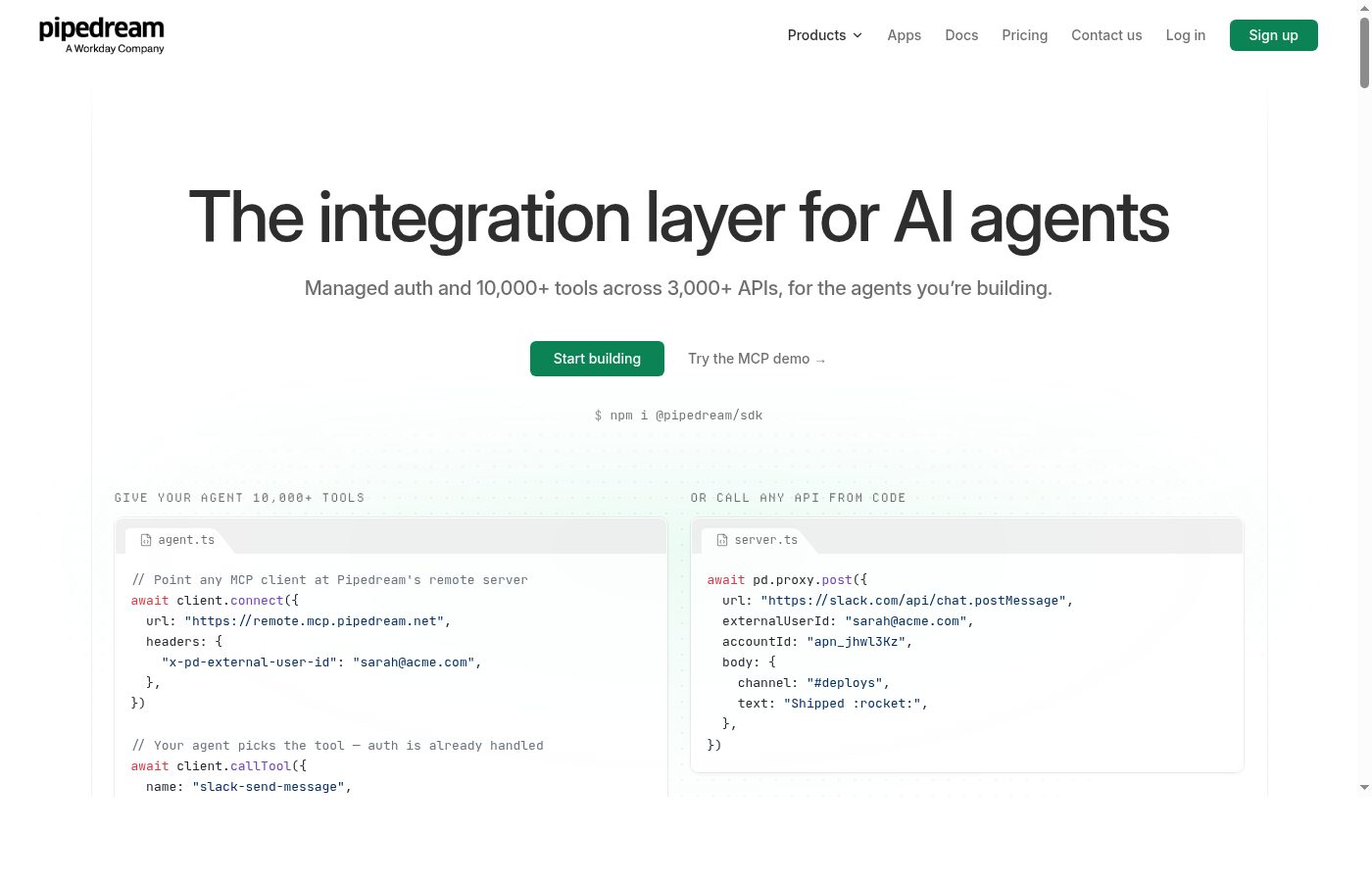
    Pipedream is a developer-first workflow automation platform that enables teams to connect APIs, build event-driven workflows, and deploy AI agents from natural language prompts. The platform offers more than 2,000 pre-built integrations spanning CRM, email, cloud storage, databases, and communication tools. Users can write custom logic in Node.js, Python, Go, or Bash, or use visual no-code builders to orchestrate multi-step automations. In late 2025, Workday announced its acquisition of Pipedream to power its enterprise AI agent ecosystem, adding significant backing and distribution to a platform already favored by developer communities. For CRE teams, Pipedream offers the infrastructure to automate deal flow notifications, lease data extraction pipelines, tenant communication sequences, and cross-platform reporting without building custom middleware from scratch.

    Pipedream earns a 9AI Score of 67 out of 100, reflecting exceptional integration depth, strong innovation through its AI agent builder, and broad platform reliability, balanced by limited native CRE features and a learning curve that favors technically oriented teams. The result is a powerful automation backbone that CRE operations can leverage with modest customization.

    This review is part of BestCRE’s systematic coverage of commercial real estate AI tools across 20 CRE sectors. For the full AI tools directory, see our Best CRE AI Tools hub.

    What Pipedream Does and How It Works

    Pipedream operates as an event-driven workflow automation platform that bridges the gap between code-heavy custom integrations and no-code tools that lack flexibility. At its core, the platform allows users to create workflows triggered by events from any connected application, whether that is a new email in Gmail, a form submission in HubSpot, a webhook from a property management system, or a scheduled cron job. Each workflow consists of modular steps that can execute code, call APIs, transform data, or route logic through conditional branching. The platform handles authentication, rate limiting, and error handling automatically, which removes significant infrastructure overhead from automation projects.

    The integration library spans more than 2,000 applications, including Salesforce, Slack, Google Workspace, Airtable, HubSpot, Twilio, and dozens of database and cloud storage services. For CRE teams, this means a single Pipedream workflow can monitor a deal pipeline in Salesforce, extract lease data from incoming emails, push normalized records into a shared Airtable base, and send status updates to a Slack channel without any manual intervention. The platform also supports HTTP endpoints, making it possible to build custom API services that integrate with proprietary CRE platforms or internal tools built on systems like Yardi or MRI.

    Pipedream’s AI Agent Builder, branded as String, represents its most significant recent innovation. String allows users to describe desired workflows in natural language and have the platform generate executable automation logic. This lowers the barrier to entry for CRE professionals who understand their operational bottlenecks but lack the engineering resources to build automation pipelines. The Workday acquisition, announced in November 2025 and closed in early 2026, positions Pipedream as a core integration layer within Workday’s enterprise AI platform, joining acquisitions of Sana and Flowise to create what Workday describes as an AI platform for managing people, money, and agents. For CRE firms already using Workday for financial management or human capital, Pipedream’s integration with that ecosystem adds strategic value beyond standalone automation.

    The platform runs on a serverless architecture, meaning workflows execute on demand without requiring dedicated infrastructure. This model is well suited to CRE operations that involve bursty workloads, such as quarterly reporting cycles, lease renewal campaigns, or deal pipeline surges during active acquisition periods. Pipedream also provides built-in data stores, allowing workflows to maintain state across executions without external database dependencies. The combination of code flexibility, visual building, AI generation, and enterprise-grade infrastructure makes Pipedream one of the most versatile automation platforms available to CRE operations teams.

    9AI Framework: Dimension by Dimension Analysis

    CRE Relevance: 4/10

    Pipedream is a horizontal automation platform with no native CRE features, workflows, or terminology. It does not ship with pre-built templates for lease administration, deal tracking, tenant management, or property analytics. The platform requires CRE teams to configure their own workflows from scratch, connecting the specific tools and data sources relevant to their operations. That said, the platform’s flexibility means it can be configured for virtually any CRE workflow, from automated deal alerts to rent roll normalization pipelines. The absence of CRE-specific logic is offset by the breadth of its integration library, which includes connectors to many tools CRE firms already use. In practice: Pipedream serves CRE operations as configurable infrastructure rather than a purpose-built solution, and teams with technical resources can build highly effective CRE automations on the platform.

    Data Quality and Sources: 5/10

    Pipedream does not generate or curate data. It is a connector and orchestration layer that moves data between systems, transforms it in transit, and routes it based on conditional logic. The quality of data flowing through Pipedream depends entirely on the source systems connected to each workflow. For CRE teams, this means the platform can process CoStar exports, Yardi API responses, MLS feeds, or proprietary datasets with equal facility, but it does not validate or enrich that data independently. The platform does provide built-in data transformation capabilities, including JSON parsing, CSV manipulation, and regex matching, which support data normalization tasks common in CRE underwriting workflows. Error handling and retry logic help ensure data integrity during transit. In practice: Pipedream is a reliable data pipeline, but CRE teams must ensure the quality and accuracy of their upstream sources since the platform does not independently verify real estate data.

    Ease of Adoption: 7/10

    Pipedream offers multiple adoption paths. Developers can start building workflows immediately using familiar languages like Node.js and Python, with extensive documentation and example libraries. The visual workflow builder provides a no-code path for simpler automations, and the String AI agent builder can generate workflows from natural language descriptions. However, the platform’s full power requires some technical comfort. CRE professionals without development backgrounds may find the initial setup more complex than consumer-oriented tools like Zapier. The documentation is thorough and the community is active, which helps flatten the learning curve. The free tier allows teams to test workflows before committing to paid plans. In practice: CRE teams with at least one technically oriented member can adopt Pipedream quickly, but pure business users may need support for initial configuration.

    Output Accuracy: 7/10

    Pipedream’s output accuracy is a function of workflow design rather than inherent model quality. Automations execute deterministically: if a workflow is configured correctly, it will process data accurately and consistently across thousands of executions. The platform provides detailed execution logs, step-by-step debugging, and error reporting that allow teams to identify and resolve accuracy issues quickly. For CRE applications like automated rent roll processing or deal pipeline updates, the reliability of execution is high once workflows are validated. The AI agent builder introduces some variability, as natural language generated workflows may require refinement to match precise business logic. The serverless architecture ensures consistent execution without degradation under load. In practice: workflow outputs are highly reliable when properly configured, and the platform’s debugging tools make it straightforward to identify and correct any processing errors.

    Integration and Workflow Fit: 8/10

    Integration is Pipedream’s core strength. The platform offers pre-built connectors to more than 2,000 applications, including major CRM systems (Salesforce, HubSpot), communication platforms (Slack, Teams, Twilio), cloud storage (Google Drive, Dropbox, Box), databases (PostgreSQL, MySQL, MongoDB), and spreadsheet tools (Google Sheets, Airtable). For CRE teams, this means workflows can bridge the gap between property management systems, deal management platforms, marketing tools, and financial reporting systems. The platform also supports custom HTTP requests and webhook listeners, enabling integration with proprietary CRE platforms that offer API access. The Workday acquisition adds future integration depth with enterprise financial and HR systems. In practice: Pipedream can connect virtually any system in a CRE tech stack, making it one of the most versatile integration layers available for commercial real estate operations.

    Pricing Transparency: 7/10

    Pipedream publishes clear pricing tiers on its website. The free tier includes 100 daily workflow invocations with access to all integrations. The Starter plan begins at $29 per month for higher invocation limits and additional features. Professional and Enterprise tiers are available for teams requiring dedicated infrastructure, priority support, and higher execution volumes. The pricing model is usage-based, which aligns well with CRE operations that may have variable automation volumes across reporting cycles and deal surges. The free tier provides a genuine testing environment, not just a trial period, which lowers the barrier to evaluation. Enterprise pricing requires direct sales engagement, which is standard for platforms at this scale. In practice: CRE teams can accurately forecast automation costs based on published tier structures, though enterprise deployments will require custom quoting.

    Support and Reliability: 7/10

    Pipedream provides comprehensive documentation, a community forum, and a Discord server with active participation from the development team. The serverless architecture delivers high uptime, and the platform includes built-in monitoring, alerting, and retry logic for failed workflow executions. Enterprise customers receive dedicated support and SLA guarantees. The Workday acquisition enhances the platform’s long-term stability and support infrastructure, as it now operates under the umbrella of a major enterprise software company with established support operations. Reviewer feedback on G2 and Capterra consistently highlights the quality of documentation and the responsiveness of the support team. The platform also provides detailed execution logs and debugging tools that reduce dependency on support for troubleshooting. In practice: support quality is strong for a developer platform, and the Workday backing adds confidence in long-term reliability for enterprise CRE deployments.

    Innovation and Roadmap: 8/10

    Pipedream has consistently pushed the boundaries of workflow automation. The introduction of String, the AI agent builder, represents a meaningful leap from traditional trigger-action automation toward autonomous agent deployment. The Workday acquisition signals a roadmap that includes deeper enterprise AI capabilities, expanded connector libraries, and integration with Workday’s platform for managing financial, human capital, and operational workflows. The platform’s architecture supports rapid iteration, with new integrations and features shipping regularly. The combination of code-level flexibility and AI-driven workflow generation positions Pipedream at the leading edge of automation platform innovation. The open-source components of the platform also contribute to a strong ecosystem of community-built integrations. In practice: Pipedream demonstrates strong innovation velocity, and the Workday acquisition accelerates its trajectory toward enterprise AI agent infrastructure.

    Market Reputation: 7/10

    Pipedream has built a strong reputation among developer communities, with favorable reviews on G2, Capterra, and Software Advice highlighting its flexibility, integration depth, and developer experience. The Workday acquisition validated the platform’s market position and technology, as Workday selected Pipedream alongside Sana and Flowise to form the core of its enterprise AI agent ecosystem. The platform serves thousands of organizations across industries, though its CRE-specific client base is not publicly documented. Reviewer feedback consistently emphasizes the platform’s superiority to consumer-oriented tools like Zapier for complex, code-heavy automation use cases. The developer community on Discord and GitHub adds additional reputational strength. In practice: Pipedream is well regarded in the automation market and the Workday acquisition provides institutional credibility, though its brand recognition within CRE specifically remains limited.

    9AI Score Card Pipedream
    67
    67 / 100
    Emerging Tool
    Workflow Automation
    Pipedream
    Pipedream delivers developer-first workflow automation with 2,000 plus integrations and an AI agent builder, now backed by Workday for enterprise scale CRE operations.
    9 Dimensions, Scored 1 to 10
    1. CRE Relevance
    4/10
    2. Data Quality & Sources
    5/10
    3. Ease of Adoption
    7/10
    4. Output Accuracy
    7/10
    5. Integration & Workflow Fit
    8/10
    6. Pricing Transparency
    7/10
    7. Support & Reliability
    7/10
    8. Innovation & Roadmap
    8/10
    9. Market Reputation
    7/10
    BestCRE.com, 9AI Framework v2 Reviewed April 2026

    Who Should Use Pipedream

    Pipedream is best suited for CRE operations teams, asset managers, and brokerage firms that have at least one technically proficient team member and need to automate repetitive workflows across multiple systems. Investment firms that manage deal pipelines across Salesforce, email, and spreadsheet tools will find immediate value in Pipedream’s ability to connect those systems into automated sequences. Property management companies handling high volumes of maintenance requests, tenant communications, and vendor coordination can use Pipedream to build notification and routing automations that reduce manual processing. The platform is also well suited for CRE technology teams building internal tools that need a reliable integration layer between proprietary systems and third-party services.

    Who Should Not Use Pipedream

    Pipedream may not be the right fit for CRE teams that lack any technical resources and need turnkey automation with no configuration required. Teams looking for a purpose-built CRE workflow platform with pre-configured lease management, deal tracking, or tenant communication templates should evaluate CRE-native platforms instead. The platform’s code-first orientation, while offset by the AI agent builder, still favors teams that are comfortable with technical concepts. Organizations that only need simple, single-step automations may find consumer-oriented tools like Zapier or IFTTT more accessible for their requirements.

    Pricing and ROI Analysis

    Pipedream offers a free tier with 100 daily invocations that provides genuine testing capacity for CRE teams evaluating the platform. The Starter plan begins at $29 per month and includes higher invocation limits and additional workflow features. Professional and Enterprise tiers scale pricing based on execution volume and include dedicated infrastructure, priority support, and team collaboration features. For CRE teams, the ROI calculation centers on analyst time recovered from manual processes. A single automation that eliminates 30 minutes of daily data entry across a five-person team saves roughly 130 hours per month, which at blended analyst costs of $50 to $75 per hour represents $6,500 to $9,750 in monthly value against a subscription cost of $29 to several hundred dollars per month. The usage-based model aligns well with CRE operations that experience variable automation demands across quarterly cycles and deal surges.

    Integration and CRE Tech Stack Fit

    Pipedream’s integration depth is its primary competitive advantage. With more than 2,000 pre-built connectors and support for custom HTTP requests, the platform can connect virtually any system in a CRE technology stack. Firms using Salesforce for deal management, Yardi or MRI for property management, Google Workspace for collaboration, and Slack for team communication can build automated workflows that bridge all four systems through a single Pipedream orchestration layer. The platform’s support for webhooks and custom API calls means it can integrate with proprietary CRE platforms that offer API access, even without a pre-built connector. The Workday acquisition adds future integration depth with enterprise financial systems. For CRE firms evaluating their technology architecture, Pipedream functions as a universal integration bus that eliminates point-to-point integration complexity.

    Competitive Landscape

    Pipedream competes with Zapier, Make (formerly Integromat), and n8n in the workflow automation category, while also facing emerging competition from AI agent platforms like Relevance AI and Lindy. Against Zapier, Pipedream differentiates through code-level flexibility, developer tooling, and a more generous free tier. Against n8n, Pipedream offers a managed cloud infrastructure that eliminates self-hosting requirements. The Workday acquisition positions Pipedream distinctly from all competitors as the only major automation platform backed by a Fortune 500 enterprise software company, which adds credibility and integration depth for CRE firms operating at institutional scale. For CRE teams specifically, the choice between Pipedream and competitors often comes down to technical comfort level: Pipedream rewards teams that can write code, while Zapier favors pure no-code users.

    The Bottom Line

    Pipedream is a powerful, developer-oriented automation platform that CRE teams can configure to eliminate manual processes across their entire technology stack. Its 2,000 plus integrations, code flexibility, and AI agent builder provide the infrastructure for sophisticated automation workflows. The 9AI Score of 67 reflects strong capabilities across integration depth, innovation, and platform reliability, balanced by the absence of native CRE features and a learning curve that favors technically proficient teams. For CRE firms willing to invest in initial configuration, Pipedream delivers exceptional long-term automation value with the added stability of Workday’s enterprise backing.

    About BestCRE

    BestCRE.com is the definitive authority on commercial real estate AI, analysis, and investment intelligence. Every article advances the mission of helping CRE professionals identify, evaluate, and deploy the best technology tools for their operations. We benchmark platforms using the 9AI Framework so CRE leaders can compare tools with clear, evidence-based scoring. Explore the full category map at 20 CRE sectors for deeper coverage across the CRE technology stack.

    Frequently Asked Questions

    Can Pipedream automate commercial real estate workflows without coding?

    Pipedream offers multiple paths to automation, including a visual workflow builder and an AI agent builder called String that generates workflows from natural language descriptions. CRE teams can describe a desired automation in plain English, such as “when a new property listing appears in my email, extract the address and price, add it to my Airtable deal tracker, and send a Slack notification to my acquisitions team.” String will generate the workflow logic for review and deployment. However, more complex automations involving custom data transformations or conditional logic may still benefit from code-level adjustments. The platform’s documentation includes step-by-step guides and templates that can accelerate adoption for non-technical users. For teams that need fully turnkey automation, pairing Pipedream with a technically proficient team member or consultant is the most effective approach.

    How does Pipedream compare to Zapier for CRE automation?

    Pipedream and Zapier serve overlapping but distinct markets. Zapier excels at simple, no-code automations with a consumer-friendly interface, making it accessible for CRE professionals with no technical background. Pipedream offers significantly more flexibility through code execution, custom API calls, and a more generous free tier that includes 100 daily invocations compared to Zapier’s more restrictive free plan. For CRE teams building complex automations that involve data transformations, conditional logic, or integration with proprietary systems, Pipedream provides capabilities that Zapier cannot match without premium add-ons. The Workday acquisition also positions Pipedream for deeper enterprise integration. Industry benchmarks suggest that Pipedream workflows execute 40 to 60 percent faster than equivalent Zapier automations due to the serverless architecture and direct API access.

    What CRE systems can Pipedream integrate with?

    Pipedream’s library of more than 2,000 pre-built integrations includes many systems commonly used in CRE operations. Direct connectors exist for Salesforce, HubSpot, Google Workspace, Slack, Microsoft Teams, Airtable, Twilio, and dozens of database and cloud storage services. For CRE-specific platforms like Yardi, MRI, CoStar, or Argus that may not have pre-built connectors, Pipedream supports custom HTTP requests and webhook listeners that can integrate with any system offering API access. The platform also supports SFTP, email parsing, and file system operations, which are relevant for CRE teams that receive data through legacy channels. The Workday acquisition is expected to expand the enterprise integration library further, particularly for financial management and human capital systems used by institutional CRE firms.

    What is the total cost of using Pipedream for a CRE team?

    Total cost depends on automation volume and complexity. The free tier supports 100 daily invocations with access to all integrations, which is sufficient for testing and light production use. The Starter plan at $29 per month supports higher volumes and is adequate for small CRE teams running five to ten active workflows. Professional plans scale with usage and typically range from $79 to several hundred dollars per month for teams running dozens of workflows with higher invocation volumes. Enterprise pricing is negotiated directly. For context, a mid-sized CRE brokerage automating deal pipeline management, tenant communications, and reporting workflows across 15 to 20 active automations would typically fall in the $79 to $199 per month range. That cost is typically justified within the first month by the analyst time recovered from eliminated manual processes.

    How does the Workday acquisition affect Pipedream for CRE users?

    Workday’s acquisition of Pipedream, announced in November 2025 and closed in early 2026, strengthens the platform in several ways relevant to CRE teams. First, it adds enterprise-grade stability and support infrastructure, reducing the risk of platform discontinuation that sometimes concerns institutional adopters of smaller automation tools. Second, it positions Pipedream within Workday’s broader AI agent ecosystem alongside acquisitions of Sana and Flowise, which means future integrations with Workday Financial Management, Human Capital Management, and planning systems. For CRE firms that already use Workday for accounting or HR, this creates a natural integration path. Third, Workday’s enterprise sales and support channels make Pipedream more accessible to institutional CRE firms that prefer to procure through established vendor relationships rather than self-service developer platforms.

    Related Reviews

    Compare Pipedream with other Workflow & Automation tools BestCRE has scored: Yardi Virtuoso (79/100), Cherre (74/100), Roo Code (59/100) and Formula Bot (58/100). Browse every review in CRE Workflow & Automation, the full Best CRE AI Tools directory, or the 20 CRE Sectors hub.
  • Measurabl Navigate Review: AI-Powered ESG Data Management for CRE Portfolios

    Measurabl Navigate Review: AI-Powered ESG Data Management for CRE Portfolios

    BestCRE 9AI Score

    73/100 · Contender

    Measurabl Navigate ranks #50 of 584 commercial real estate AI tools scored on the 9AI Framework. Nine dimensions, each scored out of 10: CRE relevance, data quality, ease of adoption, output accuracy, integration fit, pricing transparency, support, innovation and market reputation.

    Environmental, social, and governance compliance has transitioned from a voluntary differentiator to a regulatory requirement across major commercial real estate markets. The European Union’s Sustainable Finance Disclosure Regulation (SFDR) now requires sustainability-related disclosure for real estate funds marketed to EU investors. GRESB participation, the industry’s primary ESG benchmarking framework, grew to cover more than 2,000 property portfolios in 2025, representing over $8.6 trillion in assets. Institutional CRE investors increasingly require ESG performance data as a condition of investment. Decarbonization pathway planning has emerged as a leading sustainability priority for commercial real estate owners, with many actively developing or implementing net-zero strategies. Managing the data infrastructure required to support these compliance, benchmarking, and strategic planning obligations has emerged as one of the most complex operational challenges facing CRE portfolio managers.

    Measurabl Navigate is a next-generation ESG platform designed specifically for real estate owners, operators, and investors to quantify value from sustainability. The platform is deployed across more than 18 billion square feet of real estate valued in excess of $3 trillion, adopted by 37% of the world’s top asset managers operating across 93 countries. Navigate’s product suite includes Data Manager for streamlined data acquisition with AI-driven quality checks, Insights for customizable analytics and reporting, Disclosure for automated submission to frameworks including GRESB, SFDR, and CDP, and Decarb for evaluating decarbonization scenarios against science-based pathways. At the platform’s core is Quantum Cloud, described as the world’s most authoritative repository of aggregated real estate ESG data, powered by Connect, an AI-enabled utility data automation tool that ingests data four times faster and more accurately than competing sustainability software.

    Under BestCRE’s 9AI evaluation framework, Measurabl Navigate earns a score of 73 out of 100, placing it in the “Solid Platform” category. The platform’s leading market position in CRE ESG data management, AI-powered data ingestion capabilities, and comprehensive regulatory reporting coverage make it the industry’s leading sustainability intelligence platform.

    This review is part of BestCRE’s systematic coverage of commercial real estate AI tools across 20 CRE sectors. For the full AI tools directory, see our Best CRE AI Tools hub.

    What Measurabl Navigate Does and How It Works

    Measurabl Navigate addresses the full lifecycle of ESG data management for commercial real estate portfolios, from raw data collection through analysis, reporting, and strategic planning. The platform recognizes that ESG compliance in CRE is fundamentally a data problem: the challenge is not whether to pursue sustainability but how to collect, validate, organize, and report the energy consumption, water usage, waste generation, emissions, and social impact data that compliance frameworks demand across portfolios spanning hundreds or thousands of properties.

    Data Manager handles the most labor-intensive aspect of ESG compliance: collecting and validating utility and resource consumption data across a portfolio. The module’s Connect feature uses AI to automate utility data ingestion from hundreds of utility providers, reducing the manual effort of gathering monthly bills, entering meter readings, and reconciling account numbers across properties. Measurabl claims this AI-enabled approach is four times faster and more accurate than competing software, which if validated represents a meaningful productivity improvement for sustainability teams managing large portfolios. The ML-driven quality checks automatically flag data anomalies such as unexplained consumption spikes, missing months, unit conversion errors, and readings that fall outside expected ranges for a property’s size and type.

    Insights provides customizable analytics and reporting capabilities that transform raw ESG data into actionable intelligence. Portfolio managers can track energy intensity, carbon emissions, water consumption, and waste diversion rates across properties, benchmark performance against peers, identify underperforming assets, and monitor progress toward sustainability targets. The analytics engine supports both internal reporting (board presentations, investment committee materials, asset management reviews) and external reporting (investor communications, tenant engagement, regulatory submissions).

    Disclosure automates the preparation and submission of ESG reports to major frameworks. GRESB submission, which traditionally requires weeks of data compilation and formatting, can be streamlined through Measurabl’s pre-mapped data templates. The platform also supports SFDR Article 8 and Article 9 fund reporting, CDP climate disclosure, ENERGY STAR benchmarking, and various local regulatory requirements. Decarb provides scenario planning tools for decarbonization strategy, allowing portfolio managers to evaluate different intervention pathways (building envelope improvements, mechanical system upgrades, renewable energy procurement, operational changes) against science-based targets and assess the capital expenditure implications of each approach.

    9AI Framework: Dimension-by-Dimension Analysis

    CRE Relevance: 9/10

    Measurabl Navigate is built exclusively for commercial real estate ESG management, with every feature designed around the specific data structures, compliance requirements, and operational patterns of property portfolios. The platform understands that CRE ESG data is organized by property, measured in building-specific units (kWh per square foot, gallons per occupant), and reported through industry-specific frameworks (GRESB, ENERGY STAR). The company’s entire product strategy, client base, and domain expertise are focused on real estate sustainability, with no general-purpose or cross-industry capabilities that might dilute the CRE focus. The deployment across 18 billion square feet demonstrates relevance at a scale that touches a meaningful portion of the global institutional CRE market. The only reason this dimension does not score a perfect 10 is that ESG represents one dimension of CRE operations rather than a core transactional or property management workflow. In practice: Measurabl is the most CRE-relevant ESG platform available, with domain depth that generic sustainability software cannot replicate.

    Data Quality and Sources: 8/10

    Measurabl’s Quantum Cloud represents the largest aggregation of real estate ESG data in the world, covering more than 18 billion square feet across 93 countries. This data scale enables the benchmarking, peer comparison, and trend analysis capabilities that make the platform valuable beyond simple data collection. The Connect AI tool automates utility data ingestion from hundreds of utility providers, reducing the manual errors and gaps that plague traditional data collection approaches. ML-driven quality checks provide automated validation that catches anomalies human reviewers might miss: consumption patterns that deviate from historical norms, meter readings that are inconsistent with building size, or data gaps that would undermine reporting accuracy. The platform’s data normalization capabilities ensure consistency across properties with different utility providers, meter configurations, and reporting periods. In practice: Measurabl’s data quality infrastructure is among the most sophisticated in CRE ESG, with the Quantum Cloud dataset providing benchmarking context that no other platform can match at comparable scale.

    Ease of Adoption: 7/10

    Measurabl Navigate operates as a cloud-based SaaS platform accessible through a web interface, eliminating infrastructure requirements. The Connect AI tool significantly reduces the onboarding burden by automating utility data ingestion rather than requiring manual entry of historical consumption data. However, ESG data management is inherently complex, and even with automation tools, onboarding a large portfolio requires mapping properties to utility accounts, establishing data connections with utility providers, validating historical data, and configuring reporting frameworks. Implementation timelines for institutional portfolios typically range from 4 to 12 weeks depending on portfolio size and data complexity. The platform’s interface is designed for sustainability professionals and requires familiarity with ESG concepts, reporting frameworks, and building performance metrics. Property managers without ESG expertise will face a steeper learning curve than sustainability team members who understand the domain. In practice: Navigate streamlines adoption relative to manual ESG data management, but the inherent complexity of utility data collection and framework compliance means onboarding is not instantaneous.

    Output Accuracy: 7/10

    Measurabl’s output accuracy benefits from its ML-driven quality validation pipeline, which catches data anomalies before they propagate into reports and disclosures. The automated utility data ingestion through Connect reduces the transcription errors that commonly occur during manual bill entry, and the platform’s normalization engine ensures that consumption data is consistently calculated regardless of billing period variations, unit differences between utility providers, or meter configuration changes. For GRESB submissions specifically, Measurabl’s pre-mapped templates reduce the formatting and calculation errors that have historically caused portfolio managers to submit inaccurate disclosures. The Quantum Cloud benchmarking dataset provides additional accuracy validation: when a property’s reported energy intensity falls significantly outside the range observed for comparable buildings, the system flags the anomaly for review. The primary accuracy limitation is that the platform’s outputs are only as good as the underlying utility data, and in markets where utility providers deliver inconsistent or delayed billing data, even automated ingestion cannot fully compensate. In practice: Navigate’s accuracy is good for well-instrumented properties with reliable utility data, with the ML quality checks providing a meaningful safety net against common data errors.

    Integration and Workflow Fit: 7/10

    Measurabl integrates with the CRE technology ecosystem through utility provider connections, property management system data exchanges, and reporting framework submissions. The Connect AI tool interfaces directly with hundreds of utility providers to automate data collection, eliminating the most tedious integration challenge in ESG data management. The platform supports data exchange with property management systems (Yardi, MRI) for property attribute synchronization and with building management systems for more granular operational data. GRESB, CDP, ENERGY STAR, and regulatory framework integrations automate the submission process, reducing the manual effort required for compliance reporting. The platform provides API access for firms that want to integrate ESG data into proprietary analytics platforms or investor reporting dashboards. The primary integration gap is that Measurabl operates as a specialized ESG data layer rather than an integrated component of the core property management workflow, meaning that ESG data management remains somewhat siloed from daily operational systems. In practice: Measurabl connects well to the external systems that matter most for ESG compliance (utility providers, reporting frameworks) while maintaining productive connections to core CRE technology platforms.

    Pricing Transparency: 5/10

    Measurabl does not publish pricing on its website, and subscription costs are determined through direct sales engagement based on portfolio size, number of properties, and feature modules required. The platform’s institutional positioning and the complexity of ESG data management create a pricing dynamic similar to other enterprise CRE platforms: custom quotes, annual contracts, and limited visibility into cost structures before engaging with the sales process. Industry feedback suggests that Measurabl’s pricing scales with portfolio size, which makes economic sense (larger portfolios derive more value from automated data management) but creates uncertainty for firms evaluating the platform’s cost-effectiveness. Although Measurabl offers a separate free solution as an entry point, Navigate has no self-service trial or published tier, so smaller CRE firms or those with limited ESG requirements must commit to the evaluation process before understanding whether the platform fits their budget. In practice: Navigate pricing is opaque, consistent with enterprise CRE software norms but frustrating for buyers seeking transparent cost comparison against alternatives.

    Support and Reliability: 7/10

    Measurabl provides enterprise support including implementation assistance, training resources, and dedicated account management for institutional clients. The company’s team includes sustainability professionals who understand both the platform and the ESG compliance landscape, which means support interactions address both technical platform questions and domain-specific advisory needs. The platform’s cloud infrastructure supports mission-critical ESG reporting workflows, with particular reliability demands during GRESB submission periods when hundreds of firms prepare and upload disclosures simultaneously. Documentation covers platform functionality, framework-specific reporting guidance, and best practices for data collection and quality management. The company hosts educational webinars and industry events that provide additional learning opportunities. The primary support consideration is that the sustainability and ESG advisory aspect of the service varies by subscription tier: larger clients receive more strategic advisory support, while smaller subscribers may rely more heavily on self-service resources. In practice: Measurabl’s support combines platform expertise with ESG domain knowledge, a combination that generic technology support organizations cannot provide.

    Innovation and Roadmap: 8/10

    Measurabl demonstrates strong innovation in applying AI to the specific challenges of real estate ESG data management. The Quantum Cloud architecture represents a significant data infrastructure investment that creates network effects: as more properties contribute data, the benchmarking and analytics capabilities become more valuable for all participants. The Connect AI tool’s ability to automate utility data ingestion from hundreds of providers at four times the speed of manual processes addresses the industry’s most persistent operational bottleneck. The Decarb module brings scenario planning and science-based target analysis to portfolio-level decarbonization strategy, a capability that most CRE firms currently approach through custom consulting engagements or spreadsheet-based models. The platform’s evolution from a data collection tool to a comprehensive sustainability intelligence platform reflects a strategic vision that anticipates the increasing centrality of ESG to CRE investment and operations decisions. In practice: Measurabl’s innovation is well-targeted at the highest-value problems in CRE sustainability, with the Quantum Cloud data platform providing a durable competitive advantage that compounds with scale.

    Market Reputation: 8/10

    Measurabl has established itself as a leading ESG data platform in commercial real estate, with market penetration metrics that are exceptional for a specialized technology provider. Deployment across 18 billion square feet, adoption by 37% of the world’s top asset managers, and presence in 93 countries represent a level of institutional validation that few CRE technology companies achieve. The company’s leadership is regularly featured in sustainability and real estate publications, and Measurabl is referenced as a standard tool in institutional investor ESG evaluation frameworks. The platform’s partnership with GRESB and its position as a recommended technology solution for GRESB reporting further cement its market standing. Industry analysts and ESG consultants routinely recommend Measurabl as the leading purpose-built CRE sustainability platform. In practice: Measurabl’s market reputation in CRE ESG is comparable to CoStar‘s position in CRE data, representing the clear category leader that competitors are measured against.

    9AI Score Card MEASURABL NAVIGATE
    76
    73 / 100
    Solid Platform
    ESG & Sustainability
    Measurabl Navigate
    The world’s leading CRE ESG platform managing sustainability data across 18B+ sq ft, with AI-powered utility ingestion and automated GRESB/SFDR reporting.
    9 Dimensions, Scored 1 to 10
    1. CRE Relevance
    9/10
    2. Data Quality & Sources
    8/10
    3. Ease of Adoption
    7/10
    4. Output Accuracy
    7/10
    5. Integration & Workflow Fit
    7/10
    6. Pricing Transparency
    5/10
    7. Support & Reliability
    7/10
    8. Innovation & Roadmap
    8/10
    9. Market Reputation
    8/10
    BestCRE.com, 9AI Framework v2 Reviewed April 2026

    Who Should Use Measurabl Navigate

    Measurabl Navigate is essential for institutional CRE investors, REITs, and operators that participate in GRESB benchmarking, report under SFDR requirements, or manage decarbonization commitments. Firms managing portfolios of 50 or more properties with active ESG reporting obligations represent the core user profile, as the platform’s automation capabilities deliver the most value at scale. Asset managers under pressure from institutional investors (pension funds, sovereign wealth funds, endowments) to demonstrate ESG performance will find Navigate’s reporting and benchmarking tools directly responsive to investor demands. Corporate real estate teams managing large occupancy portfolios subject to energy disclosure requirements (Local Law 97 in New York, BERDO in Boston) will benefit from the automated utility data management and compliance reporting capabilities. Sustainability teams seeking to move beyond basic data collection into strategic decarbonization planning will find the Decarb module’s scenario analysis capabilities relevant to their strategic needs.

    Who Should Not Use Measurabl Navigate

    Small CRE firms managing fewer than 20 properties with limited ESG reporting requirements may find Navigate’s enterprise capabilities and pricing disproportionate to their needs. Firms not subject to GRESB, SFDR, or local energy disclosure requirements may not need the compliance automation features that justify Navigate’s subscription cost. Property managers whose sustainability efforts are limited to basic ENERGY STAR benchmarking can accomplish that through the free ENERGY STAR Portfolio Manager tool without investing in a comprehensive ESG platform. Firms seeking a combined property management and sustainability solution may prefer the ESG modules available within Yardi or MRI Software rather than adding a standalone ESG platform.

    Pricing and ROI Analysis

    Measurabl does not publish pricing, and subscription costs are determined by portfolio size and feature requirements. The ROI case for Measurabl centers on three value streams. First, labor efficiency: automated utility data collection and GRESB submission can save a sustainability team 200 to 500 hours annually compared to manual processes, valued at $15,000 to $40,000 at typical sustainability analyst compensation. Second, compliance risk reduction: accurate, automated ESG reporting reduces the risk of regulatory penalties (Local Law 97 fines can reach $268 per ton of CO2 above limits) and audit findings. Third, investment access: institutional investors increasingly require GRESB participation and ESG performance documentation as conditions of capital allocation, making Measurabl’s reporting capabilities a gateway to capital that might otherwise be unavailable. For large institutional portfolios, the capital access value alone can dwarf the subscription cost.

    Integration and CRE Tech Stack Fit

    Measurabl integrates with the CRE technology ecosystem through utility provider connections (via the Connect AI tool), property management system data exchanges (Yardi, MRI), building management system interfaces for real-time operational data, and reporting framework submissions (GRESB, CDP, ENERGY STAR). The platform provides API access for firms integrating ESG data into proprietary analytics and investor reporting systems. The utility provider integration network covers hundreds of providers across the platform’s 93-country footprint, enabling automated data collection that would be impractical to replicate manually. The platform’s position as a specialized ESG data layer means it complements rather than replaces core property management technology, adding sustainability intelligence to the existing technology stack.

    Competitive Landscape

    Measurabl competes in the CRE ESG platform market against several established and emerging alternatives. Deepki provides a European-focused ESG platform with strong regulatory reporting capabilities. Envizi (acquired by IBM) offers environmental data management for enterprise portfolios. Yardi and MRI Software both offer ESG modules within their broader property management platforms, providing integration advantages for firms already on those ecosystems. Smaller specialized tools like Turntide, Aquicore, and Facilio focus on building-level energy management rather than portfolio-wide ESG reporting. Measurabl’s primary competitive advantages are its CRE-specific focus, the scale of its Quantum Cloud dataset (which enables unmatched peer benchmarking), and its GRESB reporting workflow integration. The platform’s dominance among top-tier asset managers creates a network effect that reinforces data quality and benchmarking relevance.

    The Bottom Line

    Measurabl Navigate earns a 9AI score of 73 out of 100, reflecting its position as the commercial real estate industry’s leading ESG data management platform. The deployment across 18 billion square feet, adoption by 37% of the world’s top asset managers, and the Quantum Cloud dataset’s unmatched scale provide a foundation that competitors cannot easily replicate. The score is moderated by pricing opacity, the inherent complexity of ESG data management adoption, and the specialized nature of the platform’s value proposition (ESG is critical but represents one dimension of CRE operations). For institutional CRE firms navigating the expanding landscape of sustainability regulation, investor ESG requirements, and decarbonization commitments, Measurabl Navigate represents the most comprehensive and credible platform available for converting environmental compliance from an operational burden into a strategic advantage.

    About BestCRE

    BestCRE.com is the definitive authority on commercial real estate AI, analysis, and investment intelligence. Our coverage spans 20 CRE sectors with institutional-quality research designed for practitioners, investors, and operators navigating the intersection of technology and commercial real estate. Every review, analysis, and market report is built on primary data, independent evaluation, and a commitment to advancing the CRE industry’s understanding of where AI creates genuine value and where it falls short.

    Frequently Asked Questions

    How does Measurabl’s Connect AI tool automate utility data collection?

    Measurabl’s Connect AI tool automates utility data collection by establishing direct connections with hundreds of utility providers across the platform’s 93-country operational footprint. Once a property’s utility accounts are linked to Connect, the system automatically retrieves billing data, meter readings, and consumption information on a recurring basis without manual intervention. The AI component of Connect handles the normalization challenges that make utility data collection complex: different billing periods, varying unit measurements, estimated versus actual readings, and account structure changes. The tool also applies machine learning quality checks to ingested data, flagging anomalies such as consumption spikes that might indicate meter errors, billing period overlaps that could cause double-counting, or readings that fall outside expected ranges for a property’s type and size. Measurabl claims this automated approach is four times faster and more accurate than manual utility bill entry, which for a portfolio of 500 properties could translate to hundreds of hours saved annually during the data collection phase of ESG reporting cycles.

    What ESG reporting frameworks does Measurabl Navigate support?

    Measurabl Navigate supports automated reporting for the major ESG frameworks relevant to commercial real estate. GRESB (Global Real Estate Sustainability Benchmark) is the primary framework, with Navigate providing pre-mapped data templates that streamline the annual submission process. The platform also supports SFDR (Sustainable Finance Disclosure Regulation) Article 8 and Article 9 fund reporting for firms marketing to EU investors, CDP (formerly Carbon Disclosure Project) climate disclosure, ENERGY STAR benchmarking and certification through automated data exchange with EPA’s Portfolio Manager, and various local regulatory requirements including building performance standards in cities like New York (Local Law 97), Boston (BERDO), Washington D.C. (BEPS), and others. The platform’s framework coverage continues to expand as new regulatory requirements emerge across global markets. For firms subject to multiple reporting obligations, Navigate’s ability to map a single dataset to multiple frameworks reduces the duplicative effort that would otherwise be required.

    How large does a CRE portfolio need to be to justify Measurabl?

    The economic justification for Measurabl Navigate generally becomes clear for portfolios of 50 or more properties with active ESG reporting obligations. At this scale, the manual effort required for utility data collection, data quality validation, and framework-specific reporting preparation typically consumes 400 to 800 hours of sustainability team time annually, a labor cost that often exceeds $30,000 per year. Measurabl’s automation can reduce this effort by 50% to 70%, with the time savings increasing as portfolio size grows. For portfolios of 200 or more properties, the ROI case is straightforward: the labor savings alone justify the subscription, and the added value of benchmarking, analytics, and compliance automation makes the investment compelling. Smaller portfolios of 20 to 50 properties may find the platform valuable if they face stringent reporting requirements (GRESB participation, SFDR compliance) that would be impractical to manage manually, or if institutional investors require ESG performance documentation as a condition of capital allocation.

    Can Measurabl help with building decarbonization planning?

    Yes, Measurabl’s Decarb module provides scenario planning tools for portfolio-level decarbonization strategy. The module allows portfolio managers to evaluate multiple intervention pathways against science-based decarbonization targets, comparing the emissions impact, capital expenditure requirements, and implementation timelines of different approaches. Users can model scenarios including building envelope improvements (insulation, window upgrades), mechanical system replacements (electrification of heating systems, high-efficiency HVAC), operational changes (setpoint optimization, scheduling adjustments), renewable energy procurement (on-site solar, green power purchase agreements), and combinations of these interventions. The Decarb module draws on the Quantum Cloud dataset to provide benchmark data on the effectiveness of similar interventions across comparable buildings, helping portfolio managers make investment decisions informed by real-world performance data rather than theoretical estimates. This capability is increasingly important as building performance standards with escalating carbon limits create financial penalties for properties that fail to meet reduction targets.

    How does Measurabl compare to using Yardi or MRI’s built-in ESG modules?

    Measurabl Navigate and the ESG modules offered by Yardi and MRI Software represent different strategic approaches to CRE sustainability data management. Yardi and MRI’s ESG modules provide integration advantages for firms already on those platforms, accessing property data directly from the property management system without additional connections. However, these modules are components of broader property management suites rather than purpose-built ESG platforms, which typically means less depth in sustainability-specific analytics, benchmarking, and framework reporting. Measurabl’s advantages include the Quantum Cloud dataset (enabling peer benchmarking across 18 billion square feet), dedicated framework reporting workflows (particularly for GRESB, which Measurabl has optimized extensively), the Connect AI tool for automated utility data collection from hundreds of providers, and the Decarb scenario planning module. For firms with straightforward ESG reporting needs on Yardi or MRI, the built-in modules may suffice. For firms with complex multi-framework reporting obligations, ambitious decarbonization targets, or a need for institutional-grade benchmarking, Measurabl provides capabilities that platform-native ESG modules do not match.

    Related Reviews

    Compare Measurabl Navigate with other Workflow & Automation tools BestCRE has scored: Yardi Virtuoso (79/100), Cherre (74/100), TripleZip (61/100) and Roo Code (59/100). Browse every review in CRE Workflow & Automation, the full Best CRE AI Tools directory, or the 20 CRE Sectors hub.

  • Keyway Review: AI Rent Comps and Underwriting for Multifamily CRE

    Keyway Review: AI Rent Comps and Underwriting for Multifamily CRE

    BestCRE 9AI Score

    72/100 · Contender

    Keyway ranks #189 of 450 commercial real estate AI tools scored on the 9AI Framework. Nine dimensions, each scored out of 10: CRE relevance, data quality, ease of adoption, output accuracy, integration fit, pricing transparency, support, innovation and market reputation.

    Revenue management in multifamily commercial real estate has entered a period of unprecedented complexity. Pricing reflects that complexity. MSCI’s RCA CPPI US report showed apartment prices falling 1.7 percent in June 2026 from a year earlier, the tenth consecutive month of annual declines. Asking rents and net effective rents have diverged in markets with elevated new supply, which means that surface-level rent data increasingly misrepresents actual revenue performance. The National Multifamily Housing Council estimated that the average institutional multifamily operator adjusts rents across 15,000 to 50,000 units monthly, each decision informed by competitive rent comps, concession analysis, and market demand signals that arrive in inconsistent formats from dozens of sources. Unreliable or stale rent comp data remains a persistent frustration for multifamily asset managers, creating a market opportunity for platforms that can deliver real-time, source-verified rental intelligence.

    Keyway is an AI-powered platform designed for multifamily commercial real estate that delivers real-time rent comps, automated T12 and rent roll analysis, and revenue management intelligence. The platform continuously ingests public listings, property websites, and MLS/ILS data, then normalizes rent, unit mix, and concession language using domain-specific models built specifically for the multifamily sector. Keyway has attracted institutional adoption from firms including Blackstone, Brookfield, and Goldman Sachs, positioning it as a serious contender in the CRE AI landscape. The platform’s core products, the T12 Analyzer and Rent Roll Analyzer, use machine learning to transform unstructured financial documents into standardized, enriched data suitable for underwriting and asset management workflows.

    Under BestCRE’s 9AI evaluation framework, Keyway earns a score of 72 out of 100, placing it in the “Solid Platform” category. The tool’s real-time rent comp engine, institutional client roster, and multifamily-specific AI models demonstrate genuine CRE value, while limited pricing transparency and integration breadth constrain its overall score.

    This review is part of BestCRE’s systematic coverage of commercial real estate AI tools across 20 CRE sectors. For the full AI tools directory, see our Best CRE AI Tools hub.

    What Keyway Does and How It Works

    Keyway addresses the multifamily sector’s most persistent data challenge: the gap between the volume of rental market data available across disparate sources and the ability of acquisitions and asset management teams to synthesize that data into actionable intelligence. The platform operates across three primary workflow areas: real-time rent comp generation, financial document analysis, and revenue management support.

    The rent comps engine forms Keyway’s most distinctive capability. The platform continuously monitors public listing sources, property websites, and MLS/ILS feeds, ingesting rental data as it appears and normalizing it using domain-specific machine learning models. This normalization process is critical because raw listing data is notoriously inconsistent: one property advertises “1BR from $1,450” while a competitor lists “1BR/1BA 650sf $1,525 with 6 weeks free.” Keyway’s models parse these variations, calculate net effective rents, standardize unit type classifications, and produce comparable datasets that acquisitions teams can use directly in underwriting models. The platform also tracks concession activity, identifying trends in free rent offers, reduced security deposits, and other incentives that affect actual revenue performance but rarely appear in traditional comp databases.

    The T12 Analyzer and Rent Roll Analyzer constitute Keyway’s document intelligence capabilities. These tools accept PDF uploads of trailing 12-month operating statements and rent rolls, applying AI extraction to identify and structure the data within each document. The T12 Analyzer maps revenue and expense line items to standardized categories, reconciles figures across different presentation formats, and flags anomalies that may warrant further investigation during underwriting. The Rent Roll Analyzer extracts unit-level detail including current rents, market rents, lease dates, occupancy status, and tenant information, normalizing the output regardless of the property management system that generated the source document.

    KeyBrain, the platform’s AI intelligence layer, synthesizes data from rent comps, document analysis, and market signals to provide strategic insights for revenue management and acquisitions decisions. This capability moves Keyway beyond pure data extraction into analytical intelligence, offering recommendations on rental pricing, market positioning, and investment timing based on the platform’s aggregated view of multifamily market conditions. For institutional operators managing thousands of units across multiple markets, this analytical layer transforms scattered data into a coherent revenue strategy.

    9AI Framework: Dimension-by-Dimension Analysis

    CRE Relevance: 9/10

    Keyway is built exclusively for commercial real estate, with a specific focus on multifamily that gives it exceptional depth in the sector’s most active asset class. The platform’s rent comp engine, document analyzers, and revenue management capabilities address the core workflows of multifamily acquisitions, underwriting, and asset management. Keyway’s AI models are trained on real estate data exclusively, understanding the nuances of concession structures, unit mix analysis, and the relationship between asking rents and net effective rents that define multifamily revenue performance. The company’s go-to-market strategy, conference presence, and content marketing are entirely oriented toward CRE professionals. The only reason this dimension does not score a perfect 10 is the platform’s current limitation to multifamily, which excludes office, industrial, retail, and specialty property types from its coverage. In practice: Keyway is deeply CRE-relevant within multifamily, with domain understanding that reflects genuine expertise rather than superficial market positioning.

    Data Quality and Sources: 8/10

    Keyway’s rent comp data quality benefits from its continuous ingestion of public listings, property websites, and MLS/ILS feeds, creating a real-time view of rental market conditions that traditional quarterly survey-based approaches cannot match. The platform’s domain-specific normalization models resolve the inconsistencies that make raw listing data unreliable: standardizing unit types, calculating net effective rents from gross rents and concession packages, and mapping listings to a consistent geographic and unit-type taxonomy. This normalization process is where Keyway’s CRE-specific AI training shows its value, as generic data tools would struggle with the variability and implicit assumptions in multifamily listing language. The T12 and Rent Roll Analyzer products deliver reliable extraction from financial documents, though accuracy depends on document quality and format complexity. The primary data quality limitation is source dependency: Keyway’s rent comps are only as current and complete as the public listing data available in each market. In practice: Keyway’s rent comp data quality exceeds what most acquisitions teams can produce through manual research, with real-time updates providing a meaningful advantage in fast-moving markets.

    Ease of Adoption: 7/10

    Keyway operates as a cloud-based SaaS platform accessible through a web interface, eliminating infrastructure requirements and reducing technical barriers to adoption. The document analysis tools accept standard PDF uploads, and the rent comp engine provides results through an intuitive search and comparison interface. For multifamily acquisitions teams and asset managers, the workflow is straightforward: upload a rent roll or T12, receive structured data; search for rent comps by market and unit type, receive normalized comparisons. The platform’s focus on multifamily means that users encounter real estate-specific terminology and workflows throughout the interface, reducing the translation effort required with generic tools. Onboarding typically involves platform orientation and configuration of market and portfolio preferences. The primary adoption friction is the custom pricing model, which requires sales engagement before teams can evaluate the platform, and the learning curve associated with understanding how Keyway’s rent comp methodology differs from traditional approaches. In practice: multifamily teams can achieve value quickly once subscribed, but the evaluation phase requires more effort than self-service tools.

    Output Accuracy: 8/10

    Keyway’s output accuracy is strong across its core capabilities. The rent comp engine benefits from its domain-specific normalization models, which produce more reliable net effective rent calculations than manual research by consistently accounting for concessions, free rent periods, and other adjustments that human researchers may miss or calculate inconsistently. The T12 and Rent Roll Analyzer products achieve high extraction accuracy for standard multifamily financial documents, with the platform’s models trained to recognize the formatting conventions of major property management systems. The institutional client roster (Blackstone, Brookfield, Goldman Sachs) provides indirect validation of output quality, as these firms’ underwriting standards demand reliable data inputs. The primary accuracy consideration is that rent comp data reflects publicly available listing information, which may not capture privately negotiated deals or insider concession structures. In practice: Keyway’s outputs are accurate enough for institutional underwriting and asset management workflows, with the rent comp normalization providing particular value over manual alternatives.

    Integration and Workflow Fit: 6/10

    Keyway provides data export capabilities and API access for integrating rent comp data and document analysis outputs into downstream workflows. The platform’s structured outputs can feed into Excel-based underwriting models, deal management platforms, and portfolio analytics systems. However, Keyway does not offer native connectors to the CRE technology stack’s core platforms: Yardi Voyager, MRI Software, RealPage, Argus Enterprise, or popular deal management tools like Dealpath and Juniper Square. Building automated data pipelines between Keyway and these platforms requires custom API development. The platform’s position as a specialized data and analytics layer means it complements rather than replaces existing property management and underwriting tools, but the integration work required to connect Keyway’s outputs to operational systems falls on the adopting firm. In practice: Keyway’s data is valuable but requires manual or custom integration work to flow into the broader CRE technology stack, limiting its efficiency for firms seeking fully automated workflows.

    Pricing Transparency: 4/10

    Keyway does not publish pricing on its website, and subscription costs are determined through direct sales engagement. The platform’s enterprise focus and institutional client base suggest pricing in the thousands to tens of thousands of dollars per month range, though specific figures are not publicly available. The custom pricing model is common among CRE-specific platforms but creates evaluation friction for potential buyers who cannot assess cost-effectiveness before engaging with the sales process. For acquisitions teams considering Keyway alongside alternatives like CoStar, CompStak, or Reonomy, the inability to compare pricing without multiple sales conversations adds time and complexity to the procurement process. The platform does not offer a freemium tier or self-service trial, which means teams must commit to the evaluation process before experiencing the product’s capabilities firsthand. In practice: Keyway’s pricing is fully opaque, requiring formal sales engagement before any cost information is disclosed.

    Support and Reliability: 7/10

    Keyway provides customer support commensurate with its enterprise positioning, including onboarding assistance, account management, and technical support. The company’s team includes CRE professionals who understand multifamily workflows, which means support interactions are domain-relevant and productive. The platform’s cloud infrastructure delivers consistent availability, and data refresh cycles for rent comps are frequent enough to maintain the real-time positioning that differentiates the platform. The institutional client roster suggests that Keyway’s support meets the requirements of sophisticated CRE operators, though specific SLA guarantees, uptime metrics, and support tier details are not publicly documented. The company’s relatively early stage (compared to established platforms like CoStar or Yardi) means that the support organization is smaller, which could affect response times during high-demand periods. In practice: support is CRE-knowledgeable and responsive, with the institutional client base providing indirect validation of service quality.

    Innovation and Roadmap: 8/10

    Keyway demonstrates strong innovation in its approach to multifamily data intelligence. The real-time rent comp engine represents a meaningful departure from the traditional quarterly survey model, providing acquisitions and asset management teams with current market data rather than lagged snapshots. The domain-specific normalization models that parse listing language, calculate net effective rents, and standardize concession data reflect significant AI development investment tailored to multifamily’s specific data challenges. KeyBrain’s analytical layer moves the platform beyond data processing into strategic intelligence, an evolution that few CRE AI tools have achieved. The company’s presence in Commercial Observer and CRE trade publications indicates active thought leadership and industry engagement. The platform’s expansion potential into adjacent CRE sectors (office, industrial, retail) represents a clear growth pathway, though executing this expansion while maintaining the multifamily depth that attracted institutional clients will require careful prioritization. In practice: Keyway’s innovation is well-directed and differentiated, with the real-time rent comp capability representing a genuine competitive moat in multifamily data intelligence.

    Market Reputation: 8/10

    Keyway has established credibility with some of the largest institutional names in commercial real estate. The company’s client roster, which includes Blackstone, Brookfield, and Goldman Sachs, represents the highest tier of institutional validation available in the CRE market. These firms’ adoption signals that Keyway’s data quality and analytical capabilities meet the standards of the industry’s most sophisticated operators. The company’s CEO has been featured in Commercial Observer and other CRE trade publications, building brand awareness among the institutional investor and operator communities. However, Keyway remains a relatively young company compared to established platforms like CoStar or CompStak, and its brand recognition among mid-market CRE firms is more limited. The company has not disclosed specific funding details or user metrics that would provide broader market context. In practice: Keyway’s institutional client roster provides powerful credibility, but the platform’s broader market awareness is still developing beyond the top tier of institutional CRE.

    9AI Score Card KEYWAY
    72
    72 / 100
    Solid Platform
    Rent Comps & Underwriting
    Keyway
    AI-powered real-time rent comps, T12 analysis, and revenue management intelligence for multifamily CRE, trusted by Blackstone, Brookfield, and Goldman Sachs.
    9 Dimensions, Scored 1 to 10
    1. CRE Relevance
    9/10
    2. Data Quality & Sources
    8/10
    3. Ease of Adoption
    7/10
    4. Output Accuracy
    8/10
    5. Integration & Workflow Fit
    6/10
    6. Pricing Transparency
    4/10
    7. Support & Reliability
    7/10
    8. Innovation & Roadmap
    8/10
    9. Market Reputation
    8/10
    BestCRE.com, 9AI Framework v2 Reviewed April 2026

    Who Should Use Keyway

    Keyway is best suited for institutional multifamily investors, acquisitions teams, and asset managers who need real-time rent comp data and automated document analysis at scale. Firms evaluating 20 or more multifamily deals per month will benefit most from the T12 and Rent Roll Analyzer tools, which eliminate hours of manual data extraction per deal. Asset management teams responsible for revenue optimization across large multifamily portfolios will find the real-time rent comp engine particularly valuable for monitoring competitive positioning and identifying pricing opportunities. Private equity real estate funds, multifamily REITs, and institutional operators seeking to differentiate their underwriting speed and analytical depth represent Keyway’s core customer profile. The platform’s institutional client roster (Blackstone, Brookfield, Goldman Sachs) signals that it meets the data quality and analytical standards required by the industry’s most demanding operators.

    Who Should Not Use Keyway

    CRE firms focused primarily on property types other than multifamily will find Keyway’s current capabilities less relevant. Small multifamily operators managing portfolios of fewer than 200 units may not generate sufficient deal flow or revenue management complexity to justify the enterprise subscription cost. Firms seeking a comprehensive CRE data platform that covers all property types, markets, and analytical needs should consider CoStar or CompStak as broader alternatives. Teams that need a simple, self-service document extraction tool without revenue management analytics may find specialized extractors like QuickData.ai or Docsumo more appropriate and cost-effective for their specific use case.

    Pricing and ROI Analysis

    Keyway does not publish pricing, and subscription costs require direct sales engagement. The platform’s institutional positioning and client roster suggest enterprise pricing in the range common for specialized CRE data tools. The ROI case for Keyway spans two value streams. First, document automation: if the T12 and Rent Roll Analyzers save 30 minutes per deal and a firm evaluates 40 deals monthly, the annual time savings is approximately 240 hours, valued at $12,000 to $18,000 at typical analyst costs. Second, revenue optimization: if the rent comp engine helps an asset management team identify pricing opportunities that improve effective rents by even 0.5% across a 5,000-unit portfolio with average monthly rents of $1,500, the annual revenue impact is $450,000. The combination of operational efficiency gains and revenue optimization potential creates a compelling ROI case for institutional operators, though the lack of published pricing makes it impossible to calculate specific payback periods without entering the sales process.

    Integration and CRE Tech Stack Fit

    Keyway provides API access and data export capabilities for connecting its rent comp data and document analysis outputs to downstream systems. The platform’s structured outputs can feed into Excel-based underwriting models, revenue management dashboards, and portfolio analytics tools. However, native integrations with CRE-specific platforms (Yardi, MRI, RealPage, Argus, Dealpath) are not prominently featured, and connecting Keyway to these systems requires custom API development. For firms using Excel as their primary underwriting environment, Keyway’s data exports integrate naturally into existing workflows. The platform complements rather than replaces existing property management and market data tools, serving as a specialized layer for real-time rent intelligence and document automation that enhances the broader technology stack.

    Competitive Landscape

    Keyway competes in the multifamily data intelligence space against several established and emerging platforms. CoStar provides broader market coverage but with less multifamily-specific depth in real-time rent comp analysis. CompStak offers exchange-based lease comp data with strong granularity in specific markets. RealPage’s Market Analytics (formerly MPF Research) provides multifamily-specific analytics from a different methodological approach. For document extraction specifically, Docsumo and QuickData.ai offer competing capabilities without the revenue management analytics. Keyway’s differentiators are the real-time rent comp engine with domain-specific normalization, the combination of data extraction and analytical intelligence in a single platform, and the institutional credibility conferred by its client roster. The platform occupies a distinctive position as a multifamily-focused alternative to broader CRE data platforms.

    The Bottom Line

    Keyway earns a 9AI score of 72 out of 100, reflecting its strong multifamily-specific capabilities and institutional validation. The platform’s real-time rent comp engine addresses a genuine market need, its document analyzers compete effectively with dedicated extraction tools, and the institutional client roster (Blackstone, Brookfield, Goldman Sachs) provides credibility that few CRE AI startups can match. The score is moderated by pricing opacity, limited integration breadth, and the current restriction to multifamily as the primary asset class. For multifamily acquisitions teams and asset managers seeking AI-powered rent intelligence that goes beyond traditional comp databases, Keyway represents a compelling platform that combines data processing with analytical insight in ways that the broader CRE data landscape has not yet replicated.

    About BestCRE

    BestCRE.com is the definitive authority on commercial real estate AI, analysis, and investment intelligence. Our coverage spans 20 CRE sectors with institutional-quality research designed for practitioners, investors, and operators navigating the intersection of technology and commercial real estate. Every review, analysis, and market report is built on primary data, independent evaluation, and a commitment to advancing the CRE industry’s understanding of where AI creates genuine value and where it falls short.

    Frequently Asked Questions

    How does Keyway’s rent comp data differ from CoStar or CompStak?

    Keyway’s rent comp data differs from CoStar and CompStak in methodology, timeliness, and scope. CoStar relies primarily on a research team of 2,000+ analysts who verify property data through direct outreach, producing highly accurate but periodically updated information. CompStak operates on a broker exchange model where professionals contribute verified lease comp data in exchange for access to the broader database. Keyway takes a different approach: continuously ingesting public listing data, property websites, and MLS/ILS feeds in real time, then normalizing this data using AI models trained specifically on multifamily rental language. This methodology provides more current data (updated as listings change rather than on survey cycles) but covers a different data layer (asking rents and publicly available information rather than executed lease terms). For multifamily asset managers tracking competitive positioning and market pricing trends, Keyway’s real-time approach provides faster market intelligence than quarterly surveys, though it may not capture privately negotiated terms that CompStak’s exchange model does.

    What institutional clients use Keyway?

    Keyway has disclosed working relationships with Blackstone, Brookfield, and Goldman Sachs, three of the largest institutional investors in commercial real estate globally. These firms collectively manage hundreds of billions of dollars in real estate assets and represent the highest tier of institutional validation available in the CRE market. Blackstone is the world’s largest owner of commercial real estate with approximately $300 billion in real estate assets under management. Brookfield Asset Management manages over $100 billion in real estate assets globally. Goldman Sachs’ real estate division manages institutional capital across multiple strategies. The adoption of Keyway by these firms signals that the platform’s data quality, analytical capabilities, and security standards meet the requirements of the industry’s most sophisticated operators. Additional client details beyond these named relationships have not been publicly disclosed.

    Can Keyway analyze T12 operating statements from any property management system?

    Keyway’s T12 Analyzer is designed to handle operating statements from a wide range of property management systems and presentation formats. The AI extraction models are trained on multifamily financial documents generated by Yardi, RealPage, AppFolio, Entrata, and other property management platforms, as well as manually prepared spreadsheets and custom accounting system outputs. The analyzer handles variations in line item terminology (one property manager’s “Repairs and Maintenance” versus another’s “Building Maintenance”), presentation structure (monthly columns versus quarterly summaries, actual versus budget comparisons), and formatting (native PDFs, scanned documents, Excel exports). The platform standardizes extracted data into a consistent category structure regardless of the source format, which is particularly valuable when comparing T12s across multiple properties that use different management companies. Accuracy may vary for highly unusual or non-standard T12 formats, but the core models cover the presentation styles encountered in the vast majority of institutional multifamily transactions.

    Does Keyway cover property types beyond multifamily?

    Keyway currently focuses primarily on the multifamily sector, which the company has identified as the vertical best positioned to benefit from AI-driven underwriting and revenue management due to the sector’s scale, data intensity, and margin sensitivity. The platform’s rent comp engine, document analyzers, and revenue management capabilities are all optimized for multifamily-specific workflows and data patterns. As of this review, Keyway has not announced expansion into office, industrial, retail, or specialty property types. The company’s leadership has discussed the potential for broader CRE coverage in industry publications, suggesting that multi-sector expansion is on the roadmap, but no specific timeline or product announcements have been made. For firms seeking AI-powered data intelligence across multiple property types, broader platforms like CoStar, Cherre, or Reonomy provide multi-sector coverage, though without Keyway’s depth of multifamily-specific analytical capabilities.

    How quickly does Keyway update its rent comp data?

    Keyway’s rent comp engine updates continuously, ingesting new listing data from public sources, property websites, and MLS/ILS feeds as it appears. This real-time approach contrasts with traditional rent comp methodologies that rely on quarterly surveys, broker submissions, or periodic research team updates. For multifamily markets with high listing turnover, such as growing sunbelt metros where new supply is being absorbed, the real-time data provides a more current view of competitive pricing, concession trends, and market positioning than periodic survey-based approaches. The frequency of updates varies by market and data source: major markets with active listing environments receive near-continuous data refresh, while smaller markets with less listing activity may update less frequently simply because new data points appear less often. The platform’s normalization models process new data as it arrives, recalculating net effective rents and concession analyses to reflect the most current market conditions available from public sources.

    Related Reviews

    Compare Keyway with other Workflow & Automation tools BestCRE has scored: Yardi Virtuoso (79/100), Cherre (74/100), Relay.app (61/100) and Shortcut AI (61/100). Browse every review in CRE Workflow & Automation, the full Best CRE AI Tools directory, or the 20 CRE Sectors hub.
  • MRI Software AI Review: Enterprise Document Intelligence for CRE Portfolios

    MRI Software AI Review: Enterprise Document Intelligence for CRE Portfolios

    BestCRE 9AI Score

    70/100 · Contender

    MRI Software AI ranks #214 of 584 commercial real estate AI tools scored on the 9AI Framework. Nine dimensions, each scored out of 10: CRE relevance, data quality, ease of adoption, output accuracy, integration fit, pricing transparency, support, innovation and market reputation.

    Lease administration remains one of the most document-intensive and error-prone functions in commercial real estate operations. Large institutional CRE portfolios manage a very large number of active leases, each containing numerous critical terms, dates, and financial obligations that must be accurately tracked for accounting compliance, tenant relationship management, and strategic decision-making. Manual lease abstraction is expensive, both for the initial extraction and for the ongoing maintenance that accumulates as amendments, renewals, and modifications pile up. In January 2016 the IASB estimated that listed companies using IFRS Standards or US GAAP had around $3.3 trillion of lease commitments, and that over 85 percent of them did not appear on balance sheets. The move to bring leases onto the balance sheet has since intensified the burden on lease administration teams, requiring extraction of financial terms with sufficient precision to support audit-grade accounting entries. The gap between the volume of lease data that organizations must manage and the capacity of manual processes to handle it accurately has made document intelligence the highest-priority AI use case in commercial real estate operations.

    MRI Software AI is the artificial intelligence capability layer within MRI Software’s comprehensive real estate technology platform. The AI suite focuses primarily on document intelligence, offering enterprise-grade lease abstraction, contract intelligence, and automated data extraction from forms, utility bills, invoices, and other operational documents. MRI’s Contract Intelligence product uses AI and OCR technology to extract key dates, dollar amounts, clauses, and other critical terms from commercial leases, linking extracted data directly to source documents and connecting it to MRI’s lease management and accounting modules. The platform captures hundreds of critical fields, normalizes contract terms into a consistent data model, and supports ASC 842 and IFRS 16 compliance workflows directly within the MRI ecosystem.

    Under BestCRE’s 9AI evaluation framework, MRI Software AI earns a score of 70 out of 100, placing it in the “Solid Platform” category. The tool’s deep integration with MRI’s property management ecosystem, comprehensive lease abstraction capabilities, and enterprise-grade compliance support make it a strong option for firms already operating on the MRI platform.

    This review is part of BestCRE’s systematic coverage of commercial real estate AI tools across 20 CRE sectors. For the full AI tools directory, see our Best CRE AI Tools hub.

    What MRI Software AI Does and How It Works

    MRI Software AI operates as an integrated capability within MRI’s broader real estate technology platform, which serves commercial and residential property owners, operators, and investors globally. The AI suite addresses document intelligence across several operational workflows, with lease abstraction serving as the primary and most mature capability.

    MRI Contract Intelligence is the platform’s flagship AI product for commercial real estate document processing. The system combines optical character recognition with machine learning models trained on commercial lease documents to extract critical terms automatically. Unlike generic document extraction tools that identify text on a page, Contract Intelligence understands the semantic structure of commercial leases: it recognizes that a dollar amount adjacent to “base rent” has different significance than the same format adjacent to “security deposit,” and it maps these distinctions into structured data fields that align with MRI’s lease management module. The extraction engine captures hundreds of critical fields across the full taxonomy of commercial lease terms, including base rent and escalation schedules, operating expense obligations (CAM, insurance, tax passthrough structures), renewal and expansion options with associated terms, tenant improvement allowances and construction obligations, key dates (commencement, expiration, option notice deadlines), co-tenancy clauses, exclusive use provisions, and termination rights.

    Extracted data flows directly into MRI’s lease management and accounting modules, which distinguishes MRI’s AI approach from standalone extraction tools that produce output files requiring manual import. This native integration ensures that abstracted lease terms are immediately available for ASC 842 and IFRS 16 compliance calculations, rent billing, critical date tracking, and portfolio reporting. The platform normalizes contract terms into a consistent data model, which is particularly valuable for portfolios that have accumulated leases across multiple markets, property types, and decades of documentation conventions.

    Beyond lease abstraction, MRI’s AI capabilities extend to broader document processing: automated extraction from utility bills for energy management and sustainability reporting, invoice processing for accounts payable automation, and form extraction for operational data capture. The platform’s document management module provides centralized storage with version control, workflow automation, and critical date tracking that integrates with the AI extraction layer to create a comprehensive document intelligence system.

    9AI Framework: Dimension-by-Dimension Analysis

    CRE Relevance: 8/10

    MRI Software has served the commercial real estate industry for over 50 years, and its AI capabilities are designed exclusively for real estate workflows. The platform’s lease abstraction models understand commercial lease structures at a depth that generic document processing tools cannot approach, recognizing the nuances of NNN lease structures versus gross lease terms, the distinction between base year and expense stop provisions, and the complexities of percentage rent calculations in retail leases. Every AI feature within the MRI ecosystem is oriented toward real estate operational outcomes: lease accounting compliance, rent administration, portfolio analytics, and tenant management. The score stops at 8 because this is a document intelligence layer that also reads utility bills and invoices, not a full CRE platform, although there is little cross-industry dilution of the platform’s CRE focus. In practice: MRI’s AI capabilities inherit the company’s five decades of CRE domain expertise, delivering document intelligence that understands real estate documents in the same way experienced lease administrators do.

    Data Quality and Sources: 7/10

    MRI’s AI extraction captures hundreds of fields from commercial lease documents with enterprise-grade accuracy requirements driven by accounting compliance standards. The platform’s extraction models are trained on commercial real estate documents specifically, which means the AI understands the terminology, formatting conventions, and structural patterns common in CRE leases across different property types and geographies. Extracted data is normalized into a consistent data model that resolves the inconsistencies inherent in lease documents drafted by different attorneys, across different markets, and over different decades. The direct connection to MRI’s accounting modules means that extraction accuracy is validated against financial system requirements, adding a verification layer beyond what standalone extraction tools provide. The primary limitation is that data quality is constrained to the documents processed through the system: MRI AI does not provide market data, transaction comps, or external benchmarks. In practice: MRI’s extraction quality is designed to meet the enterprise standards required for audit-grade accounting compliance, which represents a higher accuracy bar than most CRE AI tools are designed to clear.

    Ease of Adoption: 6/10

    MRI Software AI is available exclusively to firms operating on the MRI platform, which immediately narrows the addressable market to approximately 25% to 30% of institutional CRE firms. For existing MRI clients, adopting the AI capabilities requires engagement with MRI’s implementation team, configuration of extraction templates, training for lease administration staff, and integration testing with existing MRI modules. Enterprise software implementations at this scale typically take 3 to 6 months from initiation to full production deployment. The learning curve for users varies: lease administrators familiar with MRI’s interface will find the AI extraction tools intuitive, while new users face the combined learning curve of the MRI platform and the AI capabilities simultaneously. The platform does not offer a self-service trial or freemium access path, meaning that evaluation requires formal engagement with MRI’s sales and implementation teams. In practice: adoption is straightforward for established MRI clients with implementation support but requires significant commitment from firms considering MRI as a new platform.

    Output Accuracy: 7/10

    MRI Contract Intelligence’s extraction accuracy is calibrated to support ASC 842 and IFRS 16 compliance, which imposes a higher accuracy standard than most document extraction use cases. The platform’s AI models are trained specifically on commercial lease documents, and the extraction engine links every extracted data point back to its source location in the original document, enabling rapid verification by lease administrators. This source linking capability is critical for audit compliance, where auditors need to trace accounting entries back to specific lease language. The system flags low-confidence extractions for human review, directing attention to the data points most likely to require correction rather than necessitating full manual verification. For standard commercial lease formats (office NNN, retail percentage rent, industrial gross), accuracy is described as high, but no accuracy rate is published. More complex documents (ground leases with multiple amendments, subleases with pass-through obligations, synthetic leases) may require more extensive human review. In practice: MRI’s extraction accuracy is designed for the institutional standard required for financial reporting and audit compliance, with source linking providing the verification trail that enterprise clients require.

    Integration and Workflow Fit: 8/10

    MRI’s AI capabilities integrate natively within the MRI platform ecosystem, connecting directly to lease management, accounting, property management, and reporting modules. Extracted lease data flows into ASC 842/IFRS 16 compliance calculations without manual transfer, rent billing schedules are populated from abstracted terms, and critical date alerts are generated automatically based on extracted option and expiration dates. This end-to-end integration within a single platform eliminates the data transfer, format conversion, and reconciliation steps that create friction when using standalone extraction tools alongside separate property management systems. The platform also supports integration with external systems through APIs and data exchange capabilities, enabling connections to ERP systems, business intelligence tools, and third-party reporting platforms. This dimension scores 8 rather than higher because the integration advantage is limited to the MRI ecosystem: firms using Yardi, RealPage, or other property management platforms cannot access MRI’s AI capabilities. In practice: within the MRI ecosystem, integration is seamless and comprehensive, delivering the full value chain from document extraction through accounting compliance in a single platform.

    Pricing Transparency: 4/10

    MRI Software follows the enterprise pricing model common among large CRE technology platforms: no published pricing, custom quotes based on portfolio size and feature requirements, and multi-year contract structures. The AI capabilities are typically sold as add-on modules to the base MRI platform subscription, with costs determined through direct sales engagement. Industry feedback suggests that MRI’s total cost of ownership (platform plus AI modules) is comparable to other enterprise CRE technology investments, ranging from tens of thousands to hundreds of thousands of dollars annually depending on portfolio size and feature scope. The absence of published pricing, combined with the complexity of the modular pricing structure, makes it difficult for prospective buyers to estimate costs or compare MRI’s AI capabilities against alternatives before entering the sales process. In practice: MRI’s pricing is completely opaque, requiring formal sales engagement before any cost information is available, which is standard for enterprise CRE platforms but frustrating for buyers seeking transparent comparison shopping.

    Support and Reliability: 8/10

    MRI Software provides enterprise-grade support through dedicated account management, implementation consulting, training programs, and responsive technical support. The company’s support organization understands commercial real estate operations at an institutional level, which means support interactions are productive and domain-relevant. Training resources cover both the MRI platform and the AI-specific capabilities, including lease abstraction best practices, extraction template configuration, and compliance workflow design. MRI’s cloud infrastructure delivers consistent uptime for mission-critical property management and accounting operations. The company maintains SOC 2 compliance and other enterprise security certifications that institutional clients require. Implementation support for AI module deployment includes template configuration, model training on client-specific document formats, and integration testing with existing MRI modules. In practice: MRI’s support infrastructure meets institutional CRE expectations, with domain-expert staff and comprehensive training resources that accelerate time to value for AI capabilities.

    Innovation and Roadmap: 7/10

    MRI’s AI innovation focuses on practical operational outcomes rather than headline-grabbing technology announcements. The Contract Intelligence product represents meaningful innovation in how commercial leases are processed, combining OCR, machine learning, and source document linking in a way that specifically addresses the needs of lease administration teams subject to accounting compliance requirements. The expansion of AI capabilities beyond leases into utility bills, invoices, and operational forms demonstrates a strategic vision for comprehensive document intelligence across the property management workflow. MRI has also invested in AI-powered analytics for portfolio performance, market trend analysis, and predictive maintenance. However, MRI’s innovation pace appears more measured than Yardi’s Virtuoso launch, which introduced a more ambitious agentic architecture with marketplace and no-code builder capabilities. MRI’s approach prioritizes reliability and compliance over speed of innovation, which aligns with the preferences of its institutional client base but may leave it trailing Yardi in the AI feature race. In practice: MRI’s AI innovation is solid and well-targeted, but the company’s cautious approach may result in feature parity gaps relative to more aggressive competitors.

    Market Reputation: 8/10

    MRI Software holds the second-largest market share in institutional CRE property management technology, serving approximately 25% to 30% of institutional portfolios globally. The company has operated in the CRE technology market for over 50 years, building deep institutional relationships and a reputation for reliability in enterprise property management and accounting. MRI’s client base includes many of the world’s largest real estate investment managers, REITs, and corporate occupiers. The company’s acquisition strategy has expanded its capabilities across lease administration, space management, investment modeling, and strategic planning. MRI is privately held (backed by private equity), which provides financial stability while limiting some transparency compared to publicly traded competitors. Industry recognition includes consistent placement in CRE technology surveys, conference presence at Realcomm, CREtech, and NAREIT, and analyst coverage from major technology research firms. In practice: MRI’s reputation provides the institutional trust necessary for enterprise-scale AI deployment, with a client base that validates the platform’s capabilities at the highest levels of CRE operations.

    9AI Score Card MRI SOFTWARE AI
    76
    70 / 100
    Solid Platform
    Document Intelligence
    MRI Software AI
    Enterprise-grade lease abstraction and document intelligence platform with native integration into MRI’s property management and accounting ecosystem.
    9 Dimensions, Scored 1 to 10
    1. CRE Relevance
    10/100
    2. Data Quality & Sources
    8/10
    3. Ease of Adoption
    7/10
    4. Output Accuracy
    6/10
    5. Integration & Workflow Fit
    7/10
    6. Pricing Transparency
    8/10
    7. Support & Reliability
    4/10
    8. Innovation & Roadmap
    8/10
    9. Market Reputation
    7/10
    BestCRE.com, 9AI Framework v2 Reviewed April 2026

    Who Should Use MRI Software AI

    MRI Software AI is designed for property management firms, institutional investors, and corporate occupiers that already operate on the MRI platform. The tool delivers the highest value for organizations managing large commercial portfolios with thousands of active leases requiring ongoing abstraction, compliance monitoring, and critical date tracking. Lease administration teams subject to ASC 842 and IFRS 16 compliance requirements will find particular value in the automated extraction to accounting pipeline that eliminates manual data transfer between document review and financial reporting systems. Corporate real estate teams managing large occupancy portfolios will benefit from the consistent data normalization that Contract Intelligence provides across leases from multiple markets and landlords. Organizations processing high volumes of invoices and utility bills can extend the AI capabilities beyond leases to broader operational document processing.

    Who Should Not Use MRI Software AI

    Firms that do not use MRI Software as their property management platform cannot access the AI capabilities reviewed here. Migrating to MRI solely for AI features would be disproportionate unless the firm has independent reasons for a platform change. Small property management companies managing fewer than 500 leases may not generate sufficient document volume to justify the enterprise pricing and implementation investment. Firms seeking standalone document extraction tools that operate independently of their property management platform should evaluate alternatives like Docsumo or QuickData.ai. Organizations primarily focused on acquisitions underwriting rather than lease administration will find MRI’s AI capabilities less directly relevant to their workflow.

    Pricing and ROI Analysis

    MRI does not publish pricing for its AI capabilities, and costs are determined through enterprise sales negotiations. The AI modules are sold as add-ons to the base MRI platform subscription, with pricing influenced by portfolio size, lease count, document volume, and feature scope. The ROI case for MRI’s lease abstraction AI centers on labor cost displacement and error reduction. For a portfolio with 5,000 active leases where initial abstraction costs $200 per lease using manual processes, the total abstraction investment is $1 million. If AI reduces the per-lease cost by 60% through automated extraction with human review, the savings are $600,000, which would justify substantial annual subscription costs. The compliance angle adds further ROI justification: ASC 842 and IFRS 16 audit failures can result in restatements and regulatory consequences that dwarf the cost of automated extraction. For large portfolios, the ROI is compelling; for smaller operations, the enterprise pricing may exceed the achievable savings.

    Integration and CRE Tech Stack Fit

    MRI’s AI capabilities integrate natively within the MRI platform, connecting document extraction directly to lease management, accounting, property management, and compliance modules. This integration means that abstracted lease terms flow automatically into ASC 842/IFRS 16 calculations, rent billing schedules, critical date alerts, and portfolio reporting without manual data transfer. The platform also supports integration with external systems through APIs and data exchange capabilities for firms that use MRI alongside other enterprise systems. MRI’s document management module provides centralized storage with version control, creating a single repository for original documents and their extracted data. For firms operating on MRI, the AI capabilities strengthen the platform’s position as the central system of record for lease and property data.

    Competitive Landscape

    MRI Software AI competes directly with Yardi Virtuoso as the AI extension of a dominant CRE property management platform. Yardi’s agentic architecture (Marketplace, Composer) represents a more ambitious AI vision, while MRI’s approach focuses on proven enterprise document intelligence workflows. Standalone lease abstraction tools like Prophia (now part of JLL Technologies), LeaseQuery, and Leverton (now part of MRI through acquisition) compete for specific lease administration use cases. Docsumo and QuickData.ai offer CRE document extraction without platform lock-in, appealing to firms that prefer best-of-breed tools over integrated platform capabilities. The competitive dynamics mirror the broader MRI versus Yardi platform rivalry: firms choose based on existing platform allegiance, with AI capabilities increasingly influencing the platform selection decision for new implementations.

    The Bottom Line

    MRI Software AI earns a 9AI score of 70 out of 100, reflecting its strong capabilities in enterprise lease abstraction and document intelligence within the constraints of the MRI platform ecosystem. The tool’s greatest strength is the seamless connection between document extraction and downstream accounting, compliance, and portfolio management workflows, an integration depth that standalone tools cannot replicate. Its greatest limitation is accessibility: only MRI platform clients can use these capabilities, and the opaque enterprise pricing model makes cost evaluation difficult without formal sales engagement. For the approximately 25% to 30% of institutional CRE firms operating on MRI, the AI capabilities represent a natural and valuable extension of their existing technology investment, particularly for organizations managing large lease portfolios under ASC 842 and IFRS 16 compliance requirements.

    About BestCRE

    BestCRE.com is the definitive authority on commercial real estate AI, analysis, and investment intelligence. Our coverage spans 20 CRE sectors with institutional-quality research designed for practitioners, investors, and operators navigating the intersection of technology and commercial real estate. Every review, analysis, and market report is built on primary data, independent evaluation, and a commitment to advancing the CRE industry’s understanding of where AI creates genuine value and where it falls short.

    Frequently Asked Questions

    What types of documents can MRI Software AI process?

    MRI Software AI processes several categories of commercial real estate documents. The primary and most mature capability is commercial lease abstraction through Contract Intelligence, which handles office leases, retail leases (including percentage rent provisions), industrial leases, ground leases, and sublease agreements. The platform extracts hundreds of fields from each lease, including base rent terms, escalation schedules, operating expense obligations, renewal and expansion options, tenant improvement allowances, key dates, and compliance-relevant financial terms. Beyond leases, MRI’s AI capabilities extend to utility bill extraction for energy management and sustainability reporting, invoice processing for accounts payable automation, and form-based data capture for operational workflows. The platform handles native PDFs, scanned documents, and mixed-format files, with OCR capabilities for documents that are not machine-readable. Each document type uses specialized extraction models trained on the specific terminology, formatting, and data structures common in CRE operations.

    How does MRI Contract Intelligence support ASC 842 compliance?

    MRI Contract Intelligence directly supports ASC 842 and IFRS 16 compliance by extracting the specific lease terms required for lease accounting calculations and flowing them directly into MRI’s accounting modules. The extraction engine identifies and captures the financial terms that drive right-of-use asset and lease liability calculations: lease term, payment schedules, discount rates, variable lease payments, purchase options, and renewal or termination provisions that are reasonably certain to be exercised. Because these extracted terms connect directly to MRI’s lease accounting module, the data pipeline from document to journal entry is automated, reducing the manual data entry steps where transcription errors most commonly occur. This integration also supports the ongoing maintenance requirements of ASC 842 compliance: when lease amendments, renewals, or modifications are processed through Contract Intelligence, the accounting impact is calculated automatically. For audit purposes, every extracted data point links back to its source location in the original lease document, providing the traceability that auditors require.

    Do I need MRI Software to use MRI’s AI capabilities?

    Yes, MRI’s AI capabilities are available exclusively to firms operating on the MRI platform. The AI modules, including Contract Intelligence, are designed as native extensions of the MRI ecosystem, accessing the same database, user authentication, and workflow infrastructure that supports the broader property management and accounting functions. This architectural decision provides the integration depth that makes MRI’s AI valuable (direct connection to lease management, accounting, and compliance modules) but limits accessibility to MRI clients. Firms on competing platforms like Yardi Voyager, RealPage, or AppFolio would need to migrate their property management operations to MRI before accessing these capabilities, a process that typically takes 6 to 12 months and involves significant cost and organizational disruption. For firms evaluating AI-powered document extraction independently of their property management platform, standalone alternatives like Docsumo, QuickData.ai, or Prophia offer similar extraction capabilities without platform lock-in.

    How does MRI Software AI compare to Yardi Virtuoso?

    MRI Software AI and Yardi Virtuoso represent competing approaches to embedding AI within CRE property management platforms. Yardi Virtuoso has adopted an agentic architecture with a Marketplace for pre-built agents, a Composer for no-code agent creation, and an Assistant for natural language data queries. MRI’s approach focuses more specifically on document intelligence, with Contract Intelligence serving as the flagship product for lease abstraction and compliance workflows. Yardi’s broader vision encompasses AI across leasing, accounts payable, maintenance, and operational queries, while MRI’s AI capabilities are deeper but more narrowly focused on document processing and extraction. Yardi’s larger installed base (approximately 60% of institutional CRE versus MRI’s 25% to 30%) provides a broader data training foundation. For individual firms, the comparison is largely academic: the practical choice is determined by which property management platform the firm already uses. Both platforms deliver meaningful AI value within their respective ecosystems.

    What is the implementation timeline for MRI’s AI modules?

    Implementation timelines for MRI’s AI modules vary based on portfolio complexity, document volume, and the firm’s existing MRI configuration, but typically range from 3 to 6 months from project initiation to full production deployment. The implementation process includes requirements definition (identifying which document types and fields to prioritize), template configuration (mapping extraction outputs to the firm’s MRI data model), model training (processing sample documents to calibrate accuracy for the firm’s specific document formats), integration testing (validating that extracted data flows correctly into lease management and accounting modules), user training (preparing lease administration staff to use the extraction and review workflows), and production rollout (deploying the capability across the portfolio with monitoring and optimization). Firms with simpler portfolios and standardized lease formats may achieve production deployment in as little as 8 to 10 weeks, while complex global portfolios with diverse document types and multiple MRI module integrations may require 4 to 6 months or longer.

    Related Reviews

    Compare MRI Software AI with other Workflow & Automation tools BestCRE has scored: CoStar (81/100), Cherre (74/100), Pipedream (67/100) and v0 (63/100). Browse every review in CRE Workflow & Automation, the full Best CRE AI Tools directory, or the 20 CRE Sectors hub.

  • Yardi Virtuoso Review: AI Agents Built for Real Estate Operations

    Yardi Virtuoso Review: AI Agents Built for Real Estate Operations

    BestCRE 9AI Score

    79/100 · Contender

    Yardi Virtuoso ranks #17 of 584 commercial real estate AI tools scored on the 9AI Framework. Nine dimensions, each scored out of 10: CRE relevance, data quality, ease of adoption, output accuracy, integration fit, pricing transparency, support, innovation and market reputation.

    Yardi Systems has occupied the center of commercial real estate technology infrastructure for more than four decades, and the company’s entry into AI-native capabilities represents arguably the most consequential technology development in CRE operations since the migration to cloud-based property management. Yardi Voyager serves as the primary property management and accounting platform for a large number of institutional CRE portfolios in the United States. Operators are also moving on AI. AI vendor EliseAI‘s State of AI in Multifamily report, a 2025 survey of 280 executives at companies with more than 200 employees, found that 68 percent of respondents said they have integrated AI into existing business systems. The National Apartment Association’s 2025 operations survey noted that firms achieving the highest NOI growth consistently demonstrated superior technology adoption rates, with AI-enabled workflow automation identified as the most impactful emerging capability.

    Yardi Virtuoso is an AI platform designed specifically for real estate that combines AI support, data intelligence, and customizable agents to enhance operational efficiency across the property management lifecycle. The platform includes Virtuoso AI Agents for deploying intelligent workflows, a Virtuoso Marketplace offering a curated library of expert-built agents, and Virtuoso Composer, a no-code builder that allows clients to design and test their own agents without programming expertise. Virtuoso leverages Yardi’s deep operational and data infrastructure, including direct access to rent rolls, resident ledgers, lease terms, and accounting data within the Yardi Voyager ecosystem. Early adopters have reported accounts payable processing time reductions of up to 60%, a 78% resolution rate for support inquiries without live escalation, and 92% user satisfaction ratings.

    Under BestCRE’s 9AI evaluation framework, Yardi Virtuoso earns a score of 79 out of 100, placing it in the “Solid Platform” category. The platform’s native integration with Yardi’s dominant property management ecosystem, CRE-specific AI agent architecture, and demonstrated operational results position it as one of the most impactful AI tools in the commercial real estate technology landscape.

    This review is part of BestCRE’s systematic coverage of commercial real estate AI tools across 20 CRE sectors. For the full AI tools directory, see our Best CRE AI Tools hub.

    What Yardi Virtuoso Does and How It Works

    Yardi Virtuoso represents Yardi’s strategic bet that AI agents, rather than traditional software features, will define the next generation of property management technology. The platform operates within the Yardi Voyager ecosystem, giving its AI agents direct access to the operational data, accounting records, and tenant information that Yardi has accumulated across thousands of real estate portfolios. This architectural advantage is difficult to overstate: while competing AI tools must connect to property management data through APIs or manual uploads, Virtuoso’s agents operate natively within the same database that manages the property, eliminating data transfer friction and ensuring that AI outputs reflect real-time operational reality.

    The platform is organized around three core components. Virtuoso AI Agents are pre-built intelligent workflows that automate specific property management tasks. These agents can process invoices (with early adopters reporting 60% reductions in AP processing time), extract lease terms using Smart Lease technology that reads and maps critical data directly within Voyager, generate pre-tour summaries for leasing teams, automate personalized follow-up communications with prospects, and provide real-time answers to operational queries through a natural language assistant that can pull rent roll data, resident ledger information, and lease details on demand.

    Virtuoso Marketplace functions as a curated library of expert-built agents developed by Yardi and its partner ecosystem. Property management firms can browse available agents, evaluate their capabilities, and deploy them into their Voyager environment without custom development. This marketplace model accelerates adoption by providing ready-made solutions for common operational challenges while allowing Yardi’s partner ecosystem to contribute specialized agents for niche workflows. Virtuoso Composer is the platform’s no-code agent builder, enabling property management teams to design, test, and deploy custom AI agents without programming expertise. This capability addresses the reality that every property management operation has unique workflows, approval hierarchies, and reporting requirements that pre-built agents may not fully accommodate.

    The Virtuoso Assistant provides conversational access to operational data, allowing property managers and asset managers to query rent rolls, resident ledgers, maintenance histories, and financial reports using natural language rather than navigating Voyager’s menu structure. For a regional property manager overseeing 2,000 units across 15 properties, the ability to ask “show me all units with lease expirations in the next 90 days where current rent is more than 5% below market” and receive an instant, accurate response represents a fundamental shift in how operational intelligence is accessed.

    9AI Framework: Dimension-by-Dimension Analysis

    CRE Relevance: 10/10

    Yardi Virtuoso is built by the commercial real estate industry’s largest technology provider, for real estate operators, using real estate data. Every agent, workflow, and capability is designed around property management tasks that CRE professionals perform daily. The platform’s AI models understand lease structures, property accounting conventions, maintenance workflows, and the operational cadences of multifamily, office, industrial, retail, and specialty property types. There is no general-purpose functionality or cross-industry ambiguity. Virtuoso exists because Yardi recognized that its position as the dominant property management platform creates a unique opportunity to embed AI capabilities directly into the operational workflows where they generate the most value. The platform addresses leasing, accounts payable, lease administration, maintenance coordination, and operational reporting, which collectively represent the majority of property management labor. In practice: Virtuoso is purpose-built for CRE operations with a depth of industry understanding that generic AI platforms cannot replicate.

    Data Quality and Sources: 9/10

    Virtuoso’s data advantage derives from its native position within the Yardi Voyager ecosystem. The platform has direct access to the operational databases that manage millions of units across thousands of portfolios, including rent rolls, resident ledgers, lease terms, maintenance records, accounting transactions, and vendor information. This data is not imported, scraped, or estimated; it is the actual operational record of each property. For AI applications, data quality at this level is transformative: Virtuoso’s agents work with verified, current, transactional data rather than the approximations and stale snapshots that standalone AI tools must rely on. The platform’s Smart Lease extraction capability adds structured data from lease documents directly into the Voyager database, further enriching the data foundation. The primary limitation is that Virtuoso’s data quality is confined to properties managed on Yardi; it does not provide market-level data, comp sets from external sources, or competitive intelligence from non-Yardi properties. In practice: within the Yardi ecosystem, data quality is exceptional because Virtuoso operates on the actual operational dataset rather than a derivative copy.

    Ease of Adoption: 7/10

    Virtuoso’s adoption story has two distinct chapters depending on whether a firm already uses Yardi Voyager. For existing Yardi clients, Virtuoso adoption is relatively smooth: the platform integrates within the familiar Voyager environment, and pre-built agents from the Marketplace can be deployed without extensive configuration. The no-code Composer tool enables property management teams to build custom agents using visual workflows rather than programming. The 78% resolution rate for support inquiries and 92% user satisfaction score suggest that early adopters are finding value quickly. However, Virtuoso is only available to Yardi Voyager clients, which means that firms on competing property management platforms (MRI Software, RealPage, AppFolio) cannot access Virtuoso without migrating their entire property management operation to Yardi, a process that typically takes 6 to 18 months and involves significant cost and disruption. For non-Yardi firms, adoption is effectively blocked. In practice: existing Yardi clients face a manageable learning curve, but the platform’s ecosystem lock-in creates a binary adoption decision for the rest of the industry.

    Output Accuracy: 7/10

    Virtuoso’s output accuracy benefits from its direct access to verified operational data within Voyager. When the Virtuoso Assistant queries a rent roll or resident ledger, it returns the actual data from the property management system, eliminating the accuracy degradation that occurs when data is transferred between platforms. The Smart Lease extraction capability achieves high accuracy on lease term identification and mapping, with critical data points like rent amounts, key dates, escalation schedules, and option terms automatically extracted and validated against the Voyager database. The 78% resolution rate for support inquiries without live escalation indicates that Virtuoso’s AI agents provide correct, actionable responses to the majority of operational questions. The AP automation capability has demonstrated the ability to process invoices with accuracy sufficient to reduce human review time by 60%. The primary accuracy caveat is that AI-generated responses to complex or ambiguous queries may still require human verification, particularly for non-standard lease structures or unusual accounting scenarios. The 78% resolution rate, 60% AP time reduction and 92% satisfaction figures are vendor-reported early adopter results rather than independent accuracy validation, which holds the score at 7. In practice: Virtuoso’s accuracy is strong for routine operational tasks and data queries, with human oversight recommended for complex or high-stakes decisions.

    Integration and Workflow Fit: 9/10

    Virtuoso earns a near-perfect integration score because it operates natively within the Yardi Voyager platform that already serves as the backbone of property management operations for the majority of institutional CRE firms. There is no integration to configure, no API to connect, and no data mapping to maintain. Virtuoso agents access the same database, use the same user authentication, and operate within the same interface that property managers use daily. This native integration extends to every Yardi module: accounting, leasing, maintenance, procurement, budgeting, and reporting. For firms operating on Yardi Voyager, adding Virtuoso capabilities is analogous to activating a new feature within their existing system rather than adopting a new technology platform. The Marketplace model further strengthens workflow fit by providing agents designed for specific Yardi module workflows. The integration advantage is bidirectional: Virtuoso agents both read from and write to the Voyager database, meaning that automated actions (posting journal entries, updating lease records, creating work orders) are executed within the system of record. In practice: Virtuoso is the most seamlessly integrated AI capability available to any CRE platform, eliminating the integration friction that limits the effectiveness of standalone AI tools, although it works only inside the Yardi ecosystem and no connectors to non-Yardi systems such as MRI, CoStar or Argus are documented, which holds the score at 9.

    Pricing Transparency: 3/10

    Yardi Virtuoso’s pricing follows the enterprise software model that has defined Yardi’s commercial approach for decades: custom quotes based on portfolio size, user count, and feature requirements. No pricing is published on Yardi’s website, and the cost structure requires direct engagement with Yardi’s sales organization. Industry estimates suggest that enterprise AI platform subscriptions from Yardi range from thousands to tens of thousands of dollars per month, adding to the substantial base cost of a Yardi Voyager implementation. The lack of pricing transparency is compounded by Yardi’s dominant market position, which limits competitive negotiating leverage for many firms. Multi-year contracts with limited flexibility are standard. For firms evaluating Virtuoso’s ROI, the inability to obtain pricing without entering a sales conversation makes it difficult to model the investment against projected operational savings before committing to the evaluation process. In practice: Virtuoso’s pricing is entirely opaque, and its bundled relationship with Yardi Voyager means that the true cost includes both the AI platform and the underlying property management system.

    Support and Reliability: 8/10

    Yardi provides enterprise-grade support for Virtuoso as an extension of its broader Voyager support infrastructure. This includes dedicated account management, training resources, implementation assistance, and responsive technical support. The 92% user satisfaction score reported across early adopters suggests that the support experience is strong. Yardi’s support team has deep CRE domain expertise, understanding property management workflows, accounting conventions, and operational challenges at a level that generic technology vendors cannot match. Training resources for Virtuoso include documentation, webinars, and hands-on configuration assistance for custom agent development using Composer. The platform’s reliability benefits from Yardi’s established cloud infrastructure, which supports mission-critical property management operations for thousands of portfolios. The primary support consideration is that Virtuoso support quality is tied to the broader Yardi relationship, meaning that firms with challenging Yardi support histories may experience similar dynamics with Virtuoso. In practice: support is comprehensive and CRE-knowledgeable, backed by Yardi’s established enterprise support infrastructure.

    Innovation and Roadmap: 9/10

    Virtuoso represents one of the most ambitious AI initiatives in CRE technology. The platform’s agentic architecture, where AI agents perform multi-step tasks autonomously rather than responding to individual prompts, positions Yardi at the forefront of how AI is applied in property management. The Marketplace model for distributing expert-built agents creates a platform ecosystem that can scale innovation beyond Yardi’s own development capacity. The Composer no-code builder democratizes agent creation, enabling property management teams to build custom automation without technical resources. Smart Lease’s ability to extract and map lease data directly within Voyager addresses a pain point that has frustrated property managers for years. The AP automation capability, with its 60% time reduction, demonstrates practical innovation that directly impacts NOI. Yardi’s scale (managing millions of units across thousands of clients) means that Virtuoso’s models can be trained on an operational dataset of unmatched breadth, creating a data advantage that compounds over time. In practice: Virtuoso’s innovation is both technically ambitious and operationally grounded, with demonstrated results that validate the platform’s approach to AI-enhanced property management.

    Market Reputation: 9/10

    Yardi’s market reputation in commercial real estate technology is second to none. The company has been the dominant property management platform provider for institutional CRE firms for over 40 years, with a client base that includes the majority of the industry’s largest owners, operators, and investment managers. Yardi’s brand carries the weight of institutional trust: capital committees, lenders, and investors recognize Yardi as the standard operating platform for professional real estate management. Virtuoso inherits this reputation and extends it into the AI domain, although Virtuoso itself is a new product whose published results are vendor-reported early adopter figures, which holds the score at 9. The platform’s launch received significant industry attention, with coverage across CRE trade publications, technology conferences, and investor presentations. Yardi’s financial stability (privately held, consistently profitable, no venture capital pressure) provides confidence in the platform’s long-term viability and development commitment. In practice: Yardi Virtuoso benefits from the strongest brand reputation in CRE technology, giving it a trust advantage that new market entrants cannot replicate.

    9AI Score Card YARDI VIRTUOSO
    82
    79 / 100
    Solid Platform
    AI Agents & Automation
    Yardi Virtuoso
    AI platform with customizable agents, smart lease extraction, and agentic workflows built natively within Yardi’s dominant property management ecosystem.
    9 Dimensions, Scored 1 to 10
    1. CRE Relevance
    10/100
    2. Data Quality & Sources
    10/10
    3. Ease of Adoption
    9/10
    4. Output Accuracy
    7/10
    5. Integration & Workflow Fit
    10/100
    6. Pricing Transparency
    7/10
    7. Support & Reliability
    9/10
    8. Innovation & Roadmap
    3/10
    9. Market Reputation
    10/100
    BestCRE.com, 9AI Framework v2 Reviewed April 2026

    Who Should Use Yardi Virtuoso

    Yardi Virtuoso is designed for property management firms, institutional investors, and operators that already use Yardi Voyager as their primary property management platform. The tool delivers the highest value for firms managing large multifamily, office, or mixed-use portfolios where operational volume creates significant automation opportunities. Property management companies processing hundreds of invoices monthly will benefit from the AP automation capability. Leasing teams handling high-volume prospect engagement will find value in the automated lead assignment and follow-up features. Asset managers seeking faster access to operational data will appreciate the natural language query capability that provides instant answers from rent rolls and resident ledgers. The platform is particularly well-suited for institutional operators with dedicated technology teams that can leverage the Composer tool to build custom agents tailored to their specific operational workflows.

    Who Should Not Use Yardi Virtuoso

    Firms that do not use Yardi Voyager cannot access Virtuoso, making it irrelevant for the roughly 40% of institutional CRE firms that operate on competing platforms like MRI Software, RealPage, or AppFolio. Migrating to Yardi solely to access Virtuoso would be disproportionate unless the firm has independent reasons for a platform switch. Small property management operations managing fewer than 500 units may not generate sufficient operational volume to justify Virtuoso’s enterprise pricing. Firms seeking standalone AI tools that operate independently of their property management platform should explore alternatives that do not require ecosystem commitment. Organizations with strong existing automation infrastructure (custom RPA, established workflow tools) may find that Virtuoso duplicates capabilities they have already built.

    Pricing and ROI Analysis

    Yardi does not publish Virtuoso pricing, and costs are determined through enterprise sales negotiations based on portfolio size, user count, and feature requirements. Industry estimates suggest that AI platform subscriptions from Yardi add thousands to tens of thousands of dollars monthly on top of the base Voyager subscription. The ROI case centers on operational labor displacement: if Virtuoso’s AP automation reduces a 10-person accounts payable team’s processing time by 60%, the annual labor savings could exceed $200,000 at typical AP clerk compensation levels. The 78% support inquiry resolution rate without live escalation translates to reduced staffing requirements for property management call centers. For a 5,000-unit portfolio where each percentage point of operational efficiency improvement translates to approximately $50,000 in annual NOI improvement, even modest automation gains from Virtuoso can justify substantial subscription costs. The challenge is that without published pricing, firms cannot model ROI precisely before entering the sales process.

    Integration and CRE Tech Stack Fit

    Virtuoso’s integration advantage is definitive: the platform operates natively within Yardi Voyager, accessing the same database, user authentication, and interface that property managers use for all operational tasks. This eliminates the integration challenges that plague standalone AI tools: no API configuration, no data mapping, no synchronization latency, and no risk of data inconsistency between the AI platform and the system of record. Virtuoso agents can both read from and write to the Voyager database, meaning that automated actions like posting journal entries, updating lease records, creating work orders, and generating reports execute within the transactional system rather than requiring manual transfer. The Marketplace model extends this integration advantage to third-party agents, which operate within the same native framework. For firms building comprehensive technology stacks around Yardi, Virtuoso adds AI capability without adding integration complexity.

    Competitive Landscape

    Yardi Virtuoso’s competitive position is defined by its ecosystem advantage. MRI Software AI offers competing AI capabilities for MRI platform clients, providing similar document extraction and workflow automation within the MRI ecosystem. RealPage has introduced AI features focused on pricing optimization and operational analytics for its client base. Standalone AI tools like Surface AI, Cherre, and Banner compete for specific workflow automation use cases but cannot match Virtuoso’s native integration depth. The competitive dynamic in CRE AI is increasingly defined by platform allegiance: firms on Yardi will gravitate toward Virtuoso, firms on MRI will use MRI AI, and firms on RealPage will adopt RealPage’s AI capabilities. Standalone AI tools compete for the spaces between these platform ecosystems and for firms seeking best-of-breed capabilities regardless of their property management platform. Virtuoso’s primary competitive advantage is the depth of data access and integration that only a native platform extension can provide.

    The Bottom Line

    Yardi Virtuoso earns a 9AI score of 79 out of 100, one of the highest scores in BestCRE’s review database among AI tools designed for property management operations. The platform’s native integration with Yardi Voyager, CRE-specific agent architecture, demonstrated operational results (60% AP time reduction, 78% resolution rate, 92% satisfaction), and Yardi’s unmatched market position make Virtuoso a formidable addition to the CRE technology landscape. The score is held below 80 by pricing opacity (3/10) and the adoption barrier for non-Yardi firms (7/10 on Ease of Adoption). For the majority of institutional CRE firms that already operate on Yardi Voyager, Virtuoso represents the most natural and impactful AI investment available, delivering automation capabilities that work within the operational environment where property management actually happens.

    About BestCRE

    BestCRE.com is the definitive authority on commercial real estate AI, analysis, and investment intelligence. Our coverage spans 20 CRE sectors with institutional-quality research designed for practitioners, investors, and operators navigating the intersection of technology and commercial real estate. Every review, analysis, and market report is built on primary data, independent evaluation, and a commitment to advancing the CRE industry’s understanding of where AI creates genuine value and where it falls short.

    Frequently Asked Questions

    Do I need Yardi Voyager to use Yardi Virtuoso?

    Yes, Yardi Virtuoso is exclusively available to firms operating on the Yardi Voyager property management platform. Virtuoso is built as a native extension of Voyager, accessing the same database, user authentication, and operational infrastructure. This architectural decision is what gives Virtuoso its primary advantage (seamless integration with operational data) but also its primary limitation (unavailability to non-Yardi firms). Approximately 60% of institutional CRE firms in the United States use Yardi Voyager as their primary property management platform, which means Virtuoso is accessible to the majority of the institutional market. Firms on competing platforms like MRI Software, RealPage, or AppFolio would need to migrate their entire property management operation to Yardi before accessing Virtuoso, a process that typically takes 6 to 18 months and involves significant cost, disruption, and organizational change management.

    What types of tasks can Yardi Virtuoso AI agents automate?

    Virtuoso AI agents can automate a wide range of property management tasks across the operational lifecycle. Current capabilities include accounts payable processing (invoice receipt, data extraction, coding, approval routing), lease administration (extracting and mapping lease terms using Smart Lease technology), leasing workflow automation (lead assignment, pre-tour summary generation, personalized follow-up communications), maintenance request processing, and operational data queries through natural language conversations. The Virtuoso Marketplace provides a growing library of pre-built agents for specific workflow automation needs, and the Composer tool enables firms to build custom agents for unique operational processes. Early adopters report AP processing time reductions of up to 60% and support inquiry resolution rates of 78% without live escalation. As the platform matures, the range of automatable tasks is expected to expand across budgeting, reporting, compliance monitoring, and vendor management.

    How does Virtuoso Composer enable custom AI agent creation?

    Virtuoso Composer is a no-code builder that allows property management teams to design, test, and deploy custom AI agents without programming expertise. The tool provides a visual workflow interface where users define trigger conditions (what initiates the agent’s action), processing steps (what the agent does), data sources (which Voyager records the agent accesses), decision logic (how the agent handles different scenarios), and output actions (what the agent produces or updates). For example, a property management firm could build a custom agent that monitors new maintenance requests, categorizes them by urgency based on description keywords, assigns them to the appropriate vendor based on trade type and property location, and generates a work order in Voyager with pre-populated details. The Composer tool includes testing capabilities that allow teams to validate agent behavior before deploying it to production. This no-code approach democratizes AI agent creation, enabling operational managers rather than software engineers to build automation solutions.

    What results have early Virtuoso adopters reported?

    Early Virtuoso adopters have reported several measurable outcomes. Accounts payable processing time has been reduced by up to 60% through automated invoice extraction, coding, and routing. The Virtuoso support capability achieves a 78% resolution rate for inquiries without requiring live agent escalation, reducing staffing requirements for property management service desks. User satisfaction across hundreds of early-adopting clients stands at 92%, indicating that the platform delivers practical value that property management teams recognize. Smart Lease extraction has reduced lease onboarding time by automating the identification and mapping of critical lease terms that previously required manual review. While Yardi has not published aggregate ROI figures, the operational improvements reported by early adopters suggest that firms with portfolios of 1,000 or more units can achieve meaningful labor cost reductions and operational efficiency gains within the first six months of deployment.

    How does Yardi Virtuoso compare to MRI Software AI?

    Yardi Virtuoso and MRI Software AI represent parallel AI strategies from the CRE industry’s two largest property management platform providers. Both platforms embed AI capabilities natively within their respective property management ecosystems, leveraging direct access to operational data for automation and intelligence. Yardi Virtuoso’s agentic architecture (with Marketplace and Composer) emphasizes customizable autonomous workflows, while MRI’s AI approach has focused on specific capabilities like document extraction, utility bill processing, and form automation. Yardi’s larger installed base (approximately 60% of institutional CRE versus MRI’s estimated 25% to 30%) gives Virtuoso a broader data training foundation and a larger addressable market. The practical comparison for any individual firm is largely determined by which property management platform they already use: Yardi clients should evaluate Virtuoso, and MRI clients should evaluate MRI’s AI capabilities. Cross-platform comparison is academically interesting but operationally irrelevant, as neither platform’s AI is accessible to clients of the other.

    Related Reviews

    Compare Yardi Virtuoso with other Workflow & Automation tools BestCRE has scored: CoStar (81/100), Measurabl Navigate (73/100), Keyway (72/100) and n8n (69/100). Browse every review in CRE Workflow & Automation, the full Best CRE AI Tools directory, or the 20 CRE Sectors hub.

  • CoStar Review: The Industry Standard for CRE Data and Analytics

    CoStar Review: The Industry Standard for CRE Data and Analytics

    BestCRE 9AI Score

    81/100 · Contender

    CoStar ranks #44 of 450 commercial real estate AI tools scored on the 9AI Framework. Nine dimensions, each scored out of 10: CRE relevance, data quality, ease of adoption, output accuracy, integration fit, pricing transparency, support, innovation and market reputation.

    No conversation about commercial real estate technology begins or ends without mentioning CoStar. The platform has functioned as the industry’s central nervous system for property data, market analytics, and transaction intelligence for more than three decades, building a dataset that no competitor has replicated at comparable depth or breadth. CoStar is one of the most widely used technology platforms in institutional commercial real estate. CoStar’s proprietary data is widely used to inform commercial real estate transaction decisions across the United States. The National Association of Realtors reported that CoStar Group’s family of brands (including LoopNet, Apartments.com, and Ten-X) touches virtually every stage of the CRE lifecycle, from property marketing and tenant prospecting through transaction analysis and portfolio benchmarking.

    CoStar is an integrated commercial real estate information, analytics, and marketplace platform with broad coverage of properties, lease and sale comparables, and markets and submarkets worldwide. The platform provides verified lease comps, current availability data, submarket trend analysis, rent trajectory forecasting, vacancy projections, demographic overlays, and peer comparison tools. CoStar says its in-house research team continuously verifies and updates property information through direct broker contact, public records analysis, and field research, maintaining a data quality standard that automated scraping approaches cannot match. Enterprise subscriptions include CoStar’s core analytics suite, CoStar COMPS for transaction data, and market-level forecasting tools.

    Under BestCRE’s 9AI evaluation framework, CoStar earns a score of 81 out of 100, placing it in the “Strong Performer” category. The platform’s unmatched data depth, industry-standard status, and comprehensive market coverage earn top marks in multiple dimensions, while pricing opacity and the platform’s complexity prevent it from reaching Category Leader status in our scoring methodology.

    This review is part of BestCRE’s systematic coverage of commercial real estate AI tools across 20 CRE sectors. For the full AI tools directory, see our Best CRE AI Tools hub.

    What CoStar Does and How It Works

    CoStar functions as the commercial real estate industry’s primary information infrastructure. The platform aggregates property-level data, transaction records, market analytics, and forecasting models into an integrated system that supports every major CRE workflow: acquisitions sourcing, underwriting benchmarking, disposition pricing, lease negotiation, market selection, and portfolio monitoring. Understanding CoStar requires recognizing that it is not a single product but an ecosystem of interconnected data services that collectively define how institutional CRE professionals research, analyze, and transact.

    The property database covers over 6 million commercial properties across the United States and international markets, including office, industrial, retail, multifamily, hospitality, healthcare, and specialty asset types. Each property record includes physical attributes (size, year built, renovation history, parking ratio), ownership and management information, current tenant rosters, asking rents, vacancy status, and historical occupancy trends. This property-level data is maintained through CoStar’s research operation, which employs more than 2,000 analysts who verify information through direct outreach to property owners, brokers, and managers, supplemented by public records analysis and field research. This human verification layer distinguishes CoStar from automated data aggregators and contributes to the platform’s reputation for accuracy.

    CoStar COMPS provides access to over 11 million lease and sale transaction comparables, representing the largest verified transaction database in commercial real estate. Lease comps include deal terms such as starting rent, concessions, tenant improvement allowances, escalation structures, and effective rent calculations. Sale comps include transaction prices, cap rates, price per square foot, and buyer and seller identification. For underwriting teams, this comp database serves as the primary reference for validating rent assumptions, pricing dispositions, and benchmarking investment returns against market norms.

    The market analytics layer provides trend analysis and forecasting across more than 3,000 markets and submarkets. Users can analyze rent trajectories (historical and projected), vacancy rates, absorption trends, construction pipeline data, and demographic indicators that influence demand for specific property types. CoStar’s forecasting models incorporate econometric data, construction starts, lease expiration schedules, and local employment trends to project market conditions over one to five year horizons. These forecasts are widely referenced in institutional investment committees, lending decisions, and portfolio strategy discussions. The platform also offers custom reporting, portfolio benchmarking against market peers, and API access for firms that integrate CoStar data into proprietary analytics systems.

    9AI Framework: Dimension-by-Dimension Analysis

    CRE Relevance: 10/10

    CoStar defines CRE relevance. The platform was built exclusively for commercial real estate, has served the industry for over 30 years, and touches virtually every institutional CRE workflow in existence. There is no general-purpose functionality, no attempt to serve other industries, and no ambiguity about the platform’s purpose. CoStar’s product roadmap, research operation, data model, and go-to-market strategy are entirely organized around commercial real estate needs. The platform’s coverage spans every major property type, every significant U.S. market, and an expanding international footprint. When CRE professionals reference “the data,” they typically mean CoStar’s data. This level of industry centrality is unmatched by any other platform in the CRE technology ecosystem. In practice: CoStar is not merely relevant to CRE; it is foundational infrastructure that the industry has organized itself around.

    Data Quality and Sources: 10/10

    CoStar’s data quality represents the gold standard in commercial real estate information. The platform’s research team of over 2,000 analysts conducts continuous verification through direct broker contact, property manager outreach, public records analysis, and field visits. This human verification layer ensures that property attributes, tenant information, lease terms, and transaction details are confirmed rather than scraped or estimated. The database covers more than 6 million properties and 11 million transaction comparables, a scale that no competitor approaches. Data currency is maintained through systematic refresh cycles, with active markets receiving more frequent updates than stable markets. The comp database benefits from CoStar’s broker network, where thousands of brokers contribute transaction data in exchange for access to the broader database, creating a self-reinforcing data quality cycle. Forecasting models are built on proprietary econometric frameworks validated against decades of historical data. In practice: CoStar’s data quality is the benchmark against which all other CRE data sources are measured, and it earns that position through sustained investment in human-verified research.

    Ease of Adoption: 7/10

    CoStar’s comprehensive feature set creates a learning curve that takes most users several weeks to navigate effectively. The platform’s interface is clean and well-organized, but the depth of available data, the number of search parameters, and the complexity of the analytics tools require training to use proficiently. CoStar provides onboarding support, training sessions, and documentation to accelerate adoption, and most institutional CRE firms include CoStar training as part of their analyst onboarding process. The cloud-based delivery model eliminates infrastructure requirements. The primary adoption challenge is not technical but cognitive: extracting maximum value from CoStar requires understanding which data points are most relevant for specific workflows, how to construct effective searches, and how to interpret forecasting outputs in context. Junior analysts often use a fraction of the platform’s capabilities until they develop the domain expertise to leverage its full depth. In practice: CoStar is straightforward to access but takes meaningful time to master, with the gap between basic use and expert use wider than most CRE technology platforms.

    Output Accuracy: 9/10

    CoStar’s output accuracy benefits from its human-verified research methodology. Property data, transaction comps, and tenant information are confirmed through direct outreach rather than automated estimation, resulting in accuracy rates that institutional investors trust for underwriting decisions involving hundreds of millions of dollars. The comp database’s accuracy is reinforced by its broker exchange model, where contributing brokers have professional incentives to provide accurate transaction details. Market-level analytics and forecasts are built on proprietary econometric models with long track records, though all forecasting inherently involves uncertainty and CoStar’s projections are no exception. Users should treat market forecasts as informed estimates rather than certainties, particularly in volatile market conditions or for emerging submarkets with limited historical data. The platform’s greatest accuracy strength is its lease comp database, where verified deal terms provide reliable benchmarks for rent assumption validation. In practice: CoStar’s data accuracy is the industry standard for institutional decision-making, with human verification providing a quality floor that automated platforms cannot guarantee.

    Integration and Workflow Fit: 8/10

    CoStar offers API access for enterprise clients, enabling programmatic integration of CoStar data into proprietary analytics platforms, deal management systems, and reporting dashboards. The platform’s data feeds can populate underwriting models with market rent assumptions, comp data, and demographic inputs, reducing manual data gathering. CoStar’s data is also embedded within numerous third-party CRE platforms through licensing arrangements, meaning that many CRE technology tools display CoStar data within their own interfaces. The platform exports data in standard formats (Excel, PDF) for manual integration workflows. The primary integration limitation is that API access is typically reserved for enterprise-tier subscribers at premium pricing, which puts programmatic data access out of reach for smaller firms. Native integrations with deal management platforms (Dealpath, Juniper Square), property management systems (Yardi, MRI), and underwriting tools (Argus) exist through CoStar’s partner ecosystem, though the depth and quality of these integrations vary. In practice: CoStar integrates well with institutional CRE technology stacks, particularly for firms with the budget and technical resources to leverage API access.

    Pricing Transparency: 4/10

    Pricing transparency is CoStar’s weakest dimension. The platform does not publish pricing on its website, and subscription costs are determined through direct sales engagement based on firm size, number of users, geographic coverage, and which product modules are included. Third-party sources publish informal estimates of CoStar subscription costs, but buyers should treat any figure as indicative until confirmed in a quote. The lack of published pricing creates information asymmetry in the buying process and makes it difficult for firms to budget for CoStar access without engaging in what can be a lengthy sales cycle. Multi-year contracts with annual escalators are common, and firms report limited negotiating leverage due to CoStar’s dominant market position. The pricing dynamic is further complicated by CoStar’s acquisition strategy, which has consolidated several previously independent data sources (LoopNet, Apartments.com, Ten-X) under a single corporate umbrella. In practice: CoStar’s pricing is opaque, expensive, and difficult to negotiate, though the platform’s value for institutional CRE operations generally justifies the investment.

    Support and Reliability: 8/10

    CoStar provides enterprise-grade support for its subscribers, including dedicated account management, training sessions, and responsive customer service. The platform’s research team is available to assist with complex data queries, custom report requests, and market-specific questions that require local expertise. Training resources include webinars, documentation, and personalized onboarding for new users. The platform’s cloud infrastructure delivers consistent uptime, and data refresh cycles are predictable and well-documented. For institutional subscribers, the quality of account management and the accessibility of CoStar’s research analysts represent meaningful value beyond the data itself. The support team understands CRE workflows intimately, which means support interactions are productive rather than requiring users to explain basic industry concepts. The primary support limitation is that the quality of service correlates with subscription tier: smaller firms or those on lower-tier plans may experience longer response times and less personalized attention. In practice: CoStar’s support infrastructure matches the expectations of institutional CRE clients, with knowledgeable staff and responsive service at enterprise subscription levels.

    Innovation and Roadmap: 7/10

    CoStar’s innovation trajectory reflects its position as an established market leader: improvements tend to be incremental rather than disruptive. The company has invested in AI-enhanced analytics, natural language search capabilities, and predictive modeling features that leverage its vast dataset. CoStar’s acquisition strategy (Apartments.com, LoopNet, Ten-X, STR, and others) has expanded the platform’s coverage into adjacent markets and created cross-pollination opportunities between datasets. The company’s investment in visual property data, including aerial imagery and 3D property representations, represents meaningful innovation in how CRE data is presented and consumed. However, CoStar’s innovation pace is constrained by the need to maintain backward compatibility with existing workflows that millions of users rely on daily. Radical interface changes or data model restructuring would disrupt established patterns across the industry. The company’s R&D investment is substantial in absolute terms but measured as a percentage of revenue against its market capitalization, competitive challengers like Crexi and Reonomy have demonstrated more aggressive feature development velocity. In practice: CoStar innovates steadily within the constraints of its market-dominant position, but smaller competitors often move faster on AI integration and user experience modernization.

    Market Reputation: 10/10

    CoStar’s market reputation is unparalleled in commercial real estate technology. The platform is referenced in virtually every institutional investment committee presentation, included in the technology requirements of most CRE job descriptions, and cited by industry analysts as the definitive data source for market conditions. CoStar Group is publicly traded (CSGP), placing it among the most valuable real estate technology companies globally. The company’s annual revenue exceeds $2.7 billion, funded by a subscriber base that spans every major institutional investor, brokerage, lender, and developer in the commercial real estate industry. Industry awards, analyst coverage, and conference presence reinforce CoStar’s position as the de facto standard for CRE data. The platform’s reputation is self-reinforcing: because virtually everyone uses CoStar, the data quality benefits from network effects (more broker contributions, more transaction visibility), and new entrants to the industry adopt CoStar because it is what their peers and competitors use. In practice: CoStar’s market reputation is the closest thing to a natural monopoly in CRE technology, built over three decades of data accumulation and institutional adoption.

    9AI Score Card COSTAR
    81
    81 / 100
    Strong Performer
    Data & Analytics
    CoStar
    The commercial real estate industry’s foundational data platform covering 6M+ properties, 11M comps, and analytics across 3,000+ markets worldwide.
    9 Dimensions, Scored 1 to 10
    1. CRE Relevance
    10/100
    2. Data Quality & Sources
    10/100
    3. Ease of Adoption
    10/10
    4. Output Accuracy
    10/10
    5. Integration & Workflow Fit
    7/10
    6. Pricing Transparency
    9/10
    7. Support & Reliability
    8/10
    8. Innovation & Roadmap
    4/10
    9. Market Reputation
    10/100
    BestCRE.com, 9AI Framework v2 Reviewed April 2026

    Who Should Use CoStar

    CoStar is essential for institutional CRE investors, brokerages, lenders, and developers who need comprehensive property data and market analytics for professional decision-making. Acquisition teams require CoStar’s comp database for rent and sale comparable validation. Brokerage teams depend on it for listing research, market positioning, and client presentations. Lending teams reference CoStar’s market analytics when evaluating collateral and underwriting loan terms. Development teams use it for site selection research and demand analysis. Portfolio managers rely on it for benchmarking performance against market peers. If a CRE firm operates at institutional scale and participates in competitive transactions, CoStar access is not optional, it is table stakes. The platform is also valuable for CRE consultants, appraisers, and research analysts who need authoritative market data for client deliverables.

    Who Should Not Use CoStar

    Individual investors managing small portfolios of one to five properties will find CoStar’s pricing disproportionate to their data needs. Residential real estate agents working primarily with single-family homes or condominiums are better served by MLS systems and residential data platforms. CRE firms operating exclusively in very small markets with limited transaction activity may find CoStar’s coverage insufficient to justify the subscription cost, though this gap has narrowed as CoStar has expanded its geographic reach. Startups and early-stage CRE technology companies that need raw data for product development may find CoStar’s licensing terms and API pricing prohibitive relative to alternative data sources.

    Pricing and ROI Analysis

    CoStar does not publish pricing, and subscription costs vary based on firm size, geographic coverage, product modules, and negotiated terms. Third-party sources publish informal estimates of annual subscription costs, but only a direct quote from CoStar is authoritative. Per-user pricing for CoStar COMPS should be confirmed directly with CoStar. The ROI case for CoStar is less about direct cost savings and more about competitive necessity: in a market where CoStar is widely used by institutional firms, operating without access means making decisions with less information than competitors. For acquisitions teams, a single deal where CoStar comp data prevents overpayment by even 1% on a $20 million transaction justifies years of subscription costs. For brokerage teams, the listing intelligence and market data that CoStar provides directly supports revenue generation. The pricing, while substantial, is generally viewed as a cost of doing business at institutional scale rather than a discretionary technology expenditure.

    Integration and CRE Tech Stack Fit

    CoStar occupies a central position in the CRE technology stack, with its data flowing into numerous downstream systems and workflows. Enterprise subscribers can access CoStar data through APIs, enabling integration with proprietary analytics platforms, deal management systems (Dealpath, Juniper Square), and reporting dashboards. CoStar’s data is also embedded within third-party CRE platforms through licensing agreements, making it available within tools that users may not even realize are sourcing from CoStar. Standard export capabilities (Excel, PDF) support manual integration workflows. The platform’s widespread adoption means that most CRE technology vendors have designed their products to complement or integrate with CoStar rather than compete with it directly. For firms building automated data pipelines, CoStar’s API provides programmatic access to property records, comps, and market analytics, though API pricing and usage terms are negotiated separately from the core subscription.

    Competitive Landscape

    CoStar’s competitive position is defined by scale advantages that are extremely difficult to replicate. The closest competitors in property data include Crexi (which has built a growing transaction platform with data capabilities), Reonomy (focused on AI-driven property intelligence), and MSCI Real Assets (formerly Real Capital Analytics, specializing in institutional transaction data). For market analytics specifically, Green Street provides competing forecasting and market research at an institutional level. CompStak offers an exchange-based lease comp model that some users prefer for its granularity. Each competitor addresses specific segments of CoStar’s capabilities, but none offers the comprehensive breadth that CoStar provides across property data, transaction comps, market analytics, and forecasting in a single platform. CoStar’s primary competitive vulnerability is pricing power backlash: as the platform has consolidated data sources through acquisitions, some users have expressed concern about rising costs and limited negotiating leverage.

    The Bottom Line

    CoStar earns a 9AI score of 81 out of 100, reflecting its position as the commercial real estate industry’s indispensable data platform. The score is held below 90 primarily by pricing opacity (a 4/10 on transparency) and the learning curve required to extract maximum value from the platform’s depth. These are real limitations, but they do not diminish CoStar’s fundamental value proposition: no other platform provides comparable coverage, accuracy, or institutional acceptance. For CRE professionals operating at institutional scale, CoStar is not a technology choice but a business requirement. The platform’s challenge going forward is demonstrating that its AI-enhanced analytics, predictive capabilities, and data visualization features justify continued subscription growth in a market where younger competitors are offering faster innovation at lower price points.

    About BestCRE

    BestCRE.com is the definitive authority on commercial real estate AI, analysis, and investment intelligence. Our coverage spans 20 CRE sectors with institutional-quality research designed for practitioners, investors, and operators navigating the intersection of technology and commercial real estate. Every review, analysis, and market report is built on primary data, independent evaluation, and a commitment to advancing the CRE industry’s understanding of where AI creates genuine value and where it falls short.

    Frequently Asked Questions

    How much does a CoStar subscription cost?

    CoStar does not publish standard pricing, and subscription costs are determined through direct sales negotiations based on several factors: firm size, number of users, geographic coverage requirements, and which product modules are included. Cost scales with scope, from limited single-market access to comprehensive enterprise packages covering multiple markets and the full product suite. CoStar COMPS, the transaction comparable database, is a product whose per-user rate buyers should confirm directly with CoStar. Multi-year contracts are common, and firms should ask about annual price escalators during negotiation. The lack of published pricing means that firms should request quotes from multiple data providers (including Crexi, Reonomy, and CompStak) before entering CoStar negotiations to establish competitive benchmarks and strengthen their negotiating position.

    What types of CRE data does CoStar provide?

    CoStar provides four primary categories of commercial real estate data. First, property-level information on over 6 million commercial properties, including physical attributes, ownership details, current tenants, asking rents, and vacancy status. Second, transaction comparables covering more than 11 million verified lease and sale transactions with deal terms, pricing, and counterparty information. Third, market analytics across 3,000+ markets and submarkets, including rent trends, vacancy rates, absorption data, construction pipeline information, and demographic indicators. Fourth, forecasting models that project market conditions over one to five year horizons using econometric analysis, construction starts data, and employment trends. The platform covers all major property types: office, industrial, retail, multifamily, hospitality, healthcare, self-storage, and specialty assets. Data is maintained and verified by a research team of over 2,000 analysts who conduct ongoing outreach to property owners, brokers, and managers.

    How accurate is CoStar’s data compared to other CRE data sources?

    CoStar’s data accuracy is generally considered the industry gold standard for commercial real estate information. The platform’s competitive advantage in accuracy stems from its research methodology: over 2,000 analysts verify property information through direct outreach to owners, brokers, and managers, supplemented by public records analysis and field research. This human verification approach produces higher accuracy rates than automated scraping or estimation-based platforms. The transaction comp database benefits from a broker exchange model where thousands of professionals contribute verified deal data. However, accuracy varies by data type and market: lease comps in active urban markets are highly reliable, while data on smaller properties in secondary markets may be less frequently updated. Market-level forecasts are informed estimates based on rigorous econometric modeling but, like all forecasts, carry inherent uncertainty. Users report that CoStar’s property-level data is accurate enough to serve as the primary reference for institutional underwriting, though prudent practice includes cross-referencing critical data points with direct broker verification.

    Can CoStar data be integrated into proprietary analytics systems?

    Yes, CoStar offers API access for enterprise subscribers that enables programmatic integration of CoStar data into proprietary analytics platforms, deal management systems, and reporting infrastructure. The API provides access to property records, transaction comparables, market analytics, and forecasting data in structured formats suitable for database ingestion and automated processing. API access is typically negotiated separately from the core subscription and may involve additional fees based on usage volume, data types accessed, and the specific use case. For firms building custom analytics dashboards, automated underwriting models, or portfolio monitoring systems, CoStar’s API provides the data foundation that these applications require. Standard export capabilities (Excel, CSV, PDF) also support manual data integration for firms that do not require programmatic access. The breadth of available API endpoints has expanded over time, though some users report that certain data elements available in the web interface are not yet accessible through the API.

    What alternatives to CoStar exist for CRE professionals?

    Several platforms offer CRE data and analytics that partially overlap with CoStar’s capabilities, though none matches its comprehensive breadth. Crexi provides a growing commercial real estate marketplace with listing data, analytics, and transaction tools at more accessible price points. Reonomy offers AI-powered property intelligence with ownership, debt, and transaction data. CompStak provides lease comp data through a broker exchange model that some users prefer for its granularity in specific markets. MSCI Real Assets (formerly Real Capital Analytics) specializes in institutional-grade transaction data for larger deals. Green Street provides competing market research and forecasting at an institutional level. For specific use cases, Cherre offers data integration and management, while Catylist (part of Moody’s) provides commercial listing data. Most institutional CRE firms use CoStar alongside one or more complementary platforms, treating CoStar as the foundational data layer and supplementing it with specialized sources for specific analytical needs.

    Related Reviews

    Compare CoStar with other Workflow & Automation tools BestCRE has scored: Cherre (74/100), MRI Software AI (70/100), ReadyAI (56/100) and Beam AI (40/100). Browse every review in CRE Workflow & Automation, the full Best CRE AI Tools directory, or the 20 CRE Sectors hub.
  • QuickData.ai Review: AI Extraction for Multifamily Underwriting

    QuickData.ai Review: AI Extraction for Multifamily Underwriting

    BestCRE 9AI Score

    72/100 · Contender

    QuickData.ai ranks #189 of 450 commercial real estate AI tools scored on the 9AI Framework. Nine dimensions, each scored out of 10: CRE relevance, data quality, ease of adoption, output accuracy, integration fit, pricing transparency, support, innovation and market reputation.

    Multifamily acquisitions remain the highest-volume transaction category in U.S. commercial real estate, which means underwriting teams across the industry must process an enormous number of individual deal packages. Competitive multifamily bids now demand much faster initial underwriting turnaround than they did just a few years ago. The National Multifamily Housing Council estimated that the average 200-unit apartment acquisition generates between 60 and 90 pages of financial documentation requiring manual data extraction, including rent rolls with unit-level detail, trailing 12-month operating statements with line-item breakdowns, and offering memoranda with property-specific performance metrics. Many multifamily acquisition teams still rely on manual copy-and-paste workflows to transfer financial data from PDF documents into Excel underwriting models, a slow process that introduces transcription errors.

    QuickData.ai is an Excel add-in built specifically for multifamily real estate underwriting that uses machine learning to automatically extract financial data from rent rolls, T12 operating statements, and offering memoranda directly into existing Excel underwriting models. The platform’s AI has been trained on millions of property documents from various property management software outputs, PDF formats, and scanned documents, achieving 98% accuracy on rent roll extraction and 97% accuracy on T12 line item identification. QuickData.ai works within the analyst’s existing Excel environment, eliminating the need to adopt a new platform or restructure established underwriting templates. Pricing begins at $99 per month following a 14-day free trial.

    Under BestCRE’s 9AI evaluation framework, QuickData.ai earns a score of 72 out of 100, placing it in the “Solid Platform” category. The tool’s deep specialization in multifamily document extraction, direct Excel integration, and high accuracy rates make it one of the most targeted CRE AI solutions in the market.

    This review is part of BestCRE’s systematic coverage of commercial real estate AI tools across 20 CRE sectors. For the full AI tools directory, see our Best CRE AI Tools hub.

    What QuickData.ai Does and How It Works

    QuickData.ai operates as a Microsoft Excel add-in that embeds AI-powered document extraction capabilities directly into the spreadsheet environment where multifamily underwriting actually happens. This architectural decision is significant: rather than requiring analysts to upload documents to a separate web platform, extract data, export it, and then manually map the results into their underwriting model, QuickData.ai performs the entire extraction and mapping process within Excel itself. The analyst opens their existing underwriting template, activates the QuickData add-in, selects the source document (rent roll, T12, or OM), and the tool populates the appropriate cells in the model with extracted data.

    The extraction engine is built on machine learning models trained specifically on multifamily real estate documents. For rent rolls, the system identifies and extracts unit numbers, unit types, square footage, current rent, market rent, lease start and expiration dates, tenant names, deposit amounts, and occupancy status across the wide variety of formats produced by different property management systems. The platform handles the format variability that makes manual extraction so time-consuming: rent rolls from Yardi look different from those generated by RealPage, AppFolio, or Buildium, and even properties using the same management software may present data in customized formats. QuickData.ai’s models have been trained to recognize these variations and normalize the extracted data into consistent output regardless of the source format.

    For T12 operating statements, the extraction engine maps revenue and expense line items to standardized categories, handling the inconsistencies in terminology that complicate manual extraction. What one property manager calls “Repairs and Maintenance” another calls “Building Maintenance” or “General Repairs,” and QuickData.ai’s models resolve these variations automatically. The platform also handles the structural differences between T12 presentations: some show monthly columns with annual totals, others present quarterly summaries, and some include both actual and budgeted figures side by side.

    Beyond raw extraction, QuickData.ai includes analytical capabilities that add value to the underwriting process. The platform automatically standardizes disparate rent roll formats, reconciles discrepancies between documents (flagging cases where the rent roll total does not match the T12 rental income figure, for example), and generates analytics on lease turnover, vacancy trends, and rent growth patterns. These features transform the tool from a simple data entry replacement into an analytical preprocessing layer that identifies potential issues before the analyst begins their evaluation. The platform currently runs on Windows PCs only, with Mac support planned for future release.

    9AI Framework: Dimension-by-Dimension Analysis

    CRE Relevance: 9/10

    QuickData.ai earns one of the highest CRE Relevance scores in the BestCRE review database. The platform is built exclusively for commercial real estate underwriting, with every feature, model, and workflow designed around the specific document types and analytical needs of multifamily acquisition teams. The company’s entire product strategy centers on the CRE underwriting workflow: extracting data from property financial documents and placing it directly into Excel models where investment decisions are made. There is no general-purpose functionality, no attempt to serve other industries, and no dilution of the CRE focus. The platform’s training data consists entirely of real estate financial documents, and its extraction models understand CRE-specific concepts like loss-to-lease, concession adjustments, and the relationship between T12 line items and rent roll totals. In practice: QuickData.ai is as CRE-native as a technology tool can be, built by and for multifamily underwriting teams with no distractions from cross-industry ambitions.

    Data Quality and Sources: 8/10

    QuickData.ai’s data quality is defined by its extraction accuracy, which the company reports at 98% for rent rolls and 97% for T12 line items. These accuracy rates are backed by the platform’s training on millions of property documents spanning the full range of property management software outputs and document formats encountered in multifamily transactions. The system includes built-in validation checks that flag discrepancies between documents, such as rent roll totals that do not reconcile with T12 revenue figures, or unit counts that differ between the rent roll and the offering memorandum. This cross-document validation capability is particularly valuable because human transcription errors often go undetected when analysts enter data from each document independently. The confidence scoring system highlights uncertain extractions for manual review, directing analyst attention to the specific fields most likely to need correction. In practice: QuickData.ai’s extraction quality is strong enough for experienced analysts to shift from full manual verification to exception-based review, saving significant time while maintaining underwriting accuracy.

    Ease of Adoption: 7/10

    QuickData.ai’s Excel add-in architecture minimizes the adoption barrier for multifamily underwriting teams. Analysts do not need to learn a new platform, change their existing workflow, or restructure their underwriting templates. The add-in installs in minutes and operates within the familiar Excel environment. The 14-day free trial allows teams to test extraction accuracy on their own documents before committing to a subscription. The primary adoption friction comes from two sources. First, the platform currently runs only on Windows PCs, excluding Mac users who represent a growing segment of CRE professionals. Second, configuring the add-in to map extracted data to a firm’s specific underwriting model template requires initial setup work to define where each data point should be placed. Once this mapping is configured, subsequent extractions populate the model automatically. In practice: Windows-based underwriting teams can be productive within hours of installation, but Mac users must wait for the planned cross-platform release.

    Output Accuracy: 8/10

    QuickData.ai’s output accuracy is among its strongest attributes. The 98% rent roll accuracy rate means that for a typical 200-unit property, approximately 4 data points out of 200 or more may require correction, compared to the dozens of errors that typically occur during manual transcription. The 97% T12 accuracy rate is similarly strong, particularly given the variability of operating statement formats across property managers and accounting systems. The platform’s accuracy improves with usage as the machine learning models adapt to the specific document formats a firm encounters regularly. Cross-document validation adds a layer of analytical accuracy that goes beyond pure extraction: by comparing data points across the rent roll, T12, and OM, the system can identify inconsistencies that might indicate data entry errors in the source documents themselves. This is a capability that manual extraction cannot replicate efficiently. In practice: QuickData.ai’s accuracy is high enough to be trusted for initial model population, though final underwriting decisions should always include human verification of key assumptions and figures.

    Integration and Workflow Fit: 7/10

    QuickData.ai’s integration strategy is elegantly focused: by operating as an Excel add-in, the platform integrates directly into the environment where 90% or more of multifamily underwriting occurs. This eliminates the data export, format conversion, and manual mapping steps that create friction with standalone extraction platforms. The tool works with any Excel-based underwriting model, adapting to the firm’s existing template rather than requiring the firm to conform to a standardized output format. For teams that use Argus Enterprise, the Excel-based output can serve as an intermediate step for populating Argus inputs, though this requires additional manual or scripted transfer. The platform does not offer direct API integration, programmatic access, or connections to deal management platforms like Dealpath or Juniper Square. For firms seeking to build fully automated document-to-decision pipelines, QuickData.ai addresses the extraction step but requires additional tooling for downstream workflow automation. In practice: the Excel-native approach is a strong fit for traditional underwriting workflows but limits automation possibilities for firms pursuing end-to-end digital deal management.

    Pricing Transparency: 7/10

    QuickData.ai publishes a starting price point of $99 per month and offers a 14-day free trial, which provides meaningful transparency for prospective buyers. The trial period allows teams to evaluate extraction accuracy on their own documents before making a financial commitment, reducing adoption risk significantly. The published pricing covers the base subscription, but volume-based tiers and enterprise pricing for larger teams require direct sales engagement. At $99 per month, the ROI threshold is low: a firm that saves even 5 hours per month of analyst time at $50 per hour effective cost would break even on the subscription. For teams processing 10 or more deals per month, the time savings easily justify the cost. The pricing model is simpler and more accessible than many CRE technology platforms that require annual contracts, implementation fees, and minimum commitment periods. In practice: the $99 per month starting price with a free trial creates a low-risk entry point for multifamily teams evaluating document automation.

    Support and Reliability: 6/10

    QuickData.ai provides onboarding support and customer service, with documentation and video tutorials covering installation, configuration, and common use cases. As a smaller, specialized company, the support team is knowledgeable about both the platform and the CRE underwriting workflows it serves, which is an advantage over larger, horizontal technology vendors whose support teams may not understand real estate terminology. The platform’s reliability within Excel is generally consistent, though the Windows-only limitation and dependence on the Excel add-in architecture introduce potential points of friction during Excel updates or version changes. The company does not publish formal SLA guarantees, uptime metrics, or enterprise-grade security certifications, which may concern institutional investors with strict technology governance requirements. In practice: support is responsive and CRE-aware, but the absence of enterprise-grade service level commitments limits appeal to the largest institutional firms.

    Innovation and Roadmap: 7/10

    QuickData.ai demonstrates meaningful innovation in its approach to CRE document extraction. The decision to build within Excel rather than as a standalone platform reflects a sophisticated understanding of how multifamily underwriting teams actually work. The machine learning models trained on millions of property documents represent significant investment in CRE-specific AI development. The cross-document reconciliation capability, which compares data points across rent rolls, T12s, and OMs to identify discrepancies, goes beyond simple extraction into analytical preprocessing. The automated analytics on lease turnover, vacancy trends, and rent growth patterns add value beyond raw data extraction. The planned Mac release will address a meaningful gap in platform coverage. Future innovation opportunities include expanding beyond multifamily to cover office, industrial, and retail document types, adding predictive analytics based on historical extraction patterns, and building integrations with deal management platforms. In practice: QuickData.ai’s innovation is well-directed and CRE-relevant, with a clear pathway for feature expansion that would increase its score in future reviews.

    Market Reputation: 6/10

    QuickData.ai occupies a specialized niche within the CRE technology ecosystem. The platform has attracted attention from multifamily underwriting teams and is recognized by industry publications and AI tool directories as a purpose-built solution for CRE document extraction. G2 reviews reflect positive user experiences, particularly regarding extraction accuracy and time savings. However, the company’s market presence remains relatively small compared to established CRE technology vendors. QuickData.ai has not disclosed significant venture funding, major enterprise client wins, or strategic partnerships with CRE technology platforms that would elevate its market standing. The platform is not yet a fixture at major CRE technology conferences, and its brand recognition among institutional investors is limited. For prospective buyers, this means relying on the product’s demonstrated capabilities during the trial period rather than peer validation from well-known institutional firms. In practice: QuickData.ai’s product quality exceeds its current market visibility, suggesting an opportunity for growth as awareness of CRE-specific AI tools increases.

    9AI Score Card QUICKDATA.AI
    72
    72 / 100
    Solid Platform
    Document Extraction
    QuickData.ai
    Excel add-in extracting rent roll, T12, and OM data directly into multifamily underwriting models with 98% accuracy and cross-document validation.
    9 Dimensions, Scored 1 to 10
    1. CRE Relevance
    9/10
    2. Data Quality & Sources
    8/10
    3. Ease of Adoption
    7/10
    4. Output Accuracy
    8/10
    5. Integration & Workflow Fit
    7/10
    6. Pricing Transparency
    7/10
    7. Support & Reliability
    6/10
    8. Innovation & Roadmap
    7/10
    9. Market Reputation
    6/10
    BestCRE.com, 9AI Framework v2 Reviewed April 2026

    Who Should Use QuickData.ai

    QuickData.ai is ideal for multifamily acquisition teams that process five or more deals per month and rely on Excel-based underwriting models. Firms that evaluate a high volume of multifamily opportunities, including syndicators, private equity real estate funds, and institutional investors with programmatic acquisition strategies, will see the greatest return on their subscription. Analysts who currently spend 15 or more hours monthly on manual rent roll and T12 data entry represent the primary beneficiary profile. The platform is also well-suited for multifamily brokerages that prepare underwriting packages for investor clients, as faster data extraction accelerates the entire deal marketing timeline. Small to mid-size firms without dedicated data entry support staff will find particular value in automating a task that would otherwise consume expensive analyst time.

    Who Should Not Use QuickData.ai

    CRE firms focused on asset types other than multifamily, such as office, industrial, retail, or specialty sectors, will find QuickData.ai’s models less applicable to their document types. Mac users cannot currently access the platform, which eliminates a meaningful portion of the CRE analyst population. Firms seeking a comprehensive underwriting platform with built-in financial modeling, comparable analysis, and investment memo generation will find QuickData.ai too narrowly focused on the data extraction step alone. Organizations with existing enterprise document processing solutions from vendors like ABBYY or Hyperscience may not need a specialized add-on for CRE documents if their current platform can be configured for real estate use cases.

    Pricing and ROI Analysis

    QuickData.ai’s pricing starts at $99 per month with a 14-day free trial. This price point positions the tool as accessible for individual analysts and small teams while remaining cost-effective for larger operations. The ROI case is straightforward: if the platform saves an analyst 25 minutes per deal (the company’s stated average for manual extraction) and a firm evaluates 20 deals per month, the monthly time savings is approximately 8.3 hours. At a blended analyst cost of $60 per hour, that represents $500 in monthly labor savings against a $99 monthly subscription, yielding a 5:1 return. For firms evaluating 50 or more deals monthly, the ROI multiplies proportionally. The 14-day trial period effectively eliminates financial risk, allowing teams to validate extraction accuracy on their own documents and calculate firm-specific ROI before committing. Volume discounts and team pricing for larger deployments require direct engagement with the QuickData.ai sales team.

    Integration and CRE Tech Stack Fit

    QuickData.ai’s integration strategy is deliberately narrow and effective: the platform operates entirely within Microsoft Excel, the primary environment for multifamily financial modeling. This means no data export, format conversion, or manual mapping between systems. The add-in works with any Excel-based underwriting template, adapting to the firm’s existing model structure rather than imposing a standardized format. For firms using Argus Enterprise alongside Excel, QuickData.ai can accelerate the data preparation step by populating an Excel staging template that feeds into Argus. The platform does not currently offer API access, integrations with deal management platforms (Dealpath, Juniper Square), or connections to property management systems (Yardi, RealPage). For firms building automated deal pipelines, QuickData.ai handles the critical extraction step but requires additional tooling to connect with broader workflow systems.

    Competitive Landscape

    QuickData.ai competes in the CRE document extraction space against Docsumo (which offers broader document type coverage but operates as a standalone platform rather than an Excel add-in), Coyote Software (now part of Cherre’s data management platform), and the document processing capabilities embedded in enterprise platforms like MRI Software AI and Yardi Virtuoso. QuickData.ai’s primary differentiator is its Excel-native architecture, which eliminates the friction of transferring extracted data from a separate platform into the underwriting model. Against horizontal document processing platforms like ABBYY and Hyperscience, QuickData.ai’s advantage is its CRE-specific training data and out-of-the-box accuracy for multifamily documents. Its competitive vulnerability is narrow scope: platforms that bundle extraction with broader underwriting, deal management, or portfolio analytics capabilities offer more comprehensive solutions for firms willing to consolidate their technology stack.

    The Bottom Line

    QuickData.ai earns a 9AI score of 72 out of 100 by doing one thing exceptionally well: extracting financial data from multifamily property documents and placing it directly into Excel underwriting models. The platform’s 98% rent roll accuracy, 97% T12 accuracy, and Excel-native architecture make it one of the most efficient document-to-model solutions available for multifamily acquisition teams. The Windows-only limitation and narrow multifamily focus constrain its addressable market, but for the teams it does serve, QuickData.ai can eliminate 15 or more hours of monthly manual data entry at a cost that pays for itself within the first few deals processed. In a market where underwriting speed directly determines competitive positioning, QuickData.ai represents a targeted investment that converts document processing time into analytical capacity.

    About BestCRE

    BestCRE.com is the definitive authority on commercial real estate AI, analysis, and investment intelligence. Our coverage spans 20 CRE sectors with institutional-quality research designed for practitioners, investors, and operators navigating the intersection of technology and commercial real estate. Every review, analysis, and market report is built on primary data, independent evaluation, and a commitment to advancing the CRE industry’s understanding of where AI creates genuine value and where it falls short.

    Frequently Asked Questions

    How does QuickData.ai handle rent rolls from different property management systems?

    QuickData.ai’s machine learning models have been trained on millions of property documents spanning the full range of property management software used in multifamily operations. The platform handles rent rolls generated by Yardi Voyager, RealPage, AppFolio, Buildium, Entrata, and numerous smaller property management systems, as well as manually created Excel or PDF rent rolls with non-standard formatting. The extraction engine identifies common data fields (unit number, unit type, square footage, current rent, market rent, lease dates, occupancy status) regardless of how they are labeled or positioned in the source document. When the platform encounters a rent roll format it has not seen before, confidence scoring flags uncertain extractions for manual review. Over time, as the firm processes more documents, the model’s accuracy on frequently encountered formats approaches near-perfect extraction rates, reducing the correction burden to a handful of data points per document.

    Can QuickData.ai extract data from scanned or photographed property documents?

    Yes, QuickData.ai can process scanned documents and photographed pages in addition to native PDF files. The platform’s OCR (optical character recognition) engine converts scanned images into machine-readable text before applying its extraction models. Accuracy on scanned documents depends on scan quality: high-resolution scans of cleanly printed documents approach the same accuracy rates as native PDFs, while low-resolution scans, faded documents, or photographed pages with perspective distortion may produce lower accuracy and more flagged fields requiring manual review. For multifamily underwriting teams that frequently receive deal packages containing a mix of native PDFs and scanned documents (common when historical operating statements are provided as photocopies), this capability eliminates the need to manually transcribe scanned pages, which is typically the most error-prone step in the extraction process.

    Does QuickData.ai work with custom Excel underwriting models?

    Yes, QuickData.ai is designed to work with any Excel-based underwriting model. The platform does not impose a standardized template or require firms to restructure their existing models. During initial setup, users configure the mapping between QuickData.ai’s extracted data fields and the specific cells or ranges in their underwriting template where each data point should be placed. For example, a firm’s rent roll input tab might expect unit numbers in column A, unit types in column B, and current rents in column F, while another firm’s model might use a completely different layout. QuickData.ai adapts to both configurations through its field mapping system. Once the mapping is configured for a specific model template, all subsequent extractions automatically populate the correct cells. Firms that use multiple underwriting templates for different deal sizes or asset subtypes can configure separate mappings for each template.

    What is the time savings per deal when using QuickData.ai?

    QuickData.ai estimates that manual rent roll and T12 data entry takes an average of 25 minutes per document, and the platform reduces this to approximately 2 to 5 minutes including the review and correction step. For a typical multifamily acquisition that requires processing a rent roll, T12 operating statement, and offering memorandum, the total time savings is approximately 45 to 60 minutes per deal. For firms evaluating 20 to 50 deals per month, this translates to 15 to 50 hours of monthly analyst time reclaimed. The actual savings vary based on document complexity (a 500-unit property’s rent roll takes longer to process than a 50-unit property’s) and extraction accuracy for the specific document formats encountered. The more significant time savings come from error reduction: correcting a transcription error discovered during the underwriting review process typically takes three to five times longer than the original data entry, making prevention through automated extraction more valuable than the raw time saved during the initial extraction step.

    Is QuickData.ai available for Mac users?

    As of this review, QuickData.ai is available only on Windows PCs. The platform operates as a Microsoft Excel add-in that requires the Windows version of Excel for full functionality. Mac support has been announced as a planned future release, but no specific timeline has been published. This limitation is significant for the CRE industry, where Mac usage has increased substantially among younger analysts and at firms that have standardized on Apple hardware. Mac users seeking similar functionality can consider web-based alternatives like Docsumo, which provides CRE document extraction through a browser interface accessible on any operating system. Alternatively, Mac users running Windows through virtualization software (Parallels Desktop or VMware Fusion) may be able to use QuickData.ai, though this configuration is not officially supported and may affect performance or reliability.

    Related Reviews

    Compare QuickData.ai with other Workflow & Automation tools BestCRE has scored: CoStar (81/100), Cherre (74/100), TripleZip (61/100) and Roo Code (59/100). Browse every review in CRE Workflow & Automation, the full Best CRE AI Tools directory, or the 20 CRE Sectors hub.

  • Formula Bot Review: AI Spreadsheet Automation for CRE Analysts

    Formula Bot Review: AI Spreadsheet Automation for CRE Analysts

    BestCRE 9AI Score

    58/100 · Watch

    Formula Bot ranks #424 of 450 commercial real estate AI tools scored on the 9AI Framework. Nine dimensions, each scored out of 10: CRE relevance, data quality, ease of adoption, output accuracy, integration fit, pricing transparency, support, innovation and market reputation.

    Spreadsheet proficiency remains the foundational technical skill in commercial real estate analysis. CRE analysts spend a large part of every working day in Excel or Google Sheets, with financial modeling, rent roll reconciliation, and comparable analysis consuming the largest share of that time. Formula errors in CRE underwriting models can quietly distort projected returns, and junior analysts in particular devote a meaningful share of their spreadsheet time to writing, debugging, and optimizing formulas rather than interpreting the data those formulas produce. The productivity gap between analysts who can write complex array formulas from memory and those who must search for syntax documentation represents a meaningful drag on underwriting speed.

    Formula Bot is an AI-powered spreadsheet assistant that generates Excel and Google Sheets formulas from natural language descriptions, automates data analysis tasks, creates visualizations, and produces interactive dashboards. The platform operates as both a web application and a Microsoft Office add-in, allowing users to describe what they want a formula to do in plain English and receive the correct syntax instantly. Beyond formula generation, Formula Bot offers data cleaning, transformation, SQL query generation, and AI-powered chart creation. Pricing starts with a free tier for basic features, with paid plans at $18 per month (Starter, 250 messages) and $55 per month (Max, 20,000 tool credits).

    Under BestCRE’s 9AI evaluation framework, Formula Bot earns a score of 58 out of 100, placing it in the “Early Stage” category. The tool delivers genuine productivity gains for spreadsheet-intensive CRE workflows but offers no commercial real estate-specific features, data sources, or model templates.

    This review is part of BestCRE’s systematic coverage of commercial real estate AI tools across 20 CRE sectors. For the full AI tools directory, see our Best CRE AI Tools hub.

    What Formula Bot Does and How It Works

    Formula Bot translates natural language requests into spreadsheet formulas, scripts, and data transformations. A CRE analyst who needs to calculate weighted average lease term across a rent roll with varying expiration dates could describe the calculation in plain English and receive the correct SUMPRODUCT or array formula without needing to recall the precise syntax. The platform supports both Excel and Google Sheets formula languages, recognizing the differences in function names and syntax between the two environments.

    The workflow is straightforward: users type a description of what they want to accomplish, and Formula Bot returns the formula, explains its logic, and can apply it directly when used through the Office add-in or Google Sheets integration. The AI model understands context about cell references, named ranges, and data types, allowing it to generate formulas that work within the user’s existing spreadsheet structure. For more complex tasks, the platform can generate VBA macros for Excel or Apps Script code for Google Sheets, automating multi-step processes that would otherwise require manual repetition.

    Beyond formula generation, Formula Bot has expanded into a broader data analysis platform. Users can upload datasets (CSV, Excel) and receive AI-generated insights, statistical summaries, and visualizations. The dashboard creation feature allows users to describe what they want to see, and the platform generates interactive charts and tables automatically. Data cleaning capabilities include standardization, deduplication, and format normalization, which are relevant for CRE teams working with property data from inconsistent sources. The SQL query generation feature converts natural language questions into database queries, potentially useful for firms with property data stored in relational databases.

    For commercial real estate specifically, Formula Bot’s value centers on accelerating the mechanical aspects of financial modeling: writing DCF formulas, building sensitivity tables, creating VLOOKUP and INDEX/MATCH functions for rent comp analysis, and automating the formatting and calculation steps that slow down model construction. The tool does not understand CRE concepts like cap rate compression, lease structure nuances, or ARGUS output interpretation, but it can generate the mathematical formulas that express these concepts once an analyst describes them in plain language.

    9AI Framework: Dimension-by-Dimension Analysis

    CRE Relevance: 3/10

    Formula Bot is a general-purpose spreadsheet automation tool with no features designed for commercial real estate. The platform does not include CRE-specific formula templates, property analysis models, or real estate terminology in its AI model. There are no pre-built workflows for rent roll analysis, DCF modeling, comparable sales adjustment, or any other CRE-specific calculation pattern. The tool can generate formulas that CRE analysts use regularly, but only when the analyst describes the calculation in generic terms. A user asking for “a formula to calculate net operating income” would need to specify the revenue and expense line items explicitly rather than referencing standard CRE accounting categories. The platform treats a real estate proforma identically to any other spreadsheet, offering no domain intelligence about typical ranges, validation rules, or industry-standard calculation methodologies. In practice: Formula Bot is useful for CRE analysts in the same way it is useful for analysts in any industry, but it brings zero CRE-specific value to the table.

    Data Quality and Sources: 5/10

    Formula Bot does not provide any proprietary data or connect to external data sources relevant to commercial real estate. The platform operates on data that users upload or reference within their own spreadsheets. Its data manipulation capabilities are competent for cleaning, transforming, and standardizing datasets, which is useful when CRE teams receive property data in inconsistent formats from multiple sources. The AI-generated insights feature can identify patterns, outliers, and statistical properties of uploaded datasets, though these insights are based on generic statistical analysis rather than CRE-specific benchmarking. The platform cannot compare a property’s operating metrics against market averages, validate cap rates against institutional benchmarks, or flag financial statement anomalies specific to CRE document types. Data quality within Formula Bot is entirely a function of what the user provides. In practice: the platform handles data competently as a transformation layer but contributes no CRE data intelligence of its own.

    Ease of Adoption: 8/10

    Formula Bot excels at ease of adoption. The web interface requires no installation, and the Microsoft Office add-in and Google Sheets integration install in minutes. Users can begin generating formulas immediately without configuration, training, or technical setup. The natural language interface eliminates the need for specialized knowledge about formula syntax, making advanced spreadsheet functions accessible to analysts at all skill levels. The free tier allows prospective users to evaluate the platform without financial commitment, and the $18 per month Starter plan is priced accessibly for individual analysts or small teams. Documentation is clear and includes example prompts that help new users understand how to frame requests effectively. For CRE teams, the adoption barrier is minimal: any analyst who can describe a calculation in words can use Formula Bot to generate the corresponding formula. In practice: Formula Bot is one of the easiest AI tools to adopt in the CRE technology landscape, requiring virtually no onboarding time or technical expertise.

    Output Accuracy: 7/10

    Formula Bot’s formula generation is generally accurate for common calculation patterns. Simple formulas (SUM, AVERAGE, VLOOKUP, IF statements) are produced correctly in the vast majority of cases. More complex formulas involving nested functions, array calculations, or conditional aggregations are correct most of the time but occasionally require adjustment, particularly when the natural language description is ambiguous about edge cases or data structure. For CRE financial modeling, this means that standard calculations like NOI, debt service coverage ratio, or cash-on-cash return will be generated correctly, but complex waterfall distribution formulas or multi-tier promote calculations may need manual refinement. The platform’s explanations of generated formulas help users verify logic before implementation, which is an important safeguard in financial modeling where formula errors can propagate through entire proformas. In practice: Formula Bot is reliable for the 80% of spreadsheet formulas that follow common patterns, but complex CRE-specific calculations require analyst verification and occasional manual adjustment.

    Integration and Workflow Fit: 5/10

    Formula Bot integrates directly with Microsoft Excel (via Office add-in) and Google Sheets (via Workspace add-on), which covers the two spreadsheet environments where virtually all CRE financial modeling occurs. The web application supports file uploads in CSV and Excel formats. Beyond these core spreadsheet integrations, the platform offers limited connectivity to other systems. There are no integrations with CRE-specific platforms such as Yardi, MRI Software, CoStar, Argus Enterprise, or deal management tools like Dealpath. The platform does not connect to property management databases, market data providers, or investment management systems. Its role within a CRE technology stack is narrowly defined: it assists with formula creation and data analysis within spreadsheets but does not bridge the gap between spreadsheet-based workflows and the broader ecosystem of CRE software. In practice: Formula Bot fits naturally within Excel and Google Sheets workflows but does not extend its reach into the broader CRE technology infrastructure.

    Pricing Transparency: 8/10

    Formula Bot publishes clear, straightforward pricing on its website. The free tier provides basic formula generation capabilities, the Starter plan at $18 per month includes 250 messages with access to premium AI models and larger file uploads, and the Max plan at $55 per month offers 20,000 tool credits with the full feature set. There are no hidden fees, usage surprises, or opaque enterprise tiers requiring sales conversations. The credit-based pricing model is easy to understand: each formula generation, data analysis request, or dashboard creation consumes credits from the monthly allocation. For individual CRE analysts, the $18 per month cost is trivially small relative to the productivity gain from faster formula creation. For teams, the per-user cost scales linearly without the volume discount complexity common in enterprise software. In practice: Formula Bot’s pricing is refreshingly transparent and accessible, making it easy for CRE analysts to evaluate ROI without engaging in sales conversations.

    Support and Reliability: 5/10

    Formula Bot provides basic support through its website, including a help center with documentation, example prompts, and troubleshooting guides. The platform does not offer dedicated customer success management, phone support, or SLA guarantees. For a tool priced at $18 to $55 per month, this support level is consistent with market expectations, but it means that CRE teams encountering complex issues or seeking implementation guidance must rely on self-service resources. The platform’s uptime has been generally reliable, though as a relatively small company, Formula Bot does not publish formal availability guarantees or status page metrics. There is no community forum or user group where CRE professionals share formula templates, modeling techniques, or industry-specific best practices. For firms that need enterprise-grade support with guaranteed response times and dedicated account management, Formula Bot’s current support infrastructure falls short. In practice: support is adequate for individual users but insufficient for enterprise CRE teams that require guaranteed service levels and dedicated technical assistance.

    Innovation and Roadmap: 6/10

    Formula Bot has evolved from a simple formula generator into a broader data analysis platform, demonstrating meaningful product development momentum. The addition of dashboard creation, data cleaning, SQL query generation, and AI-powered insights represents a significant expansion of the original value proposition. The platform’s underlying AI model has improved in accuracy and contextual understanding over successive versions. However, Formula Bot has not invested in vertical-specific capabilities for any industry, including commercial real estate. There are no signs of planned CRE-specific features such as pre-built financial model templates, integration with real estate data providers, or domain-specific AI training. The competitive landscape for AI-powered spreadsheet tools is increasingly crowded, with Microsoft Copilot in Excel, Google’s AI features in Sheets, and specialized tools like Coefficient all vying for the same user base. Formula Bot’s ability to differentiate against these well-resourced competitors will determine its long-term viability. In practice: Formula Bot shows steady improvement but faces existential competitive pressure from platform-native AI features in Excel and Google Sheets.

    Market Reputation: 5/10

    Formula Bot maintains a positive reputation on review platforms like G2 and Software Advice, with users praising its formula generation accuracy and ease of use. The platform has accumulated a meaningful user base across industries, though the exact number of active users is not publicly disclosed. Within commercial real estate specifically, Formula Bot’s brand recognition is minimal. The tool is not featured at CRE technology conferences, is not mentioned in major CRE technology surveys, and does not appear in the technology stacks of institutional real estate firms. Its reputation is that of a competent productivity tool rather than a strategic technology platform. The company has not disclosed significant funding rounds, strategic partnerships with CRE software vendors, or enterprise client wins that would elevate its market standing. For CRE professionals evaluating the tool, the limited industry-specific reputation means relying on general user reviews rather than peer endorsements from real estate practitioners. In practice: Formula Bot is well-regarded as a general productivity tool but has not established meaningful credibility within the commercial real estate industry.

    9AI Score Card FORMULA BOT
    58
    58 / 100
    Early Stage
    Spreadsheet Automation
    Formula Bot
    AI-powered spreadsheet assistant generating Excel and Google Sheets formulas from natural language, with data analysis and dashboard creation capabilities.
    9 Dimensions, Scored 1 to 10
    1. CRE Relevance
    3/10
    2. Data Quality & Sources
    5/10
    3. Ease of Adoption
    8/10
    4. Output Accuracy
    7/10
    5. Integration & Workflow Fit
    5/10
    6. Pricing Transparency
    8/10
    7. Support & Reliability
    5/10
    8. Innovation & Roadmap
    6/10
    9. Market Reputation
    5/10
    BestCRE.com, 9AI Framework v2 Reviewed April 2026

    Who Should Use Formula Bot

    Formula Bot is best suited for CRE analysts and associates who spend significant time building and debugging spreadsheet formulas. Junior analysts who are still developing their Excel proficiency will benefit most, as the tool accelerates formula creation for calculation patterns they have not yet memorized. Senior analysts and underwriters can also benefit when constructing complex formulas for one-off analyses, sensitivity tables, or data transformations that fall outside their routine workflows. Individual brokers and small CRE teams that lack dedicated financial modeling support will find the tool useful for creating professional-quality spreadsheet calculations without the expertise required to write advanced formulas from scratch. The $18 per month price point makes it an easy addition to any individual analyst’s toolkit without requiring organizational procurement approval.

    Who Should Not Use Formula Bot

    Institutional CRE firms with established financial modeling templates and experienced analyst teams will find limited value in Formula Bot, as their analysts already possess the formula expertise the tool provides. Teams seeking CRE-specific AI capabilities such as automated underwriting, market data integration, or property valuation should look to purpose-built CRE platforms rather than a general spreadsheet assistant. Firms that require enterprise-grade security, audit compliance, or IT-approved software deployment may find Formula Bot’s consumer-oriented product insufficient for their governance requirements. Anyone expecting Formula Bot to replace a financial modeling course or provide CRE-specific analytical judgment will be disappointed.

    Pricing and ROI Analysis

    Formula Bot’s pricing is accessible and transparent. The free tier provides basic formula generation for evaluation purposes. The Starter plan at $18 per month includes 250 messages with access to premium AI models, and the Max plan at $55 per month offers 20,000 tool credits with the full feature set. For an individual CRE analyst who saves 30 minutes per day on formula writing and debugging, the annual productivity gain at a $50 per hour effective cost is approximately $6,250, providing a return of more than 25 times the annual subscription cost. However, this ROI calculation assumes the analyst encounters formula challenges frequently enough to justify regular use. Analysts who work primarily with established model templates may use the tool only occasionally, reducing the realized return. The platform competes for the same productivity budget as Microsoft Copilot for Excel, which is increasingly bundled with Microsoft 365 enterprise licenses that many CRE firms already hold.

    Integration and CRE Tech Stack Fit

    Formula Bot integrates with Microsoft Excel (via Office add-in) and Google Sheets (via Workspace add-on), covering the two environments where CRE financial modeling occurs. The web application accepts CSV and Excel file uploads for data analysis. Beyond these core integrations, the platform does not connect to CRE-specific systems, databases, or market data providers. Its role in a CRE technology stack is purely supplementary: it assists with spreadsheet creation within existing tools without bridging to property management systems, deal management platforms, or market intelligence services. For firms whose CRE technology stack centers on Excel-based workflows (which remains the majority of the industry), Formula Bot fits naturally into the existing work pattern without requiring changes to established processes.

    Competitive Landscape

    Formula Bot operates in an increasingly competitive market for AI-powered spreadsheet assistance. Microsoft Copilot in Excel represents the most significant competitive threat, as it provides similar formula generation and data analysis capabilities natively within the Excel application that CRE teams already use, often at no additional cost for firms with Microsoft 365 enterprise licenses. Google’s Gemini AI integration in Google Sheets offers comparable functionality for Google Workspace users. Specialized alternatives include Coefficient (which adds live data connections to spreadsheets from CRM, database, and API sources) and Rows.com (which combines spreadsheet functionality with AI analysis). Formula Bot’s advantages include its focused feature set, transparent pricing, and cross-platform support for both Excel and Google Sheets. Its primary vulnerability is the commoditization risk as AI-powered formula assistance becomes a built-in feature of the dominant spreadsheet platforms.

    The Bottom Line

    Formula Bot earns a 9AI score of 58 out of 100, reflecting its position as a useful general-purpose productivity tool with no CRE-specific capabilities. The platform solves a genuine pain point for analysts who struggle with spreadsheet formula syntax, and its natural language interface makes advanced Excel and Google Sheets functions accessible to users at all skill levels. For CRE professionals, the value proposition is real but narrow: Formula Bot helps you write formulas faster, but it cannot help you decide which formulas to write, what assumptions to make, or how to interpret the results in a commercial real estate context. At $18 per month, the risk-reward calculation favors experimentation. The looming question is whether standalone formula assistants like Formula Bot can maintain relevance as Microsoft and Google embed increasingly capable AI directly into their spreadsheet platforms.

    About BestCRE

    BestCRE.com is the definitive authority on commercial real estate AI, analysis, and investment intelligence. Our coverage spans 20 CRE sectors with institutional-quality research designed for practitioners, investors, and operators navigating the intersection of technology and commercial real estate. Every review, analysis, and market report is built on primary data, independent evaluation, and a commitment to advancing the CRE industry’s understanding of where AI creates genuine value and where it falls short.

    Frequently Asked Questions

    Can Formula Bot generate CRE financial modeling formulas like DCF and IRR calculations?

    Formula Bot can generate the Excel or Google Sheets formulas used in CRE financial modeling, including IRR, NPV, XIRR, XNPV, and the array formulas commonly used in discounted cash flow models. However, the tool generates formulas based on user descriptions rather than CRE-specific knowledge. If you ask for “a formula to calculate internal rate of return on annual cash flows in cells B2 through B12 with an initial investment in cell B1,” Formula Bot will produce the correct IRR formula. It will not, however, advise on appropriate discount rates for commercial real estate, suggest cash flow projection methodologies, or validate whether your DCF assumptions are reasonable for a given asset class. The formula accuracy for standard financial functions is high, typically exceeding 95% for well-described requests. Complex waterfall distribution formulas or multi-tier promote calculations may require refinement after initial generation.

    How does Formula Bot compare to Microsoft Copilot in Excel for CRE analysis?

    Formula Bot and Microsoft Copilot in Excel serve similar functions but differ in deployment and pricing model. Copilot is embedded directly within Excel, providing a more seamless experience without switching between applications or installing add-ins. For firms with Microsoft 365 E3 or E5 licenses, Copilot may be available at no additional cost, making it effectively free compared to Formula Bot’s $18 to $55 monthly subscription. Formula Bot’s advantages include cross-platform support (it works with both Excel and Google Sheets, while Copilot is Excel-only), potentially more focused formula generation capabilities, and independence from Microsoft’s broader AI platform decisions. For CRE teams that work exclusively in Excel, Copilot is likely the more practical choice. For teams that split work between Excel and Google Sheets, or that want a dedicated formula assistant without Microsoft’s broader AI ecosystem, Formula Bot remains a viable option.

    Is Formula Bot accurate enough for institutional CRE underwriting?

    Formula Bot’s accuracy is sufficient for generating individual formulas but not for replacing the judgment required in institutional underwriting. The tool produces correct formulas in approximately 90% to 95% of cases for standard financial calculations, which means that every formula should be verified before being incorporated into an underwriting model where errors could affect investment decisions worth millions of dollars. The verification step is straightforward: Formula Bot provides explanations of each generated formula, and analysts can check the logic against their understanding of the intended calculation. For institutional CRE firms, the appropriate use pattern is as an acceleration tool (generating formulas faster) rather than an autonomous calculation engine (generating formulas without review). No institutional investor should submit a capital committee memo based on formulas that have not been independently verified, regardless of whether those formulas were written by a human or generated by AI.

    What spreadsheet tasks does Formula Bot handle beyond formula generation?

    Formula Bot has expanded beyond formula generation to include several data analysis capabilities. The platform can create AI-generated dashboards from uploaded datasets, perform data cleaning and standardization (removing duplicates, normalizing formats, standardizing column names), generate SQL queries from natural language descriptions, and produce statistical summaries and visualizations from uploaded CSV or Excel files. For CRE analysts, the data cleaning features are particularly useful when working with property data from inconsistent sources, such as rent rolls from different property managers that use varying formatting conventions. The dashboard creation feature can produce quick visualizations of portfolio metrics, market comparisons, or financial trend analyses from structured data. These capabilities position Formula Bot as more than a simple formula generator, though each feature is general-purpose rather than optimized for CRE-specific data types or analytical patterns.

    What is the learning curve for CRE analysts using Formula Bot?

    The learning curve for Formula Bot is minimal, typically requiring less than 30 minutes for a CRE analyst to become productive. The natural language interface means users do not need to learn new syntax, navigation patterns, or configuration steps. The primary skill to develop is writing clear, specific descriptions of desired calculations, which improves with a few iterations of trial and refinement. Analysts who describe their requests with specific cell references, data types, and desired output formats receive more accurate formulas than those who make vague requests. For example, asking “calculate the weighted average lease term for units in column A with square footage in column B and remaining term in months in column C” will produce a more accurate result than “calculate WALT.” The platform’s explanation feature helps users understand the generated formulas, which serves double duty as both a verification mechanism and an educational tool that can improve the analyst’s own formula proficiency over time.

    Related Reviews

    Compare Formula Bot with other Workflow & Automation tools BestCRE has scored: Cherre (74/100), Measurabl Navigate (73/100), v0 (63/100) and Relay.app (61/100). Browse every review in CRE Workflow & Automation, the full Best CRE AI Tools directory, or the 20 CRE Sectors hub.

PRIME 7.00%FED FUNDS 3.88%5-YR UST 4.59% ▼10-YR UST 4.84% ▼SOFR 30D 3.91%Updated Nov 7, 2026
Talk to a CRE Capital Advisor
Sizing a deal? | Curated capital network Tell Us About Your Deal (307) 439-0410