
Category: CRE Marketing

  • LeaseUp Review: AI-enabled transaction platform streamlining marketing assets for tenant rep brokers

    LeaseUp Review: AI-enabled transaction platform streamlining marketing assets for tenant rep brokers

    BestCRE 9AI Score

    73/100 · Contender

    LeaseUp ranks #162 of 450 commercial real estate AI tools scored on the 9AI Framework. Nine dimensions, each scored out of 10: CRE relevance, data quality, ease of adoption, output accuracy, integration fit, pricing transparency, support, innovation and market reputation.

    LeaseUp is an AI-enabled deal and transaction platform built specifically for commercial real estate brokers, focusing on tenant representation. In an industry historically burdened by static PDFs and fragmented email chains, this software centralizes market data, client feedback, and marketing deliverables into a single digital workspace. As a Tier 2 CRE-Native platform, it targets the core inefficiencies of the site selection process. According to BestCRE research, LeaseUp starts at approximately $100 per user per month, making it an accessible addition to the modern brokerage tech stack. By replacing manual spreadsheet comparisons and cumbersome document creation, the platform allows brokerage teams to present building data through interactive, mobile-friendly interfaces.

    For commercial real estate principals and analysts evaluating new software in August 2026, the primary appeal of LeaseUp lies in its ability to accelerate the transaction cycle. The platform acts as a bridge between internal data management and external client presentation. Instead of spending hours compiling property details into static reports, brokers can use the system to instantly generate branded surveys and interactive tour books. This transition from static documents to collaborative digital environments directly impacts how clients interact with property data, ultimately speeding up their decision-making process. While the commercial real estate technology landscape is crowded, LeaseUp differentiates itself by focusing specifically on the workflow of tenant rep brokers, offering a specialized environment rather than a generic project management tool.

    What LeaseUp does and how it works

    At its core, LeaseUp functions as a centralized hub for commercial real estate deal data and marketing asset generation. Brokers input or import property data, which the system then organizes into a standardized format. From this central repository, users can instantly generate branded client deliverables, such as site surveys and tour books. The software eliminates the need to manually copy and paste building specifications, floor plans, and financial details into presentation templates. Instead, the AI-enabled platform pulls the necessary data points and formats them into professional, client-ready documents or digital portals.

    The platform goes beyond static document creation by offering an interactive, mobile-first experience for clients. When a broker shares a survey or tour itinerary, the client receives a digital link rather than a heavy PDF attachment. Within this digital environment, clients can review property details, view layered geographic data, and leave direct feedback on specific spaces. This interactive feedback loop is captured within the platform, allowing the brokerage team to track client preferences and adjust their site selection strategy accordingly. The system acts as a shared workspace where both the broker and the client can collaborate on the transaction in real time.

    Furthermore, LeaseUp addresses the internal project management needs of brokerage teams. It provides a unified dashboard where team members can track the status of various deals, monitor client engagement with shared materials, and coordinate tasks. By consolidating client communications, document storage, and property data into one platform, the software reduces reliance on disjointed third-party applications. The platform aims to replace traditional methods like shared spreadsheets for property comparisons and generic mapping tools for tour routing, offering a specialized toolkit designed specifically for the nuances of commercial real estate transactions.

    9AI Framework: the score, dimension by dimension

    Dimension Score
    CRE Relevance 9/10
    Data Quality and Sources 7/10
    Ease of Adoption 8/10
    Output Accuracy 8/10
    Integration and Workflow Fit 7/10
    Pricing Transparency 8/10
    Support and Reliability 6/10
    Innovation and Roadmap 7/10
    Market Reputation 6/10
    Composite 9AI Score 73/100

    CRE Relevance: 9/10

    As a Tier 2 CRE-Native database, LeaseUp is explicitly designed for the commercial real estate sector, with a laser focus on tenant representation workflows. Unlike generic presentation or project management tools, the platform understands the specific data points required for commercial transactions, such as lease rates, floor plans, and tenant improvement allowances. The interface is tailored to the site selection process, mapping out properties and organizing data in a way that aligns with how brokers and clients actually evaluate space. This specialized approach ensures that the software immediately resonates with brokerage teams without requiring extensive customization to fit their operational model. In practice: Brokers can adopt the platform quickly because the data structures and output formats already match industry-standard site surveys and tour books.

    Data Quality and Sources: 7/10

    The quality of the data within LeaseUp is inherently tied to the inputs provided by the brokerage team and any integrated market data sources. As a transaction platform rather than a primary data provider, it relies on users to populate the system with accurate property details and financial metrics. However, the software enforces a standardized data structure, which significantly reduces the risk of formatting errors and inconsistencies that often plague manual spreadsheets. By centralizing the data, it ensures that all team members are working from the most current information, mitigating the issue of version control. In practice: The platform improves data consistency across deliverables, but users must remain diligent about the accuracy of the initial property information they enter into the system.

    Ease of Adoption: 8/10

    LeaseUp is engineered to be highly intuitive, minimizing the learning curve for brokers who may not be highly technical. The process of moving from account creation to generating a shared client deliverable is streamlined into a few straightforward steps. The mobile-first design ensures that brokers can access deal information and manage client interactions while on the go, which is critical for professionals who spend significant time touring properties. The intuitive nature of the digital surveys and tour books also extends to the client side, requiring no training for clients to navigate and provide feedback. In practice: Brokerage teams can transition away from their legacy PDF and spreadsheet workflows within days rather than months.

    Output Accuracy: 8/10

    The platform excels in producing accurate, professional marketing assets by pulling directly from the centralized deal database. Because the surveys and tour books are generated automatically from the source data, the risk of transcription errors during the document creation process is virtually eliminated. The AI-enabled formatting ensures that the deliverables are visually appealing and consistently branded, regardless of which team member generates them. The accuracy of the geographic data layers and mapping features further enhances the reliability of the site selection materials presented to clients. In practice: Brokers can trust that the digital deliverables match the underlying property data exactly, preventing embarrassing discrepancies during client presentations.

    Integration and Workflow Fit: 7/10

    LeaseUp is designed to fit into the modern commercial real estate tech stack, complementing existing CRM systems and lead generation tools. By centralizing the transaction workflow, it actively replaces the need for multiple disjointed applications, such as generic mapping software, disparate document storage, and shared spreadsheets. The platform’s architecture suggests a focus on interoperability, allowing it to act as the primary interface for deal execution while drawing on data from other specialized tools. The company is also developing API access, which will further enhance its ability to connect with enterprise-level brokerage systems. In practice: The software centralizes the deal execution phase, acting as the connective tissue between initial lead generation and final document execution.

    Pricing Transparency: 8/10

    The vendor maintains a clear and accessible pricing structure, which is a significant advantage for principals evaluating the software. According to BestCRE research, pricing starts at approximately $100 per user per month. This published baseline allows firms to accurately model the financial impact of deploying the platform across their brokerage teams. The subscription model is straightforward, avoiding the hidden fees or complex tiered structures that often complicate software procurement in the commercial real estate sector. This level of transparency facilitates faster decision-making for firms looking to upgrade their technology stack. In practice: Analysts can easily calculate the total cost of ownership and project the required return on investment based on the published per-user pricing.

    Support and Reliability: 6/10

    As a relatively young PropTech startup, LeaseUp is still establishing its long-term support infrastructure and reliability track record. While the platform is currently utilized by innovative brokerage firms, it does not yet have the decades of proven stability associated with legacy enterprise software providers. Users should anticipate the typical growing pains associated with early-stage technology companies, including potential shifts in support protocols and feature updates. However, the company’s dedicated focus on the commercial real estate niche suggests a highly specialized support team that understands broker workflows. In practice: Firms should assign an internal champion to manage the relationship with the vendor and navigate any early-stage support dynamics.

    Innovation and Roadmap: 7/10

    The company demonstrates a strong commitment to evolving its product offering, particularly in the realm of artificial intelligence and data accessibility. The integration of AI-enabled features indicates a forward-looking approach to automating the more tedious aspects of transaction management. Furthermore, the development of API access shows an understanding of the broader commercial real estate ecosystem and the need for data portability. The vendor actively engages with the industry through webinars and content, suggesting that customer feedback directly influences their product development cycle. In practice: Users can expect regular feature releases that continuously refine the digital presentation and data management capabilities.

    Market Reputation: 6/10

    LeaseUp is building a solid reputation among forward-thinking tenant representation brokers, though it remains an emerging player in the broader commercial real estate technology landscape. Its recent seed funding round indicates growing investor confidence and market validation for its specific approach to deal management. While it may not yet possess the universal name recognition of industry giants, it is highly regarded by its current user base for solving a very specific and painful workflow problem. The platform is increasingly viewed as a necessary tool for modernizing the client experience. In practice: The software is respected by early adopters, but conservative firms may still view it as an unproven challenger.

    Who should use LeaseUp

    LeaseUp is highly specialized, making it an excellent fit for specific types of commercial real estate professionals who manage complex site selection processes. The platform delivers the most value to teams that handle a high volume of property data and require frequent, polished client communication.

    Tenant Representation Brokers: Professionals who need to compile and present multiple property options to clients quickly and efficiently.

    Boutique Brokerage Firms: Smaller agencies looking to punch above their weight by delivering highly professional, interactive digital experiences that rival larger competitors.

    Brokerage Team Leads: Managers seeking to standardize the quality of marketing deliverables across their team and track client engagement metrics.

    Commercial Real Estate Analysts: Staff members tasked with compiling market surveys who want to eliminate the manual formatting of static presentation documents.

    Who should look elsewhere

    While powerful for its intended use case, the software is not a universal solution for all commercial real estate disciplines. Firms operating outside of traditional leasing or those requiring heavy financial modeling will find the platform lacking in necessary functionality.

    Investment Sales Brokers: Professionals focused on capital markets transactions who require complex financial underwriting tools rather than tenant tour books.

    Property Managers: Teams needing operational software for rent collection, maintenance tracking, and tenant communication post-lease execution.

    Firms Requiring Primary Market Data: Users looking for a database of off-market properties or historical lease comps, as this tool is a management platform rather than a data provider.

    Pricing and ROI

    According to BestCRE research, LeaseUp operates on a subscription model with pricing starting at approximately $100 per user per month. This published pricing provides a clear baseline for commercial real estate principals to evaluate the financial feasibility of the platform. For a mid-sized brokerage team of ten professionals, the annual software expenditure would total roughly $12,000.

    To justify this investment, analysts must calculate the return on investment based on time saved and deal velocity. The traditional process of compiling a market survey and formatting a PDF tour book often consumes five to ten hours of an analyst’s or junior broker’s time per client. Assuming a conservative estimate of ten hours saved per user per month, and valuing that time at a standard internal rate of $50 per hour, the software generates $500 in productivity value per user monthly. This yields a 5x return on the initial subscription cost purely through operational efficiency.

    Furthermore, the interactive nature of the digital deliverables can accelerate the client decision-making process. If the platform helps a broker close just one additional lease transaction per year by preventing deal fatigue and keeping the client engaged, the commission earned will exponentially cover the annual cost of the software for the entire team.

    Integration and CRE tech stack fit

    LeaseUp is positioned to serve as the central hub for the deal execution phase, fitting neatly between top-of-funnel lead generation tools and bottom-of-funnel legal execution software. In a standard commercial real estate tech stack, a broker might use a CRM to track a prospect and a data provider to source initial property options. LeaseUp takes over once the active site selection process begins, replacing the ad-hoc combination of shared spreadsheets, generic mapping applications, and PDF editors.

    The platform is designed to consolidate these disparate functions into a single workspace. By standardizing property data and client feedback within its system, it ensures that information is not lost in fragmented email chains. While the software currently acts as a standalone environment for deal management, the company is actively developing API access. This future connectivity will allow firms to push and pull data directly between LeaseUp and their enterprise CRM or proprietary databases, further solidifying its role as a specialized presentation and collaboration layer within the broader technology ecosystem.

    Competitive landscape

    When evaluating LeaseUp, commercial real estate principals must consider how it stacks up against both generic productivity tools and specialized industry software. Historically, the primary competitors have been the Microsoft Office suite and Adobe Acrobat, which brokers use to manually construct spreadsheets and static PDFs. While these legacy tools are universally understood, they lack the automation, interactive client interface, and CRE-specific formatting that LeaseUp provides.

    Within the realm of specialized presentation and marketing software, tools like Beautiful.ai (BestCRE Score: 89) offer faster document creation but lack the CRE-native data structures and mapping capabilities essential for site selection. Similarly, AI writing assistants like Jasper AI (BestCRE Score: 89) or Copy.ai (BestCRE Score: 87) can help draft property descriptions but cannot manage the actual transaction workflow or generate interactive tour books.

    In the proptech sector, brokers might compare LeaseUp to broader deal management platforms like VTS or Dealpath. However, those platforms are primarily geared toward landlords and investment teams, respectively, whereas LeaseUp is explicitly built for the tenant representation workflow. Another alternative is Buildout, which excels in creating marketing memorandums for investment sales but is less focused on the interactive, mobile-first client collaboration required during a tenant’s site selection process. Ultimately, LeaseUp carves out a distinct niche by focusing heavily on the broker-client interaction during the active touring and evaluation phase.

    The bottom line

    LeaseUp is a mandatory evaluation for any tenant representation team looking to modernize their client deliverables and accelerate the site selection process. The platform successfully identifies and eliminates the specific friction points associated with manual market surveys and static tour books. By transitioning these assets into an interactive, digital environment, brokers can provide a superior client experience that directly impacts deal velocity. While conservative firms may hesitate to adopt software from an early-stage startup, the published pricing of roughly $100 per user per month makes the financial risk negligible compared to the potential productivity gains. Principals should mandate a trial of the software for their most active leasing teams. If your brokers are still spending hours formatting PDFs and managing client feedback via messy email chains, LeaseUp offers a highly specialized, immediately deployable solution to upgrade your operational efficiency.

    Frequently asked questions

    What is the primary function of LeaseUp?

    LeaseUp is an AI-enabled transaction platform designed specifically for commercial real estate brokers. It centralizes deal data to automatically generate branded marketing assets, such as interactive market surveys and digital tour books, effectively replacing manual spreadsheets and static PDF documents within the tenant representation workflow.

    How much does LeaseUp cost per user?

    According to BestCRE research, LeaseUp utilizes a straightforward subscription pricing model that starts at approximately $100 per user per month. This transparent pricing structure allows commercial real estate brokerage firms to easily calculate their total cost of ownership and project potential return on investment.

    Is LeaseUp suitable for investment sales brokers?

    No, the platform is explicitly designed for the tenant representation workflow and the site selection process. Investment sales brokers require complex financial underwriting capabilities and capital markets distribution tools, which are not the primary focus of this specific transaction management software.

    Does LeaseUp provide primary market data or property listings?

    No, LeaseUp functions as a deal management and presentation platform, not a primary data provider. Brokers must input their own property data or import it from their existing commercial real estate market research tools to populate the digital surveys and tour books.

    Can clients interact with the deliverables generated by LeaseUp?

    Yes, the software generates mobile-first, digital deliverables. Clients receive a secure link where they can review property details, view geographic data layers, and leave direct feedback on specific spaces, facilitating a highly collaborative and efficient site selection process for the brokerage team.

    Does LeaseUp integrate with existing commercial real estate CRMs?

    The platform is designed to complement existing tech stacks by handling the active deal execution phase. While it currently operates as a centralized workspace, the vendor is actively developing API access to enable deeper integrations with enterprise commercial real estate CRMs and proprietary databases.

    Related Reviews

    Compare LeaseUp with other Marketing tools BestCRE has scored: Lofty (72/100), Twain (72/100), Henry (68/100) and Adobe Photoshop (68/100). Browse every review in CRE Marketing, the full Best CRE AI Tools directory, or the 20 CRE Sectors hub.


  • Henry Review: AI-powered deal decks and underwriting for commercial real estate brokers

    Henry Review: AI-powered deal decks and underwriting for commercial real estate brokers

    BestCRE 9AI Score

    68/100 · Niche

    Henry ranks #359 of 584 commercial real estate AI tools scored on the 9AI Framework. Nine dimensions, each scored out of 10: CRE relevance, data quality, ease of adoption, output accuracy, integration fit, pricing transparency, support, innovation and market reputation.

    Henry is an artificial intelligence copilot built specifically for commercial real estate brokers, designed to automate the creation of offering memorandums, deal decks, and underwriting materials. According to the BestCRE master database, the platform’s primary use case is automating deal decks for CRE brokers, addressing a bottleneck that traditionally consumes dozens of analyst hours per transaction. Founded by Sammy Greenwall and Adam Pratt, the Y Combinator-backed company recently secured a $16.5 million Series A funding round in July 2026 to expand its capabilities beyond basic marketing materials into deeper financial analysis and buyer list generation.

    Unlike general-purpose design tools like Beautiful.ai or horizontal AI writers such as Jasper AI, Henry is trained on the specific vernacular and visual requirements of institutional real estate. The platform ingests a firm’s proprietary underwriting models, comparable sales data, and brand guidelines to generate custom presentations. By focusing exclusively on the commercial real estate sector, Henry attempts to solve the persistent challenge of maintaining high-quality output while increasing deal velocity. For brokerage principals and originations teams evaluating the software, the core proposition is time savings: reducing the typical fifteen-hour design and formatting process down to a few hours of automated generation followed by human review. The system is SOC 2 compliant and encrypts data by default, which is a necessary baseline for handling sensitive deal flow at enterprise brokerages.

    What Henry does and how it works

    Henry operates as a specialized workflow engine that bridges the gap between raw financial data and client-ready marketing materials. The core mechanic begins when an analyst or broker uploads their completed underwriting model and market comparables into the platform. Users then provide a brief input, typically three bullet points outlining the core investment thesis or deal narrative. Instead of requiring the user to manually populate templates, Henry’s artificial intelligence processes these inputs, extracts the relevant financial metrics, and drafts the accompanying narrative text.

    The system applies the brokerage’s specific brand guidelines, including fonts, color palettes, and layout preferences, which are established during the initial onboarding phase by training the AI on the firm’s historical decks. The output is a fully formatted offering memorandum or pitch deck. While the machine handles the heavy lifting of data extraction and initial layout, the workflow is designed to include a human-in-the-loop phase. Analysts must review the generated materials, adjust the narrative tone if necessary, and verify the financial figures before finalizing the document. The median turnaround time for this process is under four hours, with the actual human review portion taking approximately thirty minutes.

    With the recent introduction of the Henry Deal product line in Q3 2026, the platform has expanded its mechanical capabilities deeper into the originations process. The software now assists with generating targeted buyer lists and drafting internal investment memos. By combining external market data with the firm’s proprietary CRM and historical transaction records, Henry attempts to automate the entire top-of-funnel marketing motion. The platform supports multiple asset classes, including multifamily, retail, and specialty commercial properties, adjusting its output structure to match the specific reporting standards of each category.

    9AI Framework: the score, dimension by dimension

    Dimension Score
    CRE Relevance 9/10
    Data Quality and Sources 7/10
    Ease of Adoption 6/10
    Output Accuracy 6/10
    Integration and Workflow Fit 6/10
    Pricing Transparency 5/10
    Support and Reliability 7/10
    Innovation and Roadmap 8/10
    Market Reputation 7/10
    Composite 9AI Score 68/100

    CRE Relevance: 9/10

    Henry is entirely purpose-built for the commercial real estate industry, directly addressing the specific workflow bottlenecks of investment sales and capital markets teams. Unlike horizontal presentation software, the platform understands the structural requirements of an offering memorandum, the standard metrics of a multifamily underwriting model, and the visual hierarchy expected by institutional investors. The system is trained to handle specialized asset classes and recognizes the difference between a retail strip center pitch and an industrial portfolio disposition. This deep vertical focus ensures the generated narrative aligns with industry standards rather than reading like generic AI-generated text, although the scope is concentrated on broker deal marketing and underwriting rather than the full asset lifecycle, which holds the score at 9. The platform’s recent expansion into buyer list generation further cements its alignment with the broker’s daily operational needs. In practice: Brokers can upload a standard rent roll and operating statement, and the system will correctly interpret the net operating income without requiring manual mapping.

    Data Quality and Sources: 7/10

    The platform’s data quality relies heavily on a hybrid approach, merging a firm’s proprietary internal data with external market sources. Because Henry ingests the user’s specific underwriting models and comparable sales, the accuracy of the financial narrative is directly tied to the quality of the uploaded spreadsheets. Market figures cite their sources, but no accuracy metrics or independent validation are published, which holds the score at 7. The AI excels at extracting and formatting this data without introducing transcription errors, which is a common issue in manual deck creation. Furthermore, Henry maintains strict data isolation protocols; it is SOC 2 compliant and encrypts information by default, ensuring that a brokerage’s proprietary deal metrics are not leaked into public training models. This architecture protects the integrity of the firm’s historical data while allowing the AI to learn formatting preferences. In practice: Analysts must ensure their initial underwriting models are flawless, as the AI will faithfully reproduce whatever financial assumptions are provided.

    Ease of Adoption: 6/10

    Implementing Henry requires an initial setup phase where the platform is trained on a firm’s historical marketing materials to establish brand guidelines, fonts, and stylistic preferences. Once this baseline is configured, the daily user experience is highly streamlined. Analysts simply upload their existing Excel models and provide a few bullet points of context, bypassing the steep learning curves associated with complex design software like Adobe InDesign. The interface is designed for real estate professionals rather than graphic designers, focusing on speed and simplicity. However, teams must adapt their internal workflows to trust the automated generation process, shifting their time from document creation to document review. The cloud-based nature of the platform ensures no local installation is required. However, the vendor site offers only a Book a Call path with no self-serve sign-up or trial, and brand training on a firm’s historical decks is needed before first use, which holds the score at 6. In practice: Once brand training is complete, a junior analyst can generate an on-brand, institutional-quality draft without needing a tutorial on corporate formatting standards.

    Output Accuracy: 6/10

    Henry produces highly polished visual documents that strictly adhere to established corporate brand guidelines. The text generation is specifically tuned for commercial real estate, avoiding the generic or overly enthusiastic tone often produced by consumer-grade AI writers. However, because the system translates complex financial models into narrative text, the output requires mandatory human verification, and no published accuracy metrics or independent validation exist, which holds the score at 6. The platform is designed to condense hours of manual formatting, but it is not infallible when interpreting highly nuanced or non-standard deal structures. Users report that while the visual layout and data extraction are highly precise, the qualitative investment thesis sometimes requires manual refinement to capture the exact strategic angle of the lead broker. The system provides an editing interface to make these final adjustments. In practice: Deal teams should allocate approximately thirty minutes per deck for a senior analyst to verify financial figures and refine the strategic narrative.

    Integration and Workflow Fit: 6/10

    Henry is designed to sit directly in the middle of a brokerage’s existing technology stack, acting as a bridge between financial modeling tools and client communication. The platform accepts standard file formats, primarily Excel, which means it integrates naturally with the way most commercial real estate analysts already work. While it does not boast an extensive marketplace of native API connections to every CRM or property management system, its ability to ingest standard underwriting files makes it adaptable, although no native Yardi, MRI, CoStar or Argus connection is documented, which holds the score at 6. The recent addition of the Henry Deal product indicates a move toward deeper integrations with internal buyer databases and contact management systems. The platform’s enterprise-grade security ensures it meets the strict IT compliance requirements of major global brokerages. In practice: Teams do not need to change their underlying underwriting software; they simply export their final models and upload them into the Henry interface.

    Pricing Transparency: 5/10

    Henry operates with a custom pricing model and does not publish standard subscription tiers on its public website. Based on industry analysis and the BestCRE master database, the platform targets enterprise and mid-market brokerages rather than individual independent agents. Pricing is typically structured around usage volume and the scale of the deployment, with entry points starting in the thousands of dollars per month and scaling significantly for national firms. This opaque approach is common for enterprise software but makes it difficult for smaller teams to evaluate the financial viability of the tool prior to engaging with the sales team. Because the vendor does not publish pricing, it receives a penalized score in this dimension under the 9AI Framework. In practice: Prospective buyers must commit to a discovery call and scoping process to receive a customized quote based on their specific deal volume.

    Support and Reliability: 7/10

    As a Y Combinator-backed company that recently closed a $16.5 million Series A in July 2026, Henry has the financial backing to support enterprise-grade reliability. The platform is already deployed across more than 150 firms, including major national brokerages, which requires a high standard of uptime and customer support. The system is SOC 2 compliant and encrypted by default, demonstrating a mature approach to data security for a relatively young company. While it remains a startup and is subject to the operational growing pains typical of rapid scaling, the significant venture capital investment ensures they can hire dedicated customer success teams to manage onboarding and troubleshooting. Under the 9AI Framework, its score is constrained by its startup status, though its trajectory is highly positive. In practice: Enterprise clients can expect dedicated account management to assist with custom brand training and workflow integration.

    Innovation and Roadmap: 8/10

    Henry is moving aggressively to expand its footprint within the commercial real estate transaction lifecycle. Originally focused solely on automating the creation of offering memorandums and pitch decks, the company has recently launched Henry Deal. This expansion signals a strategic shift from a pure marketing utility to a comprehensive deal management copilot. The roadmap includes deeper automation of underwriting processes, automated generation of internal investment memos, and intelligent buyer list curation. Backed by significant recent venture capital funding, the engineering team has the resources to rapidly deploy new artificial intelligence models and refine their proprietary context engine. The pace of product releases over the past year indicates a strong commitment to solving complex, multi-step back-office workflows. Henry Deal is new and its expanded roadmap is not yet proven at scale, which holds the score at 8. In practice: Buyers are investing in a platform that will likely automate an increasing percentage of the analyst workload over the next twelve months.

    Market Reputation: 7/10

    Henry has rapidly established a strong reputation within the commercial real estate sector, particularly among investment sales and capital markets teams. The vendor reports more than 150 firms on the platform, with published case studies from Marcus & Millichap, Farbman Group, The Kase Group, and American South Capital Partners. This level of enterprise adoption in a notoriously relationship-driven and skeptical industry validates the product’s core value proposition. Testimonials from executive vice presidents and operations directors consistently highlight significant time savings and the ability to punch above their weight class regarding marketing quality. The company is young, having raised its seed round in early 2025 and a $16.5 million Series A in July 2026, so its track record is short, which holds the score at 7. In practice: When pitching a seller, brokers can confidently present Henry-generated materials knowing the formatting meets the highest institutional standards.

    Who should use Henry

    Henry is highly specialized and delivers the most value to teams that produce a high volume of standardized, data-heavy marketing materials. The ideal users are those who currently experience bottlenecks in the design and formatting phases of the deal cycle.

    Investment Sales Teams: Brokerages handling high transaction volumes that need to produce institutional-quality offering memorandums quickly to beat competitors to market.

    Capital Markets Groups: Debt and equity placement teams that require polished pitch decks and internal investment memos synthesized from complex underwriting models.

    Boutique Brokerages: Lean teams looking to produce marketing materials that rival the output of global firms without hiring dedicated in-house graphic designers.

    Real Estate Private Equity: Acquisition teams that need to rapidly generate internal deal memos and committee presentations based on initial underwriting files.

    Who should look elsewhere

    While powerful for transaction-focused teams, Henry is not a general-purpose tool and will not provide a return on investment for every real estate professional.

    Residential Real Estate Agents: The platform is built for complex commercial underwriting and institutional marketing, making it entirely unnecessary for single-family home sales.

    Independent Solo Brokers: Professionals with low deal volume who only produce a few simple flyers a year will find the enterprise pricing model prohibitive.

    Firms Seeking General AI Writers: Teams looking for a tool to write blog posts, social media captions, or general emails should look toward horizontal tools like Copy.ai or Jasper AI.

    Property Managers: Operations-focused teams handling tenant requests and maintenance logs will not benefit from a platform designed for deal origination and marketing.

    Pricing and ROI

    According to the BestCRE master database, Henry operates with custom pricing and does not publish standard subscription tiers on its website. Industry data indicates that enterprise contracts typically start at several thousand dollars per month and scale upward based on the size of the firm and the volume of deals processed. Because pricing is not published, prospective buyers must engage in a direct scoping process with the vendor’s sales team to receive an accurate quote.

    To calculate the return on investment, a brokerage must evaluate the fully loaded cost of its analyst and design teams. If a junior analyst earns $90,000 annually and spends twenty hours a week manually extracting data from Excel to format offering memorandums, the firm is spending approximately $45,000 per year just on document formatting. If Henry reduces that twenty-hour process down to three hours of automated generation and review, the firm reclaims seventeen hours of analyst capacity per week. This allows the team to underwrite more properties and pitch more sellers without increasing headcount. For a mid-sized brokerage executing fifty transactions a year, the ability to bring a property to market a week faster than the competition can directly impact win rates and commission revenue, easily justifying a five-figure annual software contract.

    Integration and CRE tech stack fit

    Henry is engineered to fit cleanly into the standard commercial real estate technology stack, primarily by accommodating the industry’s universal reliance on Microsoft Excel. Rather than forcing firms to abandon their proprietary underwriting models, Henry ingests these existing spreadsheets directly. This approach bypasses the need for complex API integrations with specialized financial software like ARGUS Enterprise, as analysts can simply export their cash flow projections and rent rolls into Excel before uploading them to the platform.

    The platform also requires historical marketing materials, typically in PDF or presentation formats, during the onboarding phase to train the AI on the firm’s brand identity. With the recent rollout of the Henry Deal functionality, the software is beginning to interact more closely with top-of-funnel data, suggesting future alignment with industry-standard CRMs like Salesforce or Dealpath. However, the current workflow is highly modular: data is exported from the underwriting tool, processed through Henry, and the final output is delivered as a polished presentation ready for distribution via email or a virtual data room. Enterprise-grade encryption and SOC 2 compliance ensure that this data transfer meets the strict security protocols required by institutional brokerages.

    Competitive landscape

    When evaluating Henry, commercial real estate firms typically compare it against three categories of software: horizontal AI writers, general presentation builders, and traditional outsourced design services.

    Horizontal AI tools like Jasper AI (BestCRE Score: 89) and Copy.ai (BestCRE Score: 87) are excellent for drafting general marketing copy, emails, and blog posts. However, they lack the specific commercial real estate context required to interpret a multifamily rent roll or draft a credible investment thesis. They cannot ingest an Excel underwriting model and format it into a cohesive offering memorandum.

    General presentation platforms like Beautiful.ai (BestCRE Score: 89) offer superior design capabilities compared to standard PowerPoint. They enforce clean layouts and brand guidelines, making it easier for analysts to build decks. Yet, Beautiful.ai still requires the user to manually input the data and write the narrative. Henry differentiates itself by entirely automating the initial generation of both the text and the layout based on raw data uploads.

    For virtual property tours and spatial data, firms utilize Matterport (BestCRE Score: 92), which serves a completely different marketing function than Henry’s document generation. Finally, many brokerages rely on internal graphic design teams or outsourced agencies. While human designers provide ultimate creative control, they introduce significant bottlenecks, often requiring weeks to turn around a single offering memorandum. Henry competes directly against this manual process by offering a median turnaround time of a few hours, trading bespoke artistic design for extreme speed and institutional consistency.

    The bottom line

    Henry is a mandatory evaluation for any mid-market or enterprise commercial real estate brokerage experiencing bottlenecks in their marketing and origination workflows. If your analysts are spending more time formatting PowerPoint slides and copying data from Excel than they are underwriting new deals, this platform offers a direct, measurable solution. The custom pricing model means it requires a significant financial commitment, making it unsuitable for solo practitioners or residential agents. However, for high-volume investment sales and capital markets teams, the ability to compress a multi-week offering memorandum creation process into a single afternoon provides a distinct operational advantage. The recent $16.5 million Series A funding ensures the product will continue to mature. Brokerages should deploy Henry to reclaim analyst capacity, accelerate speed-to-market, and enforce strict brand consistency across all outgoing deal materials.

    Frequently asked questions

    Can Henry match our brokerage’s specific brand guidelines and deck style?

    Yes. During the initial onboarding process, users provide historical marketing materials and pitch decks. The platform trains its artificial intelligence on these documents to ensure all generated materials strictly adhere to your firm’s specific fonts, color palettes, layouts, and narrative tone.

    Does the platform support specialized commercial real estate asset classes?

    The software is built to support a wide range of commercial property types, including multifamily, retail, industrial, and specialty asset classes. The artificial intelligence adjusts its formatting and the metrics it highlights based on the specific requirements of the uploaded asset data.

    How does Henry handle my proprietary underwriting models and financial data?

    You upload your existing Excel underwriting models directly into the platform. The system extracts the relevant financial metrics, such as net operating income and internal rate of return, and automatically populates the narrative and charts within the offering memorandum. This entirely eliminates manual data entry.

    Is the data uploaded to the platform secure and kept confidential?

    Yes. The system is built with enterprise-grade security, is SOC 2 compliant, and encrypts all data by default. Your proprietary deal flow, comparable sales, and client information remain isolated and are not used to train public artificial intelligence models. This ensures strict institutional compliance.

    Can I edit the offering memorandum after the AI generates it?

    Absolutely. While the platform automates the heavy lifting of data extraction and initial layout, it includes an editing interface. Analysts are expected to review the document, verify the financial figures, and refine the strategic narrative before finalizing the presentation for client distribution.

    Does the company publish its pricing tiers online?

    No, pricing is not published on the website. The vendor operates with a custom pricing model tailored to the size of the firm and the expected deal volume. Prospective buyers must engage with the sales team to receive a specific quote based on their unique operational requirements.

    Related Reviews

    Compare Henry with other Marketing tools BestCRE has scored: BrandWell (74/100), Loom AI (74/100), Buildout (69/100) and Adobe Photoshop (68/100). Browse every review in CRE Marketing, the full Best CRE AI Tools directory, or the 20 CRE Sectors hub.
  • Closera Review: AI platform generating commercial real estate marketing materials in minutes

    Closera Review: AI platform generating commercial real estate marketing materials in minutes

    BestCRE 9AI Score

    67/100 · Niche

    Closera ranks #311 of 450 commercial real estate AI tools scored on the 9AI Framework. Nine dimensions, each scored out of 10: CRE relevance, data quality, ease of adoption, output accuracy, integration fit, pricing transparency, support, innovation and market reputation.

    Closera is an artificial intelligence platform built specifically for commercial real estate brokerages, focusing on the rapid generation of property marketing collateral. According to the BestCRE Master Database, the primary use case for the software is producing offering memorandums (OMs), broker opinions of value (BOVs), and marketing materials in minutes. Classified as a Tier 2 CRE-Native application, the software aims to reduce the administrative burden associated with pitching and listing commercial properties.

    Brokerages historically spend days formatting financials, property descriptions, and market data into presentable PDFs or web pages. As of August 2026, analysis indicates that Closera attacks this bottleneck by applying generative AI to structure and format these inputs automatically. The platform operates in a highly competitive category, sitting alongside general-purpose AI writing tools and presentation software. However, Closera differentiates itself by focusing exclusively on the specific document types required by CRE professionals. Rather than asking a broker to engineer prompts for a generic language model, the system is structured around the standard components of an OM or BOV. The core value proposition relies on the assumption that saving hours of analyst time on document formatting justifies the adoption of a specialized tool over cheaper, general-purpose alternatives.

    What Closera does and how it works

    Closera functions as an automated document assembly engine tailored for commercial real estate transactions. Users begin by inputting core property data, which typically includes rent rolls, historical operating expenses, property photos, and basic physical characteristics. The system then processes these inputs through its AI models to generate the narrative sections of an offering memorandum or a broker opinion of value. This includes drafting the executive summary, property description, and location overview based entirely on the structured data provided by the user.

    The platform includes templating features that allow brokerages to maintain brand consistency across their marketing materials. Once the AI generates the initial draft, users interact with a document editor to refine the text, adjust financial tables, and swap images. Analysis suggests that the workflow is designed to replace the traditional process of manually copying and pasting data from Excel into InDesign or Word templates. By centralizing the data ingestion and document formatting steps, the software attempts to shorten the cycle time from winning a listing to taking it to market.

    Beyond OMs and BOVs, the system generates supplementary marketing collateral. This includes email blast copy, social media captions, and property flyers derived from the master property record. The mechanics rely heavily on the quality of the initial data entered by the broker or analyst. If the rent roll is incomplete or the expense history is inaccurate, the resulting BOV will reflect those deficiencies. Therefore, while the software accelerates document creation, it does not eliminate the need for human underwriting and data verification before distributing materials to potential buyers or clients.

    9AI Framework: the score, dimension by dimension

    Dimension Score
    CRE Relevance 9/10
    Data Quality and Sources 7/10
    Ease of Adoption 8/10
    Output Accuracy 7/10
    Integration and Workflow Fit 6/10
    Pricing Transparency 4/10
    Support and Reliability 6/10
    Innovation and Roadmap 7/10
    Market Reputation 6/10
    Composite 9AI Score 67/100

    CRE Relevance: 9/10

    As a Tier 2 CRE-Native application, Closera is built entirely around the workflows of commercial real estate brokerages. Unlike general-purpose AI writers that require extensive prompt engineering to understand cap rates, net operating income, or tenant improvements, this platform is pre-configured for these concepts. The interface and output templates are specifically designed for offering memorandums and broker opinions of value, which are highly specialized documents unique to this industry. Analysis shows that this narrow focus significantly reduces the friction typically associated with adopting AI in a brokerage setting. Users do not need to explain commercial real estate terminology to the system. In practice: Brokers can generate industry-standard documents without teaching the software basic real estate finance concepts.

    Data Quality and Sources: 7/10

    The quality of the output generated by Closera is directly proportional to the accuracy of the data supplied by the user. Because the system relies on user-uploaded rent rolls, financials, and property details to draft BOVs and OMs, it cannot independently verify the truthfulness of the inputs. Analysis indicates that while the AI effectively structures and formats the provided information, it does not pull proprietary market comps or verify zoning data on its own. The platform assumes the broker has already conducted the necessary underwriting and market research before initiating the document creation process. In practice: Analysts must still rigorously audit their financial inputs before relying on the platform to generate client-facing valuation documents.

    Ease of Adoption: 8/10

    Implementing Closera requires minimal technical expertise, as the platform operates primarily as a web-based document generator. The user interface guides brokers through a structured intake process, asking for specific property details and financial metrics. Because the templates are pre-built for standard CRE marketing materials, the learning curve is substantially lower than mastering complex design software like Adobe InDesign. Analysis suggests that teams can begin producing viable drafts within their first few sessions. However, configuring the platform to perfectly match a brokerage’s highly specific custom branding guidelines may require initial setup time and coordination with the vendor. In practice: Most brokerage teams can transition from manual drafting to AI-assisted generation within a matter of days.

    Output Accuracy: 7/10

    Generative AI models are prone to occasional hallucinations or phrasing inconsistencies, and Closera is not immune to these limitations. While the software excels at formatting financial tables and drafting boilerplate location descriptions, the narrative text requires careful review. Analysis of similar AI writing tools suggests that users must verify that the generated property descriptions accurately reflect the physical reality of the asset and do not exaggerate features. The financial summaries are generally accurate provided the input data is correct, but the qualitative text must be treated as a first draft rather than a final product. In practice: Brokers must allocate time to proofread and edit the AI-generated text before publishing any marketing materials.

    Integration and Workflow Fit: 6/10

    As a Tier 2 startup, Closera’s ability to connect with the broader commercial real estate technology stack remains developing. Analysis suggests that while the platform excels as a standalone document generator, users may need to manually export data from their CRM or underwriting software to feed into the system. There is limited evidence of deep, native integrations with enterprise-grade property management or financial modeling tools. Consequently, analysts will likely find themselves downloading CSV files from one platform and uploading them into another to initiate the marketing process. In practice: Users should expect a standalone workflow that requires manual data transfer rather than an automated pipeline from their existing CRM.

    Pricing Transparency: 4/10

    Closera does not publish its pricing tiers publicly, operating instead on a custom pricing model. According to the BestCRE Master Database, prospective buyers must engage with the sales team to receive a quote tailored to their brokerage size and usage volume. This lack of transparency makes it difficult for independent analysts or small boutique firms to evaluate the software’s return on investment prior to a demo. Analysis indicates that custom pricing often scales based on the number of seats or the volume of OMs and BOVs generated monthly. In practice: Buyers must invest time in the sales process to discover if the platform fits within their marketing budget.

    Support and Reliability: 6/10

    Classified as a Tier 2 vendor, Closera operates with the typical support constraints of an emerging startup. While the company is highly focused on its core brokerage user base, it may lack the 24/7 global support infrastructure found in enterprise legacy systems. Analysis suggests that users can expect responsive, personalized assistance during standard business hours, likely interacting directly with the product team. However, weekend support or immediate troubleshooting for urgent, late-night OM deadlines may be limited. The platform’s reliability is generally stable for document generation, but buyers must accept the support realities of a younger company. In practice: Teams should plan their critical document generation during business hours when support staff is readily available.

    Innovation and Roadmap: 7/10

    The product roadmap for Closera appears focused on deepening its AI generation capabilities specifically for brokerages. Analysis of the current feature set suggests future updates will likely target faster processing times, more sophisticated design templates, and potentially automated data extraction from messy financial documents. As a Tier 2 startup, the company has the agility to push updates frequently, responding directly to broker feedback. However, the long-term viability of the roadmap depends on the company’s ability to maintain its niche advantage against rapidly advancing general-purpose AI models that are constantly improving their context windows. In practice: Buyers are investing in a fast-moving product that will likely introduce new AI features at a rapid pace.

    Market Reputation: 6/10

    Closera is building a reputation as a specialized, time-saving utility for commercial real estate brokers, but it remains an unproven startup in the broader market. It has not yet achieved the ubiquitous name recognition of established tools like Matterport. Analysis indicates that early adopters appreciate the platform’s focus on CRE-specific documents, which provides a clear advantage over generic AI writers. However, as a Tier 2 vendor, it lacks a long track record of enterprise deployments. The company must still prove it can scale its user base and maintain performance as transaction volumes increase across a larger client base. In practice: Adopters are taking a calculated risk on a specialized startup rather than buying an established industry standard.

    Who should use Closera

    Closera is optimized for transaction-focused teams that spend excessive time formatting documents rather than calling clients. The platform provides the highest value to organizations that lack dedicated, in-house graphic design departments.

    Investment sales brokers who need to quickly turn around BOVs to win listings.

    Boutique brokerages seeking to produce institutional-quality OMs without hiring graphic designers.

    Marketing coordinators at mid-sized firms struggling to manage high volumes of property flyers and email blasts.

    Junior analysts who currently spend hours manually transferring Excel data into presentation templates.

    Who should look elsewhere

    Firms with highly rigid, complex branding requirements or those relying on deeply integrated enterprise tech stacks may find the platform limiting. It is not a substitute for underwriting software or a CRM.

    Enterprise brokerages with proprietary, heavily customized automated marketing systems already in place.

    Analysts looking for an AI tool to perform complex financial modeling or cash flow projections.

    Firms that refuse to use cloud-based software for confidential client financial data.

    Pricing and ROI

    Closera operates strictly on a custom pricing model, meaning exact costs are not published on their website. Prospective buyers must contact the sales team to receive a quote, which analysis suggests is likely based on the number of user seats, the volume of documents generated, or the size of the brokerage. Because pricing is not published, evaluating the immediate financial commitment requires engaging in a sales process.

    To calculate the return on investment, brokerages must measure the cost of the software against the labor hours saved during document production. If a junior analyst or marketing coordinator currently spends ten hours formatting a single offering memorandum in InDesign, and Closera reduces that time to two hours of data entry and proofreading, the firm saves eight hours of labor per listing. Assuming an analyst’s fully loaded cost is $50 per hour, the platform saves $400 per OM. If a boutique firm produces five OMs and ten BOVs per month, the labor savings quickly reach thousands of dollars. The ROI is realized only if the brokerage redirects those saved hours into revenue-generating activities, such as prospecting or underwriting additional deals, rather than simply absorbing the free time.

    Integration and CRE tech stack fit

    Fitting Closera into an existing commercial real estate technology stack requires manual effort. As a Tier 2 application, the platform currently functions primarily as a standalone destination rather than a deeply integrated node within a broader ecosystem. Analysis indicates that users will not find native, push-button integrations with major industry CRMs or complex financial modeling platforms.

    Instead, the workflow relies on data export and import. Analysts must finalize their rent rolls and operating expenses in Excel, and then upload those files or manually input the data into Closera’s interface. Once the offering memorandum or broker opinion of value is generated, the final product is exported as a PDF or web link for distribution. While this lack of connectivity prevents the software from automatically pulling live property data from a CRM, it also simplifies the initial deployment. Brokerages do not need IT departments to configure API keys or map custom data fields. The platform sits adjacent to the core tech stack, utilized specifically at the moment a property is ready to be pitched or marketed.

    Competitive landscape

    Closera competes in a crowded landscape of both specialized real estate software and general-purpose AI tools. For pure text generation, brokers often turn to Jasper AI (BestCRE Score: 89) or Copy.ai (BestCRE Score: 87). These platforms excel at drafting email blasts and property descriptions but lack native understanding of commercial real estate financials and do not format BOVs or OMs. Beautiful.ai (BestCRE Score: 89) offers superior presentation design capabilities and faster slide creation than traditional software, but it still requires the user to manually structure the real estate narrative.

    Within the CRE-specific ecosystem, Closera competes with established marketing and deal management platforms that provide highly structured, automated OM and flyer generation. For custom app creation and internal property portals, Glide Apps (BestCRE Score: 87) allows firms to build bespoke property databases, but it is not designed for generating printable marketing PDFs. Dan AI (BestCRE Score: 87) offers CRE-specific AI chat capabilities, but focuses more on market research and conversational queries rather than end-to-end document assembly. Matterport (BestCRE Score: 92) dominates the visual marketing space but does not generate financial documents. Ultimately, Closera distinguishes itself by combining the generative text capabilities of a Jasper AI with the document structure of a traditional marketing platform, specifically targeting the bottleneck of BOV and OM creation.

    The bottom line

    Closera is a highly practical utility for commercial real estate brokerages looking to accelerate their marketing output. By focusing exclusively on offering memorandums, broker opinions of value, and property marketing materials, it eliminates the prompt engineering required by generic AI tools. The platform is not a magic solution; analysts must still ensure the accuracy of their financial inputs, and the generated text requires human review to correct inevitable AI phrasing quirks. Furthermore, the lack of published pricing and limited integrations require buyers to carefully evaluate the cost and workflow friction. However, for boutique firms and mid-sized brokerages spending excessive hours formatting PDFs in InDesign, the labor savings are undeniable. If your team is bottlenecked by document production rather than deal origination, Closera is a recommended purchase to modernize your listing process.

    Frequently asked questions

    Does Closera integrate with my existing CRM?

    Analysis indicates that Closera operates primarily as a standalone platform rather than a deeply connected node. Users typically need to manually export data from their existing customer relationship management systems and upload it into the software to generate marketing materials, as native integrations are currently limited.

    Can the AI underwrite a property automatically?

    No, the software cannot underwrite a property automatically. The platform formats and structures data into OMs and BOVs, but it relies entirely on the analyst to provide accurate financial inputs, rent rolls, and operating expenses. Users must complete their financial modeling before using the tool.

    How much does Closera cost?

    Pricing is not published on the official website. The company uses a custom pricing model, requiring prospective buyers to contact their sales team directly for a quote. Analysis suggests these costs are likely scaled based on firm size, the number of user seats, or total document volume.

    Do I need graphic design experience to use it?

    No graphic design experience is necessary to operate the platform. The software uses pre-built templates and artificial intelligence to format documents automatically. This approach replaces the need for complex design tools like Adobe InDesign, allowing brokers to produce standard marketing materials with basic data entry skills.

    Can it generate content for social media and emails?

    Yes, the platform extends beyond standard offering memorandums. In addition to OMs and BOVs, the system can generate supplementary marketing collateral. This includes drafting email blast copy and social media captions based on the master property data, helping teams distribute their listings across multiple digital channels.

    Is the generated text ready to publish immediately?

    No, the generated text should not be published immediately without review. While the artificial intelligence drafts executive summaries and property descriptions quickly, users must carefully review and edit the text. This ensures the narrative accurately reflects the physical asset and corrects any phrasing inconsistencies before client distribution.

    Related Reviews

    Compare Closera with other Marketing tools BestCRE has scored: RealtyAds (76/100), Ylopo (74/100), Henry (68/100) and Adobe Photoshop (68/100). Browse every review in CRE Marketing, the full Best CRE AI Tools directory, or the 20 CRE Sectors hub.

  • Apply Design Review: AI virtual staging tool delivering photorealistic furniture for commercial real estate marketing

    Apply Design Review: AI virtual staging tool delivering photorealistic furniture for commercial real estate marketing

    BestCRE 9AI Score

    66/100 · Niche

    Apply Design ranks #326 of 450 commercial real estate AI tools scored on the 9AI Framework. Nine dimensions, each scored out of 10: CRE relevance, data quality, ease of adoption, output accuracy, integration fit, pricing transparency, support, innovation and market reputation.

    Apply Design is a commercial real estate marketing application focused on AI virtual staging with photorealistic furniture. Classified within the BestCRE database as a CRE-Native, Tier 2 software provider, the platform aims to replace traditional physical staging and manual 3D rendering services. For commercial brokers and property marketers, empty floor plates and vacant office suites present a persistent challenge in tenant visualization. Physical staging requires significant capital expenditure and logistical coordination, while legacy digital rendering often demands weeks of lead time and specialized architectural design skills. Apply Design addresses this bottleneck by applying artificial intelligence to standard property photos, generating furnished environments without the need for physical asset deployment.

    As of Q3 2026, the commercial real estate sector continues to scrutinize marketing spend, forcing brokerages to seek cost-effective alternatives for property campaigns. Our analysis indicates that virtual staging tools have transitioned from residential novelties to commercial necessities, particularly for Class B and Class C office spaces requiring repositioning. Apply Design operates entirely within this specific niche, focusing solely on the visual enhancement of existing space rather than broader workflow automation or text generation. While it competes for marketing budgets alongside established spatial capture tools like Matterport, its utility is strictly confined to post-production imagery. Buyers evaluating this platform must weigh its specialized output against the lack of published pricing and its status as a Tier 2 vendor in a crowded marketing technology landscape.

    What Apply Design does and how it works

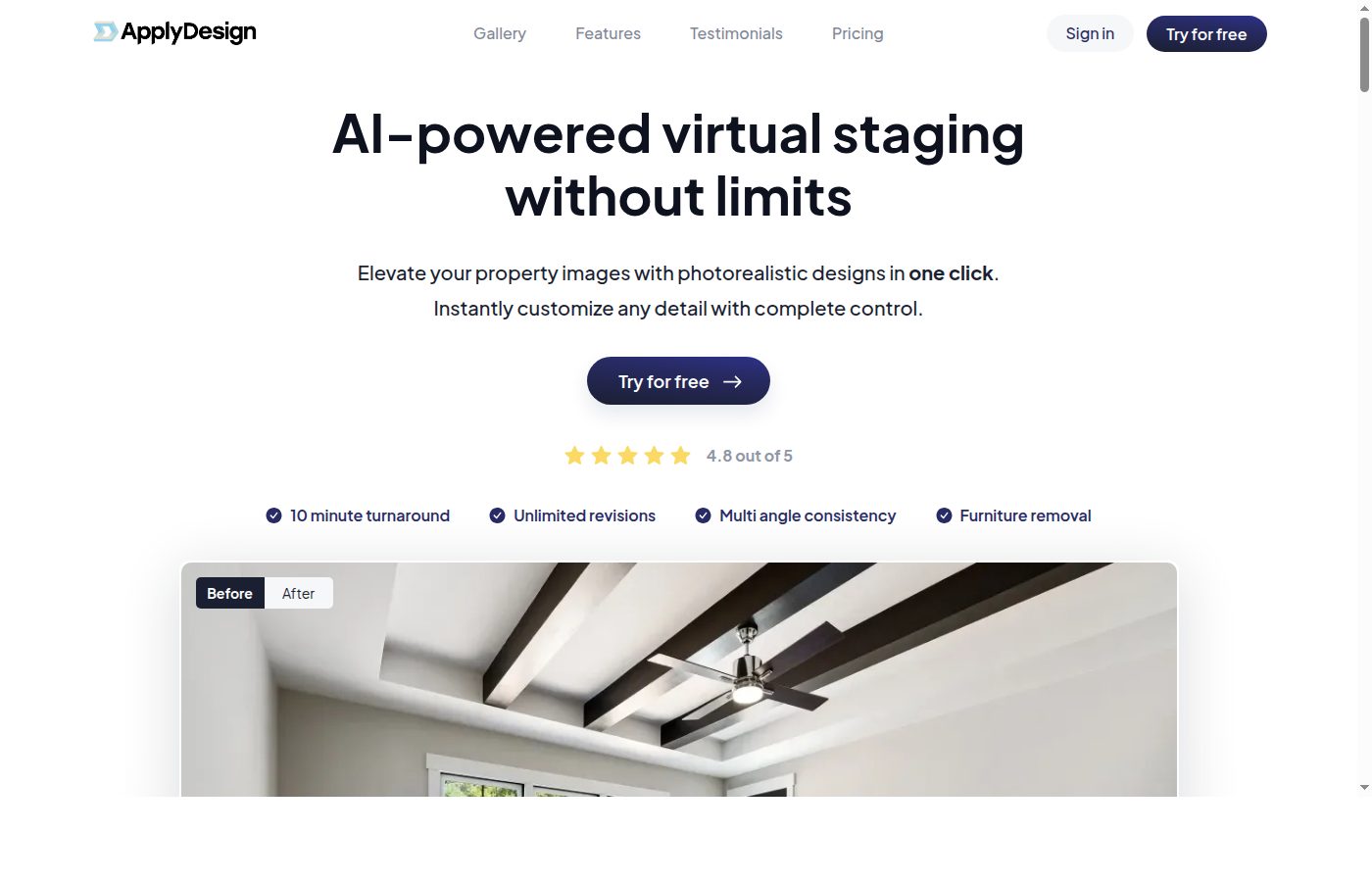
    Apply Design functions as an image processing engine that accepts 2D photographs of vacant commercial spaces and outputs digitally furnished versions of those same rooms. The core mechanic relies on computer vision algorithms to analyze the geometry, lighting, and scale of the uploaded image. Once the spatial dimensions are mapped, the software allows users to select from digital furniture catalogs to populate the room. The AI attempts to match the lighting and shadows of the inserted 3D models with the ambient light sources detected in the original photograph, creating a composite image that mimics a physically staged environment.

    Our analysis of the platform’s mechanics reveals a workflow designed for users without computer-aided design or 3D modeling experience. A marketing associate uploads a high-resolution image of an empty office suite or retail shell. The user then selects a desired interior design style or specific furniture bundles appropriate for the target tenant profile, such as open-plan tech workstations, traditional executive suites, or boutique retail fixtures. The software processes the request and renders the photorealistic furniture into the scene. Users can typically download the finished assets for immediate deployment in offering memorandums, listing websites, or email campaigns.

    Unlike comprehensive spatial data platforms, Apply Design does not create navigable digital twins or floor plans. Its scope is strictly confined to static image enhancement. The platform processes each image individually, meaning a complete property tour requires uploading and staging multiple separate photos. This mechanical limitation means the tool serves as a point solution for specific marketing collateral rather than a holistic property documentation system. The final output is a standard 2D image file, heavily dependent on the quality and resolution of the initial photograph provided by the user.

    9AI Framework: the score, dimension by dimension

    Dimension Score
    CRE Relevance 8/10
    Data Quality and Sources 7/10
    Ease of Adoption 8/10
    Output Accuracy 7/10
    Integration and Workflow Fit 6/10
    Pricing Transparency 5/10
    Support and Reliability 6/10
    Innovation and Roadmap 6/10
    Market Reputation 6/10
    Composite 9AI Score 66/100

    CRE Relevance: 8/10

    Apply Design is categorized as a CRE-Native application, built specifically to address the real estate industry’s need for property visualization. Unlike general-purpose image editors or generic generative AI art generators, this platform focuses entirely on the spatial constraints and aesthetic requirements of commercial and residential staging. Our analysis shows that its utility directly aligns with the daily requirements of leasing brokers and property marketers who struggle to market vacant spaces. The tool understands architectural contexts like floor plans, ceiling heights, and window placements to ensure furniture scales correctly. In practice: Brokers use this software to convert photos of empty white-box suites into targeted, furnished marketing images for specific tenant profiles.

    Data Quality and Sources: 7/10

    The primary data input for Apply Design consists of user-uploaded property photographs, while the output is a high-resolution composite image. The quality of the final product is heavily contingent on the resolution, lighting, and angle of the source material. The platform’s internal database consists of 3D furniture models and textures, which must be rendered accurately to achieve the promised photorealistic standard. Our analysis indicates that the AI’s ability to calculate accurate shadow casting and perspective matching is the critical variable in output quality. Poor source photos will inevitably yield unconvincing staging results. In practice: Marketing teams must ensure they capture well-lit, high-resolution photography of their vacant spaces to extract acceptable results from the rendering engine.

    Ease of Adoption: 8/10

    As a targeted marketing application, Apply Design requires minimal technical onboarding compared to enterprise resource planning or property management systems. The user interface is designed for marketing coordinators and brokers rather than specialized 3D rendering artists. Users simply upload images, select design parameters, and initiate the rendering process. There is no requirement to install heavy desktop software or undergo extensive training on spatial mapping. However, users must still learn to navigate the platform’s specific design catalogs and adjustment controls to refine the final images. In practice: A new marketing associate can typically begin generating staged images on their first day of using the platform without formal technical certification.

    Output Accuracy: 7/10

    Output accuracy for virtual staging is measured by the realism of the final image and the correct proportional scaling of the digital furniture. Apply Design utilizes computer vision to estimate room dimensions from a 2D photo, which introduces a margin of error. If the AI miscalculates the depth of a room, a digital conference table may appear unnaturally large or small compared to the surrounding architecture. Our analysis notes that while the furniture assets themselves are photorealistic, the accuracy of their placement and the realism of artificial shadows dictate the success of the staging. In practice: Users must carefully review the rendered images to ensure digital desks and chairs do not appear to float or violate the physical dimensions of the room.

    Integration and Workflow Fit: 6/10

    Apply Design operates primarily as a standalone web application rather than an integrated component of a broader commercial real estate technology stack. It does not typically connect directly via API to customer relationship management systems, property management software, or listing syndication networks. Users must manually download the staged images and subsequently upload them to their preferred marketing channels, such as LoopNet, CoStar, or internal brokerage websites. This lack of automated data flow requires manual file management by the marketing team. In practice: Marketing professionals will use this tool in isolation, treating it as an independent utility for asset creation before manually migrating the final files to their active marketing campaigns.

    Pricing Transparency: 5/10

    BestCRE research confirms that Apply Design does not publish its pricing details publicly. Prospective buyers must contact the company directly to obtain cost information. This lack of transparency severely limits the ability of commercial real estate analysts to conduct preliminary return on investment calculations or compare costs against competing virtual staging services without engaging in a sales process. Because the vendor does not publish pricing, it cannot exceed a score of 5 in this dimension according to our rating methodology. In practice: Procurement teams must allocate time for direct vendor negotiations and request custom quotes to determine if the software fits within their property marketing budgets.

    Support and Reliability: 6/10

    Classified as a Tier 2 vendor, Apply Design represents an unproven startup within the broader commercial real estate technology ecosystem. Consequently, its support infrastructure is likely still maturing. Buyers should not expect the dedicated enterprise account management or 24/7 global support desks provided by established Tier 1 corporations. Support is typically handled through standard ticketing systems, email, or basic web chat. Given its startup status, our methodology caps this dimension at a score of 6 to reflect the inherent risks of relying on a developing company for critical marketing operations. In practice: Users should anticipate standard business-hour support and potential delays in resolving complex technical rendering issues.

    Innovation and Roadmap: 6/10

    The trajectory for Apply Design involves refining its core computer vision algorithms to improve the speed and realism of its photorealistic furniture rendering. As a Tier 2 startup, the company must continuously update its 3D asset library to reflect current commercial interior design trends. Future developments may include better handling of complex lighting environments, automated removal of existing physical clutter from photos, or eventual expansion into 360-degree panoramic staging. However, as an early-stage vendor, the execution of these features remains speculative and dependent on ongoing capital efficiency. In practice: Buyers are purchasing the current static image capabilities and should not base their procurement decisions on promised future features.

    Market Reputation: 6/10

    Apply Design is currently building its market reputation within the specialized niche of virtual staging. As an unproven Tier 2 startup, it lacks the extensive case studies, widespread industry adoption, and long-term client retention metrics of dominant marketing platforms. While it competes for attention against established visualization companies like Matterport, which holds a BestCRE score of 92, Apply Design is still working to secure a definitive foothold among major commercial brokerages. Our rating framework restricts its score to a maximum of 6 in this category due to its emerging status. In practice: Commercial real estate firms adopting this tool are acting as early adopters rather than following an established industry consensus.

    Who should use Apply Design

    Apply Design is best suited for commercial real estate professionals who frequently market vacant spaces and require high-quality visual collateral without the expense of physical staging.

    Landlord Representation Brokers: Teams tasked with leasing empty office suites or retail shells who need to show prospective tenants the potential of a white-box space.

    Property Marketing Coordinators: In-house marketing staff at mid-sized brokerages looking to accelerate the production of offering memorandums and listing brochures.

    Value-Add Investors: Buyers acquiring distressed or vacant Class B properties who need to generate compelling repositioning imagery for capital partners before commencing physical renovations.

    Boutique Commercial Agencies: Smaller firms that lack the budget for dedicated 3D architectural rendering services but require professional-grade listing photos.

    Who should look elsewhere

    This software is entirely focused on static 2D image enhancement and will not satisfy teams requiring comprehensive spatial data, interactive tours, or broad workflow automation.

    Firms Requiring Digital Twins: Teams that need navigable 3D walkthroughs or precise spatial measurements should look to established platforms like Matterport.

    Industrial Real Estate Brokers: Professionals marketing raw warehouse or logistics spaces where photorealistic office furniture staging provides minimal value to prospective logistics tenants.

    Enterprise Operations Teams: Departments seeking text generation, data analysis, or CRM automation, as this tool offers no capabilities in those areas compared to platforms like Jasper AI or Copy.ai.

    Pricing and ROI

    Based on our current research, Apply Design does not publish its pricing details publicly. Prospective buyers are required to contact the company directly to obtain a custom quote. This opaque pricing model complicates initial vendor screening for commercial real estate analysts, as it prevents immediate cost comparisons against competing virtual staging services or traditional physical staging providers. Because pricing is not published, buyers must engage with the sales team to understand whether the platform charges a flat subscription fee, a per-image rendering cost, or a hybrid credit-based system.

    Despite the lack of transparent pricing, analysts can still construct a basic return on investment framework. The baseline comparison is the cost of physical staging, which typically involves thousands of dollars in furniture rental, delivery, and setup fees per suite, plus weeks of logistical coordination. Alternatively, outsourcing photos to a manual 3D rendering agency often costs hundreds of dollars per image and requires several days of lead time. If Apply Design can deliver photorealistic furniture staging at a fraction of the cost of physical staging and faster than a manual rendering agency, the software generates immediate ROI through reduced marketing expenditures and accelerated time-to-market for vacant listings. Buyers must simply ensure the negotiated contract price remains significantly lower than these traditional alternatives.

    Integration and CRE tech stack fit

    Apply Design presents a low integration footprint within the standard commercial real estate technology stack. Our analysis indicates that the platform functions primarily as an independent web-based utility rather than a connected node in a broader data ecosystem. It does not offer native API connections to major industry platforms such as Salesforce, Buildout, or Yardi, nor does it push data directly to listing syndication networks like CoStar or LoopNet.

    For marketing teams, this means the software sits outside of automated workflows. Users must manually upload raw photography from their local drives or cloud storage, process the images within the Apply Design interface, and manually download the finished assets. These staged images are then manually inserted into InDesign templates, email marketing platforms, or digital brochures. While this lack of integration prevents the software from streamlining complex operational workflows, it also means the tool can be adopted immediately without requiring IT department oversight, complex software implementation phases, or concerns regarding data security and privacy compliance across connected systems.

    Competitive landscape

    The market for commercial real estate marketing software is highly fragmented, with vendors offering vastly different approaches to property visualization and content creation. Apply Design occupies a specific niche focused solely on static image virtual staging. When evaluating this platform, buyers must differentiate between static staging, spatial capture, and generative text tools.

    For spatial capture and interactive 3D tours, Matterport remains the dominant alternative. Scoring a 92 in the BestCRE database, Matterport provides navigable digital twins and precise floor plans, which offer far more utility than Apply Design’s static 2D images, albeit requiring specialized camera hardware and higher costs. For broader marketing automation and copywriting, platforms like Jasper AI (score: 89) and Copy.ai (score: 87) are frequently utilized by commercial brokerages to generate property descriptions and email campaigns. Apply Design does not compete with these text-based tools, as it strictly handles visual assets.

    Direct competitors in the virtual staging space include BoxBrownie and various independent 3D rendering agencies. BoxBrownie operates as a service rather than a pure software-as-a-service platform, utilizing human editors assisted by software to deliver staged images. Apply Design attempts to differentiate itself by providing a self-service software interface driven by AI, theoretically reducing turnaround times. Additionally, buyers might consider presentation software like Beautiful.ai (score: 89) to house the final staged images, though Beautiful.ai does not generate the staging itself. Ultimately, Apply Design competes against the traditional costs of physical furniture rental and manual architectural rendering.

    The bottom line

    Apply Design offers a highly specialized, single-purpose utility for commercial real estate marketing teams burdened by the cost and logistics of physical property staging. It is not a comprehensive marketing suite, nor does it provide the spatial data capabilities of industry leaders like Matterport. Buyers should view this software strictly as an image enhancement tool designed to make vacant office and retail spaces more visually appealing in digital brochures and listing sites. The lack of published pricing and its status as an unproven Tier 2 startup introduce standard procurement risks, requiring buyers to negotiate carefully. However, if the negotiated cost per image remains significantly lower than traditional physical staging or manual 3D rendering services, Apply Design provides a practical, immediate solution for brokers needing to accelerate their go-to-market strategy for empty white-box suites. Purchase this tool if your brokerage spends excessive capital on physical furniture rentals; pass if you require interactive 3D tours or integrated marketing automation.

    Frequently asked questions

    Does Apply Design create interactive 3D virtual tours like Matterport?

    No, Apply Design does not create navigable digital twins or interactive 3D walkthroughs. It strictly processes static 2D photographs and outputs static 2D images featuring photorealistic furniture. Buyers requiring fully navigable spatial capture should evaluate platforms like Matterport instead.

    How much does Apply Design cost for commercial real estate teams?

    Apply Design does not publish its pricing publicly. Prospective buyers must contact their sales team directly to receive a custom quote. Because pricing is not published, teams must engage in direct negotiations to determine if the platform utilizes a subscription model or charges per rendered image.

    Can this software automatically generate property descriptions or marketing copy?

    Apply Design is exclusively a visual staging tool and does not feature text generation capabilities. Commercial real estate professionals looking to automate the writing of offering memorandums, property descriptions, or email campaigns should evaluate dedicated generative text platforms like Jasper AI or Copy.ai.

    Does the platform integrate directly with CoStar or LoopNet?

    The software does not offer direct API integrations or automated syndication to commercial real estate listing platforms like CoStar or LoopNet. Users must manually download the staged images from the application and subsequently upload them to their preferred listing services or marketing templates.

    Do I need CAD experience or 3D modeling skills to use this tool?

    No specialized architectural design or CAD experience is required. The platform is built for marketing coordinators and brokers, utilizing an intuitive interface where users upload standard property photos and select digital furniture from pre-built catalogs. The AI handles the spatial mapping and rendering automatically.

    What type of commercial properties benefit most from this software?

    The tool is highly effective for vacant Class B and Class C office suites, retail shells, and white-box spaces that lack visual appeal. It provides minimal value for raw industrial warehouses or fully occupied properties where photorealistic furniture staging cannot improve the existing tenant visualization.

    Related Reviews

    Compare Apply Design with other Marketing tools BestCRE has scored: HeyGen (70/100), Henry (68/100), Adobe Photoshop (68/100) and Lately (62/100). Browse every review in CRE Marketing, the full Best CRE AI Tools directory, or the 20 CRE Sectors hub.

  • AIHomeDesign Review: AI virtual staging and photo enhancement for commercial real estate marketing

    AIHomeDesign Review: AI virtual staging and photo enhancement for commercial real estate marketing

    BestCRE 9AI Score

    63/100 · Niche

    AIHomeDesign ranks #359 of 450 commercial real estate AI tools scored on the 9AI Framework. Nine dimensions, each scored out of 10: CRE relevance, data quality, ease of adoption, output accuracy, integration fit, pricing transparency, support, innovation and market reputation.

    AIHomeDesign operates as a specialized commercial and residential real estate marketing platform, classified by the BestCRE master database as a Tier 2, CRE-native application. The company focuses primarily on AI virtual staging, decluttering, and photo enhancement for property listings. As of August 2026, visual marketing requirements for commercial assets have escalated, forcing brokers and owners to seek alternatives to expensive physical staging. AIHomeDesign enters this space by applying generative artificial intelligence directly to property photography, allowing users to digitally furnish empty spaces or strip out existing tenant clutter without deploying physical contractors. While general-purpose image generators struggle with architectural geometry and realistic scaling, a CRE-native tool attempts to maintain structural integrity while altering the interior design.

    Evaluating this software requires looking past the impressive marketing examples to understand how it handles the complex lighting, varied ceiling heights, and unique spatial configurations typical of commercial real estate assets. The platform aims to accelerate the listing process, reducing the time from vacancy to active marketing from weeks to mere minutes. However, buyers must weigh the visual output against the reality of the physical space to avoid misrepresenting the property to potential tenants or investors. The technology represents a shift from physical logistics to digital processing, but it demands careful oversight to ensure the generated marketing materials remain factually representative of the underlying commercial asset.

    What AIHomeDesign does and how it works

    AIHomeDesign functions as a cloud-based image processing engine that manipulates uploaded property photographs using generative AI models. Users begin by uploading standard two-dimensional images of empty or occupied commercial spaces. The primary workflow involves selecting a specific room type, such as an office suite, retail storefront, lobby, or multifamily apartment, followed by a preferred interior design style. The system then analyzes the geometric boundaries of the room, identifying floors, walls, windows, and light sources. Once the spatial mapping is complete, the engine generates and places digital furniture, fixtures, and decor into the image, attempting to match the perspective and lighting of the original photograph.

    Beyond virtual staging, the platform includes a dedicated decluttering module. This feature allows users to upload photos of spaces currently occupied by outgoing tenants. The AI identifies non-architectural elements like desks, boxes, cables, and personal items, digitally erasing them and reconstructing the background walls and flooring. This reconstruction relies on predictive algorithms to fill in the gaps with appropriate textures, such as carpet patterns or drywall, matching the surrounding environment.

    The final core component is photo enhancement, which addresses common issues in amateur real estate photography. The system automatically corrects exposure, straightens vertical lines, enhances window pulls to show exterior views, and replaces overcast skies with clear weather. Users can process single images or upload batches for bulk enhancement. The output files are standard high-resolution JPEGs or PNGs, ready for upload to listing services, digital brochures, or offering memorandums. The entire process occurs within the web browser, requiring no local software installation or specialized hardware, making it highly accessible for distributed marketing teams.

    9AI Framework: the score, dimension by dimension

    Dimension Score
    CRE Relevance 8/10
    Data Quality and Sources 7/10
    Ease of Adoption 8/10
    Output Accuracy 7/10
    Integration and Workflow Fit 5/10
    Pricing Transparency 4/10
    Support and Reliability 6/10
    Innovation and Roadmap 6/10
    Market Reputation 6/10
    Composite 9AI Score 63/100

    CRE Relevance: 8/10

    AIHomeDesign earns a solid score here because it specifically trains its models on interior architecture and real estate photography rather than general internet imagery. Unlike basic image generators, it understands the difference between a drop ceiling in a Class B office and exposed ductwork in a creative loft. The platform provides specific commercial staging options, allowing brokers to visualize spaces as traditional cubicle layouts, modern open-plan offices, or retail showrooms. However, it still leans slightly toward residential and multifamily aesthetics, occasionally struggling with the massive scale of industrial warehouses or large-format retail boxes. The tool directly addresses a core CRE marketing pain point: marketing vacant, unappealing square footage. In practice: Brokers can quickly show prospective tenants multiple layout possibilities for the same empty floorplate without hiring an architect.

    Data Quality and Sources: 7/10

    The quality of the generative output depends heavily on the training data, and AIHomeDesign demonstrates a strong baseline of high-resolution, realistic furniture and texture assets. The AI successfully renders complex materials like leather, glass, and polished concrete with accurate reflections and grain. However, the system occasionally introduces visual artifacts, particularly when reconstructing floors during the decluttering process or when handling complex shadows from multiple light sources. The generated lighting sometimes appears slightly too perfect, creating a subtle uncanny valley effect that betrays the image as digitally altered. Despite these occasional glitches, the final images generally surpass the quality of older, manual virtual staging software that relied on pasting two-dimensional stickers onto photos. In practice: Users will need to carefully review the generated images for minor architectural hallucinations before publishing them to high-stakes offering memorandums.

    Ease of Adoption: 8/10

    The platform is designed for immediate use by marketing professionals and brokers with zero technical background in 3D modeling or prompt engineering. The user interface relies on simple drag-and-drop uploads and straightforward dropdown menus for selecting room types and styles. There are no complex parameters to tune, which flattens the learning curve entirely. Users can typically generate their first staged image within five minutes of creating an account. This simplicity comes at the cost of granular control; users cannot easily nudge a specific virtual chair a few inches to the left or change the color of a single digital cushion. The workflow is highly automated, prioritizing speed over meticulous customization. In practice: A junior marketing assistant can fully stage a ten-photo property listing in under an hour with minimal training.

    Output Accuracy: 7/10

    Spatial accuracy is the most critical metric for virtual staging, and AIHomeDesign performs adequately, though not perfectly. The AI generally respects the physical boundaries of the room, avoiding the common mistake of placing furniture through walls or floating above the floor. Scaling is usually accurate, giving viewers a realistic sense of how many desks or retail displays can fit into the square footage. However, the software can struggle with complex architectural geometries, occasionally misinterpreting angled ceilings, structural columns, or mirrored walls. When decluttering, the system might accidentally erase structural elements like baseboards or fire sprinklers if it misidentifies them as clutter. The perspective mapping is strong but can fail if the original photograph was taken with an extreme wide-angle lens. In practice: Photographers should provide standard, distortion-free images to ensure the AI correctly calculates the spatial dimensions and furniture scaling.

    Integration and Workflow Fit: 5/10

    As a Tier 2 application, AIHomeDesign operates primarily as a standalone web portal rather than a deeply integrated enterprise system. It does not currently offer native plugins for major CRE platforms like Buildout, SharpLaunch, or standard CRM systems. Users must manually download the processed images and then upload them into their respective marketing stacks or listing databases like LoopNet and CoStar. While it lacks direct API connectivity for automated workflows, the output format is universally compatible with any digital or print medium. The absence of enterprise integrations limits its utility for massive brokerages looking to automate thousands of listings simultaneously, but it serves the needs of independent teams perfectly well. In practice: Marketing teams will need to manually manage file transfers between AIHomeDesign and their primary property marketing software.

    Pricing Transparency: 4/10

    AIHomeDesign obscures its commercial tier costs, requiring prospective enterprise buyers to contact sales for pricing details. This lack of transparency forces analysts to invest time in discovery calls simply to establish baseline budget requirements. While consumer or single-use pricing might be hinted at, the volume discounts, API access costs, and enterprise licensing terms remain unpublished. This approach makes it difficult for a CRE principal to quickly compare the software against transparent competitors or traditional staging services during the initial research phase. We penalize tools heavily for hiding their pricing, as it often indicates variable pricing models based on client size rather than a standardized software-as-a-service structure. In practice: Procurement teams must engage directly with the vendor’s sales representatives to negotiate enterprise agreements and determine the actual cost per processed image.

    Support and Reliability: 6/10

    As an unproven startup in the Tier 2 category, AIHomeDesign lacks the extensive support infrastructure of legacy software providers. Customer service primarily operates through web tickets and email, with response times varying based on the user’s subscription tier. The company does not publish explicit service level agreements for uptime or processing speed guarantees. While the cloud-based architecture generally ensures the tool is available, users may experience slower generation times during peak hours when server loads are high. The knowledge base is adequate for basic troubleshooting, but enterprise clients requiring dedicated account managers or 24/7 phone support will find the current offerings limited. The long-term viability of the company remains a standard startup risk. In practice: Users should anticipate self-serve troubleshooting and potential delays in support responses during major marketing pushes.

    Innovation and Roadmap: 6/10

    The product development trajectory for AIHomeDesign aligns with the broader advancements in generative artificial intelligence. Current updates focus on improving the resolution of the output and expanding the library of commercial design styles. The roadmap suggests future capabilities may include 360-degree photo staging and video enhancement, which would significantly increase its value for virtual tours. However, the company has not yet demonstrated integration with 3D spatial data or CAD files, which limits its transition from a pure marketing tool to a true architectural visualization platform. The reliance on underlying foundational AI models means their innovation pace is somewhat tied to external advancements in the broader tech sector. In practice: Buyers are purchasing a highly capable 2D image manipulator today, with the expectation of incremental improvements rather than immediate leaps to full 3D spatial computing.

    Market Reputation: 6/10

    AIHomeDesign is currently building its reputation among early adopters in the real estate marketing sector. It lacks the widespread institutional recognition of platforms like Matterport, which scored a 92 in our framework for its dominant market position. Feedback from initial users highlights satisfaction with the speed and cost savings compared to physical staging, but some professional architectural photographers express concern over the hyper-realistic but technically inaccurate outputs. The tool is frequently discussed in digital marketing forums as a cost-effective alternative to traditional rendering agencies. However, major commercial brokerages have yet to mandate its use at an enterprise level, keeping it firmly in the category of an emerging, opportunistic tool rather than an industry standard. In practice: The software is viewed as a tactical asset for individual marketing teams rather than a strategic platform for institutional landlords.

    Who should use AIHomeDesign

    AIHomeDesign offers the most value to real estate professionals who need to market vacant or poorly presented spaces quickly and economically.

    Commercial Leasing Brokers: Those representing Class B and C office spaces who need to show potential layouts without funding physical test fits.

    Multifamily Property Managers: Teams needing to market empty units with varied, appealing aesthetics to different demographic targets.

    Value-Add Investors: Buyers who want to visualize and market the potential of a distressed or cluttered property before renovations are complete.

    Independent Marketing Agencies: Small firms requiring scalable, fast turnaround times for property brochures and digital listings.

    Who should look elsewhere

    Certain segments of the commercial real estate market require precision and integration that this platform cannot currently provide.

    Class A Institutional Developers: Teams that require exact architectural renderings and millimeter-accurate spatial representations for pre-leasing.

    Industrial Brokers: Professionals marketing warehouses and logistics centers where clear, empty space is preferred over staged environments.

    Enterprise Operations: Large brokerages requiring deep API connections to internal CRMs and automated property marketing engines.

    Pricing and ROI

    AIHomeDesign operates with an unpublished pricing model for its commercial and enterprise tiers, requiring interested parties to contact their sales team for a custom quote. This lack of published pricing makes immediate budget forecasting difficult for evaluating analysts. Based on industry standards for similar generative AI marketing tools, pricing is typically structured either as a pay-as-you-go credit system per image or a monthly subscription offering a set number of processing credits. Volume discounts are highly likely for enterprise accounts processing hundreds of listings.

    Despite the opaque pricing, the return on investment math is heavily weighted in favor of the software when compared to traditional alternatives. Physical staging for a standard commercial office suite can easily cost between $2,000 and $5,000 per month, factoring in furniture rental, logistics, and design fees. Traditional 3D rendering agencies typically charge $200 to $500 per image with a turnaround time of several days. Assuming AIHomeDesign charges even $10 to $20 per processed image, the cost savings are substantial. A broker can fully stage a five-room suite digitally for under $100 in a matter of minutes. The primary ROI driver is not just the direct cost reduction, but the acceleration of the marketing timeline, allowing properties to hit listing networks days or weeks faster than traditional methods allow.

    Integration and CRE tech stack fit

    In the context of a modern commercial real estate tech stack, AIHomeDesign functions as an isolated utility rather than a connected node. As of August 2026, the platform lacks native integrations or direct API links to industry-standard platforms like Buildout, SharpLaunch, LoopNet, or CoStar. It also does not connect directly to major CRM systems like Salesforce or Hubspot.

    The workflow relies entirely on manual file management. Users must download the enhanced and staged JPEGs or PNGs to their local drives and subsequently upload them into their digital asset management systems, marketing template builders, or listing services. While this manual process is standard for photography assets, it prevents the tool from being fully automated within a larger enterprise marketing pipeline. Furthermore, the software does not currently integrate with 3D spatial data platforms. Unlike Matterport, which creates a navigable digital twin, AIHomeDesign produces flat, two-dimensional media. It serves as a preliminary step in the marketing supply chain, generating the visual collateral that will eventually populate the brochures, websites, and offering memorandums built by other software applications.

    Competitive landscape

    The landscape for property marketing technology is highly competitive, and AIHomeDesign faces pressure from both specialized real estate services and general-purpose AI platforms. Its most direct competitors are hybrid services like BoxBrownie, which combine AI processing with human-in-the-loop quality control. While BoxBrownie offers superior accuracy by having human editors fix architectural anomalies, AIHomeDesign provides significantly faster turnaround times by relying entirely on automated generation.

    In the broader CRE marketing sector, AIHomeDesign occupies a different niche than spatial data leaders. Matterport, which scored an outstanding 92 in our framework, remains the gold standard for creating immersive, 3D digital twins. Matterport provides verifiable spatial accuracy that AIHomeDesign cannot match, but Matterport requires physical scanning hardware and an on-site visit, whereas AIHomeDesign only requires a standard 2D photograph.

    For general marketing tasks, firms often employ platforms like Jasper AI (Scored 89) for copywriting or Beautiful.ai (Scored 89) for pitch deck creation. While those tools excel at text and presentation formatting, they cannot perform the specialized architectural image manipulation that AIHomeDesign executes. General-purpose image generators like Midjourney or DALL-E can create beautiful interiors but frequently fail to preserve the structural geometry of the original property photo, making them unsuitable for factual real estate listings. AIHomeDesign bridges this gap, offering a specialized, CRE-native image engine that prioritizes structural retention over pure artistic generation, positioning it as a highly specific, tactical alternative to both expensive physical staging and generic AI art generators.

    The bottom line

    AIHomeDesign is a highly effective, specialized utility for commercial real estate marketing teams looking to reduce staging costs and accelerate listing timelines. It successfully applies generative AI to the specific problem of vacant and cluttered property photography, delivering realistic results in minutes. However, its lack of pricing transparency, absence of enterprise integrations, and occasional architectural hallucinations prevent it from achieving top-tier status. It is not a replacement for precise 3D spatial scanning tools like Matterport, nor is it suitable for high-end institutional developments requiring millimeter-accurate pre-leasing renderings. For mid-market brokers, multifamily operators, and value-add investors, AIHomeDesign is a compelling purchase. The immediate cost savings over physical staging justify the investment, provided users implement a strict quality control review before publishing the AI-generated images to public listing networks.

    Frequently asked questions

    Does AIHomeDesign work for commercial office spaces?

    Yes, the platform includes specific design styles and room types tailored for commercial real estate, including office suites, lobbies, and retail storefronts. It can digitally furnish empty floorplates to help prospective tenants visualize the space.

    How long does it take to get staged photos back?

    Because the platform relies on automated generative AI rather than human editors, the processing time is nearly instantaneous. Users typically receive their fully staged or decluttered images within minutes of uploading the original files.

    Can I remove existing tenant furniture from a photo?

    Yes, the software includes a dedicated decluttering module. The AI identifies non-architectural elements like desks, boxes, and personal items, digitally erases them, and reconstructs the background walls and flooring to present a vacant space.

    Is there an API for enterprise integration?

    Currently, AIHomeDesign operates as a standalone web application and does not offer a published API for deep integration into enterprise CRMs or automated property marketing platforms like Buildout or SharpLaunch.

    How does this compare to Matterport?

    Matterport creates navigable, 3D digital twins using physical scanning hardware, offering exact spatial accuracy. AIHomeDesign manipulates standard 2D photographs to visualize potential designs. They serve different purposes: Matterport documents reality, while AIHomeDesign visualizes potential.

    What is the cost per image?

    AIHomeDesign does not publish its commercial pricing tiers, requiring buyers to contact sales for a quote. Pricing is typically structured as a monthly subscription for a set number of credits or a volume-based enterprise license.

    Related Reviews

    Compare AIHomeDesign with other Marketing tools BestCRE has scored: Flux (68/100), Synthesia (68/100), Henry (68/100) and Adobe Photoshop (68/100). Browse every review in CRE Marketing, the full Best CRE AI Tools directory, or the 20 CRE Sectors hub.

  • Aigentless Review: AI automated leasing platform enabling unaccompanied multifamily property tours and renter insights

    Aigentless Review: AI automated leasing platform enabling unaccompanied multifamily property tours and renter insights

    BestCRE 9AI Score

    70/100 · Contender

    Aigentless ranks #240 of 450 commercial real estate AI tools scored on the 9AI Framework. Nine dimensions, each scored out of 10: CRE relevance, data quality, ease of adoption, output accuracy, integration fit, pricing transparency, support, innovation and market reputation.

    Aigentless is an artificial intelligence automated leasing platform designed specifically for the multifamily commercial real estate sector, enabling prospective renters to conduct unaccompanied, self-guided property tours. Based in Chicago, the company provides a mobile application that guides prospects through physical spaces while simultaneously capturing renter insights and answering property-specific questions without requiring a human leasing agent on site. According to the BestCRE master database, the primary use case is serving as an AI automated leasing platform for multifamily operators, filling the gap between purely virtual tours and fully staffed physical walkthroughs. Cardinal Group Companies has partnered with Aigentless to launch self-guided tours, signaling early institutional adoption.

    The platform operates at the intersection of property technology and marketing, aiming to reduce the overhead costs associated with traditional leasing operations. By utilizing a mobile application interface, prospective tenants can schedule and execute tours at their convenience, unlocking doors and accessing community amenities through digital integrations. While other tools in the CRE marketing category focus on content generation or virtual spatial mapping, such as Matterport, which earned a BestCRE score of 92, Aigentless focuses strictly on the physical, in-person leasing journey. The system captures data during the tour, logging prospect preferences and engagement levels to inform follow-up strategies for the property management team. This review evaluates the platform’s utility for multifamily principals and analysts assessing automated leasing solutions in August 2026.

    What Aigentless does and how it works

    Aigentless functions as a digital leasing agent that facilitates in-person, self-guided tours for multifamily communities. The core mechanic relies on a consumer-facing mobile application that prospective renters download to their smartphones. When a prospect arrives at a property, the application utilizes location services and integrated access control systems to grant entry to the building, specific amenity spaces, and the model or vacant units. The software supports both digital entry systems and traditional lockboxes, ensuring compatibility across different asset classes and building ages.

    During the tour, the artificial intelligence engine acts as an interactive guide. The application curates a personalized route through the property based on the prospect’s pre-tour questionnaire. As the user navigates the space, the AI provides contextual information about the unit features, building amenities, and neighborhood highlights. Renters can ask the application questions in real-time regarding pet policies, parking availability, or lease terms, and the system retrieves answers from the property’s specific knowledge base. This eliminates the delay typically associated with self-guided tours where prospects must wait to email or call a leasing office after leaving the property.

    Simultaneously, the platform functions as a data collection tool for the property operator. The software tracks which areas of the property the prospect visited, how much time they spent in specific rooms, and the exact questions they asked the AI. This telemetry data is compiled into a renter insight profile and pushed directly into the property’s customer relationship management system. If the prospect is ready to proceed, the application provides a direct link to the online application portal, facilitating an immediate conversion opportunity while the buyer is still physically present on the property.

    9AI Framework: the score, dimension by dimension

    Dimension Score
    CRE Relevance 9/10
    Data Quality and Sources 7/10
    Ease of Adoption 7/10
    Output Accuracy 8/10
    Integration and Workflow Fit 9/10
    Pricing Transparency 4/10
    Support and Reliability 6/10
    Innovation and Roadmap 7/10
    Market Reputation 6/10
    Composite 9AI Score 70/100

    CRE Relevance: 9/10

    Aigentless is entirely purpose-built for the commercial real estate industry, specifically targeting the multifamily and student housing sectors. Unlike generic chatbot applications or broad marketing tools, the platform’s architecture is designed around the physical realities of property leasing. It addresses a highly specific operational bottleneck: the cost and scheduling friction of agent-led property tours. The software understands CRE-specific concepts like floor plans, amenity access, lease terms, and fair housing compliance, ensuring that the artificial intelligence operates within the strict regulatory boundaries of real estate marketing. Because it is a CRE-Native platform, it does not require operators to train the base model on industry terminology or standard leasing practices. In practice: Multifamily operators receive a tool that speaks the language of property management immediately upon deployment, requiring only property-specific details to function.

    Data Quality and Sources: 7/10

    The platform generates proprietary data by tracking physical prospect movements and conversational inputs during the self-guided tour. The quality of this data is highly dependent on the user’s engagement with the mobile application. When prospects actively use the app to ask questions and navigate the space, the resulting telemetry provides excellent behavioral insights for the leasing team. However, the accuracy of the AI’s responses relies entirely on the quality of the property data fed into the system during onboarding. If the property management team fails to update pricing, availability, or policy changes in the central database, the AI will confidently provide outdated information to prospective renters. The system does not independently verify the physical status of the units. In practice: Analysts must ensure strict data hygiene within their property management systems to prevent the AI from quoting incorrect lease terms.

    Ease of Adoption: 7/10

    Implementing Aigentless requires significant physical and digital coordination, making it more complex than adopting standard software-as-a-service marketing tools. The deployment process involves mapping the property, configuring the AI knowledge base, and establishing hardware integrations for access control. While the software supports various entry methods, properties with legacy hardware may experience friction during the initial setup phase. On the consumer side, prospects must download a dedicated application from the Apple App Store or Google Play Store and complete a registration process before touring. This creates a slight barrier to entry compared to browser-based solutions, though the app interface itself is straightforward. Staff training is minimal, as the system is designed to operate autonomously. In practice: Deployment timelines will be dictated by the complexity of your building’s existing access control hardware and the cleanliness of your property data.

    Output Accuracy: 8/10

    The artificial intelligence engine is programmed to deliver specific, factual answers based on the property’s provided documentation. Because it operates in a highly regulated housing environment, the system is constrained to prevent hallucinations or the accidental creation of non-compliant policies. When queried about standard topics like square footage, utility billing, or pet fees, the output is highly accurate and consistent. However, if a prospect asks a highly nuanced or subjective question about the neighborhood or building culture, the AI may default to generic responses or direct the user to contact a human agent. The platform prioritizes safety and compliance over conversational creativity, which is the correct approach for commercial real estate applications. In practice: The AI functions exceptionally well as an interactive FAQ document but will gracefully fail to human staff for complex negotiation scenarios.

    Integration and Workflow Fit: 9/10

    Aigentless excels in its ability to connect with the established multifamily technology stack. The platform offers direct integrations with primary property management systems including Yardi, Entrata, and RealPage, ensuring that pricing and availability data remain synchronized. Furthermore, it connects with industry-standard customer relationship management tools such as Funnel, RentCafe, and Salesforce. This prevents the creation of data silos, as prospect information, tour completion status, and conversational logs are automatically pushed into the systems where leasing teams already work. The most critical integration point is access control, where the software communicates with smart lock providers to issue temporary digital credentials during the scheduled tour window. In practice: The software acts as a connective layer between your access hardware, your CRM, and your core accounting system without requiring manual data entry.

    Pricing Transparency: 4/10

    Aigentless operates with custom pricing, and the vendor does not publish standard subscription tiers or implementation fees on its public website. Buyers must engage with the sales team to receive a customized quote based on portfolio size, unit count, and specific hardware integration requirements. In the commercial real estate technology sector, this lack of transparency is common for enterprise deployments but frustrates analysts attempting to build preliminary financial models. The total cost of ownership will likely include a software licensing fee, an implementation charge for mapping the AI knowledge base, and potential hardware costs if the property requires upgraded access control mechanisms to facilitate unaccompanied entry. In practice: Buyers should demand a detailed breakdown of implementation fees versus recurring software costs before committing to a pilot program.

    Support and Reliability: 6/10

    As a startup, Aigentless is still establishing its long-term support infrastructure. The company provides standard email support and maintains a real-time status page for its services and infrastructure. While early institutional adopters like Cardinal Group Companies have successfully deployed the platform at scale, the vendor lacks the decades of historical uptime data associated with legacy CRE software providers. The reliance on physical access control means that support issues can immediately impact a prospect’s ability to enter a building, making rapid response times critical. Mobile application updates are pushed regularly. In practice: Operators must establish clear internal protocols for handling prospects who experience technical difficulties accessing the property outside of standard business hours.

    Innovation and Roadmap: 7/10

    The company has demonstrated rapid iteration since its inception, moving quickly from concept to securing a partnership with Cardinal Group Companies. The current trajectory focuses on deepening the artificial intelligence’s ability to handle complex conversational workflows and improving the telemetry data extracted from physical tours. Future development will likely center on expanding access control partnerships and refining the predictive analytics used to score prospect conversion probability based on tour behavior. While the vendor does not publish a public roadmap, their focus on the self-service leasing journey aligns with broader multifamily industry trends toward automation and decentralized property management. In practice: Buyers are investing in a specialized tool that will likely expand its AI capabilities to handle a larger percentage of the pre-lease communication funnel over the next two years.

    Market Reputation: 6/10

    Aigentless is currently classified as a Tier 2, CRE-Native vendor in the BestCRE database, reflecting its status as a newer entrant with growing traction. The platform gained significant credibility following its selection by Cardinal Group Companies as an exclusive provider for student housing self-guided tours. User reviews on the Apple App Store indicate that renters find the application easy to navigate, appreciating the ability to tour at their own pace without high-pressure sales tactics. However, the company does not yet possess the universal brand recognition of established marketing tools like Matterport (BestCRE Score: 92). The firm is actively building its reputation by targeting specific operational pain points in multifamily leasing. In practice: The vendor is highly motivated to ensure the success of early enterprise clients to solidify its position in the competitive proptech landscape.

    Who should use Aigentless

    Aigentless is engineered for operators who manage high-volume leasing environments and possess the technical infrastructure to support digital integrations.

    Multifamily operators managing large portfolios who want to reduce onsite leasing headcount while expanding available tour hours.

    Student housing managers dealing with massive seasonal leasing surges that overwhelm traditional leasing staff.

    Developers of new construction lease-ups seeking to capture prospect data and accelerate conversion rates through immediate, on-site application links.

    Asset managers looking to standardize the tour experience and gather objective data on prospect behavior across multiple properties.

    Who should look elsewhere

    The platform relies heavily on modern access control and standardized property data, making it unsuitable for certain asset classes and operational models.

    Owners of older, Class C properties lacking digital access control or the capital budget to install compatible smart lock hardware.

    Commercial office or industrial brokers, as the platform is strictly designed for residential leasing workflows.

    Boutique property managers who rely heavily on white-glove, relationship-based leasing and view automated tours as detrimental to their brand.

    Operators using legacy, on-premise accounting software that cannot integrate via API with modern cloud applications.

    Pricing and ROI

    Aigentless operates on a custom pricing model, and the vendor does not publish standard subscription tiers, per-unit costs, or implementation fees on its public website. Buyers must engage directly with the sales team to scope the deployment and receive a customized quote. In the commercial real estate technology sector, this approach is standard for enterprise-grade platforms that require deep integrations with existing property management systems and access control hardware.

    When modeling the return on investment for Aigentless, analysts must calculate the fully burdened cost of their current leasing operations. The primary ROI driver is the reduction in human hours required to conduct physical property tours. If an average leasing agent spends 45 minutes conducting a tour and the property averages 40 tours per week, the platform can theoretically recover 30 hours of staff time weekly. This time can be reallocated to resident retention efforts or allow ownership to operate the building with a leaner onsite team. Additionally, operators must factor in the potential revenue lift from capturing leases outside of standard business hours, as prospects can tour on weekends or evenings when the leasing office is closed. Buyers should ensure they account for any necessary hardware upgrades to smart locks when calculating the total cost of deployment.

    Integration and CRE tech stack fit

    The technical architecture of Aigentless is expressly designed to sit within the existing multifamily software ecosystem. The platform requires a bidirectional flow of data to function correctly. It pulls real-time pricing, unit availability, and property details from core property management systems such as Yardi, Entrata, and RealPage. This ensures the artificial intelligence does not quote outdated rental rates during a self-guided tour. Simultaneously, the platform pushes prospect contact information, tour completion data, and conversational logs directly into customer relationship management platforms like Funnel, RentCafe, and Salesforce.

    The most complex integration point involves physical access control. Aigentless must communicate with the building’s hardware to issue temporary digital keys or access codes to the prospect’s mobile device for the duration of the scheduled tour. While the vendor states compatibility with digital entry systems and traditional lockboxes, properties utilizing fragmented or proprietary access hardware may require custom API configuration. For operators with standardized tech stacks across their portfolios, the platform acts as a highly effective middleware layer, connecting physical access events with marketing data and core accounting records without requiring manual data entry from the leasing staff.

    Competitive landscape

    When evaluating Aigentless, buyers must distinguish between tools that virtualize the property and those that automate physical access. In the broader CRE Marketing category, Matterport (BestCRE Score: 92) remains the dominant force for spatial mapping and virtual tours. However, Matterport serves a different function; it allows prospects to view a digital twin of the property from their computer, whereas Aigentless facilitates actual, physical walkthroughs using AI as a guide.

    For content generation and marketing copy, operators frequently utilize general-purpose AI tools such as Jasper AI (BestCRE Score: 89) or Copy.ai (BestCRE Score: 87). While these platforms excel at drafting property descriptions or email campaigns, they possess no CRE-specific data and cannot facilitate a physical leasing journey. Similarly, presentation software like Beautiful.ai (BestCRE Score: 89) is utilized for creating pitch decks and marketing collateral, but operates entirely outside the operational leasing funnel.

    Direct competitors to Aigentless include established self-guided tour providers like Tour24 and Pynwheel. These platforms also offer unaccompanied physical access and integrate with major property management systems. The primary differentiator for Aigentless is its heavy reliance on an interactive artificial intelligence engine to answer prospect questions in real-time during the tour, attempting to replicate the conversational benefits of a human agent. Buyers might also consider custom application development using platforms like Glide Apps (BestCRE Score: 87) or Dan AI (BestCRE Score: 87) for basic chatbot functionality, though building a custom access-control integration from scratch would be highly inefficient compared to purchasing a purpose-built solution.

    The bottom line

    Aigentless delivers a highly specific solution for a distinct operational challenge: executing physical property tours without tying up onsite personnel. For institutional multifamily operators and student housing managers struggling with high tour volumes and staffing costs, the platform presents a compelling financial case. The integration depth with major PMS and CRM platforms ensures that data flows logically through the enterprise tech stack. However, the requirement for compatible access control hardware and the inherent complexities of custom pricing mean this is not a casual software purchase. It requires a committed operational shift toward self-service leasing. If your portfolio relies on older physical infrastructure or your brand identity is tied to high-touch, human-led leasing, this tool will introduce unnecessary friction. For modern, data-driven operators aiming to expand tour hours and capture behavioral insights, Aigentless is a highly effective, purpose-built acquisition.

    Frequently asked questions

    Does Aigentless require smart locks on every unit?

    While digital access control provides the most secure and streamlined experience for prospective renters, the platform can also integrate with traditional lockboxes. However, managing physical keys introduces operational friction that diminishes the overall efficiency of an automated leasing system, making smart locks highly recommended.

    Which property management systems integrate with the platform?

    The software offers direct API integrations with industry-standard core property management systems, prominently including Yardi, Entrata, and RealPage. This connectivity ensures that the artificial intelligence always references accurate, real-time pricing and unit availability data when interacting with prospective renters during their physical tours.

    How does the AI handle complex negotiation questions?

    The artificial intelligence engine is strictly programmed for fair housing compliance and factual accuracy based on provided property documentation. If a prospect asks a highly nuanced question or attempts to negotiate lease terms, the system will gracefully fail and direct the user to contact a human leasing agent for resolution.

    Do prospective renters have to download a mobile app?

    Yes, prospective renters are required to download the dedicated Aigentless application from either the Apple App Store or Google Play Store. They must also complete a secure registration and identity verification process before the system will grant them physical access to the property for their scheduled self-guided tour.

    Is this tool suitable for commercial office leasing?

    No, this software is not designed for commercial office or industrial properties. The platform is specifically engineered for residential real estate, focusing entirely on the unique workflows, access control requirements, and fair housing compliance standards associated with multifamily communities and student housing operations.

    How does the platform track prospect behavior?

    The mobile application utilizes location services to track which specific areas of the property the user visits and calculates the duration spent in each room. Additionally, it logs all conversational questions asked to the AI, automatically pushing this comprehensive behavioral telemetry data directly into the property’s customer relationship management system.

    Related Reviews

    Compare Aigentless with other Marketing tools BestCRE has scored: Henry (68/100), Adobe Photoshop (68/100), OpenAI 4o Image Generation (66/100) and Resquared (64/100). Browse every review in CRE Marketing, the full Best CRE AI Tools directory, or the 20 CRE Sectors hub.
  • AI Room Planner Review: An interior design generation tool for commercial real estate space visualization.

    AI Room Planner Review: An interior design generation tool for commercial real estate space visualization.

    BestCRE 9AI Score

    52/100 · Watch

    AI Room Planner ranks #438 of 450 commercial real estate AI tools scored on the 9AI Framework. Nine dimensions, each scored out of 10: CRE relevance, data quality, ease of adoption, output accuracy, integration fit, pricing transparency, support, innovation and market reputation.

    AI Room Planner is a commercial real estate marketing application focused primarily on AI generating interior design ideas. Classified in the BestCRE Master Database as a Tier 2 CRE-Native tool, the platform is designed to help brokers, property managers, and leasing agents visualize empty or outdated spaces for prospective tenants. Instead of relying on expensive physical staging or slow traditional virtual staging services, users can upload photos of existing spaces and receive immediate, AI-generated interior design concepts. This capability targets the persistent industry challenge of marketing vacant commercial suites, where prospective tenants often struggle to imagine the potential of a bare floorplate or a dated office layout.

    As of August 2026, the commercial real estate sector continues to evaluate the practical utility of generative image models. While tools like Matterport have established a high benchmark for spatial reality capture with a BestCRE score of 92, AI Room Planner operates in the adjacent space of conceptual visualization. Our analysis indicates that the platform serves as a top-of-funnel marketing aid rather than a precise architectural drafting utility. By instantly producing varied design aesthetics for a single room, it provides leasing teams with collateral to include in offering memorandums or digital listings. However, evaluating the software requires a clear understanding of its limitations, particularly regarding dimensional accuracy and enterprise-grade deployment features.

    What AI Room Planner does and how it works

    AI Room Planner functions as an image-to-image generative design platform. Users begin by uploading a two-dimensional photograph of an existing commercial space, such as an empty retail storefront, a vanilla shell office suite, or an outdated lobby. The software then processes this base image through its proprietary models to output a new image that retains the foundational geometry of the room while applying new interior design elements. Users can specify different styles, such as modern industrial, corporate traditional, or minimalist retail, prompting the system to populate the empty space with appropriate furniture, lighting fixtures, and surface finishes.

    Our analysis of the product mechanics reveals that the tool does not build a three-dimensional model of the space. Instead, it relies on pixel-level manipulation to create a convincing two-dimensional rendering. This means the software does not require CAD files, floor plans, or specialized camera equipment. A standard smartphone photograph is sufficient to initiate the generation process. Once the image is processed, the leasing agent or marketer can download the rendered concepts to use in brochures, email campaigns, or property websites, offering prospective tenants a visual menu of what the space could become after a tenant improvement build-out.

    While the primary use case is AI generating interior design ideas, the platform’s outputs are strictly conceptual. The generated furniture is not tied to real-world vendor catalogs, and the applied finishes do not correspond to specific material SKUs. Furthermore, because the system interprets depth and scale from a single flat image, the resulting designs may occasionally feature spatial inconsistencies, such as a desk that is disproportionately large for a corner or a lighting fixture that ignores the actual ceiling grid. The tool is engineered for speed and aesthetic inspiration, prioritizing rapid visual transformation over architectural precision.

    9AI Framework: the score, dimension by dimension

    Dimension Score
    CRE Relevance 6/10
    Data Quality and Sources 6/10
    Ease of Adoption 8/10
    Output Accuracy 5/10
    Integration and Workflow Fit 4/10
    Pricing Transparency 3/10
    Support and Reliability 5/10
    Innovation and Roadmap 5/10
    Market Reputation 5/10
    Composite 9AI Score 52/100

    CRE Relevance: 6/10

    AI Room Planner is classified as a CRE-Native Tier 2 application, meaning it was developed with commercial property use cases in mind, even if the underlying technology mirrors consumer-grade interior design generators. The platform addresses a specific pain point in commercial leasing: marketing vacant or second-generation spaces. By allowing brokers to show the potential of a vanilla shell without paying for custom architectural renderings, it serves a distinct function in the commercial real estate marketing lifecycle. However, its utility is confined strictly to the marketing and conceptualization phase, offering no value to asset management, underwriting, or actual construction planning. The tool is a specialized visual aid rather than a comprehensive property platform. In practice: Leasing teams use this software to quickly generate inspirational imagery for property flyers when marketing empty suites.

    Data Quality and Sources: 6/10

    Because the platform operates as an image generator rather than a data analytics tool, data quality is evaluated based on the fidelity and realism of its visual outputs. The software relies on training data to understand spatial depth, lighting, and commercial design trends. Our analysis shows that while the tool successfully identifies walls, floors, and ceilings in most standard photographs, it can struggle with complex architectural features or uneven lighting conditions. The generated images are generally high enough resolution for digital viewing, but they may exhibit the artifacts common to generative models, such as blurred lines where furniture meets the floor or structurally impossible window frames. The visual data produced is illustrative, not exact. In practice: Marketers must carefully review the generated images to ensure no glaring structural anomalies distract from the presentation.

    Ease of Adoption: 8/10

    The software requires virtually no technical training or specialized commercial real estate knowledge to operate. Its interface is highly intuitive, functioning much like basic consumer web applications. Users simply upload a photo, select a desired design style from a dropdown menu, and click a button to generate the output. There is no need to input exact room dimensions, upload complex CAD files, or configure intricate lighting settings. This low barrier to entry means that junior analysts, marketing coordinators, or even independent brokers can begin using the tool immediately without waiting for IT deployment or lengthy onboarding sessions. The system is designed for immediate, self-serve usage. In practice: A brokerage team can adopt and successfully utilize this platform to stage a listing photo within five minutes of creating an account.

    Output Accuracy: 5/10

    The platform’s primary weakness lies in its dimensional and architectural accuracy. Because it extrapolates a design from a single two-dimensional photograph, the AI lacks true spatial awareness. It cannot account for load-bearing walls, HVAC ducting constraints, or ADA compliance requirements. The generated furniture is often scaled incorrectly relative to the actual square footage, and the system may accidentally erase or alter structural columns if they interfere with the requested design style. While the outputs are aesthetically pleasing, they are not mathematically reliable representations of what can actually be built in the space. The tool generates interior design ideas, not actionable construction plans. In practice: Brokers must explicitly label these images as conceptual virtual staging to avoid setting unrealistic expectations for prospective tenants regarding the actual floorplate capacity.

    Integration and Workflow Fit: 4/10

    Based on our analysis of the platform’s mechanics, AI Room Planner operates as a standalone web application with minimal integration into the broader commercial real estate technology stack. Users manually upload photos and manually download the finished renderings. There are no direct API connections to major listing platforms like LoopNet or Crexi, nor does it sync with CRM systems like Salesforce or Dealpath. Furthermore, it does not integrate with actual spatial data tools like Matterport or AutoCAD. The workflow is entirely siloed, requiring marketers to move files back and forth between their local drives and the application. While this simplicity aids in quick adoption, it prevents automated workflows at the enterprise level. In practice: Marketing teams will need to manually insert the generated images into their existing InDesign templates or digital listing portals.

    Pricing Transparency: 3/10

    AI Room Planner severely limits its appeal to enterprise buyers by failing to publish its pricing structure. According to the BestCRE Master Database, the vendor requires prospective users to contact for pricing. This lack of transparency is a significant friction point for commercial real estate firms that require predictable software expenditures. Without public tiers, it is impossible for an analyst to determine if the software charges a flat monthly subscription, a per-image generation fee, or a per-user license. This opacity forces interested buyers into a sales funnel simply to qualify the product’s financial viability, which is a major deterrent for independent brokers or small marketing teams looking for quick solutions. In practice: Firms evaluating this tool must allocate time for direct vendor negotiations rather than relying on standard procurement approvals.

    Support and Reliability: 5/10

    As a Tier 2 startup in the rapidly evolving generative AI space, AI Room Planner carries inherent risks regarding long-term support and reliability. The company is unproven compared to established marketing incumbents, and our analysis indicates a lack of enterprise-grade service level agreements. Users should expect standard email-based support rather than dedicated customer success managers or 24/7 technical assistance. Furthermore, because the tool relies on cloud-based generative models, processing times may vary during periods of high server load. While the application is generally stable for single-image generation, enterprise clients scaling this across hundreds of listings may encounter bottlenecks or inconsistent support response times. In practice: Users should treat this as a self-serve utility and not rely on immediate technical support for urgent, deadline-driven marketing deliverables.

    Innovation and Roadmap: 5/10

    The underlying technology for image-to-image generation is advancing rapidly, but AI Room Planner’s specific roadmap remains opaque. While the primary use case of generating interior design ideas is currently functional, the tool must evolve to maintain relevance against broader AI platforms. We anticipate that future iterations will need to incorporate better spatial constraints, allowing users to lock certain structural elements in place while only altering the furniture and finishes. Additionally, the ability to ingest 3D spatial data or integrate directly with virtual tour software would represent a logical next step. However, as an unproven vendor, their capacity to fund and execute these complex technical upgrades is uncertain. In practice: Buyers should purchase the software based entirely on its current capabilities rather than anticipating future workflow enhancements or deeper integrations.

    Market Reputation: 5/10

    AI Room Planner operates with a relatively low profile within the institutional commercial real estate sector. Classified as an unproven startup, it lacks the widespread name recognition and trusted track record of established marketing tools. While individual brokers and boutique leasing teams have experimented with the platform for quick visual staging, it has not yet secured major enterprise contracts with top-tier brokerages like CBRE or JLL. Its reputation is currently that of a niche, lightweight utility rather than a core infrastructure component. The market views it as a convenient, albeit flawed, tool for rapid ideation, but it has yet to prove its staying power in a highly competitive proptech environment. In practice: Firms adopting this tool are acting as early adopters of a niche product rather than following an established industry standard.

    Who should use AI Room Planner

    AI Room Planner is best suited for professionals focused on the top of the leasing funnel who need fast, inexpensive visual collateral.

    Landlord Representation Brokers: Agents tasked with leasing second-generation office or retail spaces who need to show prospective tenants the potential of an outdated suite without paying for physical staging.

    Property Marketing Coordinators: Marketing staff who need to quickly generate multiple design concepts to include in offering memorandums, property flyers, and digital listing campaigns.

    Independent Commercial Agents: Solo practitioners who lack the budget for traditional architectural renderings but want to elevate the visual appeal of their property listings.

    Retail Leasing Teams: Professionals marketing vanilla shell storefronts who need to illustrate how different retail concepts, from cafes to boutiques, could utilize the footprint.

    Who should look elsewhere

    The platform is entirely unsuitable for professionals who require dimensional accuracy or technical architectural planning.

    Commercial Architects and Space Planners: Teams needing precise, to-scale floor plans or CAD-compatible models, as the tool’s outputs are purely conceptual and dimensionally inaccurate.

    Construction Managers: Professionals estimating tenant improvement costs or planning build-outs, since the generated images do not correlate with real-world materials, SKUs, or structural constraints.

    Enterprise IT Procurement: Departments looking for deeply integrated, SOC2-compliant marketing platforms that connect directly with existing CRM and property management databases.

    Pricing and ROI

    As confirmed by the BestCRE Master Database, AI Room Planner does not publish its pricing structure, requiring prospective buyers to contact for pricing. This lack of transparency makes it difficult to benchmark the software against standard subscription models. Our analysis suggests that tools in this tier typically utilize either a monthly subscription model ranging from $20 to $100 per user, or a credit-based system where users pay a micro-transaction fee per generated image.

    Despite the opaque pricing, the return on investment (ROI) math for conceptual virtual staging is highly favorable when compared to traditional alternatives. Hiring a specialized 3D rendering firm to create a single, high-fidelity visualization of a commercial suite typically costs between $300 and $800 and requires a turnaround time of several days. Physical staging for a commercial office space can cost thousands of dollars per month. If AI Room Planner charges an estimated $50 per month, a broker only needs to generate one usable marketing image per quarter to justify the expense relative to traditional rendering costs. The primary ROI driver is the acceleration of the marketing timeline, allowing teams to list a visually appealing property on the market days or weeks faster than relying on external rendering vendors.

    Integration and CRE tech stack fit

    The integration fit for AI Room Planner within a standard commercial real estate technology stack is exceptionally limited. Our analysis categorizes the platform as a siloed, standalone utility rather than an interconnected enterprise application. Users must manually upload JPEG or PNG files from their local drives and manually download the resulting generated images. There are no published APIs or native plugins to connect the software directly with industry-standard marketing platforms like Buildout, nor does it sync with listing syndication networks.

    Furthermore, the tool does not interface with spatial data capture systems. While a platform like Matterport (BestCRE score: 92) creates highly accurate, embeddable digital twins that integrate across various property management systems, AI Room Planner operates entirely outside of these workflows. It cannot ingest 3D point cloud data or export CAD-compatible files to software like AutoCAD or Revit. Marketing teams adopting this tool must accept a manual workflow, inserting the generated images into their presentation decks, brochures, and email marketing software via standard file uploads. This lack of connectivity restricts its utility for large-scale, automated marketing operations.

    Competitive landscape

    AI Room Planner competes in a fragmented market of visual marketing and generative AI tools, sitting between general-purpose AI image generators and highly specialized commercial real estate visualization platforms.

    For precise spatial capture and virtual walkthroughs, Matterport remains the industry standard. With a BestCRE score of 92, Matterport provides dimensionally accurate digital twins that are far superior for actual space planning and contractor bidding, though it requires specialized hardware or significant processing time compared to AI Room Planner’s instant photo manipulation.

    When looking at pure generative AI, general-purpose marketing tools like Jasper AI (BestCRE score: 89) and Copy.ai (BestCRE score: 87) dominate the text generation space for listing descriptions, but they do not offer native spatial image manipulation. For visual presentations, Beautiful.ai (BestCRE score: 89) provides automated slide design, which pairs well with AI Room Planner’s outputs but does not generate the interior images itself.

    Direct competitors in the virtual staging space include consumer-focused apps like Remodeled.ai or specialized commercial staging services like BoxBrownie. BoxBrownie utilizes human editors to create highly realistic, dimensionally accurate virtual staging, which takes 24 to 48 hours but delivers a far more professional result than AI Room Planner’s instant, but sometimes flawed, AI generations. Ultimately, AI Room Planner trades accuracy and realism for immediate speed and lower presumed costs, making it a distinct, albeit lower-tier, alternative to professional rendering services.

    The bottom line

    AI Room Planner is a highly specialized, single-purpose utility that solves one specific problem: helping prospective tenants visualize empty commercial spaces quickly. It is not an enterprise-grade marketing platform, nor is it a reliable architectural tool. Commercial real estate professionals should view this software strictly as a top-of-funnel marketing aid for generating inspirational imagery. If your brokerage team frequently struggles to market vanilla shells or second-generation spaces and lacks the budget or timeline for professional 3D renderings, this tool provides an immediate, low-barrier solution. However, firms requiring dimensional accuracy, enterprise integrations, or transparent pricing structures should avoid this platform. Do not deploy AI Room Planner expecting precise space planning; deploy it solely to accelerate the production of visual collateral for property listings and offering memorandums.

    Frequently asked questions

    Does AI Room Planner provide accurate floor plan measurements?

    No. The software is an image-to-image generative AI tool that creates conceptual interior designs based on a single uploaded photograph. It does not calculate square footage, recognize load-bearing walls, or provide dimensionally accurate floor plans for actual construction or space planning.

    How much does AI Room Planner cost for commercial brokers?

    The vendor does not publish its pricing structure publicly. According to the BestCRE Master Database, prospective buyers must contact the company directly for pricing details. Our analysis indicates you will need to negotiate a custom subscription or credit-based package through their sales team.

    Can I upload a CAD file or 3D Matterport scan?

    No, the platform does not support the ingestion of CAD files, 3D point clouds, or Matterport digital twins. It relies entirely on standard two-dimensional photographs, such as JPEGs or PNGs, to generate its conceptual interior design renderings for marketing purposes.

    Is the generated furniture available to purchase for my office?

    No. The furniture, lighting fixtures, and finishes generated by the AI are purely conceptual and do not correspond to real-world vendor catalogs or specific material SKUs. The tool generates aesthetic inspiration rather than an actionable procurement list for tenant improvements.

    Does the software integrate with commercial real estate listing platforms?

    AI Room Planner operates as a standalone web application and does not offer direct API integrations with listing platforms like LoopNet, Crexi, or Buildout. Marketing teams must manually download the generated images and upload them into their respective listing portals or presentation software.

    Who owns the copyright to the images generated by the AI?

    While the vendor’s specific terms of service dictate usage rights, AI-generated images generally exist in a complex legal gray area regarding copyright ownership. Commercial real estate marketers should use these images freely for property flyers and listings, but cannot trademark the generated conceptual designs.

    Related Reviews

    Compare AI Room Planner with other Marketing tools BestCRE has scored: Henry (68/100), Adobe Photoshop (68/100), Deep Art Effects (47/100) and AI Social Bio (44/100). Browse every review in CRE Marketing, the full Best CRE AI Tools directory, or the 20 CRE Sectors hub.

  • ADCreative.ai Review: AI-powered ad creative generation and scoring for commercial real estate marketing

    ADCreative.ai Review: AI-powered ad creative generation and scoring for commercial real estate marketing

    BestCRE 9AI Score

    68/100 · Niche

    ADCreative.ai ranks #286 of 450 commercial real estate AI tools scored on the 9AI Framework. Nine dimensions, each scored out of 10: CRE relevance, data quality, ease of adoption, output accuracy, integration fit, pricing transparency, support, innovation and market reputation.

    ADCreative.ai is an artificial intelligence platform designed to automate the generation, scoring, and optimization of digital advertising creatives for commercial real estate marketing teams. Acquired by Appier Technologies in February 2025 for $38.7 million, the Paris-founded company has shifted from a standalone startup to a core component of a larger advertising technology ecosystem. For commercial real estate firms, the platform aims to solve the persistent bottleneck of producing high volumes of visual assets for property campaigns, portfolio announcements, and brand awareness initiatives across social media and display networks. Rather than relying entirely on human designers to manually build dozens of banner variations for a single retail leasing campaign, marketing analysts can input basic brand parameters and property details to generate hundreds of optimized options instantly.

    Despite its BestCRE database classification as a CRE-Native, Tier 2 application, ADCreative.ai operates fundamentally as a horizontal marketing tool that real estate professionals have adopted for property-specific workflows. The system does not pull from proprietary commercial real estate data feeds like CoStar or Yardi, nor does it inherently understand the nuances of cap rates, zoning classifications, or tenant improvement allowances. Instead, its intelligence is rooted in analyzing millions of historical ad impressions across all industries to predict which visual layouts, color palettes, and copywriting structures will yield the highest click-through rates. For brokerages and property managers evaluating the software in August 2026, the primary value proposition lies in scale and speed rather than specialized industry knowledge, allowing teams to execute aggressive A/B testing on property listings without escalating graphic design costs.

    What ADCreative.ai does and how it works

    At its core, ADCreative.ai functions as a high-volume design and copywriting engine powered by machine learning. Users begin by establishing a brand profile, which involves uploading corporate logos, specifying exact hex codes for brand colors, and defining the typography used by the commercial real estate firm. Once the brand identity is locked, the user initiates a project by entering the specific parameters of the campaign, such as a new Class A office building lease-up or a multifamily property acquisition. The user provides a target audience description and a core promotional message. The platform’s text-generation module then drafts primary text, headlines, and call-to-action buttons tailored to the constraints of specific platforms like LinkedIn, Facebook, or the Google Display Network.

    The visual generation phase is where the platform executes its primary mechanics. Users can upload their own architectural photography and property renderings, or they can prompt the system to generate or source contextual background imagery. The AI engine then rapidly composites these elements, text, branding, and imagery, into hundreds of distinct visual layouts. It automatically resizes the assets to fit the exact dimensional requirements of various ad placements, from square Instagram posts to vertical stories and horizontal leaderboard banners. This eliminates the manual resizing work that typically consumes hours of a junior designer’s schedule.

    Before the user downloads or pushes the creatives to an ad network, ADCreative.ai applies its proprietary Creative Scoring AI. This predictive model evaluates each generated banner against a database of historical ad performance metrics, assigning a score from 1 to 100 that estimates its probability of conversion. A commercial real estate marketer can look at fifty generated variations for a retail space advertisement and immediately isolate the top five layouts the algorithm identifies as most likely to drive clicks. The platform also includes a competitor insight tool, allowing users to analyze the active advertising campaigns of rival brokerages to inform their own visual strategies.

    9AI Framework: the score, dimension by dimension

    Dimension Score
    CRE Relevance 5/10
    Data Quality and Sources 7/10
    Ease of Adoption 8/10
    Output Accuracy 7/10
    Integration and Workflow Fit 8/10
    Pricing Transparency 4/10
    Support and Reliability 7/10
    Innovation and Roadmap 8/10
    Market Reputation 7/10
    Composite 9AI Score 68/100

    CRE Relevance: 5/10

    ADCreative.ai is classified in the BestCRE database as a CRE-Native, Tier 2 application, but it functions primarily as a horizontal marketing engine adapted for property campaigns. The platform lacks native integrations with commercial real estate data providers and does not inherently understand industry-specific metrics like net operating income or triple net leases. Its intelligence is trained on general digital advertising performance rather than specialized real estate transactions. Consequently, users must manually inject all property-specific context, terminology, and data points into the prompts and text fields. While it accelerates the production of property brochures and digital banners, it remains a general-purpose tool at its core. In practice: Commercial real estate marketers will need to carefully guide the AI with specific property details to prevent the output from looking like generic corporate advertising.

    Data Quality and Sources: 7/10

    The platform relies on a massive repository of historical ad performance data to train its predictive scoring models. By analyzing millions of past campaigns across various industries, the system identifies patterns in color contrast, text placement, and visual hierarchy that correlate with higher engagement rates. However, because this training data is aggregated across e-commerce, software, and consumer goods, the insights may not perfectly align with the specific behavioral patterns of institutional real estate investors or high-net-worth property buyers. The text generation also relies on standard large language models, which can occasionally produce repetitive or overly sensational copy if not strictly prompted. In practice: Analysts should trust the structural design recommendations of the algorithm but remain skeptical of its automated copywriting when targeting sophisticated commercial real estate professionals.

    Ease of Adoption: 8/10

    The user interface is explicitly designed for marketing generalists rather than professional graphic designers, featuring a shallow learning curve comparable to consumer-grade design applications. Setting up a brand profile takes only a few minutes, requiring nothing more than a logo upload and color selection. The dashboard is highly intuitive, guiding users linearly from project creation to asset generation and finally to the scoring interface. Most commercial real estate analysts or marketing coordinators can produce their first batch of property advertisements within an hour of logging in. The platform provides ample templates and pre-set formats that remove the anxiety of starting from a blank canvas. In practice: A brokerage can onboard a new marketing assistant and have them generating platform-compliant ad variations on their very first day without extensive training.

    Output Accuracy: 7/10

    When generating visual assets, the software demonstrates high precision in adhering to platform-specific dimensional requirements and maintaining brand consistency. Logos are placed correctly, and brand colors are applied without deviation. However, the automated image cropping can sometimes misalign with architectural photography, occasionally cutting off the top of a skyscraper or obscuring a key retail frontage. The text generation is grammatically accurate but often requires manual refinement to ensure it captures the professional tone expected in commercial real estate transactions. The predictive conversion scores are generally reliable indicators of visual balance, though they cannot guarantee actual market performance. In practice: Users must manually review the generated creatives to ensure that property photos are framed correctly and the automated text aligns with strict corporate compliance standards.

    Integration and Workflow Fit: 8/10

    The platform is engineered to sit at the front end of the digital advertising workflow, connecting directly with major distribution channels. It offers direct API connections to Google Ads, Meta (Facebook and Instagram), LinkedIn, and Pinterest. This allows marketing teams to push their highest-scoring creatives directly into active campaigns without downloading and re-uploading large ZIP files. However, it lacks native integrations with commercial real estate CRM systems like Salesforce or property marketing platforms like Buildout. Users cannot automatically pull property data or listing information from their existing tech stack into the ad generator, requiring manual data entry for every new property campaign. In practice: Marketers will experience significant time savings when deploying ads to social networks, but must still manually copy and paste listing details from their internal property databases.

    Pricing Transparency: 4/10

    Based on the BestCRE master database record, ADCreative.ai requires prospective buyers to contact the company for specific pricing details. The vendor does not publish a clear, standardized pricing tier list on its primary marketing pages for enterprise users, obscuring the actual cost of entry, credit limits, and feature gating. This lack of public documentation makes it difficult for a commercial real estate firm to accurately forecast their software expenditures or compare costs against alternative design tools before engaging with a sales representative. Hidden costs related to video generation or premium stock imagery may only become apparent during contract negotiations. In practice: Procurement teams must engage directly with the sales department and carefully audit the contract to understand exactly how many ad generation credits are included in their monthly commitment.

    Support and Reliability: 7/10

    Following its $38.7 million acquisition by Appier Technologies in early 2025, the platform benefits from the financial backing and infrastructure of a publicly traded parent company. This ensures a high degree of server uptime and reliable performance even when generating hundreds of high-resolution images simultaneously. However, independent user reports on forums like Reddit have occasionally highlighted frustrations with automated billing cycles and difficulties in securing refunds for unused subscriptions. Technical support is primarily handled through chat interfaces and ticketing systems, which may result in delayed resolution times for complex integration issues or account disputes. In practice: Firms should assign a dedicated administrator to monitor usage credits and subscription renewals closely to avoid unexpected charges from automated billing systems.

    Innovation and Roadmap: 8/10

    The company is aggressively expanding its capabilities beyond static image generation into the realm of artificial intelligence video production. Recent updates have focused on generating short-form video ads, animated banners, and dynamic product showcases, which are increasingly prioritized by social media algorithms. The integration into Appier’s broader marketing technology ecosystem suggests future enhancements will likely focus on deeper personalization and automated campaign management. For commercial real estate, this could eventually mean generating automated video tours or dynamic property highlight reels from a single set of static architectural photos. In practice: Buyers are investing in a platform that is actively evolving to match the rapid shifts in digital advertising formats, particularly the transition toward automated video content.

    Market Reputation: 7/10

    The software has achieved significant market penetration, scaling rapidly to millions of dollars in recurring revenue before its strategic acquisition. It is widely recognized in the broader digital marketing community as a highly efficient tool for overcoming creative block and scaling ad production. However, its reputation within the specialized commercial real estate sector is still developing, as it competes against specialized property marketing agencies and standard design tools like Canva. While praised for its speed and volume, some advanced users criticize the output as feeling slightly algorithmic or lacking the bespoke polish of human-designed campaigns. In practice: The tool is highly respected for high-volume, low-cost ad testing, but premium brokerages may still prefer traditional agencies for their most prestigious flagship property campaigns.

    Who should use ADCreative.ai

    ADCreative.ai is best suited for high-volume marketing teams that need to test multiple visual variations across different digital channels without escalating design costs.

    Commercial real estate marketing agencies managing digital campaigns for dozens of different property clients simultaneously.

    In-house marketing coordinators at mid-sized brokerages tasked with running Facebook and LinkedIn ads for numerous active listings.

    Retail leasing teams that need to rapidly generate and test different promotional offers to drive foot traffic to specific shopping centers.

    Investment firms looking to scale their digital brand awareness campaigns across the Google Display Network through aggressive A/B testing.

    Who should look elsewhere

    Firms requiring highly bespoke, artisanal design work or those with very low digital advertising volumes will find the platform unnecessary.

    Boutique brokerages handling ultra-luxury commercial properties that require custom, human-crafted design for every touchpoint.

    Firms that do not actively run paid social media or display advertising campaigns.

    Analysts looking for a tool that automatically pulls data from CoStar or Yardi to generate property offering memorandums.

    Pricing and ROI

    According to the BestCRE master database, ADCreative.ai does not publish its enterprise pricing publicly; prospective buyers must contact the company’s sales team to obtain specific pricing details and negotiate contract terms. Because the vendor operates on a credit-based system where different actions, such as generating static images versus rendering AI video content, consume varying amounts of credits, forecasting exact monthly costs requires a detailed scoping call.

    Despite the lack of published transparency, the return on investment (ROI) math for a commercial real estate marketing department is highly compelling when compared to traditional graphic design workflows. A mid-sized brokerage running active digital campaigns for twenty properties might typically spend $3,000 per month on freelance designers or agency fees to produce the necessary volume of ad variations for proper A/B testing. If an ADCreative.ai enterprise license is negotiated at $500 per month, the firm immediately saves $2,500 in direct design costs. Furthermore, by utilizing the platform’s predictive scoring to deploy only the highest-converting visuals, the firm can improve its click-through rates by an estimated 15% to 20%. On a $10,000 monthly ad spend, a 20% improvement in media efficiency yields an additional $2,000 in effective value, bringing the total monthly financial impact to over $4,500 against the cost of the software license.

    Integration and CRE tech stack fit

    When evaluating ADCreative.ai’s fit within a standard commercial real estate technology stack, buyers must understand that it operates entirely within the marketing and advertising layer, disconnected from core property data systems. The platform does not offer native integrations with industry-standard databases like CoStar, CRM platforms like Salesforce or HubSpot, or property management software like Yardi and RealPage. Consequently, marketing coordinators cannot automatically sync property listing data, square footage details, or financial metrics directly into the ad generator.

    However, the software excels at integrating with the downstream distribution channels. It features direct API connections to major advertising networks, including Google Ads, Meta (Facebook and Instagram), LinkedIn, and Pinterest. This connectivity allows commercial real estate marketers to push generated and scored creatives directly into their live ad accounts, bypassing the tedious process of downloading, organizing, and re-uploading hundreds of image files. While the lack of upstream data integration means users must manually input property details to generate the text and visuals, the downstream connectivity significantly accelerates the deployment of digital campaigns once the creative assets are finalized.

    Competitive landscape

    In the rapidly expanding landscape of AI-driven marketing tools, ADCreative.ai faces competition from both general-purpose generative AI platforms and specialized design software. For commercial real estate firms focused heavily on automated copywriting for property descriptions and ad text, Jasper AI (BestCRE Score: 89) and Copy.ai (BestCRE Score: 87) represent formidable alternatives. While Jasper AI and Copy.ai are primarily text-generation engines, they offer superior control over brand voice and tone, which is often critical for maintaining the professional gravitas required in institutional real estate marketing.

    For visual asset creation, Canva remains the dominant incumbent. While Canva is not strictly an automated ad generator, its recent integration of AI design features and its vast library of real estate templates make it a highly accessible alternative for brokerages that prefer a more hands-on design approach. Beautiful.ai (BestCRE Score: 89) is another strong competitor for firms focused on generating presentation decks and offering memorandums rather than digital display ads.

    Direct competitors in the automated ad generation space include platforms like Plai.io and Madgicx, which also offer AI-driven creative testing and deployment. However, ADCreative.ai distinguishes itself through its proprietary Creative Scoring AI, which attempts to predict performance before a campaign launches. Ultimately, if a commercial real estate firm requires deep, native property data integrations, they may need to look toward specialized CRE marketing platforms like Glide Apps (BestCRE Score: 87) for custom internal tools, though these lack the high-volume AI generation capabilities of ADCreative.ai.

    The bottom line

    ADCreative.ai is a highly effective volume-creation engine for commercial real estate firms that spend aggressively on digital advertising and social media marketing. If your brokerage is bottlenecked by the time and cost required to design dozens of visual variations for property lease-ups or brand awareness campaigns, this tool will immediately eliminate that friction. The predictive scoring model provides a mathematical foundation for A/B testing, allowing marketing teams to optimize their media spend rather than guessing which property photo will perform best.

    However, firms must recognize that this is a horizontal advertising tool, not a specialized real estate platform. You will not find native integrations with your property databases, and the AI requires careful prompting to ensure the output sounds like professional commercial real estate copy rather than generic consumer marketing. Do not buy this expecting it to write your offering memorandums. Purchase ADCreative.ai specifically to scale your digital ad production, reduce freelance design costs, and execute rapid, data-driven marketing tests across Google and LinkedIn.

    Frequently asked questions

    Does ADCreative.ai integrate with CoStar or Yardi?

    No, the platform does not offer native integrations with commercial real estate data providers or property management systems. Marketing users must manually input specific property details, dimensions, and financial metrics into the platform to generate relevant advertising copy and visual assets.

    Can I generate video ads for property tours?

    Yes, the platform has recently expanded its generative capabilities to include AI-driven video content. However, these features are often gated behind higher-tier enterprise plans, and the output is currently better suited for short social media animations rather than full architectural walkthrough tours.

    How does the Creative Scoring AI actually work?

    The scoring algorithm is trained on millions of historical ad impressions across various industries. It analyzes the visual composition, text density, and color contrast of your generated property ad to predict its probability of achieving a high click-through rate before you spend money on it.

    Is the pricing based on the number of users or ad credits?

    The pricing structure is primarily based on a credit system, where generating different types of assets consumes a specific number of credits. Because pricing is not publicly published, buyers must negotiate the exact ratio of users to monthly credits directly with the sales team.

    Can I use my own architectural photography?

    Absolutely. Users can upload their own high-resolution property photos, architectural renderings, and corporate logos. The AI engine will use your uploaded imagery as the foundational background while automatically overlaying the generated text, branding, and call-to-action buttons for the digital campaign.

    How does it compare to using Canva for real estate marketing?

    Canva is a manual design tool that requires a human to arrange elements, making it better for custom brochures. ADCreative.ai is an automated generation engine designed to instantly produce and score hundreds of ad variations simultaneously, making it superior for high-volume digital campaign testing.

    Related Reviews

    Compare ADCreative.ai with other Marketing tools BestCRE has scored: Henry (68/100), Adobe Photoshop (68/100), AI Room Planner (52/100) and Domiq (47/100). Browse every review in CRE Marketing, the full Best CRE AI Tools directory, or the 20 CRE Sectors hub.
  • Stable Diffusion Review: Open-source image generator offering high control for commercial real estate marketing teams

    Stable Diffusion Review: Open-source image generator offering high control for commercial real estate marketing teams

    BestCRE 9AI Score

    64/100 · Niche

    Stable Diffusion ranks #337 of 450 commercial real estate AI tools scored on the 9AI Framework. Nine dimensions, each scored out of 10: CRE relevance, data quality, ease of adoption, output accuracy, integration fit, pricing transparency, support, innovation and market reputation.

    Stability AI is the developer behind Stable Diffusion, an open-source AI image generation model that is available as a free, self-hosted solution. For commercial real estate firms evaluating marketing technology in Q3 2026, this tool represents a divergence from standard SaaS subscriptions. Instead of paying per seat or per generation, brokerages and developers can download the model weights and run the software on their own hardware. This approach provides total ownership of the generated assets and privacy for unannounced development projects, but it shifts the cost burden from software licenses to hardware requirements and technical labor.

    As a general-purpose model, Stable Diffusion was trained on billions of internet images rather than a curated set of commercial properties, floor plans, or architectural renderings. Analysts reviewing the platform must weigh the financial appeal of a free tool against the operational reality of deploying it. While peers in the CRE marketing category like Matterport (Scored 92) or Jasper AI (Scored 89) offer specialized, out-of-the-box functionality with dedicated customer success teams, Stable Diffusion requires a highly technical implementation. It is not an application you simply log into; it is foundational infrastructure that internal developers or hired consultants must configure. Consequently, the evaluation of this software hinges entirely on a firm’s internal technical capacity and their specific need for hyper-customized visual asset generation.

    What Stable Diffusion does and how it works

    Stable Diffusion operates by taking a text prompt and converting it into a high-resolution image through a process of gradually removing noise from a static field until a coherent picture emerges. In a commercial real estate context, marketing teams use this mechanism to generate conceptual renderings, stage vacant office spaces virtually, or create neighborhood lifestyle imagery for offering memorandums. Because the model is open-source, users are not restricted by the content filters or stylistic limitations often imposed by proprietary competitors. A user can input a prompt describing a Class A office lobby with specific lighting, materials, and atmospheric conditions, and the model will produce multiple variations within seconds, provided the local hardware is sufficiently powerful.

    Beyond basic text-to-image generation, the software supports advanced manipulation techniques critical for real estate applications, such as inpainting and img2img. Inpainting allows a user to mask a specific portion of an existing photograph, such as an outdated reception desk, and prompt the AI to replace only that element with a modern alternative, leaving the rest of the image intact. The img2img function takes a rough sketch or a basic 3D massing model and renders it as a photorealistic building. These capabilities give graphic designers granular control over the final output, far exceeding the basic prompt-and-pray mechanics of early AI image generators.

    However, operating the software requires interacting with graphical user interfaces like Automatic1111 or ComfyUI, which are built by the community rather than a central corporate entity. Users must manually install dependencies, manage Python environments, and download specialized checkpoints to force the model to understand specific architectural styles or interior design trends. This mechanical complexity means the tool functions more like a professional CAD program than a consumer application, demanding significant training and experimentation before yielding usable commercial real estate marketing materials.

    9AI Framework: the score, dimension by dimension

    Dimension Score
    CRE Relevance 4/10
    Data Quality and Sources 6/10
    Ease of Adoption 3/10
    Output Accuracy 7/10
    Integration and Workflow Fit 8/10
    Pricing Transparency 10/10
    Support and Reliability 4/10
    Innovation and Roadmap 8/10
    Market Reputation 8/10
    Composite 9AI Score 64/100

    CRE Relevance: 4/10

    Stable Diffusion is a general-purpose image generation model with no inherent specialization in commercial real estate. The base model does not natively understand the difference between a triple-net lease retail strip and a power center, nor does it possess specific training on architectural floor plans or zoning envelopes. Any real estate utility comes entirely from how the user writes prompts or fine-tunes the model with their own proprietary property photos. Because it lacks built-in CRE data, workflows, or templates, it requires significant adaptation to fit into a brokerage or development firm’s daily operations. In practice: CRE marketers will need to spend hours building custom workflows and training specialized modules to generate accurate architectural or staging imagery.

    Data Quality and Sources: 6/10

    The model was trained on the LAION dataset, which contains billions of image-text pairs scraped from the public internet. While this vast dataset allows the software to generate almost any subject matter, the quality and accuracy of architectural and real estate imagery can be highly inconsistent. The training data includes a mix of professional architectural photography, amateur snapshots, and distorted panoramas, meaning the AI often struggles with structural logic, generating buildings with physically impossible geometry or asymmetrical windows. Users must rely on secondary tools like ControlNet to enforce structural integrity and perspective. In practice: Analysts must heavily scrutinize the generated images for structural errors and rely on advanced plugins to maintain realistic building proportions.

    Ease of Adoption: 3/10

    Deploying the free, self-hosted version of this software is exceptionally difficult for standard commercial real estate firms. It requires a computer with a high-end dedicated graphics processing unit (GPU), familiarity with command-line interfaces, and an understanding of open-source software repositories. Unlike Glide Apps (Scored 87) or Beautiful.ai (Scored 89), which offer simple browser-based onboarding, this tool demands IT intervention just to achieve a basic installation. While cloud-based API alternatives exist, achieving the granular control necessary for professional real estate marketing requires the complex local setup. In practice: Only firms with dedicated technical staff or highly tech-savvy marketing directors will successfully deploy and maintain the local version of this software.

    Output Accuracy: 7/10

    When properly configured, the visual fidelity of the generated images is exceptionally high, capable of passing for professional photography. However, the accuracy of the content relative to the user’s prompt can be erratic. If a broker asks for a specific ceiling height, column spacing, or window mullion detail, the model will often ignore these precise physical constraints in favor of aesthetic composition. Achieving a highly accurate virtual staging of a specific floor plan requires iterative prompting, masking, and the use of structural control plugins. In practice: Marketers should expect to generate dozens of variations and perform manual touch-ups to achieve an image that accurately reflects a specific property’s physical reality.

    Integration and Workflow Fit: 8/10

    Because the software is open-source, its integration potential is technically limitless, though entirely manual. There are no native plugins for standard commercial real estate platforms like Buildout, VTS, or Salesforce. Instead, developers can use the API to connect the image generation capabilities directly into a firm’s custom intranet or proprietary marketing software. The local installation outputs standard image files (JPEG, PNG) that drop easily into InDesign or PowerPoint, but there is no automated data flow between property databases and the image generator. In practice: Integration relies entirely on a firm’s internal development resources to build custom bridges between the image generation engine and existing marketing technology stacks.

    Pricing Transparency: 10/10

    Stability AI provides the base model weights entirely free of charge for self-hosted use, making the software cost exceptionally transparent. There are no hidden subscription tiers, seat licenses, or usage limits imposed by the developer when running the open-source version locally. The published pricing model is a straightforward zero-dollar software cost. However, users must account for the substantial hardware costs required to run the model, as high-performance GPUs are mandatory, or the cost of cloud computing credits if using a third-party hosting service. In practice: While the software license is completely free and transparent, the total cost of ownership will be dictated by hardware purchases and internal technical labor.

    Support and Reliability: 4/10

    As an open-source project, the self-hosted version offers zero formal customer support. There is no account manager, no ticketing system, and no service level agreement (SLA) guaranteeing uptime. If the software crashes or a dependency update breaks the installation, users must rely entirely on community forums, Reddit threads, and GitHub issue trackers to find a solution. While the community is massive and highly active, this decentralized support model is entirely unsuited for commercial real estate firms that require immediate, professional assistance during a critical offering memorandum deadline. In practice: Technical troubleshooting falls entirely on the user’s internal IT department, making the platform unreliable for teams without dedicated technical support.

    Innovation and Roadmap: 8/10

    The development trajectory of this open-source ecosystem is incredibly rapid, driven by a global community of researchers and developers. Updates to the core model, new fine-tuning techniques, and advanced control plugins are released weekly, often outpacing proprietary competitors. However, this decentralized roadmap can be chaotic. Features are introduced, abandoned, or superseded by community forks without warning, making it difficult for a commercial real estate firm to plan a long-term technology strategy around the tool. Stability AI occasionally releases official major version updates, but the community drives most daily innovation. In practice: Firms will benefit from constant, rapid advancements but must dedicate time to monitoring community developments to keep their installation current.

    Market Reputation: 8/10

    Stability AI is universally recognized as a pioneer in the generative AI space, holding a dominant position alongside proprietary competitors like Midjourney and OpenAI. In the broader technology sector, the company and its open-source model are highly respected for democratizing access to image generation. However, within the specific niche of commercial real estate, the tool is viewed with caution due to its technical complexity and lack of specialized workflows. It is known as a powerful engine for those who can tame it, rather than a reliable, off-the-shelf product for standard brokerage operations. In practice: The software is highly respected by technologists but remains a niche, experimental tool among mainstream commercial real estate professionals.

    Who should use Stable Diffusion

    The self-hosted nature and technical flexibility of this software make it suitable for specific segments of the commercial real estate industry that prioritize control and asset ownership over immediate ease of use.

    In-house design teams at large development firms who need to generate conceptual architectural renderings without paying third-party visualization studios.

    Marketing departments with dedicated technical staff capable of managing local Python environments and hardware infrastructure.

    Firms handling highly confidential, unannounced development projects that cannot risk uploading proprietary sketches to cloud-based AI services.

    Agencies specializing in CRE virtual staging that require granular control over lighting, perspective, and furniture placement through advanced plugins.

    Who should look elsewhere

    Due to its steep learning curve and hardware requirements, this tool is highly inappropriate for individuals or teams seeking a simple, plug-and-play marketing solution.

    Independent brokers or small tenant-rep teams looking for a quick way to enhance property photos without technical training.

    Firms utilizing standard corporate laptops without dedicated, high-performance graphics processing units.

    Marketing directors who require immediate customer support, service level agreements, and dedicated account managers.

    Teams needing specialized commercial real estate templates, floor plan generation, or automated offering memorandum creation.

    Pricing and ROI

    The BestCRE master database confirms that the primary version of Stable Diffusion is available under a Free/Self-hosted pricing model. Stability AI publishes the model weights openly, meaning commercial real estate firms can download and operate the software without paying any monthly subscription fees, seat licenses, or per-image generation charges. This absolute pricing transparency is highly attractive on paper, but analysts must calculate the true total cost of ownership. Running the software locally requires a workstation equipped with a high-end GPU, which typically costs between $1,500 and $3,500 per machine. Furthermore, the technical labor required to install, configure, and maintain the software environment can easily consume dozens of hours from an IT professional or a highly paid marketing director. To calculate the return on investment, a CRE firm must compare these hardware and labor costs against their current expenditure on third-party architectural rendering and virtual staging services. If a development firm currently spends $10,000 annually on conceptual massing visualizations, investing $3,000 in a dedicated hardware setup and absorbing the internal labor costs will yield a positive ROI within the first six months. Conversely, for a brokerage that only occasionally needs to touch up a leasing flyer, the upfront hardware investment and steep learning curve will result in a negative financial return compared to using a low-cost, cloud-based subscription tool.

    Integration and CRE tech stack fit

    Fitting this open-source software into a standard commercial real estate technology stack requires custom engineering. Unlike platforms such as Jasper AI or Copy.ai, which offer browser extensions or direct connections to CRM systems, a local installation of this image generator operates in complete isolation. It does not natively connect to property databases like CoStar, nor does it integrate with marketing automation platforms like Buildout or SharpLaunch. Instead, the software functions as a standalone utility, similar to Adobe Photoshop. Marketers generate the required visual assets locally, export them as standard image files, and manually upload them into their offering memorandums, email campaigns, or property websites. For enterprise firms with internal development teams, the software does offer a comprehensive API. This allows developers to build custom integrations, potentially connecting the image generation engine directly to a firm’s proprietary intranet or automated document creation system. However, for the vast majority of brokerages and investment firms, the integration fit is entirely manual, relying on human operators to move files between the AI generator and the final marketing collateral.

    Competitive landscape

    When evaluating generative AI for commercial real estate visual marketing, analysts must compare this self-hosted model against both proprietary image generators and specialized CRE marketing platforms. The most direct competitors are Midjourney and OpenAI’s DALL-E. Midjourney operates via a Discord interface and requires a monthly subscription, but it consistently produces superior aesthetic results out-of-the-box without requiring local hardware or complex prompt engineering. DALL-E, integrated into ChatGPT, offers a far simpler user experience and excels at following strict prompt instructions, though it lacks the granular control provided by Stable Diffusion’s inpainting and ControlNet features. Firms must also consider whether they need a general-purpose image generator or a specialized real estate tool. Platforms like Matterport (scored 92) offer highly accurate, specialized 3D spatial data capture that AI image generators cannot replicate. If the goal is marketing copywriting rather than visual asset creation, text-focused tools like Jasper AI (scored 89) or Copy.ai (Scored 87) provide specialized templates for property descriptions and email campaigns that integrate much more easily into a broker’s daily workflow. Ultimately, Stable Diffusion competes on its cost structure and absolute user control. It is the only option among its peers that allows a firm to generate unlimited images entirely offline, keeping highly sensitive development plans and architectural concepts completely secure from third-party cloud servers.

    The bottom line

    Commercial real estate firms should not adopt the self-hosted version of this software unless they possess dedicated technical infrastructure and a specific mandate for hyper-customized visual asset generation. The allure of a free, open-source tool is quickly offset by the steep learning curve, the necessity for high-end local hardware, and the absence of any customer support. For standard brokerage operations, tenant-rep marketing, or basic property flyer creation, proprietary cloud-based alternatives offer a far superior return on time invested. However, for large development firms, specialized in-house design agencies, or organizations prioritizing strict data privacy for unannounced projects, the software provides an unmatched level of control. If your firm has the technical capacity to manage local Python environments and requires absolute authority over the image generation process, this is the definitive foundational tool to build your visual marketing stack upon.

    Frequently asked questions

    Is this software actually free for commercial real estate use?

    Yes, the open-source model weights are available for free and can be used for commercial purposes, including generating real estate marketing materials. However, users must supply their own high-performance hardware to run the software locally, which represents a significant hidden cost.

    Can I use this tool to generate accurate floor plans?

    No, the base model does not understand architectural logic or spatial dimensions. While it can generate images that look like floor plans aesthetically, the layouts will lack accurate measurements and structural integrity, making them unsuitable for actual space planning.

    Does it integrate with Buildout or SharpLaunch?

    There are currently no native integrations or official plugins available for standard commercial real estate marketing platforms like Buildout. Users must manually export their generated images as JPEG or PNG files and upload them into their preferred marketing software systems.

    What kind of computer do I need to run this locally?

    You need a workstation equipped with a high-end dedicated graphics processing unit (GPU), preferably with at least 8GB to 12GB of VRAM. Standard corporate laptops with integrated graphics will struggle to run the software efficiently or fail to run it entirely.

    Is my unannounced development project data secure?

    Yes, if you run the software locally on your own hardware. Because the application does not require an internet connection to generate images once installed, your proprietary sketches and prompts remain completely private and are not sent to cloud servers.

    Can it virtually stage an empty office space?

    Yes, through a process called inpainting. A user can mask the empty areas of a photograph and prompt the AI to generate office furniture, lighting, and decor. This requires practice and advanced plugins to maintain correct perspective and scale.

    Related Reviews

    Compare Stable Diffusion with other Marketing tools BestCRE has scored: Henry (68/100), Canva (67/100), Smartwrite (58/100) and Snapdeck (56/100). Browse every review in CRE Marketing, the full Best CRE AI Tools directory, or the 20 CRE Sectors hub.

  • Midjourney Review: The premier AI image generator for commercial real estate marketing and conceptual architecture

    Midjourney Review: The premier AI image generator for commercial real estate marketing and conceptual architecture

    BestCRE 9AI Score

    61/100 · Niche

    Midjourney ranks #512 of 584 commercial real estate AI tools scored on the 9AI Framework. Nine dimensions, each scored out of 10: CRE relevance, data quality, ease of adoption, output accuracy, integration fit, pricing transparency, support, innovation and market reputation.

    Midjourney is an independent AI research lab and generative platform that specializes in AI-powered image creation, operating purely on a subscription pricing model. Founded by David Holz, the company has grown into a dominant force in visual artificial intelligence without taking venture capital from the major tech conglomerates. For commercial real estate professionals, it serves as a high-fidelity visualization engine capable of turning text prompts into striking architectural renderings, interior design concepts, and marketing assets. By August 2026, the platform had evolved significantly from its early days as a niche Discord bot, offering a dedicated web interface that dramatically lowers the barrier to entry for non-technical brokers and marketing teams.

    Despite its general-purpose nature, Midjourney has found a distinct foothold in the commercial real estate sector. Brokers and developers use it to conceptualize adaptive reuse projects, generate mood boards for tenant build-outs, and create placeholder imagery for offering memorandums before formal architectural renderings are commissioned. However, evaluating Midjourney requires a clear understanding of its limitations in structural accuracy. It is a creative tool, not a CAD replacement. The platform excels at atmospheric, photorealistic imagery but frequently hallucinates architectural details, meaning its outputs require careful review before being placed in front of institutional clients. As commercial real estate marketing becomes increasingly visual, Midjourney offers a cost-effective way to elevate pitch materials, provided the user understands how to engineer precise prompts and manage the inherent unpredictability of generative models.

    What Midjourney does and how it works

    At its core, Midjourney translates natural language text prompts into four high-resolution image variations. Users interact with the platform primarily through its dedicated web interface, which was introduced to replace the steep learning curve of the original Discord-based workflow. A commercial real estate marketer can type a prompt such as ‘exterior shot of a modern Class A office building with glass facades, surrounded by urban landscaping, photorealistic, twilight lighting,’ and the engine will generate four distinct visual interpretations within seconds. From there, users can upscale their preferred image, pan in different directions to expand the canvas, or use the inpainting tool to regenerate specific parts of the image, such as removing an unwanted structural element or adding a specific type of tree to the landscaping.

    The underlying mechanics rely on massive datasets of visual information, allowing the model to understand complex lighting, material textures, and architectural styles. With the rollout of the V7 and V8.1 models in Q1 and Q3 2026, Midjourney introduced advanced features like Omni Reference and Raw Mode. Omni Reference allows a user to upload a reference image, such as a photograph of an existing vacant retail space, and instruct the AI to maintain that exact structural layout while applying a new interior design style. Raw Mode forces the engine to strictly adhere to the prompt without adding its own artistic embellishments, which is critical for commercial real estate users who need realistic, grounded imagery rather than highly stylized concept art.

    Beyond static images, Midjourney now supports short image-to-video generation. A broker can take a generated rendering of a proposed lobby renovation and animate it into a five-second sweeping video clip for use in a digital marketing campaign. The platform operates entirely in the cloud, utilizing heavy GPU compute power on the backend, meaning users do not need specialized hardware to generate high-fidelity assets.

    9AI Framework: the score, dimension by dimension

    Dimension Score
    CRE Relevance 3/10
    Data Quality and Sources 5/10
    Ease of Adoption 8/10
    Output Accuracy 6/10
    Integration and Workflow Fit 4/10
    Pricing Transparency 9/10
    Support and Reliability 5/10
    Innovation and Roadmap 8/10
    Market Reputation 7/10
    Composite 9AI Score 61/100

    CRE Relevance: 3/10

    Midjourney is a general-purpose AI model trained on a vast, unstructured dataset of internet imagery, meaning it possesses absolutely no specialized commercial real estate data. It does not understand zoning laws, floor area ratios, load-bearing walls, or practical building codes. When asked to generate an office building, it relies on aesthetic patterns rather than architectural logic. Consequently, while it can produce visually stunning representations of commercial properties, these images are strictly conceptual. The platform cannot integrate with property databases or read CAD files to produce accurate renderings of specific assets. It serves purely as a top-of-funnel marketing and ideation tool, lacking the industry-specific guardrails required for technical real estate applications. In practice: CRE teams must treat the outputs as conceptual mood boards rather than structurally viable architectural plans.

    Data Quality and Sources: 5/10

    The visual fidelity produced by Midjourney is widely considered the highest in the generative AI market. The training data allows the model to accurately replicate complex lighting scenarios, material textures like brushed steel or polished concrete, and intricate landscaping details. With the V8.1 update in Q3 2026, the model’s ability to render photorealistic environments without the telltale artificial look of earlier AI generation has reached a new peak. However, because the training data is generalized, the AI occasionally merges conflicting architectural styles or generates impossible structural geometries, such as staircases leading nowhere or windows intersecting with structural columns. Despite these occasional hallucinations, the aesthetic quality of the output is excellent, but it rests on generalized training data with no verified commercial real estate source. In practice: Users will spend more time correcting minor structural hallucinations than worrying about the overall visual appeal.

    Ease of Adoption: 8/10

    Historically, Midjourney’s reliance on the Discord messaging app created a significant barrier to entry for corporate users. By August 2026, the transition to a standalone web interface at midjourney.com has largely solved this issue. The new web dashboard is intuitive, featuring visual sliders for parameters like stylization and variety, which eliminates the need to memorize complex text commands. However, achieving specific, repeatable results still requires learning the nuances of prompt engineering. Users must understand how to sequence keywords, weight different elements of a prompt, and utilize reference images effectively to get exactly what they want. While generating a basic image is easy, mastering the tool for precise commercial real estate marketing requires dedicated practice. In practice: Marketing associates can generate usable images on day one, but mastering prompt syntax takes several weeks.

    Output Accuracy: 6/10

    When evaluating output accuracy, one must distinguish between prompt adherence and structural reality. With recent 2026 updates, Midjourney follows natural language instructions well, successfully incorporating specific requested elements like twilight lighting or a brick facade. However, its structural accuracy remains a vulnerability for real estate applications. The AI lacks spatial awareness, meaning it might generate a beautiful retail storefront that physically could not exist due to impossible physics or inconsistent perspective lines. The introduction of the Raw parameter helps mitigate unwanted artistic flourishes, keeping the output closer to photographic reality. Yet, users must maintain a sharp editorial eye to catch subtle errors before publishing these images in client-facing materials. In practice: Always scrutinize generated building facades and interior layouts for impossible geometry before including them in an offering memorandum.

    Integration and Workflow Fit: 4/10

    Midjourney operates as a walled garden, offering virtually zero native integration with standard commercial real estate technology stacks. There are no direct plugins for graphic design mainstays like Adobe Creative Cloud, nor does it connect to CRM platforms like Salesforce or marketing engines like Buildout. Users must generate images within the Midjourney web interface, download the high-resolution files locally, and manually upload them into their preferred marketing or presentation software. While some third-party wrappers offer API access, Midjourney’s official stance has historically restricted direct enterprise API integrations for standard users, keeping the ecosystem closed. This lack of connectivity forces a manual, disjointed workflow for marketing teams trying to produce high volumes of collateral. In practice: Expect a highly manual process of downloading, organizing, and re-uploading assets into your existing marketing templates.

    Pricing Transparency: 9/10

    Midjourney excels in pricing transparency, publishing a clear, straightforward subscription model directly on its website. As of Q3 2026, the platform offers four tiers: Basic ($10/month), Standard ($30/month), Pro ($60/month), and Mega ($120/month). The pricing is based on fast GPU compute hours rather than a strict per-image quota, which can initially confuse new users, but the metrics are clearly defined. The Standard plan provides 15 hours of fast generation and unlimited relaxed generation, making it the sweet spot for most users. Furthermore, the company clearly outlines commercial usage rights, which are granted to all paid tiers, though companies generating over $1 million in gross revenue are required to purchase the Pro or Mega plans. In practice: The $30 monthly Standard plan provides predictable costs and sufficient capacity for almost any CRE marketing department.

    Support and Reliability: 5/10

    As an independent research lab with a relatively small team, Midjourney does not provide the white-glove enterprise support typical of B2B software vendors. There are no dedicated account managers, service level agreements, or direct phone support lines for commercial real estate firms. Support is primarily handled through extensive documentation and a massive, community-driven Discord server where experienced users help troubleshoot issues. On the reliability front, the platform is highly stable, though generation times can occasionally slow down during peak global usage hours. The cloud infrastructure handling the intensive GPU processing rarely experiences total outages, ensuring that users can generally access the tool when facing a tight deadline for a pitch deck. In practice: If you encounter a technical issue or billing dispute, expect to rely on self-serve documentation and community forums rather than a dedicated support representative.

    Innovation and Roadmap: 8/10

    Midjourney’s pace of development is rapid, keeping pace with larger tech rivals in the generative AI space. Throughout 2026, the company successfully rolled out the V7 and V8.1 models, drastically improving text rendering, prompt adherence, and photorealism. The introduction of personalized aesthetic profiles and image-to-video capabilities demonstrates a clear commitment to expanding the platform’s utility beyond static, generic images. The roadmap clearly points toward enhanced control mechanisms, allowing users to dictate exact spatial relationships and maintain consistent characters or objects across multiple generations. This relentless focus on core model improvement ensures that subscribers are constantly receiving upgraded capabilities without additional fees. In practice: Users can expect major model upgrades every few months that significantly improve the quality and control of their generated architectural assets.

    Market Reputation: 7/10

    Within the broader technology landscape, Midjourney holds an undisputed reputation as the premier AI image generator, frequently beating competitors in blind quality tests. While it is not designed specifically for commercial real estate, its reputation among designers, architects, and marketers is stellar. It is widely regarded as the tool of choice for high-end conceptualization, favored over alternatives that produce more sterile or obviously artificial outputs. The company’s decision to remain independent and self-funded has earned it significant goodwill among creative professionals. In the CRE sector, it is gaining attention, though no named CRE clients are cited, among boutique brokerages and developers looking to punch above their weight in marketing and visual presentations. In practice: Midjourney is widely respected as the gold standard for AI imagery, and mastering it provides a tangible competitive advantage in marketing.

    Who should use Midjourney

    Midjourney is an exceptional tool for commercial real estate professionals who need to produce high-quality visual concepts quickly and cost-effectively. It is best suited for teams that understand the difference between conceptual mood boards and precise architectural renderings.

    Marketing Directors: Looking to elevate offering memorandums, pitch decks, and social media campaigns with striking, photorealistic imagery of conceptual spaces.

    Retail Leasing Brokers: Needing to help prospective tenants visualize how a vacant, white-box space could look after a specific brand’s build-out.

    Real Estate Developers: Seeking early-stage visual aids for community meetings or initial investor pitches before spending thousands on formal architectural CAD renderings.

    Interior Space Planners: Generating rapid mood boards to explore different material finishes, lighting setups, and furniture arrangements for office renovations.

    Who should look elsewhere

    Because Midjourney is a purely generative, general-purpose tool, it is fundamentally incompatible with workflows that require mathematical precision, strict adherence to existing site conditions, or integration with standard real estate databases.

    Architects and Engineers: Requiring precise, dimensionally accurate renderings based on specific CAD files, blueprints, or zoning restrictions.

    Appraisers and Valuation Professionals: Needing factual, unaltered photographic evidence of current property conditions for formal reporting.

    Enterprise IT Directors: Looking for software that offers native API integrations with Salesforce, secure single sign-on (SSO), and dedicated enterprise account management.

    Property Managers: Seeking tools to document actual maintenance issues or create accurate digital twins of existing physical assets.

    Pricing and ROI

    Midjourney operates on a highly transparent subscription model, with pricing clearly published on its website. As of Q3 2026, the company offers four primary tiers: Basic at $10 per month, Standard at $30 per month, Pro at $60 per month, and Mega at $120 per month. Users who commit to an annual billing cycle receive a 20% discount across all tiers. The pricing structure is based on fast GPU compute hours rather than a strict cap on the number of images generated.

    For commercial real estate applications, the Standard plan ($30/month) is the most practical entry point. It provides 15 hours of fast generation and unlimited relaxed generation, which is more than enough capacity for a busy marketing department. It is important to note that companies generating over $1 million in annual gross revenue are contractually required to subscribe to the Pro or Mega plans to maintain commercial usage rights.

    The return on investment (ROI) math is compelling. A traditional architectural rendering firm might charge between $500 and $2,000 for a single conceptual image of a proposed lobby renovation, taking several days to deliver. By utilizing the $60/month Pro plan, a brokerage can generate dozens of high-quality conceptual images in-house within hours. If Midjourney replaces even one outsourced conceptual rendering per year, the software pays for itself multiple times over, offering an immediate and massive ROI for marketing budgets.

    Integration and CRE tech stack fit

    Midjourney’s integration fit within a standard commercial real estate technology stack is virtually nonexistent. The platform operates as an entirely standalone ecosystem, accessible via its web interface or the Discord application. It does not offer native plugins for industry-standard platforms like Buildout, SharpLaunch, or VTS, nor does it connect directly to CRM systems like Salesforce or Hubspot.

    For CRE marketing teams, this means the workflow is inherently manual. Users must generate the images within Midjourney, upscale the final selections, download the files to a local drive, and then manually upload them into Adobe InDesign, Canva, or their firm’s proprietary pitch deck software. While some third-party developers have attempted to build API wrappers to connect Midjourney to other tools, the company’s official stance restricts standard enterprise API access, keeping the platform isolated.

    Despite this lack of connectivity, the friction is generally accepted by users because the quality of the output justifies the manual effort. However, IT departments looking to build automated, interconnected marketing pipelines will find Midjourney frustratingly siloed. It is a powerful standalone utility, not a puzzle piece designed to fit neatly into an automated enterprise tech stack.

    Competitive landscape

    The generative AI image market is fiercely competitive, but Midjourney holds a distinct position when compared to its primary alternatives. For commercial real estate professionals, the most direct competitor is OpenAI’s DALL-E 3, which is conveniently integrated directly into ChatGPT. DALL-E 3 is significantly easier to use, as it interprets conversational prompts perfectly and requires no specialized parameter knowledge. However, DALL-E 3’s outputs often suffer from a distinct, overly smooth artificial look that feels more like a digital illustration than a photograph. Midjourney consistently beats DALL-E 3 in achieving the moody, photorealistic aesthetics required for high-end real estate marketing.

    Another major alternative is Stable Diffusion, which appeals to highly technical users. Unlike Midjourney’s closed ecosystem, Stable Diffusion is open-source and can be run locally, allowing for complex workflows involving ControlNet. This enables architects to upload actual CAD wireframes and force the AI to respect exact structural dimensions, a feat Midjourney cannot reliably perform. However, Stable Diffusion requires significant technical expertise and powerful local hardware, making it impractical for the average CRE broker.

    Finally, Adobe Firefly offers a compelling alternative for users heavily entrenched in the Adobe Creative Cloud. Firefly is integrated directly into Photoshop and focuses on commercially safe, copyright-cleared generation. While Firefly excels at modifying existing photos, such as removing a dumpster from a property photo, it lacks the raw creative power and cinematic quality of Midjourney when generating entirely new conceptual spaces from scratch. For pure visual impact, Midjourney remains the industry leader.

    The bottom line

    Midjourney is an essential acquisition for any commercial real estate marketing department or boutique brokerage that relies on visual storytelling to win business. While its lack of structural accuracy and zero integration with standard CRE software prevent it from being an architectural tool, its ability to generate stunning, photorealistic concepts is unparalleled. Do not buy this software expecting it to replace your CAD drafters or produce dimensionally accurate site plans. Instead, purchase the $60 Pro plan to empower your marketing team to create breathtaking mood boards, conceptual adaptive reuse visualizations, and premium pitch deck assets at a fraction of the cost of traditional rendering. The learning curve for prompt engineering is real, and the workflow is entirely manual, but the sheer quality of the visual output provides a distinct competitive advantage that far outweighs the platform’s isolated nature. It is a definitive buy for CRE marketers.

    Frequently asked questions

    Can Midjourney create accurate architectural renderings from CAD files?

    No. Midjourney is a conceptual image generator, not a structural tool. It cannot read CAD files, blueprints, or maintain exact dimensional accuracy. It is best used for conceptual mood boards and atmospheric marketing images rather than precise architectural planning, as it frequently hallucinates impossible structural geometries.

    Do I still need to use Discord to access Midjourney in 2026?

    No. While the Discord integration remains active, Midjourney now offers a fully featured, dedicated web interface at midjourney.com. This web dashboard makes it significantly easier for non-technical users to generate, edit, and organize their commercial real estate marketing assets.

    Who owns the copyright to the images I generate for my real estate firm?

    Midjourney grants full commercial usage rights to users on any paid subscription tier. However, under current US law, AI-generated images generally cannot be copyrighted. You can use them freely in your marketing materials, but you cannot claim exclusive legal ownership of the raw outputs.

    What is the difference between the Standard and Pro pricing plans?

    The $30 Standard plan offers 15 hours of fast generation, while the $60 Pro plan provides 30 hours and includes Stealth Mode, which keeps your generated images private. Companies with over $1 million in annual revenue are required to purchase the Pro or Mega plan.

    Can Midjourney remove objects from an existing property photograph?

    Yes, using the inpainting tool on the web interface, you can highlight a specific area of an uploaded photograph, such as an unwanted vehicle or debris, and prompt the AI to replace it with landscaping or empty pavement, though Adobe Photoshop remains superior for precise edits.

    Does Midjourney integrate with real estate marketing software like Buildout?

    No. Midjourney operates as a closed system with no native API integrations for standard commercial real estate technology stacks. Users must manually download their generated high-resolution images and upload them into their preferred CRM or marketing presentation software.

    Related Reviews

    Compare Midjourney with other Marketing tools BestCRE has scored: Henry (68/100), Adobe Photoshop (68/100), Voicebooking (59/100) and OpenAI Sora (59/100). Browse every review in CRE Marketing, the full Best CRE AI Tools directory, or the 20 CRE Sectors hub.

PRIME 7.00%FED FUNDS 3.88%5-YR UST 4.64% ▲10-YR UST 4.86% ▲SOFR 30D 3.91%Updated Nov 10, 2026
Talk to a CRE Capital Advisor
Sizing a deal? | Curated capital network Tell Us About Your Deal (307) 439-0410