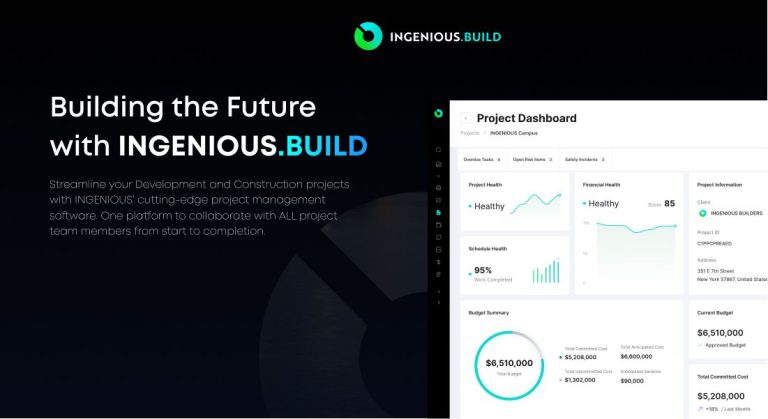
Ingenious.Build is construction project management software for owners, developers, owner representatives, general contractors, specialty trades, architects and engineers. Its core proposition is a shared project environment covering financial controls, project management and construction administration. For a CRE principal, the workflow change is straightforward: budgets, commitments, invoices, change orders, RFIs, submittals and closeout records can move through one connected system instead of separate spreadsheets, inboxes and contractor portals.
The product is most relevant during development, renovation and capital improvement programs. Owners can monitor portfolio spending and project forecasts, while delivery teams process day to day records inside permissioned workspaces. Participating companies retain their own records when information passes between organizations. That architecture addresses a persistent construction problem: several firms need to collaborate on the same transaction, yet each has different contractual responsibilities, access rights and recordkeeping requirements.
Ingenious.Build now positions artificial intelligence as a native product layer rather than a separate reporting accessory. Its public product description says built in AI can read documents and reduce rekeying, while the Pro offering includes an MCP server that lets compatible external AI systems work across authorized project information. Analysis: this is a meaningful technical direction, particularly for firms developing internal AI assistants, but buyers should distinguish connectivity from dependable automation. The vendor does not publish sufficient independent evidence to establish accuracy across document types, contract structures or unusual approval paths.
The buying case is strongest for organizations seeking one operating system across construction financials and administrative workflows. It is weaker for teams that only need a narrow field capture, design coordination or scheduling product. Ingenious.Build presents a broad functional footprint, transparent pricing tools and formal security claims, including SOC 2 compliance and ISO 27001 certification. Prospective customers should still validate the applicable reports, certificate scope, implementation requirements, accounting connections and permission behavior during diligence. BestCRE views the platform as promising and differentiated, but not yet as publicly proven as the largest construction software incumbents.
What Ingenious.Build Does and How It Works
Ingenious.Build organizes work around private company workspaces connected to shared projects. Owners and developers can manage budgets, commitments, forecasts, funding sources and capital plans. Contractors and trades can submit invoices, pay applications and change orders, while project teams route approvals and maintain an activity history. When a record crosses company boundaries, each organization can retain its own version rather than depending on another party’s database. That model is particularly useful for owner representatives managing multiple clients, because it separates organizational control from project collaboration.
Operational functions extend beyond cost management. Teams can maintain Gantt schedules, milestones, tasks, daily logs, meeting minutes, documents, drawings and specifications. Construction administration covers RFIs, submittals, punch lists, inspections and digital closeout packages. Mobile access brings relevant records to field users, although buyers should test offline behavior, drawing performance and jobsite usability against their specific conditions. Portfolio features support multiyear capital forecasting and scenario planning, giving owners a potential bridge between annual capital allocation and project execution.
The AI layer is intended to read project records, assist with repetitive data handling and check information moving through workflows. The public example follows a pay application from a trade through the contractor and owner representative to the owner, with checks against schedules of values, waivers, contractual markups, fees and budgets. That illustration explains the intended mechanics, but it is not independent proof of production accuracy. MCP connectivity is the more distinctive capability. It can expose authorized platform context to compatible AI clients or internal agents. Buyers need detailed answers about authentication, data boundaries, write permissions, logging, retention and error handling before allowing an AI system to act on financial or contractual records.
9AI Framework: Dimension by Dimension Analysis
CRE Relevance: 8/10
Ingenious.Build earns an 8 for CRE relevance because it directly addresses development, renovation and capital project workflows used by owners, developers and their delivery partners. Budget controls, commitments, forecasts, change orders, pay applications, RFIs, submittals and closeout records are central to CRE construction operations. Portfolio capital planning further strengthens the owner use case. The limitation is that the platform is construction focused rather than a complete CRE operating system. It does not replace leasing, property management, valuation, transaction management or investment accounting software. Its relevance therefore depends on whether construction delivery represents a material part of the buyer’s responsibilities. Analysis: CRE owners with active development pipelines should see a close operational fit, while stabilized asset managers with limited capital work will find less value.
Data Quality and Sources: 7/10
Ingenious.Build earns a 7 for data quality. Its connected workspace model can reduce duplicate entry and preserve the context surrounding records exchanged by project participants. Financial transactions, documents, approvals and administrative records can remain associated with the relevant project and organization, which is preferable to fragmented email attachments. Role based permissions and activity logs also support governance. However, data quality ultimately depends on implementation discipline, source system synchronization and consistent participation by outside firms. The vendor does not publish broad, independently verified measurements for extraction completeness, document classification accuracy or synchronization failures. Analysis: the platform has a sound structure for creating a dependable project record, but buyers should run representative legacy documents and accounting transactions through a pilot before treating it as an authoritative data layer.
Ease of Adoption: 7/10
Ingenious.Build earns a 7 for ease of adoption. A unified interface for financials, documents and construction administration can reduce the burden of moving between spreadsheets, email and point applications. Separate organizational workspaces may also make participation more acceptable to contractors and consultants concerned about ownership or access. The challenge is breadth. Replacing established budget, approval, RFI and submittal processes requires configuration, data migration, training and agreement across multiple companies. Adoption can fail when owners mandate a platform without aligning contractual procedures or when project partners continue parallel records. The vendor does not publish standard implementation duration, training hours or time to proficiency. Analysis: adoption should be manageable for a committed project team, but an enterprise portfolio rollout deserves formal process mapping, a controlled pilot and named internal administrators.
Output Accuracy: 6/10
Ingenious.Build earns a 6 for output accuracy. Structured financial calculations and workflow states should be testable, but the newer AI functions introduce uncertainty. Reading pay applications, waivers, contracts and schedules of values requires reliable extraction from documents that vary substantially in layout and quality. Contract checks also depend on complete source records and correctly configured business rules. The vendor describes AI assisted reading and checking, but does not publish independent benchmark results, error rates or validation performance by document type. Buyers should therefore keep human approval in place for payments, commitments and contractual notices. Analysis: the product appears capable of reducing clerical work, yet available public evidence does not justify assuming that AI generated fields or exceptions are consistently correct. Accuracy should be measured during a pilot using the buyer’s own forms, amendments and edge cases.
Integration and Workflow Fit: 8/10
Ingenious.Build earns an 8 for integration because connected workflows and external system access are central to its positioning. The platform describes two way ERP and accounting synchronization, conventional integrations and an MCP server within Pro. That combination could connect project execution records with financial systems while also making authorized context available to compatible AI applications. The score stops short of 9 because the practical value depends on named connectors, supported objects, synchronization frequency, exception handling and API limits. Those details are not comprehensively published in the available public product information. Analysis: MCP is strategically interesting, but it should complement proven transactional integrations rather than substitute for them. Buyers should require a field level integration map covering vendors, commitments, invoices, cost codes, forecasts, documents, identity management and audit events before selecting the platform.
Pricing Transparency: 5/10
Ingenious.Build earns a 5 for pricing transparency. The company publicly offers a pricing calculator and describes its approach as transparent and based on users. That is more useful than a website containing only a demo request. However, standard subscription prices, package minimums, implementation charges, integration costs, storage allowances, AI usage limits and contract terms are not clearly published in the available public information. The framework therefore caps the score at 5. Prospective buyers should obtain a written total cost schedule that separates software, onboarding, migration, configuration, support and optional services. Analysis: the calculator may help establish an initial range, but it does not by itself provide enough information for a reliable multiyear comparison with competing systems. Pricing should also be tested under realistic collaborator counts and portfolio growth.
Support and Reliability: 6/10
Ingenious.Build earns a 6 for support. The company provides a public help center and documentation entry point, indicating that users are not entirely dependent on sales or account teams for basic guidance. A broad platform serving owners, contractors, trades and designers will nevertheless require more than product documentation, particularly during workflow design, migration and integration testing. The vendor does not publish enough detail about standard response times, service levels, support hours, escalation procedures, dedicated account coverage or included implementation resources to justify a higher score. Analysis: buyers should evaluate support as part of procurement rather than assuming the subscription includes extensive process consulting. Contractual commitments are especially important for payment workflow interruptions, permission problems and synchronization errors. Reference calls should address both initial deployment and support quality after the implementation team exits.
Innovation and Roadmap: 8/10
Ingenious.Build earns an 8 for innovation. The combination of connected company workspaces, embedded document intelligence and native MCP access goes beyond attaching a generic chatbot to a project database. Allowing authorized AI clients to work with project context could support internal assistants, portfolio reporting and cross system workflows without forcing every buyer into one vendor supplied interface. The workspace architecture also recognizes the legal and operational boundaries between project participants. Innovation does not automatically equal reliability, however. MCP deployments are still evolving, and secure context access is only one component of a controlled production workflow. Analysis: the technical direction is ahead of many conventional construction platforms, but its value will depend on permission enforcement, observability, model governance and real adoption. The vendor does not publish enough production evidence to award a top score.
Market Reputation: 6/10
Ingenious.Build earns a 6 for market reputation. It competes in a demanding market against established platforms with large partner ecosystems and extensive reference bases. The company presents case studies, customer wins and comparisons with major competitors, but it does not publish enough independently verifiable information about customer count, renewal rates, implementation success or transaction volume to demonstrate market leadership. Public customer evidence appears more limited than that of Procore or Autodesk Construction Cloud. The score reflects credible market participation without assuming scale that has not been disclosed. Analysis: buyers should not treat relative youth as disqualifying, but they should conduct deeper reference checks and continuity diligence. Ask for customers with a similar asset type, portfolio size, accounting environment and contracting structure, then verify adoption among external collaborators as well as the owner’s internal team.
Who Should Use Ingenious.Build
Ingenious.Build is best suited to owners, developers and owner representatives managing multiple active construction or capital improvement projects. These buyers stand to gain when financial controls, approvals, project correspondence and portfolio forecasts currently live in separate systems. It is particularly relevant when an owner wants direct visibility into commitments, invoices and forecast changes rather than relying entirely on monthly reports assembled by a contractor. Owner representatives operating several client environments may also value private workspaces and connected records.
General contractors, specialty trades, architects and engineers can use the platform when project participants agree to conduct administrative workflows in one system. The fit improves for organizations willing to standardize RFIs, submittals, pay applications, change orders and closeout procedures. Technology leaders developing internal AI tools should examine the Pro tier because MCP connectivity offers a governed route into project context. Analysis: the ideal buyer has enough project volume to justify process redesign, an internal owner for governance and a willingness to validate integrations and AI behavior before broad deployment.
Who Should Not Use Ingenious.Build
Ingenious.Build is not the natural choice for a stabilized CRE operator whose primary needs are leasing, tenant billing, maintenance, valuation or investment reporting. Those functions require dedicated property or investment management systems. Small teams running occasional, uncomplicated projects may also find the platform’s breadth greater than necessary. A spreadsheet, accounting product or narrower construction application could be less expensive and easier to govern.
Buyers should hesitate if they need a proven field first ecosystem with a very large subcontractor network, deeply established regional implementation partners or highly specialized design coordination. They should also avoid making AI automation the sole purchase rationale until document accuracy and controls have been tested. Organizations unwilling to standardize workflows across participants are poor candidates, because connected software cannot correct inconsistent approval authority or incomplete source records. Analysis: if most collaborators will continue working through email and duplicate logs, the platform’s central benefit will be materially weakened.
Pricing and ROI Analysis
Ingenious.Build offers a public pricing calculator and indicates that pricing is structured per user, but complete standard prices are not published in the available public information. The vendor also identifies Pro as the tier containing MCP connectivity. Buyers need a formal quotation to determine subscription cost, minimum commitments, onboarding fees, migration services, storage, integrations, AI allowances and support coverage. Procurement teams should request comparable totals for the initial term and renewal periods, including the cost of collaborators who require more than limited access.
Analysis: a simple ROI model should start with fully loaded labor rather than vendor claims. Suppose 15 regular users each save 90 minutes per week and their blended labor cost is $70 per hour. The annual gross capacity benefit would be 15 multiplied by 1.5 hours, multiplied by 50 working weeks, multiplied by $70, which equals $78,750. Subtract subscription, implementation, integration and internal administration costs to estimate net benefit. This is an illustrative calculation, not a claim about actual savings. Buyers should replace every assumption with pilot evidence and separately value avoided payment errors, faster approvals and improved forecasting only when those outcomes can be documented.
Integration and CRE Tech Stack Fit
Ingenious.Build is designed to sit between project participants and the owner’s broader technology stack. Its stated two way ERP and accounting synchronization matters because commitments, invoices, vendors, cost codes and actual payments cannot remain isolated inside a construction platform. The useful architecture is usually bidirectional: approved project transactions move into accounting, while payment status and financial master data return to the project record. Buyers should confirm supported systems and fields directly with the vendor.
MCP connectivity in Pro creates another integration path for internal AI assistants and compatible clients. It does not eliminate the need for APIs, identity controls or transactional connectors. A CRE organization should map Ingenious.Build alongside accounting, document storage, identity management, business intelligence and portfolio planning systems. Analysis: the product can become a strong construction data hub if record ownership and synchronization rules are explicit. Without that design, teams risk conflicting forecasts, duplicate vendors and AI responses based on incomplete context.
Competitive Landscape
Procore is the clearest alternative for buyers prioritizing market presence, contractor familiarity and a broad construction application ecosystem. Autodesk Construction Cloud is stronger when design coordination, drawings, models and Autodesk workflows are central to delivery. Both have more established market recognition, although their packaging and total cost require careful comparison. Ingenious.Build differentiates through connected stakeholder workspaces, owner oriented financial controls and native MCP access. Analysis: buyers should compare actual workflows and permission models rather than feature counts.
Buildertrend is another option, particularly for residential builders and smaller construction businesses, but its market emphasis may be less aligned with complex institutional CRE programs. PMWeb, Kahua and Trimble Unity Construct also deserve consideration for owner focused project controls, capital programs and configured enterprise workflows. Smartsheet remains relevant when flexibility and familiar grid based processes matter more than purpose built construction records.
Among the BestCRE peer set, ALICE Technologies focuses more heavily on construction planning and schedule optimization, OpenSpace and OnsiteIQ emphasize visual site capture, Field Materials targets material procurement, and Firmus concentrates on design review risk. Those products are complements or specialized alternatives rather than direct platform substitutes. Ingenious.Build should win when a buyer wants connected financial and administrative execution. It should lose when one specialist problem carries more economic weight than platform consolidation.
The Bottom Line
Ingenious.Build merits a serious evaluation from CRE owners, developers and project managers seeking tighter control of construction financials and cross company workflows. Its combination of portfolio planning, project administration, organizational workspaces and MCP connectivity is differentiated. The product appears broad enough to replace several fragmented processes, but public evidence does not yet establish best in class AI accuracy or market scale.
BestCRE recommends a controlled pilot rather than an immediate portfolio mandate. Use live project documents, connect the intended accounting environment and include at least one contractor, trade and design participant. Measure duplicate entry, approval time, forecast reconciliation, extraction errors and user participation. Proceed if the platform produces a trustworthy shared record and the total cost is supported by measured labor or risk reduction. Choose a larger incumbent or focused specialist if ecosystem depth, field adoption or one technical workflow matters more than consolidation.
About BestCRE
BestCRE.com is the definitive authority on commercial real estate AI, analysis, and investment intelligence. Every article advances the platform’s mission to help CRE professionals identify, evaluate, and adopt the best tools and strategies in the industry. We benchmark platforms using the 9AI Framework so CRE leaders can compare tools with clear evidence. Explore the category map at 20 CRE sectors for deeper coverage across the CRE stack.
Frequently Asked Questions
What is Ingenious.Build?
Ingenious.Build is construction project management software for owners, developers, owner representatives, general contractors, specialty trades, architects and engineers. It combines project financials, project management, construction administration and capital planning in connected company workspaces. Typical records include budgets, commitments, forecasts, invoices, pay applications, change orders, schedules, RFIs, submittals, drawings, inspections and closeout documents. Each participating organization can maintain its own permissions and records while sharing relevant information across a project. The platform also includes built in AI features intended to read documents and reduce repetitive data handling. The Pro offering adds an MCP server for connecting compatible external AI systems to authorized project context.
How does Ingenious.Build compare with Procore?
Ingenious.Build and Procore both cover broad construction management workflows, but their buying cases differ. Procore has greater market recognition, a broad application ecosystem and widespread contractor familiarity. Ingenious.Build places particular emphasis on connected stakeholder workspaces, owner oriented financial controls and MCP access for external AI tools. A buyer should compare budget structures, change management, pay applications, document controls, mobile usability, collaborator licensing, accounting synchronization and permissions using a live project scenario. Analysis: Ingenious.Build may appeal to owners seeking tighter cross company records and an AI ready architecture. Procore may be safer when subcontractor familiarity, implementation capacity and ecosystem breadth are decisive. Neither should be selected from a generic feature checklist.
How much does Ingenious.Build cost?
Ingenious.Build provides a public pricing calculator and describes pricing on a per user basis, but complete standard prices are not published in the available public information. MCP connectivity is identified as part of Pro. Buyers should request a written quotation covering subscription fees, user categories, minimum commitments, implementation, data migration, integrations, storage, AI usage, support and renewal terms. Ask whether external collaborators require paid licenses and whether portfolio growth changes the pricing basis. Analysis: calculate value from verified time savings and avoided reconciliation work, then subtract every direct and internal cost. A short pilot can establish how much effort the platform actually removes before the organization commits to a wider rollout.
Who is Ingenious.Build best suited for?
Ingenious.Build is best suited to CRE owners, developers and owner representatives with active construction, renovation or capital improvement portfolios. It fits organizations that need direct control over budgets, commitments, forecasts, change orders, invoices, approvals and construction administration. General contractors, trades and designers can also benefit when the project team agrees to use shared digital workflows. The strongest buyer has multiple projects, fragmented current processes, an internal platform owner and enough influence to secure collaborator adoption. It is less suitable for stabilized property operators focused primarily on leasing and maintenance, or for small teams that only need a narrow scheduling, field capture or document sharing tool. Analysis: value rises with project complexity and repeated workflows.
Will Ingenious.Build become an AI operating layer for construction?
Ingenious.Build has a credible foundation for becoming an AI access layer because it combines structured project records, permissioned company workspaces, built in AI and MCP connectivity. That architecture could let authorized assistants answer portfolio questions, inspect document handoffs and support repetitive workflows. The outcome is not guaranteed. Construction data remains fragmented, contractual language varies and financial actions require strong controls. The vendor does not publish enough independent production evidence to establish how reliably external AI systems perform across projects. Analysis: the forward path depends less on chatbot features than on permission enforcement, complete integrations, audit logs, evaluation methods and human approval. Buyers should treat MCP as strategic infrastructure, then test narrowly defined use cases before allowing consequential actions.
Related Reviews
Compare Ingenious.Build with other tools BestCRE has scored in the same category: Civils.ai, Field Materials, ALICE Technologies. Explore more CRE AI tool reviews in our Best CRE AI Tools directory. For sector-specific analysis and market intelligence, visit our 20 CRE Sectors hub.