Category: Uncategorized

  • Advance Auto Parts NNN Lease Investment Profile & Credit Analysis

    Executive Summary

    Advance Auto Parts, Inc. operates approximately 4,000 retail automotive aftermarket locations across North America, making it one of the largest suppliers of automotive parts, accessories, and maintenance products. As a specialist automotive retailer serving both professional mechanics and do-it-yourself consumers, Advance Auto Parts represents a below-investment-grade tenant with defensive characteristics. The company’s essential automotive aftermarket positioning and substantial market presence provide moderate lease stability despite current credit challenges.

    Company Overview & Business Model

    Advance Auto Parts operates approximately 4,000 store locations across the United States and Canada, serving automotive professionals, small business operators, and do-it-yourself consumers. The company generated annual revenue exceeding $5 billion, making it one of the largest automotive aftermarket retailers globally. Advance Auto Parts’s market position is supported by extensive product selection, knowledgeable staff, and convenient store locations near customer concentration points.

    The company’s business model generates revenue through three primary channels: over-the-counter sales to professional mechanics (approximately 50% of revenue), do-it-yourself consumer sales (approximately 35% of revenue), and commercial fleet and delivery services (approximately 15% of revenue). This diversified customer base provides multiple revenue streams while reducing dependence on any single customer segment.

    Advance Auto Parts maintains relationships with numerous manufacturers and suppliers, providing exclusive products and preferred pricing arrangements that enhance competitive positioning. The company benefits from network effects where each store location creates awareness and customer acquisition benefits for nearby locations.

    The company operates under significant competitive pressure from national competitors (AutoZone, O’Reilly Auto Parts), online retailers (Amazon, RockAuto), and manufacturer direct sales. Recent strategic challenges have required significant operational restructuring and store consolidation to maintain competitive positioning.

    Credit Analysis & Financial Strength

    Credit Ratings: Advance Auto Parts does not maintain investment-grade credit ratings. The company is rated below investment-grade by major rating agencies, reflecting operational challenges, competitive pressures, and recent profitability deterioration. This below-investment-grade rating reflects heightened credit risk relative to other retail tenants.

    Financial Challenges: Advance Auto Parts has faced significant operating challenges in recent years, including reduced customer traffic, inventory management issues, and competitive pressures from online retailers. The company has undertaken substantial operational restructuring including store closures, cost reduction initiatives, and supply chain optimization.

    Operational Restructuring: Management has implemented strategic initiatives to improve profitability including store rationalization, digital capabilities enhancement, and supply chain modernization. These initiatives reflect management recognition of competitive challenges and commitment to operational improvement.

    Cash Flow Generation: While profitability has been challenged, Advance Auto Parts continues generating positive operating cash flows supporting ongoing operations and capital investments. The company maintains access to credit facilities enabling operational flexibility during the restructuring process.

    NNN Lease Structure & Key Terms

    Lease Classification: Advance Auto Parts store locations typically operate under net lease arrangements where the tenant bears responsibility for property operating expenses including property taxes, insurance, and maintenance. This structure protects landlord cash flow while ensuring store locations remain competitive and well-maintained.

    Lease Duration & Renewals: Advance Auto Parts store leases typically include terms of 5–10 years with renewal options. The shorter lease terms compared to some retail competitors reflect the company’s ongoing store portfolio optimization. This provides landlords with periodic opportunities to re-evaluate lease economics and tenant performance.

    Rental Escalations: Most Advance Auto Parts store leases include annual escalation clauses of 2–3%, tied to inflation indices or fixed percentage increases. These escalations provide periodic income growth while maintaining competitive positioning.

    Location Economics: Advance Auto Parts store locations generate moderate per-square-foot sales economics, typically ranging from $200–$400 per square foot depending on store format and market characteristics. These economics reflect the automotive aftermarket retail segment and the company’s competitive positioning.

    Investment Merits & Competitive Advantages

    Essential Automotive Aftermarket Positioning: Automotive maintenance and repair represents essential consumer and business spending. Vehicle owners must maintain and repair vehicles regardless of economic conditions. This essential positioning creates relatively stable demand for automotive parts and maintenance products.

    Diversified Customer Base: Advance Auto Parts serves professional mechanics, small business operators, and do-it-yourself consumers. This diversified customer base reduces dependence on any single customer segment while providing multiple revenue sources.

    Geographic Footprint: The company’s approximately 4,000 store locations across North America provide extensive customer accessibility. This geographic scale enables efficient distribution and creates network effects supporting market position.

    Store Productivity Diversity: While the company faces competitive challenges, numerous store locations remain highly productive. The company’s ongoing store optimization focuses resources on highest-productivity locations, supporting long-term profitability.

    Omnichannel Development: Management is investing in digital capabilities, online ordering, curbside pickup, and delivery services. These capabilities position the company to compete effectively in evolving consumer preferences while leveraging physical store network.

    Risk Factors & Considerations

    Intense Competitive Pressures: Advance Auto Parts faces substantial competition from AutoZone, O’Reilly Auto Parts, online retailers (Amazon, RockAuto), and manufacturer direct sales. These competitors have stronger financial positions and comparable market presence.

    Below-Investment-Grade Credit Quality: The company’s credit challenges reflect fundamental competitive and operational pressures. Below-investment-grade ratings indicate elevated default risk relative to investment-grade tenants.

    Store Rationalization Risk: The company’s ongoing store optimization process involves continued closures of underperforming locations. Landlords face potential lease non-renewal risk at stores selected for closure, though the company typically provides appropriate lease termination notice.

    Consumer Preference Shifts: Long-term industry trends toward electric vehicle adoption and reduced vehicle ownership among younger consumers could reduce long-term demand for traditional automotive parts and maintenance products.

    Operational Execution Risk: The company’s turnaround strategy requires effective execution of supply chain optimization, digital capability development, and store productivity improvement. Execution shortfalls could further impair financial performance.

    Economic Cycle Sensitivity: While automotive maintenance is relatively essential, severe economic downturns reduce discretionary maintenance and accessory purchases. Economic recessions could reduce sales and profitability.

    Historical Performance & Trends

    Advance Auto Parts has faced significant operational challenges in recent years. The company faced profitability deterioration, store productivity declines, and competitive pressures from larger competitors and online retailers. These challenges prompted major operational restructuring including significant store closures.

    The company’s strategic transformation toward digital capabilities, supply chain modernization, and store optimization demonstrates management awareness of competitive challenges. Implementation of these initiatives appears to be improving operational metrics and positioning the company for improved long-term competitiveness.

    While historical performance has been challenged, the company’s essential market positioning and ongoing operational improvements suggest stabilization is possible. However, below-investment-grade ratings appropriately reflect execution risks and competitive pressures remaining.

    Comparable Tenants & Market Position

    Advance Auto Parts is significantly larger and more diversified than many automotive retailers, competing directly with AutoZone and O’Reilly Auto Parts. While these competitors maintain stronger credit ratings and financial positions, Advance Auto Parts remains one of the largest automotive aftermarket retailers in North America.

    Among below-investment-grade retail tenants, Advance Auto Parts represents a substantial company with essential market positioning and ongoing operational improvements. The company’s diversity, geographic scale, and customer base exceed many smaller retail tenants.

    Advance Auto Parts leases generally command lower cap rates than typical below-investment-grade retail due to the company’s size, market position, and essential service characteristics of automotive aftermarket retail.

    Cap Rate Analysis & Valuation

    Advance Auto Parts store leases typically trade at cap rates ranging from 7.0% to 8.5%, depending on property location, lease term remaining, and specific tenant creditworthiness. Premium locations in high-traffic areas command lower cap rates (7.0–7.5%), while secondary markets command higher cap rates (7.5–8.5%).

    These cap rates reflect the company’s below-investment-grade credit status and the competitive challenges facing automotive aftermarket retail. The elevated cap rates provide returns appropriate for credit risk undertaken relative to investment-grade tenants.

    Current market conditions suggest Advance Auto Parts leases offer value for investors willing to accept below-investment-grade credit risk in exchange for enhanced yield and exposure to the essential automotive aftermarket retail segment.

    Investment Conclusion

    Advance Auto Parts NNN store leases represent a below-investment-grade investment opportunity for yield-focused investors willing to accept credit and operational risk in exchange for enhanced returns and exposure to the essential automotive aftermarket retail segment. The company’s market scale, geographic footprint, and customer diversity provide moderate defensibility despite current credit challenges.

    The company’s ongoing operational restructuring and strategic initiatives toward digital capability development and supply chain modernization suggest management commitment to competitive positioning improvement. While execution risks remain, the company’s essential market positioning provides baseline demand stability that supports ongoing store operations.

    Investors should recognize that below-investment-grade ratings appropriately reflect execution risks, competitive pressures, and credit challenges. However, for yield-focused investors with appropriate credit risk tolerance, Advance Auto Parts leases offer compelling risk-adjusted returns given the company’s market position and essential service characteristics. Landlords should ensure appropriate lease structures, security deposits, and renewal provisions reflecting credit status.

    Key Investment Metrics

    Metric Value
    Company Advance Auto Parts, Inc.
    Sector Retail – Automotive Aftermarket
    S&P Rating Below Investment Grade
    Moody’s Rating Below Investment Grade
    Investment Grade No
    Store Count ~4,000
    Annual Revenue $5+ Billion
    Typical Lease Term 5–10 Years
    Typical Cap Rate Range 7.0%–8.5%
    Annual Escalations 2–3%
    Lease Type Net Lease (NNN)
    Credit Status Below Investment Grade (Higher Risk)
  • Best Buy NNN Lease Investment Profile & Credit Analysis

    Executive Summary

    Best Buy Company, Inc. is the largest consumer electronics and appliances retailer in North America, operating approximately 1,000 store locations. As the dominant player in its category, Best Buy represents a solid investment-grade tenant providing stable, predictable lease cash flows. The company’s market leadership position, essential service characteristics, and demonstrated operational resilience make NNN leases a compelling opportunity for investors seeking consumer discretionary exposure with institutional credit quality.

    Company Overview & Business Model

    Best Buy operates approximately 1,000 store locations across North America, primarily in the United States and Canada. The company generated annual revenue exceeding $55 billion, making it the dominant retailer in consumer electronics, appliances, and consumer technology. Best Buy’s market position is reinforced by exclusive product availability, knowledgeable staff, and comprehensive product selection that online-only competitors struggle to replicate.

    Best Buy’s business model generates revenue through three primary channels: consumer electronics and appliances sales, service contracts and technical support, and ancillary services including installation and extended warranties. The diversified revenue model provides multiple cash flow streams while the company transitions toward services-centric positioning.

    The company operates under significant competitive pressure from online retailers (Amazon, Newegg) and has adapted by emphasizing in-store experience, expert consultation, and services rather than competing purely on price. This strategic shift toward services and experience has created more defensible competitive positioning and higher-margin revenue streams.

    Best Buy maintains approximately 140,000 employees across North America, providing substantial employment and supporting local communities. The company’s Magnolia and Pacific Sales subsidiary brands serve premium home theater and custom installation markets, providing exposure to higher-income consumers and discretionary spending.

    Credit Analysis & Financial Strength

    Credit Ratings: Best Buy maintains investment-grade ratings from major rating agencies. Standard & Poor’s rates the company at BB+, which represents the highest rating in the speculative-grade category, while Moody’s rates the company at Ba1. These ratings reflect the company’s market leadership position, solid operating margins, and demonstrated capacity to adapt to evolving consumer preferences.

    Financial Scale: With annual revenue exceeding $55 billion, Best Buy maintains significant scale in its operating category. The company generates operating margins of approximately 3–4%, producing annual operating cash flows exceeding $3 billion. These substantial cash flows provide capacity for lease obligations, capital investments, and shareholder returns.

    Balance Sheet: Best Buy maintains conservative balance sheet positioning with manageable leverage ratios. The company has systematically reduced debt levels while returning capital to shareholders through dividends and share repurchases. This financial discipline demonstrates management commitment to balance sheet strength.

    Profitability & Cash Generation: Best Buy has maintained profitability through the transition away from pure consumer electronics retail. The company’s focus on services, extended warranties, and higher-margin categories has stabilized operating margins. Annual net earnings typically exceed $1 billion, providing substantial cushion for lease obligations.

    NNN Lease Structure & Key Terms

    Lease Classification: Best Buy retail locations typically operate under net lease arrangements where the tenant bears responsibility for property operating expenses including property taxes, insurance, and maintenance. This structure protects landlord cash flow while ensuring store locations remain competitive and modern.

    Lease Duration & Renewals: Best Buy store leases typically include terms of 10–20 years with multiple renewal options. The substantial lease duration provides predictable long-term cash flows. Best Buy’s strategy of maintaining locations in high-traffic shopping centers suggests reasonable renewal probability at productive locations.

    Rental Escalations: Most Best Buy store leases include annual escalation clauses of 2–3%, typically tied to inflation indices or percentage rent components. These escalations protect investor purchasing power while maintaining alignment with retailer expectations.

    Location Economics: Best Buy store locations generate strong per-square-foot sales economics, typically exceeding $600–$800 per square foot. These strong sales economics ensure store locations maintain profitability across different markets and economic periods, supporting lease renewal likelihood.

    Investment Merits & Competitive Advantages

    Market Leadership: Best Buy is the dominant consumer electronics retailer in North America with approximately 1,000 stores and unmatched retail presence in this category. This market leadership enables exclusive product availability, purchasing power advantages, and brand recognition that online competitors struggle to replicate.

    Physical Retail Resilience: Despite online competition, Best Buy has demonstrated that physical retail remains valuable for technology and appliances. Consumers desire hands-on product evaluation, expert consultation, and immediate availability that Best Buy’s store format provides. This has enabled Best Buy to maintain market share despite Amazon disruption.

    Services Revenue Growth: Best Buy’s strategic shift toward services (technical support, extended warranties, installation, home theater consulting) creates higher-margin recurring revenue streams. Services revenue has grown as a percentage of total revenue, supporting margin stability and cash flow predictability.

    Digital Integration: Best Buy has invested substantially in omnichannel capabilities enabling online ordering with in-store pickup, curbside delivery, and digital consultation. These capabilities position the company to compete effectively in evolving consumer preferences while leveraging store network advantages.

    Vendor Partnerships: Best Buy’s market leadership enables partnership opportunities with major technology vendors (Apple, Samsung, Microsoft) that generate exclusive in-store experiences and co-marketing support. These partnerships strengthen competitive positioning and customer draw.

    Risk Factors & Considerations

    Amazon & E-Commerce Competition: Amazon’s expansion into physical retail and same-day delivery capabilities represent ongoing competitive threats. Consumer preference for convenience and price competition from online retailers could compress Best Buy margins or reduce store traffic.

    Consumer Discretionary Exposure: Unlike essential services (grocery, banking, pharmacy), consumer electronics purchases are discretionary. Economic downturns reduce consumer spending on technology and appliances, creating earnings volatility. However, the company’s services focus provides some offsetting stability.

    Technology Product Cycles: Best Buy’s business is influenced by consumer technology upgrade cycles. Slower adoption of new categories or extended product replacement cycles could reduce traffic and sales momentum.

    Speculative-Grade Rating: While Best Buy maintains high ratings within the speculative-grade category (BB+/Ba1), the company is technically below investment-grade by traditional definitions. This rating reflects the inherent cyclicality and competitive pressures facing retail electronics retailers.

    Store Productivity Variation: Best Buy’s store portfolio includes both highly productive locations and underperforming stores. Some locations may face closure or non-renewal if demographic shifts or competitive pressures reduce store productivity.

    Historical Performance & Trends

    Best Buy has demonstrated remarkable operational resilience through multiple technological transitions and competitive disruptions. The company survived the shift from physical media (DVDs, CDs) to digital streaming, maintaining relevance despite fundamentally changed product categories.

    During the 2008–2009 financial crisis and the COVID-19 pandemic, Best Buy demonstrated operational flexibility and customer demand resilience. During COVID-19, the company benefited from accelerated digital device purchases and home technology investments while maintaining store operations under enhanced safety protocols.

    The company’s strategic transformation from pure electronics retailer toward services-centric positioning demonstrates management awareness of evolving competitive dynamics. This proactive adaptation suggests continued competitive viability despite ongoing e-commerce disruption.

    Comparable Tenants & Market Position

    Best Buy compares favorably to other major retail tenants within REIT portfolios. While the company’s BB+/Ba1 ratings place it in the speculative-grade category, the company is at the high end of that spectrum with institutional-quality operations and market leadership. Best Buy’s credit quality is significantly stronger than struggling retailers that have filed for bankruptcy.

    Among consumer discretionary retailers, Best Buy represents one of the strongest tenants available, with market leadership, brand value, and demonstrated competitive resilience exceeding most peers. The company’s services evolution provides defensive characteristics unusual for discretionary retailers.

    Best Buy’s location quality and sales productivity exceed many traditional retailers, supporting higher valuation multiples and greater lease payment reliability confidence.

    Cap Rate Analysis & Valuation

    Best Buy store leases typically trade at cap rates ranging from 5.5% to 7.5%, depending on property location, lease term remaining, and market conditions. Premium locations in high-traffic shopping centers command lower cap rates (5.5–6.5%), while secondary market locations command higher cap rates (6.5–7.5%).

    These cap rates reflect Best Buy’s speculative-grade but high-quality credit status and the stability of consumer electronics retail operations. The cap rate range provides attractive income yields appropriate for credit risk undertaken.

    Current market conditions suggest Best Buy leases offer attractive value for investors willing to accept retail operational risk in exchange for above-market yield and exposure to the leading consumer electronics retailer.

    Investment Conclusion

    Best Buy NNN store leases represent an attractive investment opportunity for yield-focused investors willing to accept retail operational risk in exchange for superior credit quality relative to retail peers and exposure to the dominant North American consumer electronics retailer.

    The company’s market leadership position, strategic services transformation, and demonstrated operational resilience through multiple technological disruptions provide confidence in long-term competitive viability. While consumer discretionary exposure creates earnings volatility, Best Buy’s scale and market position provide defensibility exceeding most retail competitors.

    For investors seeking enhanced yield with moderate retail exposure and exposure to quality management and strategic positioning, Best Buy store leases represent a compelling investment. The company’s demonstrated ability to adapt to consumer preference changes and online competition suggests continued operational viability and lease payment reliability.

    Key Investment Metrics

    Metric Value
    Company Best Buy Company, Inc.
    Sector Retail – Consumer Electronics
    S&P Rating BB+
    Moody’s Rating Ba1
    Investment Grade No (High Speculative)
    Store Count ~1,000
    Annual Revenue $55+ Billion
    Operating Margin 3–4%
    Annual Operating Cash Flow $3+ Billion
    Typical Lease Term 10–20 Years
    Typical Cap Rate Range 5.5%–7.5%
    Annual Escalations 2–3%
    Lease Type Net Lease (NNN)
  • Kroger NNN Lease Investment Profile & Credit Analysis

    Executive Summary

    The Kroger Company is the largest supermarket retailer in the United States, operating approximately 2,800 store locations across 35 states. As a pure-play grocery operator, Kroger represents a solid investment-grade tenant providing stable, recession-resistant cash flows. The company’s essential service positioning and market-leading scale make NNN leases a compelling opportunity for conservative investors seeking defensive consumer staple exposure.

    Company Overview & Business Model

    Kroger operates the nation’s largest supermarket chain, employing over 400,000 associates across approximately 2,800 store locations. The company generated annual revenue exceeding $150 billion, making it one of the largest food retailers globally. Kroger’s geographic footprint spans the entire continental United States with particularly strong presence in Midwest and Southeast regions.

    The company operates through diversified banner brands including Kroger, Fred Meyer, Ralphs, Smith’s, and Harris Teeter, enabling market-specific positioning and customer preference accommodation. This diversified banner approach allows Kroger to compete effectively in different regional markets while maintaining operational scale efficiencies.

    Kroger’s business model generates revenue through traditional grocery sales (low single-digit margins of 1–3%) supplemented by high-margin ancillary services including pharmacy, fuel centers, and grocery delivery services. This diversified revenue model provides multiple cash flow streams while the company transitions toward e-commerce and digital capabilities.

    As a publicly traded company with approximately 3.4 billion shares outstanding, Kroger maintains liquid publicly traded equity enabling access to capital markets. The company has substantial scale advantages enabling negotiation power with suppliers, competitive pricing for consumers, and operational efficiency across a national footprint.

    Credit Analysis & Financial Strength

    Credit Ratings: Kroger maintains investment-grade credit ratings from major rating agencies. Standard & Poor’s rates Kroger at BBB, while Moody’s rates the company at Baa1. These solid investment-grade ratings reflect the company’s market leadership position, stable cash flows, and demonstrated financial capacity to manage debt obligations.

    Financial Scale: With annual revenue exceeding $150 billion, Kroger is one of the largest retailers globally. The company’s substantial scale provides negotiation leverage with suppliers, enabling favorable pricing and terms. This scale advantage directly translates to cost competitiveness and financial strength.

    Operating Margins & Cash Flow: Kroger generates operating margins of approximately 3–4% on sales, producing annual operating cash flows exceeding $5 billion. These substantial cash flows provide multiple avenues for lease obligation fulfillment, capital investments, and debt service.

    Debt Management: Kroger maintains debt levels consistent with investment-grade peers. The company’s net debt to EBITDA ratios typically range from 2.0x to 2.5x, which while elevated relative to some peers, remains appropriate for the company’s stable business model and cash generation capacity.

    NNN Lease Structure & Key Terms

    Lease Classification: Kroger supermarket locations typically operate under net lease arrangements where the tenant bears responsibility for property operating expenses including property taxes, insurance, and maintenance. This structure protects landlord cash flows while ensuring store locations remain competitive and well-maintained.

    Lease Duration & Renewals: Kroger supermarket leases typically include terms of 10–20 years with multiple renewal options. The substantial lease duration provides predictable long-term cash flows. Kroger’s market leadership position and strong operating economics suggest high probability of lease renewal at productive locations.

    Rental Escalations: Most Kroger supermarket leases include annual escalation clauses of 2–3%, typically tied to inflation indices or CPI adjustments. These escalations protect investor purchasing power while maintaining competitiveness relative to alternative retail locations.

    Sales Economics: Kroger supermarket locations generate strong per-square-foot sales economics, typically exceeding $600–$700 per square foot annually. These strong sales economics ensure locations maintain profitability and value across different markets and economic periods, supporting lease renewal probability.

    Investment Merits & Competitive Advantages

    Essential Service Positioning: Unlike discretionary retailers, supermarkets provide essential consumer staples (food, beverages, household items) that customers must purchase regardless of economic conditions. This essential positioning creates recession-resistant cash flows that continue through economic downturns.

    Market Leadership: Kroger is the dominant supermarket operator in the United States with approximately 2,800 locations providing unmatched geographic scale. This market leadership enables operational efficiencies, favorable supplier terms, and brand recognition that smaller competitors cannot match.

    Demographic Tailwinds: U.S. population growth and household formation trends support long-term supermarket demand growth. The company’s expansion into growing metropolitan areas positions it to benefit from demographic trends supporting sustained store economics.

    Private Label Growth: Kroger has successfully developed private label brands that generate higher margins than national brands. Growth in private label penetration (currently exceeding 25% of sales) provides margin expansion opportunity and customer loyalty enhancement.

    Digital & E-Commerce Evolution: While facing increased e-commerce competition from Amazon and others, Kroger has invested substantially in digital capabilities, online ordering, and delivery services. These capabilities position the company to compete effectively in evolving consumer preferences.

    Risk Factors & Considerations

    E-Commerce Competition & Amazon Threat: Amazon’s acquisition of Whole Foods and expansion into grocery delivery represents a competitive threat to traditional supermarket models. However, Kroger’s scale, existing store footprint, and brand recognition provide defensibility against pure online competitors.

    Private Label Commoditization: As grocery increasingly transitions toward commodity-like pricing, margin compression represents ongoing risk. However, Kroger’s market leadership and private label focus position the company to compete effectively on price while maintaining reasonable margins.

    Labor Cost Inflation: Supermarket operations are labor-intensive, requiring store associates, checkout personnel, and logistics workers. Wage inflation and unionization pressures could compress margins if pricing power is insufficient to offset wage increases.

    Real Estate Portfolio Optimization: As consumer shopping patterns evolve and e-commerce penetration increases, some underperforming supermarket locations may face closure or non-renewal. However, Kroger’s selective store footprint and market leadership suggest most productive locations will remain open.

    Food Cost Inflation: Supermarket margins are sensitive to food cost inflation. Rising agricultural commodity costs could compress margins if the company cannot pass costs to consumers through price increases.

    Historical Performance & Trends

    Kroger has maintained market leadership and operating viability through multiple economic cycles spanning over a century of operations. The company operated profitably through the 2008–2009 financial crisis and the COVID-19 pandemic, demonstrating resilience of the supermarket model.

    During the COVID-19 pandemic, Kroger benefited from accelerated shift toward at-home food consumption. The company expanded workforce, maintained operations despite disruptions, and continued dividend payments to shareholders. This pandemic resilience demonstrates financial strength and operational reliability.

    The company’s gradual transition toward digital and e-commerce capabilities demonstrates management awareness of evolving consumer preferences. Rather than facing disruption from changing preferences, Kroger is proactively adapting its business model to maintain market relevance.

    Comparable Tenants & Market Position

    Kroger compares favorably to other grocery and consumer staple retailers within REIT portfolios. The company’s BBB/Baa1 credit ratings are consistent with other major grocery operators. Kroger’s market leadership position provides competitive advantages over regional grocery chains with lower market shares and less diversified operations.

    Among consumer staple retailers, Kroger represents one of the largest and most creditworthy options available as an NNN lease tenant. The company’s demonstrated operational resilience and market position compare favorably to smaller regional grocers or specialty retailers.

    The company’s long-term strategic focus on market leadership through store investments, technology deployment, and supply chain optimization demonstrates commitment to maintaining store productivity and lease payment reliability.

    Cap Rate Analysis & Valuation

    Kroger supermarket leases typically trade at cap rates ranging from 5.0% to 7.0%, depending on property location, lease term remaining, and market conditions. Premium locations in dense urban or high-traffic areas command lower cap rates (5.0–6.0%), while secondary market locations command higher cap rates (6.0–7.0%).

    These cap rates reflect Kroger’s solid investment-grade credit quality and the stability of supermarket operations. The cap rate range is appropriate for investment-grade retail tenants, providing attractive income yields relative to other consumer staple retailers.

    Current market conditions suggest Kroger leases remain attractively priced for investors seeking essential service exposure with solid credit quality. The company’s market leadership and demonstrated operational resilience support valuation levels observed in market transactions.

    Investment Conclusion

    Kroger NNN supermarket leases represent a solid investment opportunity for income-focused investors seeking defensive consumer staple exposure with investment-grade credit quality. The company’s BBB/Baa1 credit ratings, market leadership position, and demonstrated resilience through economic cycles provide assurance of lease income stability.

    The company’s essential service positioning creates recession-resistant cash flows that continue through economic downturns. Supermarket demand remains relatively inelastic to economic cycles, as consumers must continue purchasing food regardless of economic conditions. This essential positioning supports predictable lease payment performance.

    While ongoing e-commerce competition and supermarket industry disruption represent long-term challenges, Kroger’s market scale, strategic positioning, and operational investments position the company to remain competitive and maintain store productivity. For investors prioritizing income stability and defensive consumer staple exposure, Kroger supermarket leases represent a compelling addition to diversified property portfolios.

    Key Investment Metrics

    Metric Value
    Company The Kroger Company
    Sector Retail – Grocery
    S&P Rating BBB
    Moody’s Rating Baa1
    Investment Grade Yes
    Store Count ~2,800
    Annual Revenue $150+ Billion
    Operating Margin 3–4%
    Annual Operating Cash Flow $5+ Billion
    Typical Lease Term 10–20 Years
    Typical Cap Rate Range 5.0%–7.0%
    Annual Escalations 2–3%
    Lease Type Net Lease (NNN)
  • Costco NNN Lease Investment Profile & Credit Analysis

    Executive Summary

    Costco Wholesale Corporation is a membership-based warehouse retailer operating one of the most successful and resilient retail business models in North America. Costco represents one of the premier NNN lease tenants in the REIT sector, combining exceptional credit quality, fortress-like balance sheet strength, and demonstrable resilience through multiple economic cycles. The company’s investment-grade credit profile makes it an ideal tenant for conservative investors seeking stable, predictable returns.

    Company Overview & Business Model

    Costco operates approximately 850 warehouse clubs globally (majority in North America) generating annual revenue exceeding $250 billion. The company’s membership-based model creates a highly stable, recurring revenue stream. Members pay annual membership fees ($60–$130 depending on membership tier), generating substantial predictable cash flows independent of unit sales.

    The company generates revenue through three primary sources: member purchases (low single-digit profit margin of 1–3%), membership fee income (high-margin recurring revenue), and ancillary services (gas stations, pharmacy, tire centers). This diversified revenue model provides multiple cash flow streams and reduces dependence on core merchandise sales.

    Costco’s warehouse format emphasizes operational efficiency and high inventory turnover. The company maintains inventory turns exceeding 10 times annually—significantly higher than traditional retailers. This inventory efficiency generates substantial operational cash flow and minimizes working capital requirements.

    The company’s member-centric culture and employee-focused policies have created exceptional customer and employee loyalty. Employee turnover is substantially below retail industry averages, reducing training costs and operational disruption. This operational excellence directly supports financial performance and lease payment reliability.

    Credit Analysis & Financial Strength

    Credit Ratings: Costco maintains investment-grade ratings across all major rating agencies. Standard & Poor’s rates the company at A, while Moody’s maintains a rating of A1. These ratings reflect the company’s exceptional business model resilience, fortress-like balance sheet, and consistent earnings quality.

    Balance Sheet Strength: Costco maintains a minimal debt profile with net debt to EBITDA ratios typically below 1.0x. The company generates substantial annual free cash flow (typically exceeding $10 billion annually) that provides multiple avenues for debt reduction, dividend growth, or strategic investments. This balance sheet strength creates an exceptional safety margin for lease obligation fulfillment.

    Profitability & Earnings Quality: While merchandise margins are intentionally maintained at low levels (1–3%) to maintain member value, membership fee income and ancillary services generate high-margin revenue. Operating margins exceed 3–4% of sales, demonstrating pricing power and operational leverage. Net earnings exceed $8 billion annually, providing substantial capacity for lease obligations.

    Recession Resilience: Costco demonstrated exceptional resilience during the 2008–2009 financial crisis and the COVID-19 pandemic. During both periods, the company expanded store count and increased capital investment despite economic uncertainty. This counter-cyclical expansion demonstrates management confidence in long-term prospects and exceptional financial flexibility.

    NNN Lease Structure & Key Terms

    Lease Classification: Costco warehouse facilities typically operate under net lease arrangements where the tenant bears responsibility for property operating expenses including property taxes, insurance, and maintenance. This structure protects landlord cash flow while ensuring warehouse locations remain highly maintained and operationally efficient.

    Lease Duration & Renewals: Costco warehouse leases typically include terms of 10–20 years with multiple renewal options. The substantial lease duration provides predictable long-term cash flow. Costco’s strategy of gradually opening new locations suggests high probability of lease renewal at existing high-performing locations.

    Rental Escalations: Most Costco warehouse leases include annual escalation clauses of 2–3%, typically tied to inflation indices. These escalations protect investor purchasing power while maintaining competitive positioning relative to other Costco leases and alternative retail spaces.

    Location Economics: Costco locations generate substantially higher per-square-foot sales than traditional retailers, typically exceeding $1,000 per square foot annually. These strong sales economics ensure Costco locations maintain value across different markets and economic periods, supporting lease renewal likelihood.

    Investment Merits & Competitive Advantages

    Fortress Business Model: The membership-based model creates recurring, predictable revenue streams substantially insulated from discretionary spending fluctuations. Members renew memberships repeatedly over decades, creating high customer lifetime value and exceptional business stability.

    Operational Excellence: Costco is renowned for operational discipline and continuous improvement. The company’s inventory turnover, labor efficiency, and supply chain management are among the best in global retail. This operational excellence directly translates to financial strength and lease payment reliability.

    Consistent Growth: Costco has demonstrated consistent growth through multiple economic cycles, expanding membership rolls and warehouse count even during recessions. Unlike commodity-dependent retailers, Costco’s growth trajectory appears sustainable across economic conditions.

    Brand Loyalty & Switching Costs: Costco members demonstrate exceptional loyalty and willingness to pay for membership privileges. The upfront membership cost creates switching costs that encourage long-term commitment. This loyalty insulates the company from competitive threats and supports consistent store performance.

    Defensive Consumer Staple Characteristics: Despite wholesale classification, Costco operates with characteristics typical of consumer staple companies. Members purchase necessities and household staples at Costco, creating non-discretionary demand patterns similar to grocery stores despite higher price points for membership.

    Risk Factors & Considerations

    E-Commerce & Omnichannel Competition: While Costco has been slower to embrace e-commerce than many retailers, online grocery and warehouse alternatives pose potential long-term competitive threats. However, Costco’s membership model and operational advantages appear to provide defensibility against online-only competitors.

    Mature Market Saturation: In mature markets like Southern California and the Pacific Northwest, Costco warehouse density is substantial. Growth in these markets will necessarily slow as the company reaches saturation. This could ultimately constrain store growth rates in core markets, though international expansion provides substantial opportunity.

    Wage Inflation: Costco’s competitive compensation philosophy (substantially above industry averages) positions the company well for attracting talent but creates exposure to wage inflation. Rising labor costs could pressure margins if membership prices don’t adjust accordingly.

    Economic Sensitivity: While Costco is substantially more recession-resistant than typical retailers, severe economic downturns could reduce membership renewal rates and per-member spending. However, the company’s demonstrated resilience suggests lease payments would remain prioritized even in severe recessions.

    Historical Performance & Trends

    Costco has demonstrated exceptional financial performance across multiple economic cycles spanning three decades of public company operations. The company has never experienced quarterly losses or missed dividend payments, demonstrating uninterrupted financial strength through recessions, financial crises, and competitive disruptions.

    During the 2008–2009 financial crisis, while many retailers filed for bankruptcy or faced severe financial distress, Costco expanded warehouse openings and increased capital investment. This counter-cyclical approach demonstrates management confidence in business resilience and financial capacity to honor lease obligations.

    The COVID-19 pandemic created unprecedented disruption to physical retail, yet Costco thrived. The company expanded warehouse openings, hired tens of thousands of employees, and increased membership growth rates. This pandemic resilience demonstrates the fundamental strength of Costco’s membership model.

    Comparable Tenants & Market Position

    Costco is widely considered among the premier tenants in the REIT sector, often cited alongside financial services titans like JPMorgan Chase and Bank of America as the most creditworthy retail/commercial tenants. Costco’s A/A1 credit ratings place it in the top tier of retail tenants alongside only the strongest specialty retailers and essential service providers.

    Among retail and consumer-oriented tenants, Costco represents an exceptional opportunity to partner with a best-in-class operator. The company’s demonstrated ability to maintain store economics through economic cycles, maintain employee satisfaction, and deliver member value creates a stable foundation for lease obligations.

    The company’s selective real estate footprint (unlike mass-market retailers operating hundreds of locations) means Costco warehouse leases represent premium properties in their respective markets, commanding appropriate economic returns.

    Cap Rate Analysis & Valuation

    Costco warehouse leases typically trade at cap rates ranging from 4.0% to 6.0%, depending on property location, lease term remaining, and market conditions. Premium locations in high-density markets command lower cap rates (4.0–5.0%), while secondary markets command higher cap rates (5.0–6.0%).

    These cap rates reflect Costco’s exceptional credit quality and the predictability of warehouse operations. The cap rate range is consistent with investment-grade office and retail tenants, validating Costco lease valuations relative to comparable investment opportunities.

    Current market conditions suggest Costco leases remain attractively priced for investors seeking best-in-class retail tenants. The company’s demonstrated performance consistency and balance sheet strength support valuation levels observed in market transactions.

    Investment Conclusion

    Costco NNN warehouse leases represent a premier investment opportunity for conservative, income-focused investors seeking exceptional credit quality and business model resilience. The company’s A/A1 credit ratings, fortress-like balance sheet, and demonstrated capacity to thrive through multiple economic cycles provide exceptional assurance of lease income stability.

    The company’s membership-based model creates recurring revenue streams substantially insulated from economic cycles. Members renew memberships repeatedly over decades, creating a stable cash flow foundation that directly supports lease payment reliability. The company’s operational excellence and continuous improvement culture ensure sustained financial strength.

    For conservative investors prioritizing income stability, credit quality, and business model resilience over maximum yield, Costco warehouse leases represent one of the most compelling opportunities in the REIT sector. The company’s institutional quality and demonstrated reliability make it one of the most preferred tenants among sophisticated real estate investors.

    Key Investment Metrics

    Metric Value
    Company Costco Wholesale Corporation
    Sector Retail – Warehouse
    S&P Rating A
    Moody’s Rating A1
    Investment Grade Yes
    Warehouse Count ~850 Global
    Annual Revenue $250+ Billion
    Annual Free Cash Flow $10+ Billion
    Typical Lease Term 10–20 Years
    Typical Cap Rate Range 4.0%–6.0%
    Annual Escalations 2–3%
    Lease Type Net Lease (NNN)
  • Wells Fargo NNN Lease Investment Profile & Credit Analysis

    Executive Summary

    Wells Fargo & Company is a leading diversified financial services company operating banking, investment, and mortgage services across the United States. As a major REIT tenant, Wells Fargo represents a lower-risk opportunity given its systemically important status, strong financial position, and predictable revenue streams. The company’s NNN lease represents a stable, credit-grade investment suitable for conservative portfolios.

    Company Overview & Business Model

    Wells Fargo is one of the largest banks in the United States with a market capitalization exceeding $180 billion. The company operates through three primary segments: Community Banking (retail banking, branch operations, mortgage services), Wholesale Banking (commercial and corporate banking), and Wealth & Investment Management (asset management and brokerage services).

    The company maintains a substantial physical branch network with approximately 4,300 branch locations across the United States. This significant real estate footprint underscores the importance of NNN lease arrangements for Wells Fargo’s operational strategy. Branch locations serve as critical customer touchpoints and generate substantial foot traffic and revenue.

    Wells Fargo’s business model relies on net interest margin (difference between interest earned and interest paid), fee-based services, and commissions. The company benefits from recurring deposits, long-term customer relationships, and regulatory barriers to entry that protect market position.

    Credit Analysis & Financial Strength

    Credit Ratings: Wells Fargo maintains investment-grade credit ratings across all major rating agencies. Standard & Poor’s rates the company at A–, while Moody’s maintains a rating of A1. These ratings reflect the company’s systemically important status within the U.S. financial system, substantial capital reserves, and consistent earnings generation.

    Financial Position: Wells Fargo operates with total assets exceeding $1.9 trillion, making it one of the largest financial institutions globally. The company maintains capital ratios well above regulatory minimums, with Tier 1 common equity ratios exceeding 11%. These substantial capital buffers provide significant cushion against economic downturns and underscore the company’s financial stability.

    Revenue Stability: With annual revenues exceeding $80 billion, Wells Fargo generates predictable revenue streams across its three primary business segments. The diversified revenue model (net interest income, service charges, investment advisory fees) reduces dependence on any single revenue source, providing stability through economic cycles.

    Operating Leverage: Wells Fargo’s scale provides significant operating leverage. The company’s substantial branch network and digital banking capabilities create multiple revenue streams per location. The fixed cost base is spread across an extensive customer base, enabling strong profitability during normal economic periods.

    NNN Lease Structure & Key Terms

    Lease Classification: Wells Fargo branch locations typically operate under net lease arrangements where the tenant bears primary responsibility for property operating expenses including property taxes, insurance, and maintenance. This lease structure protects the landlord’s cash flow while ensuring the branch location remains competitive and well-maintained.

    Lease Duration: Wells Fargo branch leases typically include terms ranging from 10 to 20 years with multiple renewal options. The substantial lease duration provides predictable, long-term cash flow to the property owner while allowing Wells Fargo flexibility to adjust its branch footprint as customer preferences and technology evolve.

    Rental Escalations: Most Wells Fargo branch leases include annual escalation clauses tied to inflation indices (typically 2–3% annual increases). These escalations help ensure that rental income keeps pace with inflation and rising operating costs, providing real return protection to investors.

    Guarantee & Creditworthiness: Wells Fargo’s national credit standing means branch leases are backed by a company with A–/A1 credit ratings. This corporate guarantee provides substantial assurance of lease payment performance, even in challenging economic periods. Wells Fargo’s regulatory capital requirements and stress-testing regimes ensure the company maintains capacity to meet lease obligations.

    Investment Merits & Competitive Advantages

    Systemically Important Institution: Wells Fargo is designated as a systemically important financial institution (SIFI) by financial regulators. This status means the company receives enhanced regulatory oversight and is considered too large and interconnected to fail without systemic consequences. This creates an implicit support mechanism that enhances credit quality.

    Diversified Revenue Streams: Unlike pure retail or hospitality tenants dependent on consumer discretionary spending, Wells Fargo generates revenue from essential financial services (deposit taking, lending, payments). These services are essential to economic function and demonstrate non-discretionary demand patterns.

    Brand Value & Customer Loyalty: Wells Fargo is one of the most recognized financial services brands in the United States with over 150 years of history. The company benefits from strong customer relationships, with many customers maintaining accounts for decades. This customer stickiness supports stable revenue and lease payment reliability.

    Regulatory Capital Requirements: As a heavily regulated financial institution, Wells Fargo must maintain substantial capital buffers and satisfy stress-testing requirements. These regulatory safeguards ensure the company maintains capacity to honor lease obligations even during economic downturns.

    Real Estate as Core Operational Asset: Branch locations represent critical operational infrastructure for Wells Fargo’s business model. Unlike discretionary real estate expansion, branch locations support the company’s core banking operations. This operational imperative provides strong motivation to maintain lease compliance.

    Risk Factors & Considerations

    Digital Banking Shift: Ongoing trends toward digital and mobile banking have reduced customer demand for physical branch locations. Wells Fargo has systematically reduced its branch count as customers shift toward online banking. This trend could potentially impact long-term lease renewal prospects at some locations, particularly in urban areas with high branch density.

    Regulatory Environment: Banks face substantial regulatory oversight and potential regulatory actions. While regulatory safeguards support financial stability, regulatory constraints can limit profitability and flexibility. Changes in banking regulations, capital requirements, or stress-testing methodologies could impact Wells Fargo’s earnings and lease payment capacity.

    Economic Sensitivity: Banking profitability is sensitive to economic cycles and interest rate environments. During severe recessions, loan losses can spike and net interest margins can compress. However, Wells Fargo’s scale and regulatory capital requirements provide substantial buffer against these cyclical risks.

    Reputational Risks: Wells Fargo has faced significant regulatory and reputational challenges in recent years. While the company has implemented remedial measures and enhanced oversight, lingering reputational concerns could impact customer acquisition and retention over time.

    Historical Performance & Trends

    Wells Fargo has demonstrated consistent earnings power across multiple economic cycles. Even during the 2008–2009 financial crisis, while the banking sector faced significant stress, Wells Fargo maintained lease payment performance and did not require government bailout support (unlike some competitors). This demonstrated resilience provides confidence in credit quality.

    The company has maintained dividend payments to shareholders throughout economic cycles, demonstrating commitment to stakeholder distributions and financial stability. The company’s ability to maintain dividends even during challenging periods provides confidence regarding lease payment priority.

    Wells Fargo’s branch network optimization strategy reflects rational capital allocation. Rather than defaulting on leases or abandoning properties, the company has methodically reduced branch count while maintaining presence in high-traffic locations. This measured approach demonstrates operational discipline and commitment to lease obligations.

    Comparable Tenants & Market Position

    Wells Fargo compares favorably to other major financial services tenants within REIT portfolios. The company’s A–/A1 credit ratings are stronger than many retail or hospitality tenants with BBB or lower ratings. Wells Fargo’s branch lease economics (rental yields of 5–7% depending on location quality) compare favorably to other investment-grade tenants.

    Among financial services tenants, Wells Fargo represents one of the largest and most creditworthy options. The company’s systemically important designation and regulatory safety net provide competitive advantages over regional or community banks with lower credit ratings.

    The company’s long-term branch lease strategy demonstrates commitment to real estate ownership through corporate leases, unlike some financial institutions that have shifted toward shorter-term subleases or alternative occupancy arrangements.

    Cap Rate Analysis & Valuation

    Wells Fargo branch leases typically trade at cap rates ranging from 4.5% to 6.5%, depending on property location, lease term remaining, and market conditions. Prime urban locations with high visibility command lower cap rates (4.5–5.5%), while secondary market locations command higher cap rates (5.5–6.5%).

    These cap rates reflect Wells Fargo’s strong credit quality and the predictability of banking operations. The cap rate range is consistent with other investment-grade tenants in the office and retail sectors, validating Wells Fargo lease valuations relative to comparable investment opportunities.

    Current market conditions and interest rate environment suggest Wells Fargo leases remain attractively priced for conservative income investors. The company’s demonstrated lease payment reliability and strong financial position support the valuation levels seen in market transactions.

    Investment Conclusion

    Wells Fargo NNN branch leases represent a compelling investment opportunity for conservative, income-focused investors seeking below-market risk profiles. The company’s A–/A1 credit ratings, systemically important designation, and demonstrated lease payment reliability provide strong assurance of lease income stability.

    The company’s substantial financial position (total assets exceeding $1.9 trillion) and regulatory capital requirements create a substantial credit safety margin. Even in severe economic downturns, Wells Fargo’s scale and regulatory protections position the company to maintain lease payment obligations.

    While digital banking trends have created long-term uncertainty regarding branch location viability, Wells Fargo’s measured approach to branch optimization demonstrates commitment to maintaining key operational real estate. Investors should recognize that some properties may face non-renewal risk as the company optimizes its branch network, but the company’s lease payment reliability during the optimization process remains strong.

    For investors prioritizing income stability and credit quality over maximum yield, Wells Fargo branch leases represent an excellent addition to diversified property portfolios. The company’s institutional quality and demonstrated reliability make it a preferred tenant for conservative real estate investors.

    Key Investment Metrics

    Metric Value
    Company Wells Fargo & Company
    Sector Financial Services
    S&P Rating A–
    Moody’s Rating A1
    Investment Grade Yes
    Total Assets $1.9+ Trillion
    Annual Revenue $80+ Billion
    Market Cap $180+ Billion
    Typical Lease Term 10–20 Years
    Typical Cap Rate Range 4.5%–6.5%
    Annual Escalations 2–3%
    Lease Type Net Lease (NNN)
  • Tobler Valuation Review: MAI-Certified CRE Appraisals with AI-Enhanced Workflows

    Tobler Valuation Review: MAI-Certified CRE Appraisals with AI-Enhanced Workflows

    Tobler Valuation CRE AI tool review

    The commercial real estate appraisal industry is approaching a structural inflection point. The Appraisal Institute reports that more than 10,000 appraisers have left the profession over the past nine years, and approximately half of those remaining are nearing retirement age. CBRE’s Valuation and Advisory division processes thousands of assignments annually across all commercial asset classes, yet turnaround times for complex CRE appraisals regularly stretch to four to six weeks in secondary markets where appraiser availability is most constrained. The Interagency Appraisal and Evaluation Guidelines require USPAP-compliant valuations for federally regulated lending transactions, creating a regulatory floor beneath which technology cannot substitute for credentialed human judgment. For lenders and investors operating in regional markets across the Gulf Coast and Southeast, the combination of appraiser scarcity, rising appraisal costs (reaching $800 or more for complex assignments), and compressed lending timelines creates urgent demand for firms that can deliver MAI-certified quality with technology-enhanced speed.

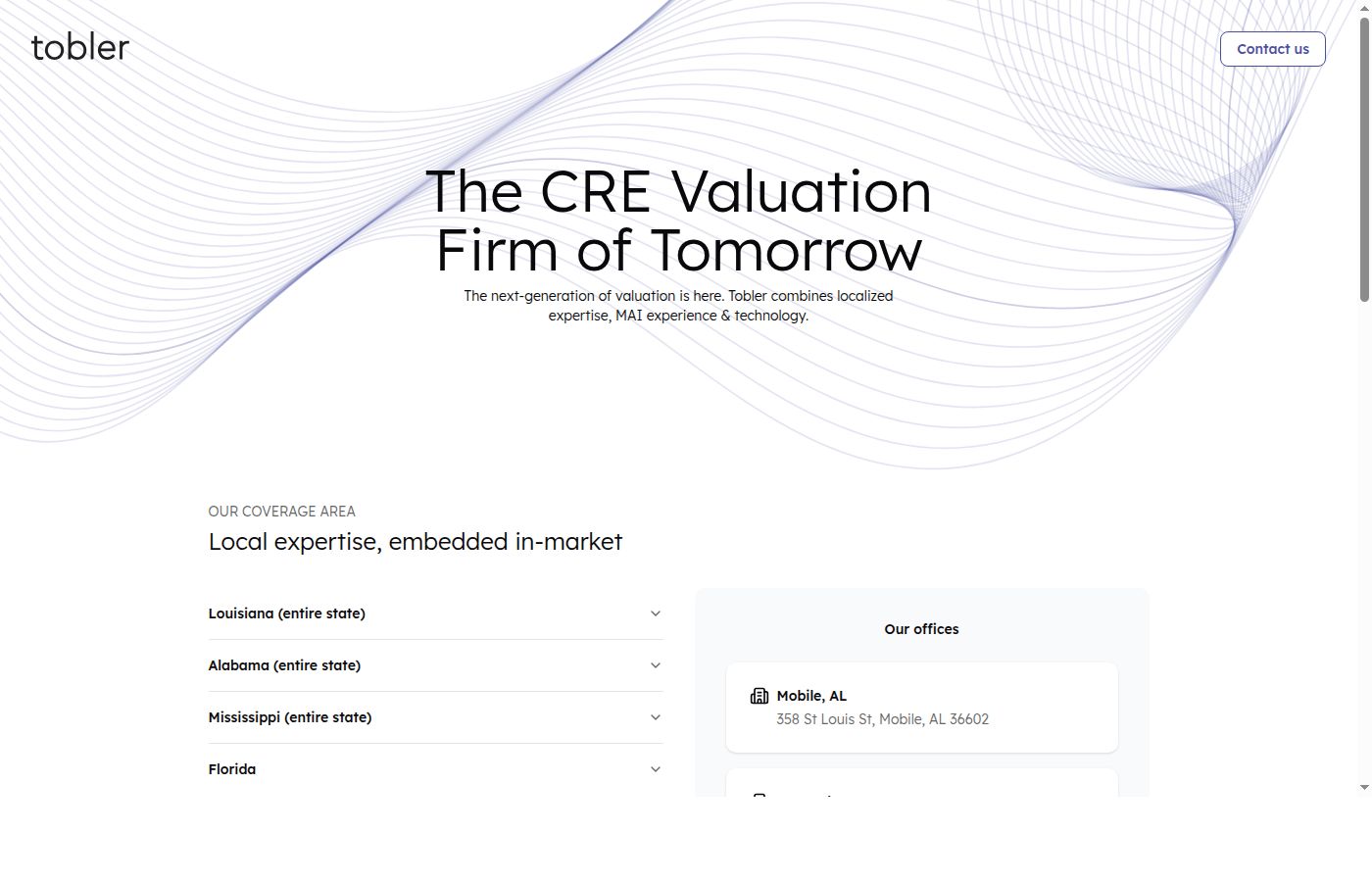
    Tobler Valuation is a commercial real estate appraisal firm headquartered in the Gulf Coast region, serving Louisiana, Alabama, Mississippi, and Florida with MAI-certified valuation products. Unlike SaaS platforms that provide automated valuation models, Tobler operates as a technology-augmented appraisal practice that embeds seasoned appraisers in each regional market and equips them with proprietary productivity tools and AI-enhanced data aggregation workflows. Every report is USPAP-compliant, digitally assembled, and signed by an MAI-designated professional. The firm’s service model targets lenders and investors who need institutional-quality appraisals delivered faster and at lower cost than traditional appraisal firms, without sacrificing the analytical rigor that MAI designation represents.

    BestCRE assigns Tobler Valuation a 9AI Score of 62/100, reflecting strong CRE relevance and output quality through MAI certification and USPAP compliance, balanced by its positioning as a regional service firm rather than a scalable technology product, limited geographic coverage, and the inherent constraints of a service-based model in a framework designed primarily for software platforms.

    This review is part of BestCRE’s systematic coverage of commercial real estate AI tools across 20 CRE sectors. For the full AI tools directory, see our Best CRE AI Tools hub.

    What Tobler Valuation Does and How It Works

    Tobler Valuation operates at the intersection of traditional MAI-certified appraisal practice and modern technology-enabled workflow optimization. The firm’s approach differs fundamentally from automated valuation model (AVM) platforms like HouseCanary or PriceHubble: rather than generating algorithmic property estimates, Tobler produces full narrative appraisal reports and evaluations that carry the legal weight and regulatory compliance required for commercial lending transactions. The technology layer accelerates the appraiser’s workflow rather than replacing the appraiser’s judgment.

    The firm’s proprietary productivity tools handle the most time-consuming components of appraisal production: data aggregation from multiple sources, comparable transaction identification and analysis, market condition documentation, and digital report assembly. AI-enhanced data aggregation automates the collection and organization of property records, transaction histories, market statistics, and regulatory information that traditionally requires manual research across multiple databases. This automation compresses the time between engagement and delivery, enabling Tobler to offer turnaround timelines that competitors using purely manual workflows cannot match without sacrificing quality.

    The regional embedding strategy is central to Tobler’s value proposition. By stationing MAI-certified appraisers in Louisiana, Alabama, Mississippi, and Florida, the firm combines hyperlocal market knowledge with centralized technology infrastructure. Each appraiser brings deep familiarity with regional transaction patterns, local economic drivers, and market-specific valuation considerations that national appraisal management companies often lack in secondary and tertiary markets. The firm handles a range of assignment types from concise evaluations for smaller loan transactions to comprehensive appraisals for complex commercial assets, including tax credit valuations for historic redevelopment and Low-Income Housing Tax Credit (LIHTC) projects. Notable assignments include a 3.5 million square foot former GM production plant in Shreveport repurposed for multi-tenant industrial use, a former bank headquarters in Mobile converted to mixed office, retail, and residential, and scattered maritime and industrial leasehold assets for Edison Chouest in Port Fourchon. The ideal client profile includes regional and community banks originating commercial real estate loans in Gulf Coast markets, institutional investors conducting due diligence on Southeast acquisition targets, developers seeking tax credit valuations for adaptive reuse projects, and lenders requiring FIRREA-compliant appraisals with accelerated turnaround in markets where appraiser availability is constrained.

    9AI Framework: Dimension-by-Dimension Analysis

    CRE Relevance: 9/10

    Tobler Valuation is 100 percent focused on commercial real estate appraisal, making it one of the most directly CRE-relevant entities in the 9AI review universe. Every product the firm delivers serves a specific CRE workflow: loan origination, acquisition due diligence, portfolio valuation, tax credit assessment, or disposition analysis. The MAI designation represents the highest professional credential in CRE appraisal, and the firm’s USPAP compliance ensures that outputs meet the regulatory standards required by federally regulated lending institutions. The relevance extends to complex, specialized asset types that generic technology platforms cannot address: industrial repurposing, maritime leaseholds, LIHTC projects, and mixed-use conversions in secondary markets. The single point deduction reflects that Tobler is a service firm rather than a technology product, which limits scalability and self-serve accessibility. In practice: lenders and investors in Gulf Coast markets receive appraisal products that are purpose-built for CRE lending and investment decisions, with MAI certification that carries legal and regulatory weight.

    Data Quality and Sources: 7/10

    Data quality reflects the combination of proprietary technology aggregation and professional appraiser judgment. Tobler’s AI-enhanced data workflows aggregate property records, transaction histories, and market statistics from multiple sources, but the specific data vendors and coverage depth are not publicly disclosed. The strength of the data quality lies in the human overlay: MAI-certified appraisers in each market verify, contextualize, and interpret data through the lens of local market expertise that automated systems cannot replicate. Comparable selection, condition adjustments, and market condition analysis all benefit from the appraiser’s firsthand knowledge of properties and transactions in their coverage area. The limitation is transparency: prospective clients cannot evaluate the data infrastructure independently because the firm does not publish its technology stack, data sources, or methodology documentation in the way that SaaS platforms typically do. In practice: the data quality is validated by the MAI credential and USPAP compliance requirements, which impose professional standards on data sourcing and verification that exceed what most technology platforms offer.

    Ease of Adoption: 6/10

    Adopting Tobler Valuation means engaging a professional services firm, not subscribing to a software platform. The onboarding process involves initial engagement discussions, scope definition for each assignment, and the establishment of ongoing client relationships for repeat business. This is fundamentally different from the self-serve onboarding that SaaS platforms offer, where users can create accounts and begin generating outputs within hours. For lenders who already have established appraisal vendor relationships and procurement processes, adding Tobler to their approved vendor panel is a familiar workflow. For firms seeking on-demand, self-serve access to valuation outputs, the service model introduces higher friction than automated platforms. The geographic limitation to four Gulf Coast states means that firms with national or multi-regional coverage requirements will need to maintain separate appraisal vendor relationships outside Tobler’s coverage area. In practice: adoption is straightforward for lenders and investors who need traditional appraisal services in Gulf Coast markets, but the service-based engagement model is less convenient than the instant access that technology platforms provide.

    Output Accuracy: 8/10

    Output accuracy benefits from the combination of MAI certification, USPAP compliance, and regional market expertise. MAI-designated appraisers have demonstrated competency through the Appraisal Institute’s rigorous education, examination, and experience requirements, providing a quality assurance layer that automated valuation models cannot match for complex commercial properties. Every report undergoes quality review before delivery, ensuring that valuation conclusions are well-supported, methodology is sound, and regulatory requirements are met. The firm’s experience with complex asset types, including industrial repurposing, tax credit valuations, and maritime leaseholds, demonstrates capability with assignments that require nuanced judgment beyond algorithmic analysis. The primary accuracy risk in any appraisal practice is the potential for individual appraiser bias or incomplete comparable data in thin markets, though MAI oversight and firm-level quality control processes mitigate these risks. In practice: outputs carry the regulatory credibility and professional accountability that lenders require for loan origination decisions, with accuracy standards that exceed what automated platforms can deliver for complex commercial assets.

    Integration and Workflow Fit: 4/10

    Integration capabilities are limited by the service-based business model. Tobler delivers digital reports (PDF format) through direct client communication channels rather than through API endpoints, webhook integrations, or automated data feeds. There is no documented connectivity to loan origination systems, appraisal management platforms, portfolio management databases, or CRE analytics tools. The firm does not appear to offer white-label or embedded solutions that would allow lender platforms to integrate Tobler’s appraisal capabilities directly into their digital workflows. Clients receive completed reports through traditional delivery methods and must manually incorporate valuation conclusions into their underwriting, credit, and portfolio systems. For lenders using appraisal management companies (AMCs) as intermediaries, Tobler’s position as an independent appraisal firm may require coordination outside the AMC’s standard vendor management platform. In practice: Tobler operates as a standalone professional service with manual report delivery, requiring clients to handle integration with their own systems through traditional document management processes.

    Pricing Transparency: 4/10

    Pricing transparency is limited, consistent with the custom engagement model used by most CRE appraisal firms. Tobler does not publish fee schedules, per-assignment pricing ranges, or standardized rate cards on its website. Appraisal fees in the CRE industry vary significantly based on assignment complexity, asset type, property size, geographic location, and regulatory requirements, making standardized pricing difficult. However, the absence of any pricing guidance forces prospective clients to engage in conversations before understanding whether Tobler’s services fit within their cost parameters. The firm’s value proposition includes reduced costs relative to traditional appraisal firms through technology-enabled workflow efficiencies, but without published benchmarks, this claim is difficult to validate independently. For context, CRE appraisal fees in Gulf Coast secondary markets typically range from $2,500 for straightforward single-asset assignments to $15,000 or more for complex portfolio or specialty valuations. In practice: clients should request detailed fee proposals that break down per-assignment costs, turnaround commitments, and any volume pricing structures available for ongoing engagement.

    Support and Reliability: 6/10

    Support operates through direct professional relationships between Tobler’s appraisers and their clients, which is typical of boutique CRE appraisal practices. The firm’s regional embedding model means that clients work with specific, named MAI-designated professionals who develop familiarity with the client’s portfolio, lending standards, and reporting preferences over time. This relationship-driven model can deliver higher-quality support than call centers or ticket systems because the appraiser providing support is the same person who produced the report. However, the small firm scale introduces capacity risk: if a primary appraiser is unavailable, backup coverage may be limited. There are no published service level agreements, guaranteed turnaround times, or formal escalation procedures. Reliability is implicitly validated by the firm’s ongoing client relationships and repeat business, but prospective clients cannot evaluate these metrics externally. In practice: clients receive personalized, expert-level support from credentialed professionals, with the tradeoff being limited formal support infrastructure and potential capacity constraints during peak demand periods.

    Innovation and Roadmap: 7/10

    Tobler’s innovation lies in applying AI and technology to a traditionally manual profession rather than building a software product from scratch. The firm’s AI-enhanced data aggregation and digital report assembly represent meaningful workflow innovation within the CRE appraisal industry, where many practitioners still rely on manual data collection, Word document templates, and PDF assembly processes that have changed little in decades. The proprietary productivity tools compress the time between engagement and delivery, creating competitive advantage in markets where turnaround speed directly impacts lender deal flow. However, the innovation is applied internally rather than productized for external users, limiting its scalability and broader market impact. The firm does not appear to offer its technology tools as a standalone product or license them to other appraisal practices. The innovation score reflects genuine advancement within the appraisal practice model, while acknowledging that service-firm innovation operates on a different scale than SaaS product innovation. In practice: Tobler demonstrates how AI can enhance rather than replace traditional appraisal practice, producing faster turnaround and lower costs while maintaining MAI-quality analytical rigor.

    Market Reputation: 5/10

    Market reputation is concentrated within the Gulf Coast CRE lending and investment community. Tobler’s client relationships with regional banks, institutional investors, and developers in Louisiana, Alabama, Mississippi, and Florida provide local credibility. The MAI designation itself carries significant weight within the appraisal profession and among lending institutions that require designated appraisers for their most important assignments. Notable project experience, including large industrial repurposing, port portfolio valuations, and LIHTC projects, demonstrates capability with complex assignment types. However, Tobler lacks the national brand recognition, published client lists, industry awards, venture funding, or media coverage that would signal broader market validation. The firm does not appear to have a significant presence at national CRE conferences or in industry publications outside its regional market. For lenders and investors operating within Tobler’s four-state coverage area, the local reputation and MAI credential provide adequate credibility. In practice: reputation is strong regionally and within the MAI-designated appraiser community, but limited visibility outside the Gulf Coast reduces the firm’s recognizability in national CRE technology evaluations.

    9AI Score Card Tobler Valuation
    62
    62 / 100
    Emerging Tool
    MAI-Certified CRE Appraisal with AI Workflows
    Tobler Valuation
    Gulf Coast CRE appraisal firm combining MAI credentials with AI-enhanced data aggregation. Strong output quality and CRE relevance, limited by regional scope and service-based model.
    9 Dimensions, Scored 1 to 10
    1. CRE Relevance
    9/10
    2. Data Quality & Sources
    7/10
    3. Ease of Adoption
    6/10
    4. Output Accuracy
    8/10
    5. Integration & Workflow Fit
    4/10
    6. Pricing Transparency
    4/10
    7. Support & Reliability
    6/10
    8. Innovation & Roadmap
    7/10
    9. Market Reputation
    5/10
    BestCRE.com, 9AI Framework v2 Reviewed March 2026

    Who Should Use Tobler Valuation

    Tobler Valuation serves regional and community banks originating commercial real estate loans in Louisiana, Alabama, Mississippi, and Florida who need MAI-certified appraisals with faster turnaround than traditional appraisal firms can deliver. Institutional investors conducting due diligence on acquisition targets in Gulf Coast markets benefit from the firm’s hyperlocal expertise and complex asset experience. Developers pursuing tax credit projects (historic redevelopment, LIHTC) need specialized valuation capabilities that generic appraisal firms and automated platforms cannot provide. Lenders facing appraiser shortages in secondary and tertiary Gulf Coast markets gain access to credentialed professionals who combine regulatory compliance with technology-enhanced delivery speed.

    Who Should Not Use Tobler Valuation

    Tobler is not appropriate for firms needing self-serve, on-demand automated property valuations or subscription-based analytics platforms. Organizations requiring national coverage or multi-regional appraisal vendor relationships will need to supplement Tobler with additional providers outside its four-state footprint. Firms seeking API-driven valuation data feeds for portfolio analytics or loan origination platforms will not find the integration capabilities they need. Residential-focused operations or firms needing high-volume automated valuations should evaluate AVM platforms like HouseCanary or PriceHubble instead. Organizations that prioritize published pricing and standardized procurement processes may find the custom engagement model a barrier.

    Pricing and ROI Analysis

    Tobler does not publish pricing. CRE appraisal fees in the Gulf Coast region typically range from $2,500 for straightforward single-asset assignments to $15,000 or more for complex portfolio, specialty, or tax credit valuations. The firm’s value proposition centers on delivering comparable quality at lower cost and faster turnaround than traditional appraisal practices through technology-enabled workflow efficiencies. ROI for lenders materializes through reduced loan processing timelines, which accelerate revenue recognition on origination fees and improve borrower experience. For investors, the value lies in receiving reliable, defensible valuations that support underwriting decisions and satisfy regulatory requirements without the multi-week delays that constrain deal flow in markets with limited appraiser availability.

    Integration and CRE Tech Stack Fit

    Tobler operates as a standalone professional services firm with traditional report delivery (digital PDF). The firm does not offer API access, automated data feeds, or pre-built integrations with loan origination systems, appraisal management platforms, or portfolio analytics tools. Clients incorporate Tobler’s appraisal products into their workflows through standard document management processes. For lenders using appraisal management companies, coordination may be required outside the AMC’s standard vendor platform. The firm’s digital report assembly represents internal workflow innovation but does not extend to external system connectivity. Organizations that need appraisal data flowing automatically into underwriting models or portfolio databases will need to handle extraction and integration manually.

    Competitive Landscape

    Tobler competes with other regional CRE appraisal firms across the Gulf Coast, national appraisal management companies like SitusAMC and Apprise by Walker & Dunlop, and the valuation advisory divisions of CBRE, JLL, and Cushman & Wakefield. Against national AMCs, Tobler differentiates through hyperlocal market expertise and direct appraiser relationships rather than the intermediated model that AMCs typically employ. Against Big Four advisory firms, Tobler offers faster turnaround and potentially lower costs for assignments in its coverage markets, though it lacks the national coverage and institutional brand recognition those firms carry. The firm’s technology-augmented approach positions it between traditional boutique practices (manual workflows, longer timelines) and fully automated platforms (no human judgment, limited to simple asset types), occupying a middle ground that preserves MAI-quality analysis while capturing some of the speed advantages that technology enables.

    The Bottom Line

    Tobler Valuation represents an important model for how AI and technology can enhance rather than replace traditional CRE appraisal practice. The 9AI Score of 62/100 reflects the honest tension between strong CRE relevance and output quality within its coverage area and the practical limitations of a regional service firm in a framework designed primarily for scalable technology products. For lenders and investors operating in Gulf Coast markets who need MAI-certified appraisals delivered faster and at lower cost than traditional alternatives, Tobler merits inclusion in the vendor evaluation process. The firm demonstrates that the most impactful AI applications in CRE valuation may not replace appraisers but rather make credentialed professionals more productive, addressing the industry’s structural appraiser shortage through workflow innovation rather than algorithmic substitution.

    About BestCRE

    BestCRE.com is the definitive authority on commercial real estate AI, analysis, and investment intelligence. Our 9AI Framework provides institutional-quality, independent assessments of every significant AI tool serving the CRE industry. For coverage across all 20 CRE sectors, visit the BestCRE Sector Hub.

    Frequently Asked Questions

    What is Tobler Valuation and how does it serve commercial real estate?

    Tobler Valuation is an MAI-certified commercial real estate appraisal firm serving Louisiana, Alabama, Mississippi, and Florida. The firm combines seasoned, regionally embedded appraisers with proprietary AI-enhanced productivity tools and data aggregation workflows to deliver USPAP-compliant valuation products faster and at lower cost than traditional appraisal practices. Services include comprehensive appraisals, concise evaluations, tax credit valuations for historic redevelopment and LIHTC projects, and specialty assignments for complex commercial assets. The firm targets lenders, institutional investors, and developers who need regulatory-grade appraisals in Gulf Coast secondary and tertiary markets where appraiser availability is often constrained.

    How does Tobler Valuation use AI in its appraisal process?

    Tobler applies AI primarily through enhanced data aggregation and workflow automation rather than through automated valuation models (AVMs). The firm’s proprietary tools automate the collection and organization of property records, comparable transaction data, market statistics, and regulatory information from multiple sources, compressing the research phase that traditionally consumes the majority of an appraiser’s time on each assignment. Digital report assembly tools streamline the production of final deliverables. The AI layer accelerates the appraiser’s workflow without replacing the appraiser’s judgment, maintaining the analytical rigor and professional accountability that MAI certification requires. This approach contrasts with AVM platforms that generate algorithmic estimates without human review.

    What types of CRE assets does Tobler Valuation appraise?

    Tobler handles a range of commercial real estate asset types across the Gulf Coast region. Notable assignments include a 3.5 million square foot former GM production plant repurposed for multi-tenant industrial use in Shreveport, a former bank headquarters converted to mixed office, retail, and residential in Mobile, scattered maritime and industrial leasehold assets for Edison Chouest in Port Fourchon, and container terminal and logistics park valuations for the Mobile Port Authority. The firm also specializes in tax credit valuations including historic redevelopment and Low-Income Housing Tax Credit (LIHTC) projects, which require specialized expertise in navigating tax credit structures alongside traditional valuation methodology.

    How does Tobler Valuation compare to automated valuation platforms?

    Tobler and automated valuation model (AVM) platforms like HouseCanary or PriceHubble serve fundamentally different needs. AVMs generate algorithmic property estimates in seconds at low per-query cost, suitable for screening, portfolio monitoring, and residential lending where regulatory requirements permit automated approaches. Tobler produces full narrative appraisal reports signed by MAI-designated professionals, carrying the legal weight and regulatory compliance required for commercial lending transactions under FIRREA guidelines. The tradeoff is speed and cost versus depth and defensibility: an AVM can estimate 10,000 properties in minutes, while Tobler delivers one comprehensive appraisal in days, but that appraisal meets the evidentiary standard that bank examiners, courts, and regulators require.

    Where is the CRE appraisal industry headed with AI adoption?

    The CRE appraisal industry faces a structural workforce shortage, with more than 10,000 appraisers leaving the profession over the past nine years and approximately half of remaining practitioners approaching retirement. AI adoption is accelerating in response, with the Appraisal Institute’s leadership acknowledging that technology restrictions will “inevitably have to drop” as AI becomes omnipresent. The most likely trajectory is hybrid models like Tobler’s approach, where AI handles data aggregation, comparable analysis, and report production while credentialed appraisers provide the judgment, market knowledge, and professional accountability that regulatory frameworks require. Retrieval-augmented generation and advanced data synthesis tools are already compressing lease abstraction from 45 minutes to under five minutes per document, signaling broader workflow transformation ahead.

    Related Reviews

    Explore more CRE AI tool reviews in the Best CRE AI Tools directory, or browse analysis across all 20 CRE sectors.

  • Placepoint Review: Norwegian Spatial Intelligence for Real Estate Development

    Placepoint Review: Norwegian Spatial Intelligence for Real Estate Development

    Placepoint CRE AI spatial analysis platform

    Real estate development due diligence remains one of the most data-intensive phases of the investment lifecycle. CBRE’s 2025 market outlook projects commercial real estate investment activity reaching $437 billion globally, yet site analysis workflows in many European markets still depend on fragmented public data sources, manual GIS assembly, and disconnected municipal databases that extend pre-development timelines by weeks or months. JLL’s European research estimates that developers spend 15 to 25 percent of pre-acquisition costs on environmental, zoning, and site feasibility studies that could be compressed through integrated spatial analytics. In Nordic markets specifically, the combination of strict environmental regulations, complex municipal planning processes, and detailed cadastral record systems creates an environment where technology that unifies spatial data into a single analysis layer delivers measurable competitive advantage for development firms evaluating land parcels and project feasibility.

    Placepoint is a Norwegian proptech company based in Sandefjord that provides next-generation spatial analysis software for real estate professionals. The platform combines cadastral information, company registry data, municipal case records, environmental overlays (soil conditions, noise levels, daylight measurements), demographic statistics, price analytics, and 3D mapping of the entire Norwegian landscape into a unified analysis environment. Placepoint’s Property Relationship Management (PRM) system adds collaborative project management capabilities, enabling development teams to build shared data environments around specific parcels and projects. The company has demonstrated AI capabilities through a text-to-3D building generation tool developed at an Autodesk Forma hackathon, signaling an innovation trajectory that extends beyond traditional GIS analysis into generative design.

    BestCRE assigns Placepoint a 9AI Score of 62/100, reflecting genuine innovation in spatial intelligence and strong CRE relevance for Norwegian development workflows, balanced by geographic limitations to a single country, absence of published pricing, limited market visibility outside Scandinavia, and minimal integration with international CRE software platforms.

    This review is part of BestCRE’s systematic coverage of commercial real estate AI tools across 20 CRE sectors. For the full AI tools directory, see our Best CRE AI Tools hub.

    What Placepoint Does and How It Works

    Placepoint operates as a comprehensive spatial intelligence platform that aggregates Norway’s public real estate data infrastructure into a single analysis interface designed for development feasibility, site selection, and investment screening. The platform ingests cadastral records from the Norwegian Mapping Authority, ownership and corporate structure data from the Bronnoysund Register Centre, municipal planning documents and case histories, environmental datasets covering soil composition, flood risk zones, noise contours, and agricultural land classifications, along with demographic and socioeconomic statistics at the district level. Users access this data through an interactive map interface that supports layered analysis, enabling a developer to evaluate a specific parcel against dozens of relevant data dimensions simultaneously.

    The 3D mapping capability covers all of Norway, allowing users to visualize existing building stock, terrain elevation, and surrounding context in three dimensions. Daylight analysis tools calculate solar exposure for proposed developments, which is particularly relevant in Norwegian markets where sunlight hours vary dramatically by season and latitude. Travel time analysis measures accessibility across multiple transportation modes, helping developers and investors assess connectivity to employment centers, schools, and commercial amenities. The municipal case insight system tracks planning applications, zoning decisions, and regulatory activity at the parcel level, providing early intelligence on regulatory trajectories that affect development potential.

    The Property Relationship Management (PRM) module extends Placepoint beyond pure analytics into collaborative project management. Development teams can create shared workspaces around specific land parcels, aggregating research, regulatory documents, financial models, and stakeholder communications in a single environment. This collaborative layer addresses the reality that Norwegian development projects typically involve multiple municipal approvals, environmental assessments, and stakeholder consultations that generate substantial documentation. The text-to-3D building generation capability, demonstrated at the Autodesk Forma hackathon, represents Placepoint’s most forward-looking feature: users describe building parameters in natural language and the AI generates corresponding 3D models within the Forma extension ecosystem. While still emerging, this capability signals a product direction that could transform early-stage feasibility visualization from a specialized architectural task into an accessible development screening step. The ideal practitioner profile includes Norwegian property developers evaluating land acquisition opportunities, municipal planning consultants conducting site feasibility studies, real estate investors assessing Norwegian portfolio exposure, and architectural firms performing preliminary site analysis before committing to full design engagement.

    9AI Framework: Dimension-by-Dimension Analysis

    CRE Relevance: 8/10

    Placepoint is purpose-built for real estate development analysis, addressing the specific workflow of evaluating land parcels and development feasibility in the Norwegian market. The platform combines cadastral data, zoning intelligence, environmental overlays, and 3D visualization in a way that directly mirrors how development teams conduct site analysis. Every feature maps to a concrete step in the pre-acquisition or pre-development process: ownership verification, environmental constraint identification, daylight assessment, accessibility evaluation, and regulatory history review. The platform’s PRM system extends relevance into project coordination, addressing the collaborative nature of development workflows. The CRE relevance score is held back slightly by the exclusively Norwegian geographic scope, which limits applicability for international investors or firms operating across multiple markets. In practice: Norwegian development teams can replace fragmented manual workflows with a unified spatial analysis environment that compresses site evaluation from days to hours.

    Data Quality and Sources: 8/10

    Placepoint’s data quality benefits from Norway’s exceptionally well-maintained public data infrastructure. Norwegian cadastral records, maintained by the Kartverket (Norwegian Mapping Authority), are among the most complete and accurate in Europe. The platform aggregates data from authoritative government sources including the Bronnoysund Register Centre for corporate ownership, municipal planning databases for regulatory activity, and environmental agencies for soil, noise, and flood risk data. The 3D mapping layer covers the entire country, providing consistent spatial context that developers can rely on for preliminary feasibility work. Price statistics and demographic data are sourced from official Norwegian statistical agencies. The primary data quality limitation is that all sources are Norwegian, meaning the platform cannot serve cross-border analysis or provide comparative international benchmarks. In practice: the data foundation reflects the high quality of Norwegian public records, making Placepoint outputs reliable for site selection and feasibility screening within the country’s borders.

    Ease of Adoption: 6/10

    Placepoint’s adoption path is straightforward for Norwegian real estate professionals familiar with the country’s planning and regulatory landscape. The map-based interface is intuitive for users comfortable with GIS-style tools, and the layered analysis approach allows new users to start with basic property lookups before exploring advanced features like 3D modeling and daylight analysis. However, the platform appears to be primarily Norwegian-language, which creates an immediate barrier for international users or firms with non-Norwegian team members. The depth of Norwegian-specific data and regulatory context, while a strength for local users, means the learning curve is steeper for professionals who lack familiarity with Norwegian municipal planning processes and land registration systems. Documentation and onboarding resources are limited compared to larger international platforms. In practice: Norwegian development professionals can adopt Placepoint quickly given existing familiarity with the country’s data infrastructure, while international users will find the platform inaccessible without Norwegian market expertise.

    Output Accuracy: 7/10

    Output accuracy is strong for Placepoint’s core spatial analysis capabilities, grounded in authoritative Norwegian government data sources. Cadastral boundaries, ownership records, and municipal planning data reflect official registrations that are legally definitive in Norwegian real estate transactions. The 3D mapping layer provides accurate terrain and building visualization based on national survey data. Daylight analysis calculations apply established solar geometry models to the specific latitude and terrain context of each site, producing results that inform architectural planning decisions. Environmental overlay accuracy depends on the currency and resolution of underlying government datasets, which are generally well-maintained in Norway. The text-to-3D AI generation capability is newer and less proven, with accuracy likely varying based on prompt specificity and building complexity. In practice: spatial analysis outputs are reliable for development screening and preliminary feasibility work, though users should validate critical regulatory and environmental findings against primary municipal sources before committing capital.

    Integration and Workflow Fit: 5/10

    Integration capabilities are limited compared to larger international platforms. Placepoint does not publicly market API access, connectors to property management systems like Yardi or MRI, or integrations with financial modeling tools like Argus Enterprise. The Autodesk Forma hackathon collaboration suggests technical capability and willingness to integrate with architectural design platforms, but this appears to be an emerging capability rather than a production integration. The PRM system provides internal collaboration features but does not appear to connect with external CRM, project management, or document management platforms. Data export capabilities are not prominently documented. For firms that need to move Placepoint analysis results into underwriting models, investor reporting systems, or portfolio management databases, manual data transfer is the likely workflow. In practice: Placepoint functions as a standalone spatial analysis environment with limited connectivity to the broader CRE technology stack, suitable for firms that can accept manual handoffs between analysis and execution systems.

    Pricing Transparency: 4/10

    Placepoint does not publish pricing information on its website. There is no visible pricing page, no published tier structure, and no self-serve trial or freemium access path. The only route to understanding costs is through direct contact with the company. This is common among Nordic proptech startups targeting a relatively small professional market, where personalized sales conversations are the norm. However, the absence of any pricing guidance creates friction for firms evaluating multiple tools and attempting to build technology budgets. Without published benchmarks, prospective users cannot determine whether Placepoint fits within their technology spending parameters before investing time in a sales conversation. In practice: organizations interested in Placepoint should expect to engage directly with the company’s sales team and should request clear pricing structures, including any per-user, per-project, or data access fees, before committing to evaluation.

    Support and Reliability: 5/10

    Support infrastructure details are limited in publicly available information. Placepoint appears to be a small team based in Sandefjord, Norway, which implies hands-on founder-led support but limited capacity for enterprise-scale support operations. The company participates in Norwegian real estate industry events and maintains an active LinkedIn presence, suggesting engagement with its user community. However, formal support documentation, knowledge bases, training programs, and published service level agreements are not prominently visible. For a tool serving a specialized Norwegian market, the small team size may be appropriate given the user base, but it represents a risk for firms that require guaranteed response times and structured support escalation paths. In practice: users should expect responsive but informal support from a small team, with the advantages of direct access to product developers and the limitations of a startup-scale support operation.

    Innovation and Roadmap: 8/10

    Innovation is Placepoint’s standout dimension. The text-to-3D building generation capability demonstrated at the Autodesk Forma hackathon represents a genuinely forward-looking application of large language models to architectural visualization. The team built a working implementation that generates 3D building models from text prompts and integrates them seamlessly into Autodesk Forma’s extension ecosystem, all developed from scratch in two days. This signals strong technical capability and a product direction that could transform early-stage development feasibility from static analysis into interactive generative design. The combination of comprehensive spatial data with AI-driven 3D generation creates a unique value proposition that larger platforms have not yet matched at the site-specific level. The 3D mapping of all of Norway, combined with daylight analysis and environmental overlays, already represents a more sophisticated spatial intelligence offering than many international competitors provide for any single market. In practice: Placepoint demonstrates innovation velocity that exceeds its current market scale, with AI capabilities that could position it as a category leader in spatial development intelligence if successfully productized beyond the hackathon stage.

    Market Reputation: 5/10

    Placepoint’s market reputation is concentrated within the Norwegian real estate development community. The company has relationships with Norwegian developers such as Nordbohus and participates in industry events like Eiendomsutviklingsdagene (Real Estate Development Days) organized by Estate Media. LinkedIn activity shows engagement with Norwegian real estate professionals and positive reception from early adopters. However, Placepoint lacks the international visibility, published client counts, venture funding announcements, or industry analyst coverage that would signal broader market validation. The company does not appear to have raised significant institutional venture capital or achieved the scale of recognition needed to establish reputation beyond Scandinavia. For Norwegian firms, the local industry presence and event participation provide adequate credibility signals. For international investors evaluating Norwegian real estate technology, Placepoint’s limited global visibility may require additional due diligence. In practice: Placepoint is recognized within its home market as an innovative spatial analysis tool, but has not yet achieved the scale or visibility to carry reputation weight in international CRE technology evaluations.

    9AI Score Card Placepoint
    62
    62 / 100
    Emerging Tool
    Spatial Intelligence for CRE Development
    Placepoint
    Norwegian spatial analysis platform combining 3D mapping, cadastral data, and AI-driven building generation for real estate development. Strong innovation, limited by single-country scope and early-stage market presence.
    9 Dimensions, Scored 1 to 10
    1. CRE Relevance
    8/10
    2. Data Quality & Sources
    8/10
    3. Ease of Adoption
    6/10
    4. Output Accuracy
    7/10
    5. Integration & Workflow Fit
    5/10
    6. Pricing Transparency
    4/10
    7. Support & Reliability
    5/10
    8. Innovation & Roadmap
    8/10
    9. Market Reputation
    5/10
    BestCRE.com, 9AI Framework v2 Reviewed March 2026

    Who Should Use Placepoint

    Placepoint is best suited for Norwegian property developers evaluating land acquisition opportunities and conducting pre-development feasibility analysis. Municipal planning consultants who need rapid access to layered spatial data, regulatory history, and environmental constraints for Norwegian parcels will find the platform directly aligned with their workflows. Real estate investors with significant Norwegian portfolio exposure benefit from the demographic, pricing, and market forecast capabilities that enable comparative analysis across counties and municipalities. Architectural firms performing preliminary site analysis in Norway can leverage the 3D mapping and daylight analysis tools to assess development potential before committing to full design engagement. The PRM module serves development teams that manage multi-stakeholder projects requiring centralized documentation and collaborative decision-making around specific land parcels.

    Who Should Not Use Placepoint

    Placepoint is not appropriate for any firm operating outside the Norwegian real estate market, as all data sources, regulatory frameworks, and spatial intelligence are country-specific. International investors seeking cross-border analysis tools, firms focused on U.S. or broader European markets, and organizations requiring multi-country coverage should evaluate global platforms instead. Firms needing deep integration with standard CRE software (Yardi, MRI, Argus, CoStar) will find no established connectivity. Organizations requiring published pricing for budget planning or procurement processes may find the sales-driven engagement model a barrier. Teams without Norwegian language capability or familiarity with Norwegian planning regulations will face significant adoption friction.

    Pricing and ROI Analysis

    Placepoint does not publish pricing information. The ROI case for Norwegian development firms centers on time compression in the pre-acquisition phase. Traditional site analysis in Norway requires assembling data from multiple government databases, environmental agencies, and municipal planning departments, a process that can consume several days per parcel. Placepoint consolidates these sources into a single query, potentially compressing site evaluation from days to hours and enabling development teams to screen more opportunities within the same time frame. For firms evaluating ten or more parcels annually, the labor savings from eliminating manual data assembly could justify subscription costs, though without published pricing, this calculation requires direct engagement with the Placepoint team.

    Integration and CRE Tech Stack Fit

    Placepoint functions primarily as a standalone spatial analysis platform with limited published connectivity to external systems. The Autodesk Forma hackathon collaboration demonstrates technical capability for integration with architectural design tools, but this appears to be an emerging rather than production-ready capability. The PRM module provides internal collaboration features but does not appear to connect with external CRM, project management, or financial modeling platforms. For Norwegian development firms that maintain separate systems for financial modeling, investor reporting, and project management, Placepoint operates as a specialized analysis layer with manual data transfer to downstream systems. Firms should evaluate whether the depth of spatial intelligence justifies operating an additional standalone tool alongside their existing technology stack.

    Competitive Landscape

    Within the Norwegian market, Placepoint competes with general GIS tools (QGIS, ArcGIS), municipal planning databases accessed directly, and emerging spatial intelligence platforms like Aino. Internationally, platforms such as Esri’s ArcGIS for Real Estate and PriceHubble (which does not cover Norway) address similar spatial analysis needs across broader geographies. Placepoint differentiates through its depth of Norwegian-specific data integration, combining cadastral records, municipal case histories, environmental overlays, and 3D national mapping in a way that generic GIS tools cannot match without extensive custom configuration. The text-to-3D AI capability is a genuine differentiator that neither local nor international competitors currently offer at the site-specific development analysis level. The competitive risk is that larger platforms with more resources could build comparable Norwegian data integrations, potentially compressing Placepoint’s differentiation window.

    The Bottom Line

    Placepoint is a specialized spatial intelligence tool that delivers genuine value for Norwegian real estate development workflows. The platform’s depth of local data integration, 3D national mapping, and emerging AI capabilities exceed what generic GIS tools or manual data assembly can provide. The 9AI Score of 62/100 reflects the tension between strong innovation and CRE relevance within its market and the practical limitations of single-country scope, opaque pricing, limited integrations, and early-stage market presence. For Norwegian developers and investors, Placepoint merits evaluation as a purpose-built analysis layer that compresses pre-development due diligence. For international firms, the platform’s value is limited to Norwegian market exposure and serves as an example of the localized spatial intelligence tools emerging across European markets.

    About BestCRE

    BestCRE.com is the definitive authority on commercial real estate AI, analysis, and investment intelligence. Our 9AI Framework provides institutional-quality, independent assessments of every significant AI tool serving the CRE industry. For coverage across all 20 CRE sectors, visit the BestCRE Sector Hub.

    Frequently Asked Questions

    What is Placepoint and how does it serve commercial real estate?

    Placepoint is a Norwegian proptech platform that provides spatial analysis software for real estate development professionals. Based in Sandefjord, Norway, the platform aggregates cadastral records, company registry data, municipal planning histories, environmental overlays, demographic statistics, and 3D mapping of the entire Norwegian landscape into a unified analysis environment. For CRE professionals, Placepoint addresses the pre-development feasibility phase by enabling rapid site evaluation against dozens of data dimensions simultaneously, replacing the traditional process of assembling information from multiple disconnected government databases. The platform also includes a Property Relationship Management (PRM) system for collaborative project management around specific parcels.

    How does Placepoint compare to standard GIS tools like ArcGIS?

    Placepoint differentiates from general GIS platforms through its pre-built integration of Norwegian-specific data sources. ArcGIS provides a powerful analytical framework but requires users to source, configure, and maintain data connections independently, which can take weeks of setup for a comprehensive Norwegian site analysis workflow. Placepoint delivers this integration out of the box, with cadastral records, municipal case histories, environmental overlays, and demographic data already connected and queryable through a single interface. Additionally, Placepoint’s 3D mapping of all of Norway and its emerging text-to-3D AI building generation represent capabilities that ArcGIS does not offer natively. The tradeoff is flexibility: ArcGIS supports global analysis across any geography, while Placepoint is limited to Norway.

    What types of CRE firms benefit most from Placepoint?

    Norwegian property development companies evaluating multiple land acquisition opportunities annually derive the most value from Placepoint. Firms that regularly conduct pre-development feasibility studies, requiring assessment of zoning constraints, environmental conditions, daylight exposure, and accessibility metrics, can compress evaluation timelines from days to hours per parcel. Municipal planning consultants who advise on development potential and regulatory feasibility benefit from the platform’s integrated municipal case insight system. Real estate investors with concentrated Norwegian portfolio exposure use the demographic and market forecast tools for portfolio-level analysis. The platform’s PRM module specifically serves development teams managing complex multi-stakeholder approval processes typical of Norwegian municipal planning.

    Is Placepoint available outside Norway?

    Placepoint is currently available only for the Norwegian market. All data sources, regulatory frameworks, and spatial intelligence layers are specific to Norway’s public data infrastructure, including Kartverket (Norwegian Mapping Authority) cadastral records, Bronnoysund Register Centre corporate data, and Norwegian municipal planning databases. The platform’s 3D mapping covers all of Norway but does not extend to other countries. For firms seeking similar spatial intelligence capabilities in other European markets, platforms like PriceHubble (11 European countries) or Esri’s ArcGIS (global coverage with local data packages) provide broader geographic scope, though with less depth of Norwegian-specific integration than Placepoint offers within its home market.

    Where is Placepoint headed in 2026 and beyond?

    Placepoint’s most significant development trajectory is the integration of AI-driven 3D building generation into its spatial analysis platform. The text-to-3D capability demonstrated at the Autodesk Forma hackathon, where the team built a working implementation that generates 3D buildings from natural language prompts in just two days, signals a product direction that could transform early-stage feasibility visualization. If successfully productized, this capability would enable developers to generate preliminary massing studies and building visualizations directly from site analysis data without engaging architectural teams for initial screening. The company’s participation in Norwegian real estate industry events and growing user adoption among Norwegian developers suggest continued focus on deepening the platform’s value within its home market rather than immediate geographic expansion.

    Related Reviews

    Explore more CRE AI tool reviews in the Best CRE AI Tools directory, or browse analysis across all 20 CRE sectors.

  • AI in Smart Buildings and Infrastructure: Why the $359B Market Will Be Won in Operations

    AI in Smart Buildings and Infrastructure: Why the $359B Market Will Be Won in Operations

    Executive Summary

    AI in smart buildings is no longer a pilot project. It is becoming core infrastructure for energy optimization, predictive maintenance, and tenant experience. Market researchers project this segment to reach roughly $359 billion by 2034, up from about $41.4 billion in 2024, a steep compound growth curve.

    What matters for commercial real estate is not the headline number alone. The real value is operational. AI is shifting buildings from reactive maintenance and static schedules to continuous, data driven control. That change has direct implications for NOI, asset values, and capital planning.

    This report synthesizes the latest market projections with practical CRE use cases, hard ROI math, and implementation pitfalls. It is written for owners, operators, and investors who need to know what is real, what is hype, and where to place capital over the next ten years. For context on AI’s impact across every major property sector, explore the BestCRE 20 Sectors hub, or review the full database of CRE AI tools evaluated through the 9AI Framework.

    Market Size: $359B by 2034 and Why the Number Is Credible

    The Mile High CRE headline references a $359 billion market by 2034. That figure matches the latest projection from Market.us for AI in smart buildings and infrastructure. The report puts 2024 market size at $41.4 billion, implying a 24.1 percent CAGR through 2034.

    A second independent forecast from InsightAce projects a similar trajectory, placing the 2034 market at roughly $338.5 billion with a 23.9 percent CAGR.

    The takeaway is not that the number is precise. It is that multiple independent forecasts converge on a steep, long duration growth curve. That convergence makes the market thesis materially stronger than one off headlines.

    What Counts as AI in Smart Buildings

    AI in smart buildings is not a single product. It is a layered system that turns raw sensor data into continuous operational decisions. At the base layer are the IoT devices that capture temperature, occupancy, air quality, vibration, and equipment performance. The AI layer sits on top of that data and learns patterns across weeks and seasons, then adjusts systems in real time.

    The most valuable applications are not flashy. They are the systems that quietly reduce wasted energy, catch small failures before they become expensive, and smooth operating schedules so assets run closer to their design efficiency. A smart building that reduces peak demand charges, improves chiller performance, and stabilizes tenant comfort is using AI even if no tenant ever sees a dashboard.

    This is why AI in buildings is best viewed as operational infrastructure. It is less about automation for its own sake and more about creating a steady stream of measurable savings and reliability improvements.

    What CRE Owners Actually Get: Measurable Operational Returns

    The strongest adoption driver is measurable operating savings. AI does not need to be perfect to be valuable. It just needs to reduce costs at scale.

    Energy savings

    Energy is the largest controllable operating cost in most commercial buildings. Studies on smart building HVAC optimization show typical savings in the 20 to 35 percent range, with higher outcomes in older, inefficient assets.

    For a 500,000 square foot office building with $2.50 per square foot in annual energy cost, a 25 percent reduction is $312,500 in annual savings. That is not theoretical. It is the kind of number that moves cap rates, particularly in portfolios.

    Maintenance savings

    Predictive maintenance reduces the cost of urgent repairs, unplanned downtime, and equipment replacement. Research across facilities and industrial environments shows cost reductions in the 18 to 25 percent range, with even higher savings compared to reactive maintenance models.

    For CRE operators, that means fewer elevator outages, lower overtime, and more predictable capital planning. It also means higher tenant satisfaction.

    Occupancy and retention

    Tenant experience is harder to measure but equally important. Smart buildings can adjust temperature, lighting, and air quality in real time, which improves comfort and retention. Over a multi year lease, retention improvements reduce vacancy costs, reduce leasing commissions, and stabilize cash flow.

    Where AI Delivers the Most Value in 2026

    AI deployment in CRE is not evenly distributed. The highest ROI tends to cluster in a few asset classes.

    Office and mixed use

    Office buildings benefit from AI driven energy optimization and predictive maintenance. The ROI is strongest in older Class B or value add assets where building systems are less efficient. The margin for improvement is larger, and payback periods are shorter.

    Industrial and logistics

    Large footprint industrial assets are ideal for energy and maintenance optimization. Warehouses also benefit from predictive maintenance on HVAC and dock equipment. These assets are operationally complex and sensitive to downtime.

    Data centers

    The data center sector makes AI energy management a strategic advantage. AI can optimize cooling, manage power distribution, and reduce downtime risk. This is especially relevant as grid constraints and energy availability become major bottlenecks in site selection and pricing.

    Multifamily

    AI is used for energy optimization, smart access control, and maintenance scheduling. The ROI is less dramatic per asset but scales across large portfolios.

    Why the Growth Curve Is So Steep

    The growth rate is driven by multiple structural factors:

    1. Energy volatility. As energy prices fluctuate, AI enables real time optimization that static systems cannot match.
    2. Aging building stock. Many US commercial buildings are 20 to 40 years old. Retrofitting with AI yields faster ROI than full replacement.
    3. ESG compliance. Automated energy reporting and carbon tracking are becoming table stakes for institutional capital.
    4. Labor constraints. Skilled facilities staff are in short supply. Automation offsets hiring pressure.
    5. Tenant expectations. Occupants expect smart building experiences in the same way they expect fast connectivity and flexible amenities.

    Implementation Pitfalls: Where Projects Fail

    Smart building AI projects fail for predictable reasons. Most failures are not technical. They are operational.

    1. Dirty data. If sensor data is inconsistent or incomplete, AI outputs are unreliable. The result is lost trust.
    2. Vendor fragmentation. Buildings often have multiple BMS systems and overlapping vendors. Integration complexity kills momentum.
    3. No owner champion. AI projects die when no senior operator owns outcomes and budgets.
    4. No ROI baseline. Without a baseline, savings are hard to prove and expansion stalls.

    The best deployments start with a measurable use case, not a broad AI mandate. Energy optimization and predictive maintenance are the two most reliable on ramps.

    A CRE Investor View: How AI Changes Asset Valuation

    AI changes valuation by altering net operating income and risk profiles. The simplest way to model value impact is through NOI and cap rates.

    Example

    – 500,000 square foot office building
    – Baseline energy cost: $2.50 per square foot
    – AI driven energy reduction: 25 percent

    Annual savings: $312,500
    At a 5.5 percent cap rate, that alone adds $5.68 million in value.

    That calculation excludes maintenance savings, tenant retention, and capex deferral. The value impact can be material, especially across portfolios.

    The Competitive Landscape: Who Wins the AI Stack

    The ecosystem is fragmented, but several patterns are clear.

    1. AI native platforms are replacing static BMS dashboards with predictive controls.
    2. Large OEMs are embedding AI into their systems, but adoption is slower due to legacy architecture.
    3. Energy tech firms are becoming the integration layer between sensors, utilities, and owners.

    Over time, the winners will be those who integrate control and analytics in one stack and provide measurable ROI within 12 to 24 months.

    What CRE Leaders Should Do in 2026

    1. Pick one use case. Start with energy optimization or predictive maintenance. Prove ROI before expanding.
    2. Audit sensor coverage. AI cannot optimize what it cannot measure. Map your sensor gaps.
    3. Baseline operations. Establish energy and maintenance baselines before deploying AI to make savings defensible.
    4. Align with capital planning. Position AI as a value add capex project, not an IT experiment.
    5. Set tenant experience KPIs. Comfort and retention metrics can justify investment beyond utility savings.

    Frequently Asked Questions

    How long does it take to achieve payback?

    Payback varies by asset quality and baseline inefficiency. Energy optimization projects can pay back in 12 to 36 months for older assets. Predictive maintenance projects often show positive ROI within 12 to 18 months.

    Does AI replace facilities staff?

    No. It reduces manual monitoring and enables staff to focus on higher value tasks. Most operators redeploy staff rather than reduce headcount.

    Is AI more valuable in new builds or retrofits?

    Retrofits often show faster ROI because inefficiencies are larger. New builds have lower baseline waste but can embed AI from day one.

    What is the biggest risk?

    Data quality. Poor sensor coverage or inconsistent data leads to unreliable outputs and low trust.

    Conclusion

    AI in smart buildings is not just a market headline. It is a measurable operational advantage that compounds over time. With projections pointing toward $359 billion by 2034, the market is large enough to reshape CRE operating models. The winners will be those who treat AI as infrastructure, not software, and who build a disciplined path from pilot to portfolio scale. For the broader view of how AI is crossing from experiment to balance sheet asset across the industry, see CRE AI Hits the Balance Sheet: $199B in REITs Prove It.

    Sources
    – Market.us: AI in Smart Buildings and Infrastructure Market
    – InsightAce Analytic: AI in Smart Buildings and Infrastructure Market
    – Energy and Buildings Journal: Smart Building Energy Savings Research
    – McKinsey: Maintenance 4.0

  • Best CRE Office Market: Bifurcation, Not Recovery

    Best CRE Office Market: Bifurcation, Not Recovery

    The office sector has absorbed more negative narrative than any other corner of commercial real estate over the past five years. Remote work, hybrid mandates, sublease waves, distressed loan maturities, and a cascade of institutional write-downs have made "office" a word that requires qualification in almost any capital conversation. The story the market tells about itself is one of structural decline — a sector that overbuilt for a pre-pandemic world and now faces the long reckoning.

    That story is not wrong. But it is incomplete, and the part it leaves out is where the actual opportunity lives.

    National office vacancy closed 2025 at approximately 20.5 percent, according to Cushman & Wakefield — the highest level in modern recorded history and a figure that, taken in isolation, looks like a sector in freefall. But the headline disguises what is actually happening at the asset level, and asset level is where leases get signed and capital gets deployed. Beneath that 20.5 percent aggregate sits a market that has split so completely into two parallel realities that calling it a single market is itself a kind of analytical error. Trophy office in the right submarkets is approaching full occupancy and generating all-time-high rents. Legacy Class B and C product in the wrong markets is, in some cases, approaching functionally uninvestable vacancy levels. The bifurcation is not a temporary feature of a stressed cycle. It is the new permanent structure of the sector, and investors who underwrite it as a monolith will be wrong in both directions — too pessimistic on the assets that are genuinely recovering, and too optimistic on the assets that are not.

    This is among the most consequential dynamics across the 20 CRE sectors BestCRE covers, and it sits at the intersection of Asset Classes, Market Analytics, and Underwriting.

    The Bifurcation Was Always the Story

    The framing of "office recovery" has consistently obscured more than it reveals, because it implies that the sector moves as a unit — that a rising tide will eventually lift all buildings in all markets. The data from the past several years argues conclusively against that framing. The recovery, such as it is, has been concentrated with unusual precision in the top tier of assets in a specific category of market.

    CBRE research puts the vacancy differential between trophy product and the broader market at approximately 500 basis points. That gap has not been narrowing — it has been widening. And the mechanism is not complicated: companies that have settled into hybrid work as a permanent operating model have become intensely selective about which office environments they are willing to require their employees to come to. The office that workers will actually show up for is not the one that offers the best rent. It is the one that offers the best experience — amenity density, transit access, building technology, air quality, design quality, and a sense that the landlord has invested in the asset as a workplace rather than simply a container for employees. Buildings that deliver those things are generating strong leasing velocity. Buildings that do not are struggling to fill even at steep concessions.

    By conservative estimates from CBRE, vacancy in prime buildings is expected to return to its pre-pandemic rate of approximately 8.2 percent by 2027. That figure, for any asset class, would represent a functioning landlord’s market — tighter than many suburban multifamily markets and approaching the conditions that produce genuine rent growth. But that trajectory belongs exclusively to top-tier product. The same analysis does not extrapolate to Class B or C assets; those submarkets are in a different conversation entirely, one that increasingly involves conversion economics and repositioning capital rather than traditional leasing fundamentals.

    Trophy Office Is a Seller’s Market Inside a Buyer’s Market

    The clearest evidence of bifurcation is visible not just in vacancy but in transaction pricing, leasing velocity, and the behavior of institutional capital. In Manhattan, effective rents on trophy product finished 2025 at $36.00 per square foot — actually exceeding asking rents of $35.71, a spread that signals genuine landlord pricing power in the top tier. Manhattan absorbed 15.6 million square feet during 2025, a historical best for the market. Blackstone’s acquisition of a 46 percent stake in 1345 Avenue of the Americas — a $1.4 billion transaction — was the institutional market’s clearest statement of conviction about where premium office product is headed.

    Boston represents perhaps the most striking data point on the transaction side. Sold prices for office assets in Boston increased 131 percent year-over-year, according to Crexi’s analysis of Q3 2025 market activity. That is not a typo or a rounding artifact. It reflects the specific conditions that make Boston an outlier: a deeply employment-intensive ecosystem in life sciences, healthcare, and higher education; a transit-oriented urban form that actually supports consistent commuting; and a construction pipeline that is effectively closed. When the quality of existing supply is high and the pipeline is constrained, the institutions that want premium office know they are competing for a finite pool of assets, and pricing reflects that competition.

    The average office sale price nationally increased 6.1 percent in 2025 to $182 per square foot — the first annual increase since 2021. That aggregate obscures the distribution, but the directional signal is real: the institutional buyers who have returned to the sector are paying up for conviction assets, and those transactions are pulling the average even while distressed commodity product continues to trade at steep discounts. Cap rates across the sector averaged 7.6 percent, creating legitimate current yield for investors willing to do the underwriting work to separate the trophy from the distressed.

    Miami tells a more complicated story that illustrates the risks of misreading the bifurcation. Vacancy at 31.5 percent is the highest among major Sun Belt markets, yet effective rents of $34.83 per square foot rank second nationally behind Manhattan. The apparent contradiction resolves when you understand that Miami’s vacancy is heavily concentrated in lower-quality product, while trophy supply in Brickell and Downtown remains undersupplied relative to the demand generated by financial services relocations. The lesson for investors: market-level vacancy statistics can actively mislead if the submarket and quality tier composition is not disaggregated.

    The Hybrid Work Settlement and What It Actually Means for Space

    Three years into sustained return-to-office pressure, the market has arrived at something close to a stable equilibrium — one that looks different from both the optimistic projections of 2022 and the catastrophic narratives of 2023. Office attendance rebounded to approximately 70 percent of pre-pandemic levels by October 2025, according to data cited by multiple brokerage research teams. New York and Miami are among the markets nearest to full pre-pandemic attendance. Denver, San Francisco, and parts of the Pacific Northwest lag meaningfully behind.

    The equilibrium is hybrid — but hybrid has become a specific thing, not a vague policy. Companies across sectors have settled into two to three in-office days per week as the operating standard, with more senior employees and more collaborative roles skewing toward higher attendance. The implications for space are twofold and working against each other simultaneously. On one hand, more bodies in the office on peak days requires more capacity to avoid overcrowding during Tuesday-through-Thursday crunch periods. On the other hand, the average square footage per employee has declined approximately 23 percent since 2019, as companies have redesigned their space around collaboration, hoteling, and activity-based working rather than assigned desks at 1:1 ratios. The net effect has been a footprint that is smaller in total square footage but more intentional in quality — smaller space in better buildings in better locations, configured specifically to support the collaborative work that companies can no longer do asynchronously.

    More than one-third of respondents to CBRE’s Occupier Sentiment Survey indicated plans to increase their portfolio requirements over the next two years. That figure has been widely underreported in coverage that remains anchored to the distress narrative. It does not mean vacancy is going to fall quickly — there is too much legacy sublease space and too many lease restructurings still working through the system for a rapid reversal. But it does mean that the demand side is not in freefall. Companies adapting to hybrid work are not uniformly contracting. Many are rightsizing, which means reducing in some locations while expanding in others — specifically in the trophy tier of markets where they can attract and retain the talent they need.

    The Supply Contraction Is the Most Underappreciated Dynamic

    The office sector headlines have been so consistently negative that one of its most significant structural tailwinds has gone largely unacknowledged: new construction has effectively stopped. Cushman & Wakefield reported that Q4 2025 deliveries of 4 million square feet were the lowest quarterly total since 2012. The full-year 2026 pipeline is projected to hit a 25-year low. To put that in context, the ten-year average annual delivery of new office space was 44 million square feet. The 2026 forecast is a fraction of that.

    This matters structurally because the office market’s oversupply problem is not a problem of too many good buildings. It is a problem of too many obsolete buildings that no tenant of quality wants to occupy. The buildings being constructed today — the small volume that is being constructed — are purpose-built for the post-pandemic demand profile. They are amenity-dense, technologically sophisticated, sustainably certified, and located in transit-accessible nodes. They are leasing before they deliver in most markets where they are being built.

    The supply drought sets up a dynamic that parallels what BestCRE has documented in the industrial sector’s electrical spec premium: the gap between what tenants want and what the existing stock can deliver is not going to be closed by new construction in any near-term timeframe. Trophy availability is tightening in Midtown Manhattan, Downtown Miami, and Boston already. CBRE projects that prime vacancy will approach 8.2 percent nationally by 2027. When the next wave of occupier expansion demand materializes — supported by a labor market that may give employers more leverage to enforce presence requirements — the inventory capable of meeting that demand will be significantly thinner than the headline vacancy statistics suggest.

    Conversion, Demolition, and the Shrinking of the Legacy Inventory

    The other mechanism compressing the gap between supply and quality demand is the permanent removal of obsolete assets from the office inventory. Commercial Property Executive’s research estimates that over 250 million square feet of office space will be demolished or converted from inventory — a figure that will vastly outpace new construction over the same period. That is not a rounding error. It represents a structural reduction in the office stock that will reshape vacancy calculations materially over the next five to seven years.

    Office-to-residential conversion has captured the most attention, driven by municipal incentives in cities trying to solve housing supply problems simultaneously with their office vacancy crises. New York, Washington D.C., Chicago, and Dallas have all implemented programs designed to accelerate conversions by reducing zoning friction and offering tax benefits. The economics remain challenging in many cases — older office buildings were not designed for residential use, and the cost of adding bathrooms, kitchens, and residential-grade HVAC to every floor often requires acquisition basis levels well below what sellers have historically been willing to accept. As distressed sales volume increases and pricing resets continue, more of these deals will pencil. The timeline is measured in years, not quarters, but the directional trend is clear.

    Sublease availability, which peaked at approximately 237.9 million square feet nationally in mid-2023, had declined to 173.6 million square feet by the end of 2025 — a reduction of over 26 percent in two and a half years, according to Coy Davidson’s Q4 2025 analysis. That number matters because sublease space is the most immediate competitive pressure on direct landlords, and it has been declining consistently for ten consecutive quarters. As sublease terms expire and tenants either occupy or exit those obligations, the availability pool contracts without requiring any new leasing demand to drive it. The clearing of the sublease overhang is a prerequisite for any broader vacancy recovery, and that clearing is now meaningfully underway.

    What AI Is Changing in Office Leasing and Underwriting

    Artificial intelligence is entering the office market through two distinct channels that are worth separating analytically. The first is the occupier side: corporate real estate teams deploying AI-assisted workplace analytics are making materially better decisions about how much space they need, where they need it, and how to configure it. Occupancy sensing, badge data analysis, and utilization modeling are giving space planners real-time information about how their existing portfolios are performing — which floors are chronically empty on which days, which collaborative zones are oversubscribed, which locations are generating the attendance patterns that justify lease renewals. Companies with this data are rightsizing with precision rather than guessing.

    The second channel is the investment side. AI platforms designed for CRE analysis are beginning to give office investors and developers access to submarket-level fundamental analysis that was previously the province of large institutional research teams. Vacancy trends at the building level, lease expiration waterfalls, effective rent trajectories by quality tier — these inputs are necessary for accurate underwriting in a market defined by bifurcation, and platforms that can synthesize them at scale are changing what it takes to be competitive. The 9AI Framework that BestCRE applies to evaluating CRE AI platforms pays particular attention to whether tools can parse quality-tier and submarket nuance, not just market-level abstractions. In the office sector, an analysis tool that cannot distinguish trophy from commodity in its outputs is worse than useless — it is actively misleading.

    There is a separate AI-related dynamic worth watching on the demand side. The deployment of AI across knowledge-work industries — the primary tenant base for office space — has generated competing narratives. One argument holds that AI will reduce office-using headcount by automating analytical tasks, compressing the workforce that drives demand. The opposing argument holds that AI deployment requires more human oversight, more collaborative interpretation, and more cross-functional teaming than the tasks it replaces — all of which benefit from in-person proximity. The evidence through early 2026 suggests the second argument is closer to correct for the industries that occupy premium office space. Financial services, professional services, and technology companies have not reduced office requirements at the pace that AI-driven headcount reduction forecasts suggested they would. The reason is that AI has changed what the work is, but it has not eliminated the need for the humans doing it to be in the same room sometimes.

    How Investors Should Be Reading This Market

    The office market in 2026 rewards a level of analytical precision that most market commentary does not provide. Broad exposure to the sector is, as the industrial market analysis suggests about commodity product in that sector, a way to capture the distressed tail along with whatever recovery premium exists. The premium is real and it is available, but it is tightly circumscribed to specific asset quality tiers in specific submarkets — and identifying those submarkets correctly requires work that is not captured in any national headline vacancy figure.

    The acquisition case for trophy product in core markets — Midtown Manhattan, Boston’s Seaport and Back Bay, Brickell in Miami, parts of Austin and Nashville where office-using employment growth has been sustained — is supported by the supply fundamentals. Competition for the right buildings in these markets has returned, institutional buyers are paying for conviction, and the pipeline will not produce meaningful new supply in any timeframe that competes with the existing stock. Investors buying at basis levels that reflect the distress narrative in a market where trophy fundamentals have already recovered are positioned for compression as the premium becomes more widely acknowledged.

    The distressed opportunity in secondary quality product requires a different kind of discipline. Buying a Class B building in a market with 25 percent vacancy at a basis that reflects future conversion potential is not the same as buying a recovering trophy asset — it is a development bet, and it needs to be underwritten as one. The question is not whether the market will recover broadly enough to fill the building at market rents. It is whether the specific building, in its specific location, with its specific physical attributes, can be repositioned or converted in a way that justifies the all-in cost at the acquisition basis available. Many of these opportunities will not work. Some will generate exceptional returns. The difference is in the physical assessment and the conversion economics, not the macro narrative.

    The parallel to the analysis in the data center sector is instructive: both sectors reward investors who understand that location has been redefined. In data centers, location now means power access more than geography. In office, location now means walkability, transit connectivity, and amenity density more than it means address prestige. The building that checked every institutional box in 2015 may be functionally obsolete in 2026 if it requires a car commute on a campus without restaurants or services. The building that was considered suburban and secondary may be fully competitive if it is in a walkable node where workers can combine commuting, lunch, errands, and social interaction in a single trip. Understanding the new geometry of what tenants value — and which specific assets sit at the intersection of that geometry — is where the analytical premium lives.

    Return-to-office mandates, if they broaden and enforcement strengthens in a labor market that gives employers more leverage, represent the clearest upside scenario for office fundamentals broadly. Several large-cap employers — in finance, technology, and professional services — have moved to four and five-day requirements in specific markets. If that becomes more widespread and is sustained, the demand calculus changes meaningfully. The supply pipeline is not positioned to absorb a significant acceleration in demand, and markets with the strongest existing inventory of quality space would tighten rapidly. Investors with long-duration trophy positions in those markets would benefit most directly.

    For investors also tracking the industrial sector’s bifurcation between power-ready and legacy assets, the structural parallel is worth sitting with. Both sectors are experiencing the same fundamental dynamic: tenants have raised their requirements, the existing stock cannot universally meet those requirements, and the gap between what works and what does not is not narrowing on its own. In office, the requirement is experiential and locational. In industrial, it is electrical and operational. In both cases, the asset that was adequate five years ago is no longer adequate today, and the capital that understands that distinction will outperform the capital that does not.

    The Bifurcation Is the Investment Thesis

    Office is not in recovery. Parts of it are recovering — meaningfully, with data to support genuine optimism — while other parts are in a secular decline that no cyclical upturn is going to reverse. The task for investors, brokers, and advisors is to stop treating those two realities as a single market and start underwriting them as the separate sectors they have effectively become.

    The bifurcation is structural. It was created by a permanent shift in how knowledge workers relate to physical workspace, it is reinforced by a supply pipeline that will not deliver meaningful new trophy product in most markets for years, and it is widening as the gap between what tenants want and what legacy stock can offer continues to grow. Trophy assets in the right markets are already performing like functional landlord markets. Legacy assets in the wrong markets face a question not of when the cycle turns, but of whether the building has a viable future use that justifies the capital required to get there.

    Navigating that distinction accurately is the entirety of the office opportunity in 2026. Everything else is noise.


    BestCRE exists to map commercial real estate AI honestly — the platforms worth paying for, the ones you can replicate yourself, and the market forces shaping where capital is moving. Coverage spans 20 sectors and is evaluated through the 9AI Framework. If you’re deploying capital, advising clients, or building in CRE, this is the resource built for you.


    Frequently Asked Questions

    What does office market bifurcation mean in practice?
    Bifurcation in the office market means the sector has split into two fundamentally different markets that no longer move together. Trophy Class A buildings in prime, amenity-rich, transit-accessible locations are experiencing tightening vacancy, rising effective rents, and strong institutional demand. Legacy Class B and C buildings — particularly those in suburban or transit-poor locations without competitive amenities — face structurally elevated vacancy that is unlikely to be resolved by any broad cyclical recovery. Investors, brokers, and tenants who analyze these as a single market will be systematically wrong in opposite directions depending on which tier they are looking at.

    Which U.S. office markets are performing best in 2026?
    Manhattan leads the national recovery with 15.6 million square feet absorbed in 2025, a historical best, while effective rents on trophy product exceeded asking rents — signaling genuine landlord pricing power. Boston has seen dramatic transaction price appreciation, driven by its life sciences and healthcare employment base and a nearly closed construction pipeline. Miami’s trophy submarket in Brickell commands some of the highest effective rents in the country despite elevated overall market vacancy. Dallas posted positive net absorption of 2.4 million square feet, driven by financial services growth. Markets struggling most include Portland, with CBD vacancy above 37 percent, and San Francisco, where the information sector headcount reductions have kept structural demand weak.

    How is hybrid work reshaping office space demand in 2026?
    Hybrid work has settled into a relatively stable equilibrium of two to three in-office days per week across most knowledge-work industries. Office attendance nationally has rebounded to approximately 70 percent of pre-pandemic levels. The demand effect is not a simple reduction in square footage — it is a redistribution toward quality. Companies are occupying smaller total footprints but investing more per square foot in the locations and buildings that can generate the attendance and collaboration outcomes they need. Average square footage per employee has declined approximately 23 percent since 2019, but the buildings capturing demand are commanding higher effective rents. The tenant that is downsizing from 100,000 square feet of commodity space to 75,000 square feet of trophy space is a loss in aggregate square footage but a win for trophy landlords.

    What is driving office-to-residential conversions, and does the math work?
    Office-to-residential conversions are being driven by the convergence of elevated office vacancy, severe housing supply shortfalls in major cities, and municipal policy that has reduced zoning friction and offered tax incentives to accelerate projects. The economics are challenging because older office buildings require extensive modification — bathrooms, kitchens, and residential HVAC systems on every floor — that can be prohibitively expensive at normal acquisition basis levels. As distressed sales volumes increase and pricing resets continue into the low $100s per square foot in some markets, more conversion projects will become financially viable. The timeline for meaningful inventory removal through conversions is measured in years, but the directional trend of reducing obsolete office supply is accelerating.

    How should investors underwrite office assets differently in the bifurcated market?
    The most important shift in office underwriting is treating trophy product and legacy commodity product as entirely separate asset classes with different demand drivers, different tenant profiles, and different fundamental trajectories. For trophy assets in core markets, the relevant underwriting questions are around supply pipeline tightening, submarket vacancy by quality tier, and tenant roll risk relative to market absorption rates — standard core underwriting adapted for a recovering landlord market. For legacy or distressed assets, the underwriting question is not when the market recovers enough to fill the building at market rents. It is whether the physical asset, in its specific location, can be repositioned or converted to a use with a viable economic future. Those are two very different analytical frameworks, and applying the wrong one to either asset type produces materially incorrect conclusions.


    ← Best CRE Data Centers: Why Power Is the New Location

    ← Best CRE Industrial Real Estate: The Electrical Spec Premium

    Best CRE Sectors: The 20 Categories of Commercial Real Estate AI in 2026 →

  • Best CRE Sectors: The 20 Categories of Commercial Real Estate AI in 2026

    Best CRE Sectors: The 20 Categories of Commercial Real Estate AI in 2026

    Best CRE Sectors - Optimizing The Capital Stack

    Commercial real estate runs on decisions. Acquisitions. Dispositions. Lease negotiations. Construction timelines. Capital raises. Marketing campaigns. Every one of these decisions now has an AI tool claiming to make it faster, cheaper, or smarter. The best CRE sectors below break down exactly where these tools fit across the industry.

    The problem is volume. There are now hundreds of AI-powered tools competing for attention across the CRE landscape, with new platforms launching weekly. Some are genuine products backed by years of development, proprietary data, and deep industry expertise. Others are thin interfaces layered over general-purpose language models, repackaged with a real estate skin and a subscription price.

    Best CRE exists to cut through this noise.

    We are building the most comprehensive, honest, and practitioner-focused directory of AI tools for commercial real estate professionals. Not a listicle. Not a sponsored ranking. A working resource built by people who actually close deals, raise capital, and manage assets, for people who do the same.

    Every tool we review is evaluated through a structured, consistent framework. Every category is mapped to how CRE professionals actually work, not how software companies want to be categorized. And every analysis is designed to answer the question that actually matters: does this tool make you better at your job, or is it just noise?

    The 20 Best CRE Sectors

    We have organized the commercial real estate AI ecosystem into 20 distinct sectors. These are not arbitrary groupings. They reflect the actual workflows, roles, and decision points that define the commercial real estate business. Whether you are an acquisitions analyst sourcing off-market deals, a property manager fielding maintenance requests, or a fund manager preparing quarterly investor reports, your work falls within one of these sectors.

    Here is how we see the landscape.

    1. Acquisitions

    The acquisitions process is where capital meets opportunity, and increasingly, where AI meets both. This sector covers tools for deal sourcing, off-market property identification, owner contact databases, site selection, buy-box matching, and prospecting automation. The best platforms in this space combine proprietary data with machine learning to surface opportunities before they hit the market. We evaluate everything from skip-tracing accuracy to pipeline management to how well a tool integrates with your existing CRM. For teams running volume-based acquisition strategies across multiple markets, the right technology stack here is a force multiplier.

    2. Marketing

    Marketing in commercial real estate has historically meant OM templates and cold calls. That era is ending. This sector encompasses content creation platforms, AI-powered ad generation, social media automation, video production, virtual staging, SEO tools, email marketing, and presentation software. Many of the strongest tools here are not CRE-specific but deliver exceptional results when applied to real estate workflows. We evaluate both purpose-built CRE marketing platforms and general AI tools through the lens of how effectively they serve brokers, leasing teams, and investment firms competing for attention in crowded markets.

    3. Underwriting & Deal Analysis

    Underwriting is the backbone of every real estate transaction. This sector covers AI tools for financial modeling, cash flow projection, pro forma generation, rent roll extraction, OM parsing, comparable analysis, and sensitivity testing. The tools range from lightweight browser extensions that speed up spreadsheet work to enterprise platforms that ingest entire offering memoranda and generate investment committee-ready analyses. We pay particular attention to accuracy, auditability, and whether a tool genuinely improves decision quality or simply accelerates bad assumptions.

    4. Lease Abstraction & Document Intelligence

    Every commercial lease is a liability hiding in a PDF. This sector covers AI platforms that extract, organize, and analyze lease clauses, rent schedules, option terms, and compliance requirements at scale. For portfolio operators managing hundreds or thousands of leases, these tools can compress weeks of legal review into hours. We evaluate extraction accuracy, the ability to handle non-standard lease formats, integration with property management systems, and how well each platform flags the clauses that actually matter in a disposition or refinance.

    5. Property Management & Operations

    Property management generates more data than almost any other function in real estate, and until recently, most of it went unused. This sector covers AI-enhanced platforms for tenant communication, maintenance automation, rent collection, utility optimization, resident experience, and portfolio-level operational reporting. The best tools here do not just digitize existing workflows. They predict maintenance failures, automate routine tenant interactions, and surface operational insights that directly impact NOI. We evaluate both legacy platforms adding AI features and purpose-built AI-first solutions.

    6. Market Analytics & Data

    Every investment thesis starts with a market view. This sector covers platforms for foot traffic analysis, demographic research, comparable transaction data, absorption trends, supply pipeline tracking, and location intelligence. The data landscape in CRE is both rich and fragmented, with major providers like CoStar dominating certain segments while nimble startups carve out advantages in specific data types or geographies. We evaluate data freshness, geographic coverage, analytical depth, and whether a platform genuinely provides an edge or merely repackages publicly available information.

    7. Construction & Development

    Development and construction are where capital expenditure is highest and where cost overruns can destroy returns. This sector covers AI tools for project management, progress tracking, cost estimation, quantity takeoffs, BIM integration, scheduling optimization, materials procurement, and job-site monitoring. The tools range from computer-vision platforms that detect construction defects in real time to AI schedulers that optimize sequencing across multiple trades. We evaluate how well each tool reduces the gap between budgeted and actual costs.

    8. Investor Relations & Capital Raising

    Raising capital is relationship management at scale. This sector covers IR portals, fund administration platforms, waterfall calculation engines, investor communication tools, and fundraising workflow automation. For fund managers and sponsors, these tools determine how professionally you present to institutional allocators and how efficiently you manage reporting obligations post-close. We evaluate investor experience, reporting flexibility, compliance features, and whether a platform scales gracefully from a single fund to a multi-strategy operation.

    9. Financing & Lending

    The capital stack has never been more complex. This sector covers loan marketplaces, lender matching platforms, debt placement tools, mortgage technology, rate comparison engines, and closing automation. Whether you are sourcing a construction loan, placing permanent debt, or structuring mezzanine financing, these tools aim to compress what has traditionally been a relationship-intensive, opaque process into something more transparent and efficient. We evaluate lender network breadth, execution speed, and whether a platform delivers genuine pricing advantages.

    Legal and compliance work in CRE is expensive, slow, and consequential. This sector covers AI contract review, risk flagging, virtual data rooms, certificate of insurance tracking, regulatory monitoring, title search automation, and compliance management. The best tools here do not replace attorneys. They make attorneys faster by surfacing the provisions that require human judgment while automating the identification of standard terms. We evaluate accuracy of risk detection, integration with deal management platforms, and time savings in real transaction environments.

    11. Valuation & Appraisal

    Valuation drives every transaction. This sector covers automated valuation models, computer vision property analysis, appraisal workflow platforms, aerial measurement tools, and market forecasting engines. AI is pushing valuation from periodic appraisal events toward continuous monitoring, giving owners and lenders real-time views of portfolio value. We evaluate model transparency, accuracy against actual transaction prices, geographic coverage, and whether a platform provides genuinely differentiated insights or rehashes the same comparable data everyone else uses.

    12. Permitting & Zoning

    Entitlements can make or break a development. This sector covers AI tools for permit tracking, zoning code analysis, plan review automation, entitlement intelligence, and municipal data aggregation. The regulatory landscape varies dramatically by jurisdiction, and the best tools here translate that complexity into actionable intelligence. We evaluate jurisdictional coverage, accuracy of zoning interpretation, and how effectively a tool predicts timelines and identifies potential entitlement obstacles early in the process.

    13. Architecture & Space Planning

    Design drives value. This sector covers AI tools for generative design, test-fit optimization, 3D modeling, BIM conversion, rendering, and space planning. These platforms are compressing what used to be weeks of architectural iteration into hours, allowing developers and investors to evaluate design feasibility during underwriting rather than after acquisition. We evaluate design quality, integration with standard architectural workflows, and whether generated plans reflect actual constructability constraints.

    14. Workflow & Automation

    The tools in this sector are the connective tissue of a modern CRE operation. This covers no-code and low-code platforms, AI agent builders, data pipeline tools, spreadsheet automation, CRM integration layers, and process orchestration engines. Most CRE firms use dozens of specialized tools that do not communicate with each other. Workflow automation platforms bridge those gaps, creating integrated systems from fragmented software stacks. We evaluate ease of implementation, reliability, the depth of available integrations, and whether a platform can be maintained by operations staff or requires dedicated technical resources.

    15. AI Assistants & Copilots

    General-purpose AI is reshaping how every knowledge worker operates, and CRE professionals are no exception. This sector covers large language models, CRE-specific GPT applications, productivity copilots, voice dictation tools, and writing assistants. The range is broad, from foundational models like Claude and ChatGPT to narrow-purpose tools built for specific CRE tasks like drafting LOIs or summarizing market reports. We evaluate output quality for CRE-specific tasks, accuracy of financial and market claims, and whether a tool genuinely saves time for experienced professionals or merely produces confident-sounding approximations.

    16. Brokerage & Transactions

    Deal execution requires coordination. This sector covers CRM platforms built for commercial brokers, deal pipeline management tools, e-signature platforms, auction technology, and transaction coordination software. The best tools here do not just track deals. They surface insights about deal velocity, identify bottlenecks, and help brokers allocate time toward the relationships and transactions most likely to close. We evaluate how well each platform handles the specific workflows of investment sales, tenant representation, and landlord representation.

    17. Asset Classes

    Commercial real estate is not monolithic. Multifamily performs differently than industrial. Healthcare properties carry different risk profiles than retail. This sector provides ongoing market intelligence across every major asset class, from office and multifamily to hospitality, healthcare, self-storage, data centers, and beyond. We track AI tools purpose-built for specific asset classes, publish market analysis, and connect asset-class trends to the technology that serves each vertical. If you invest in or operate within a specific property type, this is where you will find coverage tailored to your world.

    18. Sustainability & ESG

    Sustainability has moved from aspiration to obligation. This sector covers AI platforms for energy monitoring, carbon tracking, ESG reporting, green building certification, climate risk assessment, and regulatory compliance. With legislation like NYC’s Local Law 97 imposing real financial penalties and institutional allocators requiring ESG disclosures as a condition of investment, these tools are no longer optional for serious operators. LEED-certified buildings command measurable price premiums. We evaluate both the accuracy of environmental measurement and the practical usability of reporting features under real regulatory deadlines.

    19. Education & Career

    The best technology in the world is useless without the skills to deploy it. This sector covers CRE courses, professional certifications (CCIM, SIOR, CPM), AI training programs, bootcamps, coaching platforms, podcasts, and career resources. We review educational offerings with the same rigor we apply to software, evaluating curriculum quality, instructor credibility, practical applicability, and return on investment. Whether you are entering the industry, advancing your career, or training your team on AI adoption, this sector provides honest guidance on where to invest your learning time and budget.

    20. Insurance & Risk Management

    Insurance costs are the silent killer of CRE returns, and they are accelerating. Average commercial property insurance premiums are projected to nearly double by 2030. This sector covers AI-powered risk assessment platforms, insurance marketplaces, climate risk modeling, property condition assessment tools, and portfolio risk analytics. The best tools here help owners and lenders quantify exposure before it becomes a claim, using computer vision, weather modeling, and historical loss data to price risk more accurately. We evaluate predictive accuracy, carrier network breadth, and whether a platform delivers actionable risk reduction strategies rather than just reports.

    How We Evaluate: The 9AI Framework

    Every tool reviewed on Best CRE is assessed across nine standardized dimensions. This framework, developed by 9AI.co, ensures consistency across sectors and gives readers a reliable basis for comparison, whether they are evaluating an underwriting platform against a competing product or deciding between investing in a new tool versus hiring additional staff.

    The nine evaluation dimensions are:

    CRE Relevance. How deeply does this tool understand commercial real estate workflows, terminology, and data structures? A tool built for CRE from the ground up scores differently than a general-purpose platform adapted for real estate use.

    Data Quality & Sources. What data powers the tool, and how current, accurate, and proprietary is it? We distinguish between platforms with unique data assets and those repackaging publicly available information.

    Ease of Adoption. How quickly can a CRE team begin deriving value? We consider onboarding time, learning curve, integration requirements, and whether the tool requires dedicated technical staff to implement and maintain.

    Output Accuracy. Does the tool produce results you can trust in a live transaction? We test outputs against real-world scenarios and flag tools where confident-sounding results mask underlying limitations.

    Integration & Workflow Fit. How well does this tool connect with the platforms CRE professionals already use? Standalone tools that create data silos score lower than those that plug into existing technology stacks.

    Pricing Transparency. Is the cost structure clear, fair, and aligned with the value delivered? We call out hidden fees, aggressive upselling, and pricing models that penalize growth.

    Support & Reliability. When something breaks during a live deal, can you reach a human? We evaluate responsiveness, expertise of support staff, and platform uptime track record.

    Innovation & Roadmap. Is this tool getting better or standing still? We assess development velocity, responsiveness to user feedback, and whether the company’s trajectory suggests long-term viability.

    Market Reputation. What do actual practitioners say? We incorporate third-party reviews, user sentiment, industry recognition, and our own direct conversations with CRE professionals using each tool in production.

    These nine dimensions produce a structured assessment for every tool we review. BestCRE exists to map commercial real estate AI honestly — the platforms worth paying for, the ones you can replicate yourself, and the market forces shaping where capital is moving. Coverage spans 20 sectors and is evaluated through the 9AI Framework. If you’re deploying capital, advising clients, or building in CRE, this is the resource built for you.

    What Comes Next

    Best CRE is publishing in-depth reviews across all 20 sectors throughout 2026. Each review follows the 9AI Framework. Each sector will have a comprehensive guide ranking the leading tools within it. And as the market evolves, so will our coverage.

    If you are a CRE professional navigating the AI landscape, bookmark this page. It is your map to the 20 sectors that define how technology is reshaping commercial real estate.

    Frequently Asked Questions

    What are the 20 sectors of commercial real estate AI?

    The 20 best CRE sectors are: Acquisitions, Marketing, Underwriting and Deal Analysis, Lease Abstraction and Document Intelligence, Property Management and Operations, Market Analytics and Data, Construction and Development, Investor Relations and Capital Raising, Financing and Lending, Legal Compliance and Due Diligence, Valuation and Appraisal, Permitting and Zoning, Architecture and Space Planning, Workflow and Automation, AI Assistants and Copilots, Brokerage and Transactions, Asset Classes, Sustainability and ESG, Education and Career, and Insurance and Risk Management.

    What AI tools are used in CRE acquisitions?

    AI tools for CRE acquisitions include deal sourcing platforms, off-market property identification systems, owner contact databases, site selection engines, buy-box matching algorithms, and prospecting automation tools. The best platforms combine proprietary data with machine learning to surface opportunities before they hit the market.

    How is AI used in commercial real estate underwriting?

    AI is used in CRE underwriting for financial modeling, cash flow projection, pro forma generation, rent roll extraction, offering memorandum parsing, comparable analysis, and sensitivity testing. Tools range from browser extensions that accelerate spreadsheet work to enterprise platforms that generate investment committee-ready analyses from raw deal data.

    How does AI improve commercial real estate property management?

    AI improves CRE property management by predicting maintenance failures before they occur, automating routine tenant communications, optimizing utility consumption, streamlining rent collection, and surfacing operational insights that directly impact net operating income. The best platforms move beyond digitizing existing workflows to delivering predictive analytics at the portfolio level.

    What AI tools help with CRE capital raising and investor relations?

    AI tools for CRE capital raising include investor relations portals, fund administration platforms, waterfall calculation engines, investor communication automation, and fundraising workflow tools. These platforms help fund managers and sponsors present professionally to institutional allocators and manage reporting obligations efficiently across single funds or multi-strategy operations.

    How do you evaluate AI tools for commercial real estate?

    Best CRE evaluates every tool using the 9AI Framework developed by 9AI.co. The nine dimensions are: CRE Relevance, Data Quality and Sources, Ease of Adoption, Output Accuracy, Integration and Workflow Fit, Pricing Transparency, Support and Reliability, Innovation and Roadmap, and Market Reputation.

    What is the Best 9 Analysis framework?

    The 9AI Framework is a standardized evaluation system created by 9AI.co for assessing commercial real estate AI tools. It scores every tool across nine dimensions including CRE relevance, data quality, ease of adoption, output accuracy, integration fit, pricing transparency, support reliability, innovation trajectory, and market reputation. The framework ensures consistent, unbiased comparison across all 20 CRE sectors.