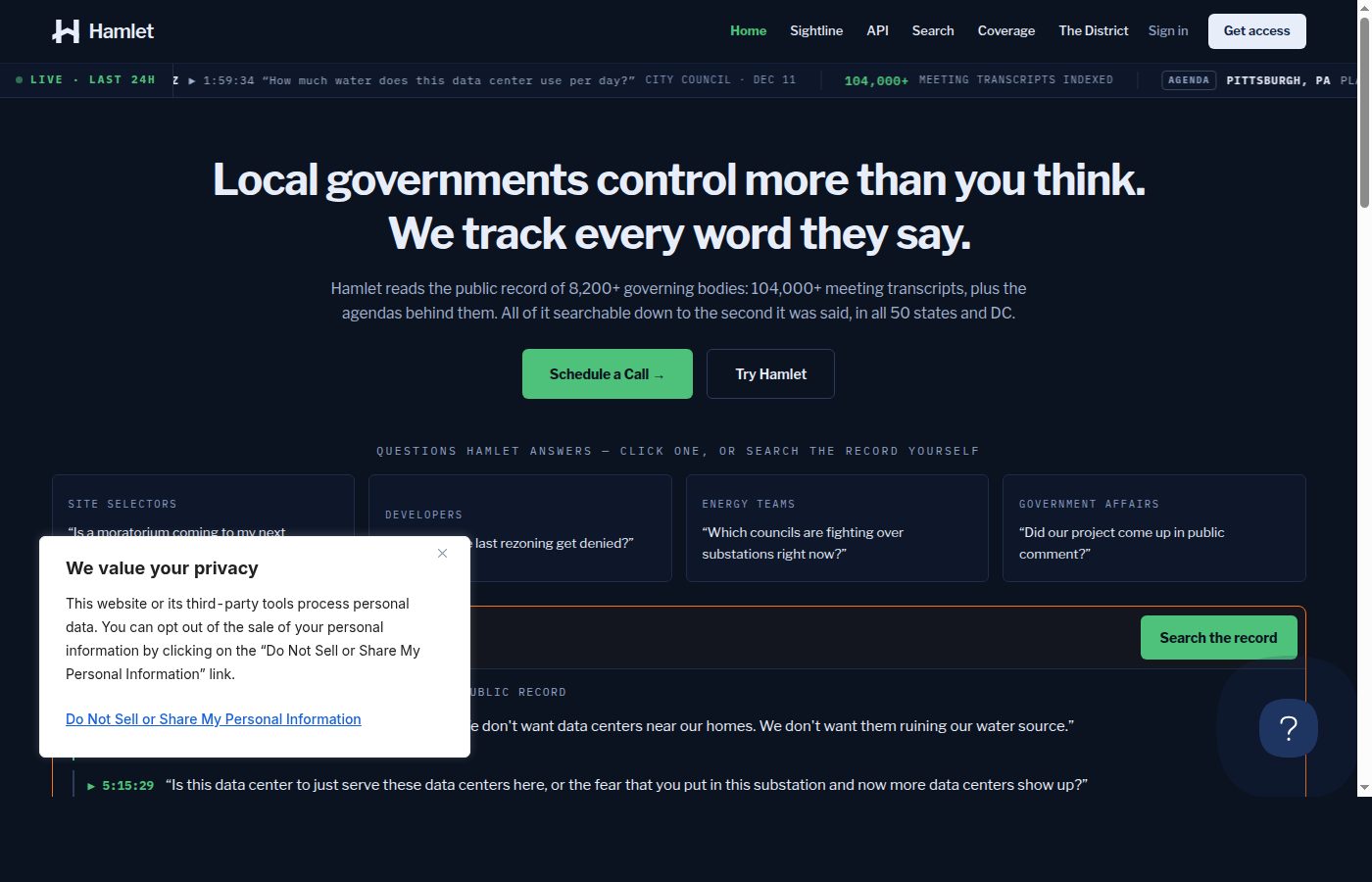
Hamlet is an AI-driven commercial real estate acquisitions tool that extracts actionable development insights directly from public meeting discussions. Classified in the BestCRE Master Database as a CRE-Native, Tier 2 application, Hamlet addresses a highly specific bottleneck in the site selection and entitlement process: monitoring local government discourse. For acquisitions analysts and development principals, tracking zoning board, planning commission, and city council meetings across multiple municipalities traditionally requires hundreds of hours of manual video review or reading dense, delayed meeting minutes. Hamlet automates this workflow by parsing spoken discussions and identifying relevant property details, zoning sentiment, and upcoming infrastructure changes that directly impact commercial real estate values.
Evaluating this tool in August 2026 requires understanding its narrow but deep focus. Unlike broader platforms such as Crexi or LoopNet that aggregate active listings and transactional data, Hamlet serves the pre-market and off-market discovery phase. By turning unstructured public meeting audio and municipal transcripts into structured real estate intelligence, it allows development teams to anticipate zoning shifts, track competitor entitlements, or identify municipal land dispositions before they hit the open market. Our analysis indicates that while the tool operates in a highly specialized niche, its utility for ground-up developers and value-add investors is significant. The platform fundamentally shifts how acquisitions teams gather local intelligence, replacing passive reliance on brokers with active monitoring of the regulatory bodies that dictate land use and density.
What Hamlet does and how it works
At its core, Hamlet functions as a specialized search and alert engine for municipal meeting data. The software ingests audio, video, and text records from city council, planning board, and zoning commission meetings across various jurisdictions. Using natural language processing trained on commercial real estate terminology, it transcribes and indexes these public sessions. When a developer or acquisitions analyst inputs specific search parameters—such as multifamily rezoning, transit-oriented development, or specific parcel addresses—Hamlet scans its database of recent and historical meetings to find exact matches and contextual mentions. This eliminates the need for junior analysts to sit through hours of irrelevant civic discussions waiting for a specific agenda item to be called.
Beyond simple keyword matching, the platform attempts to structure this unstructured civic data into actionable insights. It identifies the speakers, categorizes the sentiment of the board members regarding specific development proposals, and extracts key dates or deadlines mentioned during the hearings. Users can set up automated alerts for specific municipalities or neighborhoods, receiving notifications when a targeted keyword or address is discussed. This feature is particularly useful for tracking the progress of competing developments or monitoring shifts in local political attitudes toward density, affordable housing mandates, or commercial overlays.
The interface provides dashboards where users can review summaries of the meetings, read the exact transcripts, and often jump directly to the relevant timestamp in the source video or audio file. By linking the extracted meeting data back to the original source, Hamlet ensures that analysts can verify the context of the AI-generated summaries before making strategic decisions. While it does not replace the need for local land-use counsel, it acts as a highly efficient early warning system for acquisitions teams looking to capitalize on municipal trends or defend existing portfolios against adverse zoning changes.
9AI Framework: the score, dimension by dimension
CRE Relevance: 9/10
Hamlet is fundamentally built for commercial real estate, specifically targeting the acquisitions and development lifecycle. By focusing on public meeting discussions, it isolates the exact moment when land-use decisions, zoning variances, and infrastructure investments are debated. This is a critical data source for developers who rely on municipal intelligence to underwrite risk and identify off-market opportunities. Unlike generic transcription services, the natural language models are tuned to recognize property-specific jargon, parcel numbers, and entitlement terminology. This deep industry alignment justifies its CRE-Native classification, as the entire product architecture assumes the user is evaluating real estate development potential. In practice: Acquisitions teams use the platform to monitor local zoning boards, allowing them to spot regulatory shifts and land-use trends long before they are reported by local business journals or brokerage reports.
Data Quality and Sources: 7/10
The quality of Hamlet’s output relies entirely on the availability and clarity of municipal public records. As a Tier 2 database, it aggregates secondary data rather than generating proprietary primary data. When municipalities provide high-fidelity audio and prompt public records, the AI transcription and extraction perform exceptionally well. However, data quality degrades when dealing with smaller jurisdictions that have poor audio equipment, overlapping speakers, or delayed public record publications. The platform successfully mitigates some of this by linking directly back to the source media, allowing users to verify the AI’s interpretation of mumbled or contested statements. In practice: Analysts must remain skeptical of automated summaries from contentious or poorly recorded town halls, using the tool to locate the relevant timestamp rather than relying solely on the AI-generated text.
Ease of Adoption: 7/10
Implementing Hamlet requires minimal technical configuration, as it operates primarily as a web-based search and alert portal. Users familiar with basic boolean logic or standard property search interfaces will find the learning curve shallow. The primary hurdle in adoption is not the software itself, but rather integrating its insights into existing acquisitions workflows. Teams must learn to define effective search parameters and establish a routine for reviewing alerts, otherwise the platform simply generates unread notifications. Training junior staff to interpret municipal meeting context remains a human requirement that the software cannot bypass. In practice: A new user can set up municipal alerts and keyword trackers within an hour, but realizing the full value requires establishing a weekly internal process to review and act upon the generated municipal intelligence.
Output Accuracy: 7/10
Hamlet demonstrates high accuracy in its core function of transcribing and locating specific keywords within public meeting records. The extraction of addresses, developer names, and zoning codes is generally reliable. However, the accuracy of its sentiment analysis—determining whether a planning board is favorable or hostile to a proposal—can be inconsistent due to the nuances of political speech and municipal procedure. Sarcasm, procedural objections, or complex legal arguments during a hearing can occasionally confuse the summarization engine. Users should treat the AI summaries as directional indicators rather than definitive legal records of municipal intent. In practice: Development principals rely on the tool to accurately flag when their target parcels are discussed, but they still listen to the specific audio snippet to gauge the true tone and intent of the planning commissioners.
Integration and Workflow Fit: 6/10
The platform currently functions largely as a standalone intelligence gathering tool. While it excels at data extraction, its ability to push that data into broader commercial real estate tech stacks is limited. Users looking to automatically sync municipal meeting notes with their primary CRM or underwriting models will find the native integration options lacking. Data must typically be exported manually or copied into internal memos. For a tool focused on the top of the acquisitions funnel, the lack of deep API connectivity to platforms like Salesforce or Dealpath restricts its utility as an automated data feed. In practice: Analysts treat the software as an independent research terminal, manually transferring critical zoning updates and competitor intelligence into their firm’s centralized deal management systems.
Pricing Transparency: 4/10
Hamlet does not publish its pricing on its website, operating entirely on a custom pricing model. This lack of transparency requires prospective buyers to engage in a sales process simply to determine baseline costs. For commercial real estate firms evaluating multiple data vendors, hidden pricing creates friction and makes initial budget allocation difficult. We cap our score at 5 for any vendor that conceals its commercial terms from the public. While custom pricing is common for enterprise data solutions, the inability to compare tiers or user licenses upfront forces buyers into negotiations without a clear benchmark. In practice: Buyers must schedule a demonstration and undergo a discovery call to receive a quote, making it impossible to quickly evaluate the tool’s cost against alternative data gathering methods.
Support and Reliability: 6/10
As a relatively new entrant in the commercial real estate technology space, Hamlet provides adequate but unproven long-term support. The company offers standard email and web-based assistance, and early adopters report responsive communication from the founding team. However, it lacks the extensive support infrastructure, dedicated account management teams, and comprehensive training academies found in mature platforms. Because it is an unproven startup, we cap this dimension at 6. The risk of service interruptions or slow resolution times during complex technical issues remains a consideration for enterprise clients requiring guaranteed uptime. In practice: Users can expect personalized, high-effort support typical of early-stage startups, but they should not anticipate the enterprise-grade service level agreements or 24/7 phone support offered by legacy real estate data providers.
Innovation and Roadmap: 7/10
The product development trajectory for Hamlet shows strong potential, particularly in expanding its municipal coverage and refining its natural language processing models. The company is actively focused on deepening its AI capabilities to better understand complex zoning codes and municipal bylaws. Future updates are expected to include predictive analytics, potentially forecasting the likelihood of entitlement approvals based on historical board voting patterns. This focus on vertical-specific AI applications indicates a clear understanding of the commercial real estate development lifecycle and the specific pain points of acquisitions teams. In practice: Buyers are investing in a platform that is rapidly evolving, with the expectation that the tool will transition from a simple transcription search engine into a predictive municipal intelligence platform over the next several quarters.
Market Reputation: 5/10
Hamlet is currently building its reputation among early adopters in the commercial real estate development sector. It is recognized for addressing a highly specific, previously unautomated pain point: municipal meeting monitoring. However, as an unproven startup, it lacks the widespread industry validation and extensive case studies of established data providers. We cap its market reputation score at 6 accordingly. Word-of-mouth among site selection professionals is positive, but the tool has not yet achieved ubiquitous status or displaced traditional methods of local intelligence gathering on a macro scale. In practice: Development firms view the software as an intriguing, specialized utility rather than a core, indispensable pillar of their technology stack, often testing it on a limited basis before committing to firm-wide deployment.
Who should use Hamlet
Hamlet is highly specialized and delivers the most value to teams actively engaged in the entitlement, zoning, and ground-up development phases of commercial real estate. The ideal users are those who rely heavily on local municipal intelligence to source deals or protect existing investments.
- Ground-up Developers: Firms that need to monitor planning boards for zoning changes, infrastructure approvals, or competitor project entitlements across multiple jurisdictions.
- Value-add Acquisitions Analysts: Professionals searching for off-market opportunities by tracking municipal discussions regarding distressed properties, tax defaults, or code violations.
- Land Use Consultants and Attorneys: Specialists who must stay informed on the shifting sentiments of specific city councils and zoning commissions to advise their commercial real estate clients.
- Retail Site Selection Teams: Corporate real estate teams tracking municipal investments in new transit hubs, road expansions, or commercial overlays that dictate future foot traffic.
Who should look elsewhere
Because Hamlet focuses exclusively on public meeting data and municipal discourse, it provides little to no value for professionals focused on active market transactions, stabilized asset management, or broad demographic research.
- Investment Sales Brokers: Professionals who need active listing platforms, transaction comps, and ownership contact information will find this tool entirely unsuited to their workflow.
- Stabilized Asset Managers: Teams focused on tenant retention, lease administration, and building operations do not require early-warning municipal intelligence.
- Passive LP Investors: Individuals or funds allocating capital to syndications without direct involvement in the entitlement or site selection process.
- Residential Real Estate Agents: The platform is built for commercial development and zoning complexities, making it excessive and irrelevant for standard single-family home transactions.
Pricing and ROI
Hamlet does not publish its pricing structure on its website, operating strictly on a custom pricing model. This approach requires prospective buyers to engage directly with their sales team to receive a quote tailored to their specific coverage needs, user count, and municipal tracking volume. For a commercial real estate firm attempting to budget for Q3 2026, this lack of transparency is a notable drawback. Our analysis indicates that pricing is likely tiered based on the number of municipalities monitored or the volume of alerts generated, which is standard for specialized data extraction services.
When calculating the return on investment, acquisitions teams must measure the platform’s cost against the labor hours saved. Traditionally, an analyst might spend ten hours a week reviewing municipal agendas, reading meeting minutes, or watching city council recordings. If Hamlet costs an estimated $10,000 annually for a small team, the software pays for itself if it saves roughly 150 hours of analyst time billing at standard internal rates. More importantly, the true ROI is realized if the tool uncovers a single off-market acquisition opportunity or provides early warning of an adverse zoning change that threatens an existing asset. Buyers should demand a short-term pilot program during negotiations to verify the data coverage in their specific target markets before committing to an annual contract.
Integration and CRE tech stack fit
In the context of a modern commercial real estate technology stack, Hamlet operates primarily as a siloed intelligence application rather than a fully integrated data feed. The platform excels at extracting insights from public meetings, but it currently lacks the deep, native API connections required to push this data automatically into enterprise systems. Firms utilizing industry-standard platforms like Dealpath for pipeline management or Salesforce for relationship tracking will find that moving data from Hamlet requires manual effort.
Users typically export meeting summaries, transcripts, and alert data via CSV or rely on basic email notifications to distribute insights internally. While this is sufficient for early-stage deal sourcing and high-level market research, it creates friction for teams trying to build a centralized, automated database of municipal intelligence. Acquisitions analysts must establish a disciplined internal workflow to manually log critical zoning updates or competitor entitlement news into their primary underwriting models. For developers evaluating the tool in August 2026, it is best viewed as an independent research terminal. Buyers should press the vendor on their roadmap for open APIs and native integrations with major commercial real estate CRM systems.
Competitive landscape
Hamlet occupies a unique and highly specialized niche within the commercial real estate data ecosystem, making direct comparisons challenging. Most established platforms focus on different phases of the acquisition lifecycle. For example, Crexi (BestCRE Score: 84) and LoopNet (BestCRE Score: 76) dominate the active listings and transactional marketing space. They provide zero utility for monitoring unstructured municipal meetings.
When looking at pre-market and off-market discovery, platforms like ProspectNow (BestCRE Score: 80) and PropertyRadar (BestCRE Score: 79) are more closely aligned with Hamlet’s target audience. However, these tools rely on structured public records—such as tax assessments, deed transfers, and debt origination—to identify likely sellers or distressed assets. They do not parse spoken municipal discourse. CityBldr (BestCRE Score: 79) attempts to identify highest and best use for development parcels using algorithmic modeling, but again, it relies on static zoning codes rather than the real-time political sentiment extracted from city council hearings.
The true alternatives to Hamlet are not other commercial real estate software platforms, but rather generic transcription services, outsourced labor, or dedicated internal analysts. A firm could hire virtual assistants to monitor municipal YouTube channels or use general-purpose AI transcription tools to process downloaded meeting videos. However, these methods lack the CRE-specific natural language processing that allows Hamlet to accurately identify parcel numbers, zoning variances, and developer entities. Ultimately, Hamlet stands alone in its specific methodology, but it competes for the same off-market research budget as tools like ProspectNow and REIS (BestCRE Score: 77).
The bottom line
Hamlet is a highly effective, albeit narrowly focused, intelligence tool for commercial real estate developers and acquisitions teams. It solves a specific, labor-intensive problem: extracting actionable insights from the tedious, unstructured world of municipal public meetings. If your firm’s strategy relies on ground-up development, securing complex entitlements, or tracking local zoning shifts, this tool provides a distinct informational advantage over competitors relying on delayed meeting minutes or local news reports. However, it is not a general-purpose data platform. Firms looking for transaction comps, ownership contact information, or active listings will find no value here. The lack of transparent pricing and limited integration capabilities are drawbacks typical of early-stage software. Ultimately, buyers should invest in Hamlet only if they have the internal discipline to actively review its alerts and the operational capacity to act on early-stage, municipality-level signals before they hit the broader market.
Frequently asked questions
Does Hamlet provide ownership contact information for off-market properties?
No. The platform is designed exclusively to extract insights from public meeting discussions, such as city council or zoning board hearings. It does not function as a property ownership database or skip-tracing tool for finding owner phone numbers or email addresses.
Can I integrate Hamlet directly with my Salesforce CRM?
Native integration options are currently limited. The platform operates primarily as a standalone research terminal and alert system. Users typically must export data manually or rely on email notifications to transfer municipal insights into their primary deal management or CRM systems.
How much does an annual subscription to Hamlet cost?
The vendor does not publish pricing on its website. They utilize a custom pricing model based on your specific coverage requirements, user count, and the volume of municipalities monitored. Prospective buyers must engage directly with their sales team to receive a tailored quote.
Does the AI accurately understand complex commercial real estate zoning laws?
The natural language processing is trained on industry terminology and successfully identifies zoning codes, parcel numbers, and entitlement discussions. However, users should not rely on it for legal interpretations. It serves as an early warning system, requiring analysts to verify the context of the extracted statements.
What happens if a municipality does not record its planning board meetings?
The software relies entirely on the availability of public records, including audio, video, or official text transcripts. If a local jurisdiction does not record its sessions or delays publishing the materials, the platform cannot generate insights for those specific meetings.
Is this tool useful for residential real estate agents?
No. The platform is built specifically for commercial real estate acquisitions and ground-up development. Tracking municipal zoning variances, commercial overlays, and large-scale infrastructure approvals provides no practical utility for professionals focused on standard single-family home sales or residential leasing.
